

Notifications
Clear all
Joining the Renewable Heating Hub forums is completely free and only takes a minute. By registering you’ll be able to ask questions, join discussions, follow topics you’re interested in, bookmark useful threads and receive notifications when someone replies. Non-registered members also do not have access to our AI features. When choosing your username, please note that it cannot be changed later, so we recommend avoiding brand or product names. Before registering, please take a moment to read the Forum Rules & Terms of Use so we can keep the community helpful, respectful and informative for everyone. Thanks for joining!

14/10/2025 1:55 pm
@batpred - that Solis installation page is too vague.
Yes, they state that there's RCD protection inbuilt to the inverter.
But we don't know to what extent that offers protection to the inverter itself,
nor whether that protection covers appliances which are connected to the always-on port.
As matters stand, that integral RCD would still leave the supply cable and isolation switch unprotected.
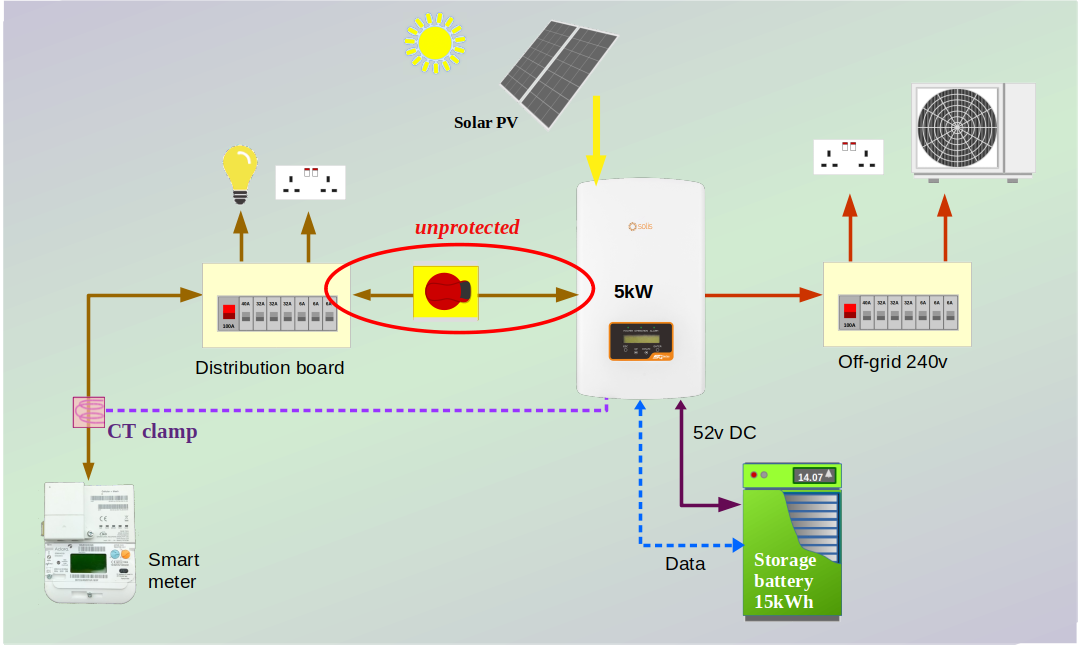
I don't like having any conductors leaving the distribution board without both over-current and earth-leakage protection.
The regulations for new installations are even tighter.
You now need ARC-detection trips within the consumer unit.
Those will disconnect the circuit in the event of cable damage within the wall - perhaps vermin eating the insulation.
Whether that measure will reduce house-fires or not is too early to say, but insurers like it.
Save energy... recycle electrons!

16/10/2025 2:49 pm
I will continue the discussion on the solis installation on the Fogstar battery thread
8kW Solis S6-EH1P8K-L-PLUS hybrid inverter; G99: 8kW export; 16kWh Seplos Fogstar battery; Ohme Home Pro EV charger; Vaillant Arotherm Pro 7kW; 100Amp head, HA lab on mini PC
16/10/2025 4:44 pm
Bu the way, my understanding is that arcing detection is not required for new circuits unless it is a shared use property? Or is it only for rental properties?
As for SPD protection, for the extra £20 or so when getting a new unit, it was a no brainer. It also helped us removing the ad-hoc surge protectors we had like to stop the boiler PCB blowing up when power comes back following a black-out.
8kW Solis S6-EH1P8K-L-PLUS hybrid inverter; G99: 8kW export; 16kWh Seplos Fogstar battery; Ohme Home Pro EV charger; Vaillant Arotherm Pro 7kW; 100Amp head, HA lab on mini PC
16/10/2025 5:16 pm
my understanding is that arcing detection is not required for new circuits unless it is a shared use property?
That's correct.
I was mentioning it as something which would be a future requirement.
Both arc-detection and surge suppression devices (SPD) are like paying an insurance package.
Even if you decide not to implement them, you should at least know that they are available options and why.
There are also different levels of protection offered, according to the specification of the devices you choose to install.
Your SPD might do all that you want at £20.
On the other hand, I use high-end Phoenix Contact suppression systems on both mains and PV panel connections.
The pair in the consumer unit which receives the mains incomer cost substantially more than £100.
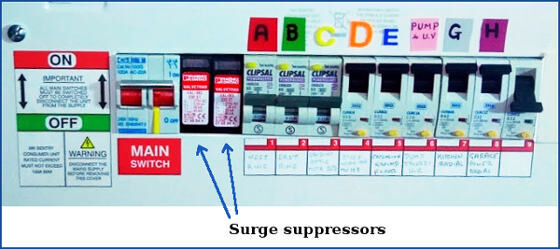
There are reasons why some insurance premiums cost less than others.
Save energy... recycle electrons!

16/10/2025 6:04 pm
Insurance helps and when adding high powered devices like EV chargers, PV panels and some inverters and heatpumps, the other circuits may need to be a bit more shielded, and future proofing is also worth. We had our supply upgraded to 100A but only after a few years and another visit did I feel they had given us that insurance.
Price of components can also be driven by volume and other considerations like supply chain requirements to recoup r&d costs.
8kW Solis S6-EH1P8K-L-PLUS hybrid inverter; G99: 8kW export; 16kWh Seplos Fogstar battery; Ohme Home Pro EV charger; Vaillant Arotherm Pro 7kW; 100Amp head, HA lab on mini PC
17/10/2025 10:39 am
Apologies, I don't follow what you've written @batpred
The possibility of damage from surges doesn't increase with 'high powered' devices.
In fact the device most likely to be damaged by a surge or spike on the mains is a landline telephone or internet router, supplied by copper wires.
That's because there can be a voltage difference between the mains and the telecom cables.
We had our supply upgraded to 100A but only after a few years and another visit did I feel they had given us that insurance.
I was referring to 'insurance' as a metaphor.
The size of the service fuse doesn't change the susceptibility to damage from surges.
Price of components can also be driven by volume and other considerations like supply chain requirements to recoup r&d costs
Phoenix Contact surge arresters dominate the commercial market.
There are thousands of types in their catalogues.
They are proven to be affective because Pheonix Contact are based in the Black Forest, in the south of Germany.
That area has the highest number of lightning storms in Europe.
They can easily test products in real-world conditions as well as a laboratory.
It's relatively easy to make a surge arrester which protects equipment from a single spike.
The key point is what then happens to the arrester?
If it doesn't recover to full operational specification, then it's useless.
The next surge will get through.
Buyers are prepared to pay more for an anti-surge device that is more likely to provide protection.
Save energy... recycle electrons!
17/10/2025 12:49 pm
I may have lost you there.. I use the insurance term as proxy for the "additional life" that was only given when the DNO replaced some components that despite being rated for 100A, were more fitting as museum pieces!
When I broadly mentioned circuits needing to be "shielded", it was not in the electrical sense, a better word may have been "cushioned". Specifically that when inverters and similar components are added to a household, some components that protect other circuits like RCDs type AC need replacing, ideally with RCBOs type A. We had a mid sized plastic consumer unit and that went a few months ago, as part of the prep.
8kW Solis S6-EH1P8K-L-PLUS hybrid inverter; G99: 8kW export; 16kWh Seplos Fogstar battery; Ohme Home Pro EV charger; Vaillant Arotherm Pro 7kW; 100Amp head, HA lab on mini PC
1
Page 2 / 2
Prev

SPONSORS

Degrees of Separation

Latest Posts
-

RE: 15kw pump for 225m2 1990's house - over kill?
@editor sorry should have been clearer - the whole hous...
By Carpenterstation , 6 hours ago
-
RE: Safety study for plug in batteries out to tender - looks like Q3 2027 at best before legal
Maybe this is why Octopus and Fuse are hell bent on plu...
By dansus , 7 hours ago
-
RE: Indevolt Batteries UK Support & Info Thread
@editor Manually setting the charging times and rates o...
By dansus , 8 hours ago
-
RE: How much of your renewable and home setup would still work if the internet went down?
Ours is similar to James, but with a few optional tweak...
By Batpred , 10 hours ago
-
RE: Renewables & Heat Pumps in the News
Yes, this is a swiss and german standard I believe, Vai...
By Batpred , 11 hours ago
-
RE: BT cuts you off, Plusnet blames Openreach... welcome to “seamless” broadband switching
My Vodafone FTTP broadband was down for a month when I ...
By JamesPa , 15 hours ago
-
RE: Octopus Cosy 12 Heat Pump Regret: Incredibly Loud, Poor Heating & Constant Hum - Help!
@editor FWIW my problem was resolved, eventually, after...
By BigFish , 17 hours ago
-
My heating has been off and DHW on throughout the summe...
By DavidAlgarve , 20 hours ago
-
RE: Anyone concerned about GivEnergy?
The GivE forum seemed to have survived the collapse of ...
By downfield , 21 hours ago
-
RE: How quickly would you want/expect heat recovery to take from setback?
@singlespeed I had better explain how my radiators are ...
By Toodles , 21 hours ago
-
RE: Cooling/heating with one unit
@mrkfm The Solo has a small capacity and only suitable ...
By dgclimatecontrol , 22 hours ago
-
First you need to know how much thermal energy you'll n...
By bobflux , 1 day ago
-
RE: Renewable Heating Hub Homeowners' Q&A Podcast
Come for the low-carbon homes. Stay for George Clarke’s...
By Mars , 3 days ago
-
RE: How should the Boiler Upgrade Scheme be reformed?
Not quite, regular A2W heat-pumps need a load of extra ...
By Temperature_Gradient , 4 days ago
-
RE: Heat Geek installations: share your experiences
one thing i learnt from reading people’s comments and e...
By Batpred , 4 days ago






SPONSORS
