

Notifications
Clear all
Joining the Renewable Heating Hub forums is completely free and only takes a minute. By registering you’ll be able to ask questions, join discussions, follow topics you’re interested in, bookmark useful threads and receive notifications when someone replies. Non-registered members also do not have access to our AI features. When choosing your username, please note that it cannot be changed later, so we recommend avoiding brand or product names. Before registering, please take a moment to read the Forum Rules & Terms of Use so we can keep the community helpful, respectful and informative for everyone. Thanks for joining!

27/04/2023 3:05 pm
Plastic heat exchangers are usually used inside MVHR units. For an air:air heatexchanger, there's not that much heat transfer needed across that plastic barrier (as the air conductivity is poor) so thin plastic is ok. Along the heat exchanger material we want low thermal conductivity, from the hot to cold end - so for this reason, plastic is preferred over metal. Piccy of I think what's in our MVHR core.
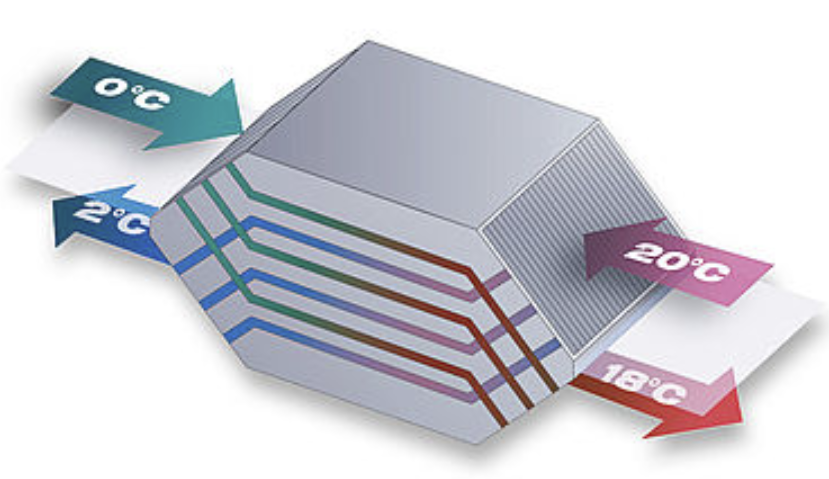
It does sound as though your unit is in permanent bypass then, so the heat exchanger core isn't being used. Some flaps open up inside the MVHR box, bypassing the core entirely. I suggest that you get a copy of the installation and user manuals, perhaps they can help. Certainly our own Vent Axia Sentinel Kinetic can be easily told not to use summer bypass ever, irrespective of temperature sensors - it's a user adjustment not installer on ours.
What unit do you have ?

27/04/2023 3:31 pm
For an air:air heatexchanger, there's not that much heat transfer needed across that plastic barrier (as the air conductivity is poor) so thin plastic is ok.
Along the heat exchanger material we want low thermal conductivity, from the hot to cold end
Can I ask what is the purpose of a heat exchanger?

27/04/2023 4:17 pm
@dandee A heat exchanger is used to transfer (in this instance anyway) warmth from the air that is about to be exhausted from the house (stale air) and that energy is used to heat the colder air being introduced to the house as fresh air from outside before it is distributed in the property. Basically a surface conducts the heat from the exhaust air and applies it to the incoming fresh air. Regards, Toodles.
Toodles, heats his home with cold draughts and cooks food with magnets.
1

27/04/2023 7:07 pm
Can I ask what is the purpose of a heat exchanger?
That question is a great leveller. 🙂
It shows the rest of us how we quickly descend into the technical depths!
In general terms a heat exchanger transfers heat between two fluids (liquids or gasses), whilst keeping those fluids separate.
The radiator of a car is a simple heat-exchanger.
Heat from the engine is passed into cooling water.
That water is pumped through the radiator, which has thin metal fins to transfer the heat into a stream of air.
The water and the air don't come into direct contact.
Within a household ventilation system (MVHR) there is a heat exchanger with a much larger surface area.
Hot, humid, sticky air is sucked out of shower/bath-rooms and kitchens.
As it passes through the heat exchanger, the heat is passed to fresh air being drawn in from outside the home.
The separation between the two streams of air means that the cooking smells from the kitchen, and the humid atmosphere from a shower cannot pass into the fresh air.
Save energy... recycle electrons!
1

27/04/2023 7:12 pm
For an air:air heatexchanger, there's not that much heat transfer needed across that plastic barrier (as the air conductivity is poor) so thin plastic is ok.
Along the heat exchanger material we want low thermal conductivity, from the hot to cold end
Can I ask what is the purpose of a heat exchanger?
Ohh boi, it was a rhetorical question, see the bold highlighted statements about the heat exchanger.
27/04/2023 7:22 pm
Placing the quoted phrases in a bold font was too subtle for me @dandee
I'd need at least one smilie to grab my attention. 🙂
As a member of a Community Energy group, I'm not daunted by receiving very basic questions from members of the public (or politicians!).
Save energy... recycle electrons!
1
28/04/2023 9:47 am
The heat exchanger material conductivity is actually a compromise. Through the material, the thin way, we want high conductivity. Along the material there is a parasitic loss mechanism, for which we want low conductivity. Plastic is a better compromise of these two competing requirements than Aluminium is for an Air:Air heat exchanger - as the air boundary layer has an effective conductivity which is quite low there's little point using Aluminium or Copper as it won't improve performance noticeably, while the parasitic losses would shoot up. For a water:water heat exchanger plastic would be a poor choice, and a metal would generally be chosen.
28/04/2023 10:17 am
Discussion on a forum is actually a compromise. Through this medium we actually want high transmissivity of information. Along the discussion there is a inherent loss-mechanism, through which we experience periods of low communication...
... which is why @robl is still posting coherent technical descriptions of the physics behind the design of heat exchangers, 25-hours after @dandee told us it was a "rhetorical question". 🤣
But hey... it's Friday!
and I've just enjoyed reading an erudite explanation of parasitic losses. 😉
Save energy... recycle electrons!


28/04/2023 10:45 am
The heat exchanger material conductivity is actually a compromise. Through the material, the thin way, we want high conductivity. Along the material there is a parasitic loss mechanism, for which we want low conductivity. Plastic is a better compromise of these two competing requirements than Aluminium is for an Air:Air heat exchanger - as the air boundary layer has an effective conductivity which is quite low there's little point using Aluminium or Copper as it won't improve performance noticeably, while the parasitic losses would shoot up. For a water:water heat exchanger plastic would be a poor choice, and a metal would generally be chosen.
Sorry I'm struggling to understand this. I'll try to play back what I've got from you: We want to conduct air from the outgoing (warm) side to the incoming (cold) side. For this, we need a thin material that has high conductivity in the perpendicular direction, to allow transfer across the interface. However, because the air passage is quite long, we don't want the material itself to be leeching heat away from the warm air and transporting it laterally along the length of the material: we want it transfering perpendicularly across the interface only. So plastic is better for this.
However, I still don't feel like I really "grok" the explanation. Nor can I explain why we want plastic for air:air but metal for water:water.
If you don't want to explain it again (which is totally understandable!) do you have any suggestions for where I can look this up?
ASHP: Mitsubishi Ecodan 8.5kW
PV: 5.2kWp
Battery: 8.2kWh

28/04/2023 12:50 pm
@scrchngwsl You have already noted that for efficient counter-current heat transfer, you want to avoid heat transfer within the fluid streams. In each fluid, there is a laminar boundary layer which constitutes the major resistance to heat transfer to the interface. There is then the heat transfer perpendicular through the exchanger surface as well as that within the plane of the exchanger surface. The exchanger plate thickness is minimised (and length of exchanger maximised) to maximise flow across plate rather than along it. Flux through plate is proportional to delta-T across plate surface while flux within plate is proportional to temperature gradient along plate.
However, the boundary layer in air poses at least an order of magnitude more resistance than water and heat flux through an air boundary layer is going to be correspondingly lower. At this lower heat flux, the delta-T across the plate will be also correspondingly reduced but the gradient along plate will not (I still want to shift that amount of heat in that distance). The lateral flow of heat within the plate will therefore start to dominate, particularly if the plate has a high conductivity. I am therefore willing to use a lower conductivity plate material (which will result in a higher delta-T) to shift the balance back towards transfer across plate.
1
28/04/2023 2:11 pm
It was just yesterday that James posted
Hello! I'm not a tech-savvy person. I'd like the moderators and other members to dumb down the complex subjects to my level. 😀
Have we achieved that yet, James? 😉
Save energy... recycle electrons!
1
28/04/2023 2:14 pm
@ronin92 thanks a lot, that cleared it up for me!
ASHP: Mitsubishi Ecodan 8.5kW
PV: 5.2kWp
Battery: 8.2kWh

SPONSORS

Degrees of Separation

Latest Posts
-

RE: Heat pump branding. Clever, contemporary… or a bit too much?
I think Heat Geek have done an amazing job on their bra...
By Tomtheheatingengineer , 7 hours ago
-
RE: HeatGeek vs Octopus surveys: puzzling disparity - any ideas why?
I have just had 3 heat loss surveys, one by heat geek o...
By David , 8 hours ago
-
RE: Heat Geek Zero Disrupt: Are We Sleepwalking Into Another Race to the Bottom?
I think that's the key question. After all inverter uni...
By Prunus , 9 hours ago
-
RE: battery storage without solar
As of October 1st they need specific qualifications to ...
By EtchedPixels , 10 hours ago
-
RE: How should the Boiler Upgrade Scheme be reformed?
A unit which uses water to transfer the heat/chill from...
By Temperature_Gradient , 10 hours ago
-
RE: Renewables & Heat Pumps in the News
With regards to the BUS grant raid, I gave it more thou...
By ASHP-BOBBA , 11 hours ago
-
RE: Why are ASHP installs so expensive?
The whole system seems to work on the basis of...
By ian33a , 11 hours ago
-
RE: Missing flow temperature in Heat Geek proposal
Good plan. If you can get half hourly meter readings a...
By JamesPa , 16 hours ago
-
RE: Heat Pumps Without Grants: Would You Have Installed One & Will You Now?
@editor Most certainly. The heat pump was an ideal s...
By Abernyte , 16 hours ago
-
Although regulations may well vary from country to coun...
By Majordennisbloodnok , 17 hours ago
-
RE: Does anyone have experience of a smart water meter?
Yep I caught our slow leak from a £100 bill rise 8)
By EtchedPixels , 17 hours ago
-
RE: Do You Need a Buffer Tank or Low Loss Header for Underfloor Heating in a Large Property?
@jamespa in some cases, failing the Turing test might b...
By GrahamF , 20 hours ago
-
RE: Passiv Smart Thermostat - Help & Forum Support
@energystoragetech The heat capacity of some...
By JamesPa , 22 hours ago
-
RE: tepeo ZEB UK Support & Info Thread
Sorry you are correct, I was remembering figures from t...
By JamesPa , 1 day ago




SPONSORS