

Notifications
Clear all
Joining the Renewable Heating Hub forums is completely free and only takes a minute. By registering you’ll be able to ask questions, join discussions, follow topics you’re interested in, bookmark useful threads and receive notifications when someone replies. Non-registered members also do not have access to our AI features. When choosing your username, please note that it cannot be changed later, so we recommend avoiding brand or product names. Before registering, please take a moment to read the Forum Rules & Terms of Use so we can keep the community helpful, respectful and informative for everyone. Thanks for joining!
Well & Truly Off The Grid
49
Posts
13
Users
54
Reactions
7,345
Views


Topic starter
08/03/2026 9:59 pm

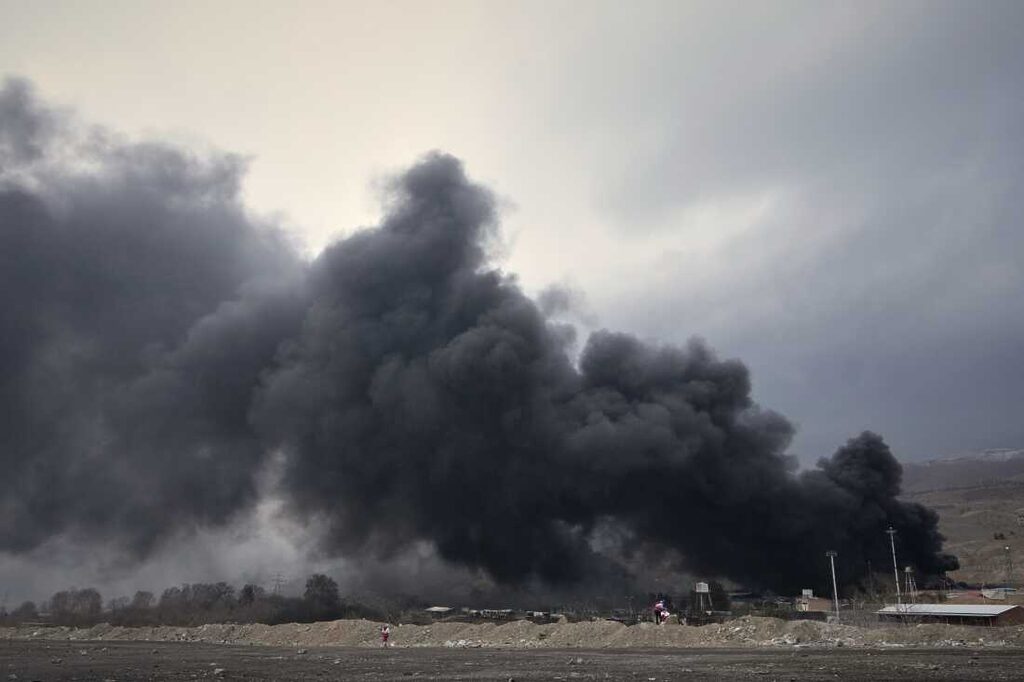
The images from Tehran continue to dominate the screens: vast plumes of black smoke rising from the Shahran oil depot and other fuel storage sites in the Iranian capital, ignited by strikes carried out jointly by American and Israeli forces as the conflict enters its second week.
Credible reporting from outlets including Sky News, BBC, CNN, France 24, The New York Times, AP and Reuters confirms that these attacks, which began targeting energy infrastructure in earnest over the weekend of 7-8 March 2026, have set alight depots holding millions of litres of refined products. The fires are not brief flares. They burn with the intensity that turns night into an orange haze, releasing hydrocarbons directly into the atmosphere in quantities that dwarf everyday calculations of domestic emissions.
A single large oil storage tank, when breached and ignited, can release tens of thousands of tonnes of petroleum products into combustion within hours. The combustion is unforgiving. Each tonne of fuel burned produces approximately 3.1 tonnes of CO2.
Eyewitness footage and satellite observations suggest multiple tanks at Shahran and nearby facilities were compromised, with fires spreading across infrastructure linked to the Revolutionary Guard. Conservative estimates, drawing on the known capacities of these depots (often in the range of hundreds of millions of litres) and the visible scale of the blazes, place the immediate CO2 release from one night's strikes in the order of 50,000 to 200,000 tonnes or more.
This figure excludes additional emissions from associated refining complexes damaged in the campaign, as well as the black carbon and other short-lived climate forcers carried aloft by the smoke.
The military operations themselves compound the damage. The United States has deployed carrier-based aviation from the Abraham Lincoln strike group in the Arabian Sea, launching waves of F/A-18 Super Hornets and F-35 Lightning IIs. Israeli squadrons of F-35 Adirs and F-15s have conducted long-range strikes, supported by aerial refuelling tankers.
Each fighter sortie consumes between 5,000 and 15,000 litres of jet fuel, each B-2 or refuelling mission several times that. Aviation kerosene emits approximately 2.53 kg of CO₂ per litre when burned. A single Super Hornet combat sortie therefore generates 15-40 tonnes of CO2... a B-2 mission more than 60 tonnes.
With hundreds of sorties flown since 28 February, when the joint operation began, the cumulative fuel burn from aircraft alone already exceeds 35,000 tonnes of CO2 in the conflict’s first week, according to preliminary assessments modelled on similar campaigns. Tomahawk cruise missiles launched from US warships add further emissions, as do the logistics flights ferrying munitions and personnel across the region. The Pentagon’s own historical data show that modern warfare is among the most carbon-intensive activities on earth. In fact, the US military alone accounts for a larger annual emissions footprint than many entire nations.
When these direct releases from targeted infrastructure and operational fuel burn are combined, the carbon cost of even a limited phase of the campaign becomes staggering. A single concentrated assault on Tehran's fuel depots, coupled with the sorties required to execute it, can equate to 100,000-300,000 tonnes of CO2 released in days.
In the United Kingdom, the switch from a conventional gas boiler to an air source heat pump typically saves between 1,400-1,900 kg of CO2 per household annually, according to figures from British Gas, Energy Saving Trust and other analyses. Pairing the heat pump with a domestic solar array pushes that saving comfortably above two tonnes per year for many homes.
The arithmetic is merciless. The emissions from one strike in Iran offset the annual decarbonisation gains of 50,000 to 150,000 British households. Extend this across the full scope of the ongoing campaign (with its repeated waves, retaliatory exchanges and broadening regional disruptions) and the equivalent quickly reaches hundreds of thousands, potentially millions, of household-years of effort erased.
This disparity raises a question that cannot be evaded by those of us who have invested time, money and conviction in home-level decarbonisation. Is it worth it?
When geopolitical decisions taken far beyond our borders unleash carbon pulses of this magnitude, when a handful of precision-guided munitions can incinerate the equivalent emissions savings of entire cities' worth of retrofitted homes, what rational basis remains for the individual householder to persist?
The British government urges millions of installations by the end of the decade, backed by grants and mandates, yet the global carbon ledger appears to be balanced not in planning documents or domestic energy bills, but in the targeting cells of distant command centres.
The conflict's wider repercussions compound the futility. Disruptions to the Strait of Hormuz, where roughly one-fifth of global oil and liquefied natural gas transits, have already forced rerouting of tankers, idled production in Qatar and elsewhere, and driven up energy prices worldwide. I covered this in my video here.
Such shocks historically prompt short-term shifts toward coal in import-dependent markets like Europe and Asia, as gas supplies tighten which is a "nightmare scenario" for energy security and emissions alike, in the words of analysts tracking parallels to the Ukraine invasion.
The war has suspended significant fractions of Middle Eastern supply, pushing consumers toward dirtier alternatives and elevating overall global emissions even as physical production halts in some areas.
None of this diminishes the intrinsic value of the technologies themselves. Heat pumps remain vastly more efficient than gas boilers, solar generation displaces marginal fossil-fired power on the grid. The physics holds.
Yet the episode exposes a profound asymmetry in accountability. Domestic climate action in Britain is measured with precision (every kilowatt-hour tracked, every tonne saved audited) while the carbon consequences of state violence remain largely externalised, uncounted in national inventories and politically insulated from scrutiny.
Humanity’s capacity for self-destruction appears to outpace its capacity for self-restraint by orders of magnitude. The same species that can engineer a heat pump capable of extracting warmth from minus five degree air cannot, it seems, restrain itself from setting fire to oil depots on the other side of the planet.
For the UK homeowner who has spent thousands on a retrofit, who monitors their smart meter with satisfaction, the question lingers. Why persist when distant decisions can undo it all so effortlessly?
The answer, if there is one, lies not in abandoning the endeavour but in recognising its limits. Individual and national action, however diligent, cannot insulate against a world where conflict remains the ultimate emitter. The fires in Tehran are burning more than oil, when the blazes at Shahran alone can release in days the carbon equivalent saved annually by tens of thousands of British heat pump and solar homes, one is forced to ask whether all this domestic effort is simply futile in the face of such effortless, distant destruction. They are burning any illusion that our small, earnest efforts can outrun the larger folly of which we remain collectively capable.
This topic was modified 7 months ago by Mars
🔥 Britain’s Heat Pump Shitshow
How Installing a Heating System Became a National Nervous Breakdown
Free UK shipping.
📗 Heat Pumps Explained
A Jargon-Free Guide for Homeowners
Rewritten and updated for 2027
📘 From Zero to Heat Pump Hero
🛠️ Bodge Buster
New to heat pumps?
Take the Heat Pump Fundamentals course and use INTRO50 at checkout for 50% off.

08/03/2026 11:43 pm
The answer, if there is one, lies not in abandoning the endeavour but in recognising its limits. Individual and national action, however diligent, cannot insulate against a world where conflict remains the ultimate emitter. The fires in Tehran are burning more than oil, when the blazes at Shahran alone can release in days the carbon equivalent saved annually by tens of thousands of British heat pump and solar homes, one is forced to ask whether all this domestic effort is simply futile
No it isn't. Conflicts will continue, its the human condition and we can only change what we can change. The good news is that climate change may well be non linear, but it isn't binary. Every tonne of carbon we save here reduces global warming a bit and makes it less likely that tipping points will be reached and more likely that the worst effects will be avoided. Furthermore, every time we build a wind turbine, fit a solar panel or move a house off of gas, we take another step to becoming energy independent, as opposed to our current position of perilous dependence on a resource shipped from despot countries through fragile shipping routes. Doing this is a key pilar of national security in a highly insecure world.
This post was modified 7 months ago by JamesPa
4kW peak of solar PV since 2011; EV and a 1930s house which has been partially renovated to improve its efficiency. 7kW Vaillant heat pump.
3
Topic starter
09/03/2026 12:05 am
@jamespa, I don’t disagree with the core of what you’re saying… conflicts are baked into the human condition, and every tonne saved does chip away at the risk of tipping points in what is a non-linear system.
And you’re right that shifting to renewables and heat pumps builds energy independence, which in this volatile world (hello, current Middle East mess) is a pillar of national security. Ed Miliband and others have hammered that home recently too… dependence on imported fossil fuels shipped through fragile routes leaves us exposed to price spikes and supply shocks that no amount of domestic North Sea output can fully shield us from long-term.
Where we might differ a bit is on the scale and psychology of it all. My piece wasn’t arguing we should stop (far from it) but highlighting how disproportionate the carbon math can feel when a single strike undoes household-level savings on a massive scale.
It can leave people wondering if their individual efforts are just pissing in the wind against geopolitics. That said, your framing flips it positively, each installation isn’t futile. It’s a brick in the wall of resilience (couldn’t think of a better metaphor) reducing both climate risk incrementally and our collective vulnerability to despot-controlled resources.
🔥 Britain’s Heat Pump Shitshow
How Installing a Heating System Became a National Nervous Breakdown
Free UK shipping.
📗 Heat Pumps Explained
A Jargon-Free Guide for Homeowners
Rewritten and updated for 2027
📘 From Zero to Heat Pump Hero
🛠️ Bodge Buster
New to heat pumps?
Take the Heat Pump Fundamentals course and use INTRO50 at checkout for 50% off.
1

09/03/2026 9:26 am
Allow me to chip in here. Before the Iran strikes kicked off, we decided to top up our oil tank (we have an oil-fired AGA). We ordered and paid for 1100 Litres of oil. The delivery has just been done, but only 500 Litres were deposited. The driver told us that the amounts were now being limited/rationed due to the conflict in Iran and that we should contact Boiler Juice to arrange a refund of the overspend.
Just my 2pennorth.
Retrofitted 11.2kw Mitsubishi Ecodan to new radiators commissioned November 2021.
14 x 500w Monocrystalline solar panels.
2 ESS Smile G3 10.1 batteries.
ESS Smile G3 5kw inverter.


09/03/2026 10:58 am
@morgan The chances are that when you request the balance of your ordered quantity, that balance will be at a somewhat higher cost! Toodles.
Toodles, heats his home with cold draughts and cooks food with magnets.
2
09/03/2026 11:13 am
@editor If we are to believe what that verbose leader of a rather large country is telling us, global warming is nonsense and as to a shortage …. well … Drill Baby, Drill!
Ever Warming Regrets, Toodles.
This post was modified 7 months ago by Toodles
Toodles, heats his home with cold draughts and cooks food with magnets.
Topic starter
09/03/2026 11:17 am
The delivery has just been done, but only 500 Litres were deposited.
Did they charge you on the pre-Iran war rate?
🔥 Britain’s Heat Pump Shitshow
How Installing a Heating System Became a National Nervous Breakdown
Free UK shipping.
📗 Heat Pumps Explained
A Jargon-Free Guide for Homeowners
Rewritten and updated for 2027
📘 From Zero to Heat Pump Hero
🛠️ Bodge Buster
New to heat pumps?
Take the Heat Pump Fundamentals course and use INTRO50 at checkout for 50% off.
09/03/2026 11:25 am
@editor Yes, but.............. we now wait for the overspend to be refunded to confirm that is what has actually been returned.
Retrofitted 11.2kw Mitsubishi Ecodan to new radiators commissioned November 2021.
14 x 500w Monocrystalline solar panels.
2 ESS Smile G3 10.1 batteries.
ESS Smile G3 5kw inverter.
1

Topic starter
09/03/2026 11:27 am
@Morgan that's why I suspect they only delivered 500 litres.
My suppliers have just written back to me: "Unfortunately, due to the unpredictable rising market, we are unable to quote a price. If you would like to place an order, we can do this for you and then give you a call the night before delivery to tell you the price. If you are not happy to go ahead we can cancel your order at that time."
Wild times!
🔥 Britain’s Heat Pump Shitshow
How Installing a Heating System Became a National Nervous Breakdown
Free UK shipping.
📗 Heat Pumps Explained
A Jargon-Free Guide for Homeowners
Rewritten and updated for 2027
📘 From Zero to Heat Pump Hero
🛠️ Bodge Buster
New to heat pumps?
Take the Heat Pump Fundamentals course and use INTRO50 at checkout for 50% off.
1

09/03/2026 12:56 pm
@morgan A friend of ours told us they placed an order with Boiler Juice just before the conflict and Boiler Juice cancelled the order a couple days later, just leaving them hanging. They managed to reorder from a local supplier at twice the cost. Our local supplier was charging 62.5p at the start of the month and now it's 144p per litre.
At the moment, someone is making a killing (no pun intended). Crude oil is bought in advance on the futures market (it's bad news to run out of crude oil in a refinery), and takes 1-3months for delivery, refining and distribution into retail channels, so there is no reason for price rises to be passed on to consumers right now. I wonder if prices will be as quick to drop at the back end of the crisis?
At least those of us who have switched to solar and a heat pump are relatively isolated from such shocks.
As an aside, many of you may already know that the Jet Fuel used in fighter jets is exactly the same as the domestic kerosene we burn in our oil boilers, other than for the addition of a fluorescent dye added to prevent people sticking it in their diesel cars due to differing rates of fuel duty.
This post was modified 7 months ago by Old_Scientist
Samsung 12kW gen6 ASHP with 50L volumiser and large radiators. 7.2kWp solar (south facing), Tesla PW3 (13.5kW). Net Zero
09/03/2026 1:07 pm
I have switched to solar and a heat pump, but retain an oil-fired AGA.
"I wonder if prices will be as quick to drop at the back end of the crisis?" I suspect that we all know the answer to that. 🤬
Retrofitted 11.2kw Mitsubishi Ecodan to new radiators commissioned November 2021.
14 x 500w Monocrystalline solar panels.
2 ESS Smile G3 10.1 batteries.
ESS Smile G3 5kw inverter.
2

09/03/2026 1:15 pm
I wonder how much coal the Germans are going to burn when they run out of natgas.
2

Page 1 / 5
Next

SPONSORS

Degrees of Separation

Latest Posts
-

RE: Replacing Storage Heaters with a Heat Pump in a Stone Cottage
I assume the 2.5 - 3kW required to heat the hot water c...
By Paul1098 , 2 hours ago
-
RE: Vaillant ecoTEC Plus - Flow Temp and Set Up
@trebor12345 I have been meaning to get home assista...
By Batpred , 4 hours ago
-
RE: Adding additional Solar Panels to a DC coupled battery system
@transparent I was replying about the accuracy of "AI" ...
By EtchedPixels , 6 hours ago
-
RE: Indevolt Batteries UK Support & Info Thread
SunSynk hybrid inverters also have the capability to as...
By Transparent , 7 hours ago
-
RE: Is This Initial Free Quote From Octopus Trusted Partner Reasonable?
If you've got a sash window or a door you can remove th...
By EtchedPixels , 8 hours ago
-
RE: Heat Geek Zero Disrupt: Are We Sleepwalking Into Another Race to the Bottom?
Roughly how most air/air is done except that step 3 doe...
By EtchedPixels , 8 hours ago
-
RE: Nook batteries from Octopus
@batpred If your energy use is low enough that just get...
By EtchedPixels , 8 hours ago
-
RE: Missing flow temperature in Heat Geek proposal
I suspect 4 yrs ago, their approach had not got to this...
By Batpred , 9 hours ago
-
RE: battery storage without solar
Also don't forget that in you may not be able to use th...
By JamesPa , 19 hours ago
-
RE: Tesla Powerwall (2) Calibration Cycles
One practical safeguard is to separate the calibration ...
By EnergyStorageTech , 20 hours ago
-
RE: tepeo ZEB UK Support & Info Thread
There is at least one large scale system in this catego...
By Toodles , 1 day ago
-
RE: Getting closer to a finished Haier system
Apart from sealing the external Primary Pro joints and ...
By Singlespeed , 2 days ago
-
RE: Air-to-Air Heat Pumps & Air Conditioning: UK Heating and Cooling Q&A
Our latest Homeowners’ Q&A episode has just dropped...
By Mars , 3 days ago
-
RE: Vaillant ecoTEC Plus with sensoCOMFORT and weather compensation
Yes, its described in the sensocomfort manual. Its als...
By JamesPa , 3 days ago
-
RE: Heat Geek installations: share your experiences
My summary, highlighting the oddities.
By Batpred , 3 days ago





SPONSORS
