

Notifications
Clear all
Joining the Renewable Heating Hub forums is completely free and only takes a minute. By registering you’ll be able to ask questions, join discussions, follow topics you’re interested in, bookmark useful threads and receive notifications when someone replies. Non-registered members also do not have access to our AI features. When choosing your username, please note that it cannot be changed later, so we recommend avoiding brand or product names. Before registering, please take a moment to read the Forum Rules & Terms of Use so we can keep the community helpful, respectful and informative for everyone. Thanks for joining!
Insulation
18
Posts
12
Users
6
Reactions
8,012
Views

Topic starter
31/07/2025 10:09 am
@toodles Glad to hear things are progressing well for you.
I opted for Triple Glazing, they are Argon filled 4-12-4-12-4 Clear Softcoat Triple Black Thermal.
We still have some more to do as funds allow, but the ones that have been done are great, glad that I got them done.
Mitsubishi Ecodan 8.5kW
4.4kW Solar PV
5.2 kWh Battery Storage
1983 build, 300mm loft insulation, cavity wall insulation (beads)

21/10/2026 12:53 pm
With 9 years repairing windows and doors, I think the idea that replacing old double glazed windows is always the best solution and triple glazing is better, is misguided. If your existing frames are in good condition and they are well fitted, repairing worn hardware and seals if required and replacing old glazing is probably a very good solution.
Obviously Double Glazed Units got thicker over the years, by increasing the width of the spacer bar between the two panes. Back in the 80s a typical window thats likely to be around today would have had a DGU that was only 20mm thick, comprising 4mm glass, 12mm aluminium spacer bar and 4mm glass.
Research showed that a larger spacer was more efficient and 24mm units became common which had a 16mm spacer bar. For many years now, 28mm has been the norm because anything wider than a 20mm spacer became less efficient as convection currents started to form inside the units.
Besides the evolution of the DGU overall thickness, glass coating technology evolved from just glass, through hard coat low emissivity coatings like Pilkington K, to soft coat coatings like Pilkington KS which are better. But there's now several high performing soft coats which offer even better U-value performance for a minimal cost increase. Planitherm One, Optitherm and HP Softcoat low-e are available from the different glass manufacturers offering U-values down to 1.0W/M^2/K depending on the spacer thickness.
Most automated glazing factories build up the unit and seal it whilst it travels through an 90% Argon filled chamber, so argon filled is often standard. However smaller businesses which make units in house may have argon filled as an option and have to manually purge and fill the unit from a compressed gas cylinder before fully sealing it... so consistency may differ and it's probably a cost option from them.
The Aluminium spacer bars of old have largely been replaced by plastic Warm Edge spacers which reduce cold bridging around the edges of the unit. Black Swiss spacer bars look less obtrusive than the older gold or silver spacers, so it's a double win.
So that's quite a lot about the glazed portion, but in contrast the PVC frames themselves haven't changed much. Other than the frame increasing from 60mm to 70mm depth. A big downside to modern frames is most of the new frames have the structural strength of a tesco carrier bag, because the wall thickness has reduced dramatically over the years. Meaning fittings are less rigidly supported and the frame itself is easily twisted or bowed when fitting. Which is why I've successfully repaired a house full of tilt and turn windows which were date stamped as 1984 but yesterday I wrote off a PVC door in a home which was only built three and a bit years ago!
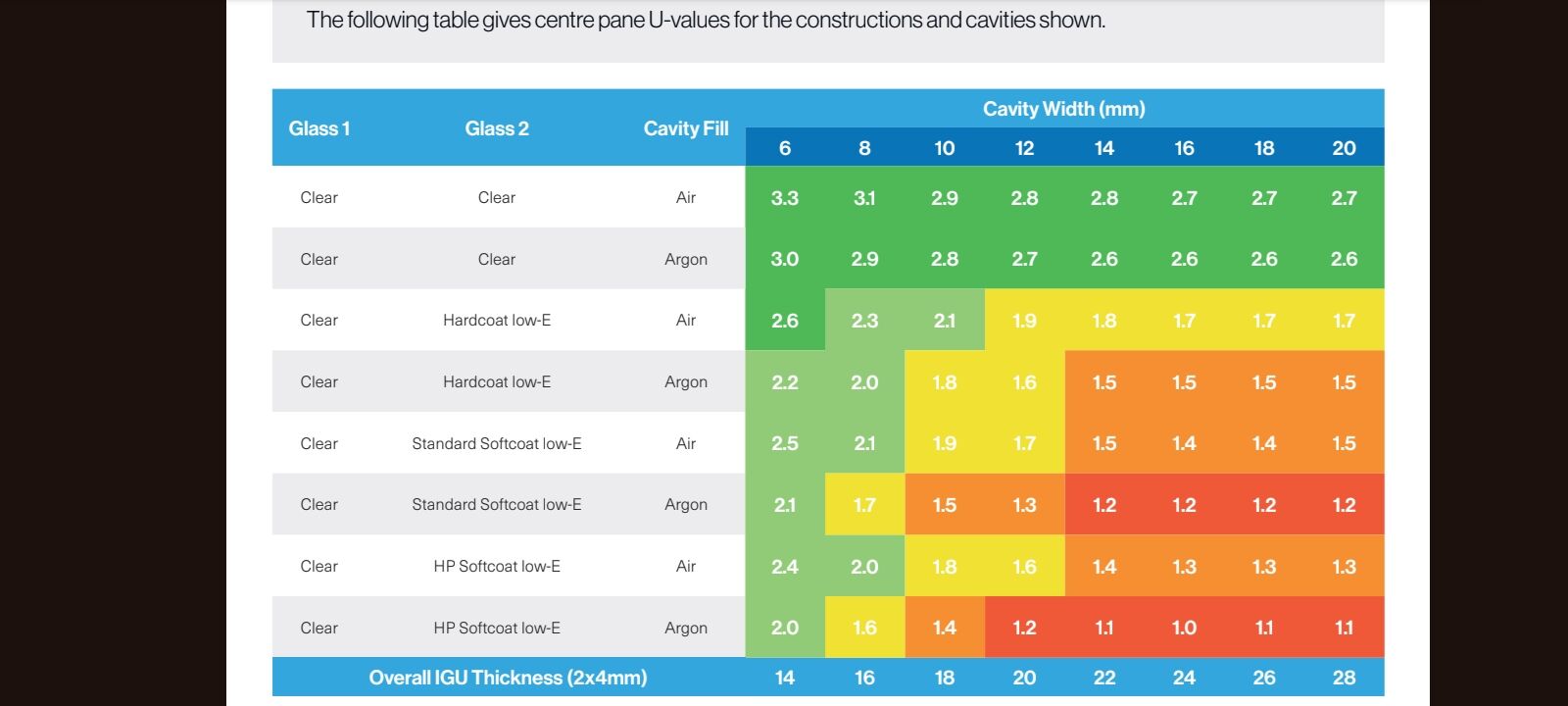
My windows date from 1989 and were fitted as part of the conversion and were only 20mm thick units. By removing the rubber glazing gaskets and using dry glaze tape (think single sided foam tape) I was able to increase to a 24mm thick unit with HP Softcoat, warm edge spacers and argon filled. New seals around the openings mean the windows will probably out perform most options offered as supposedly better new ones.
Triple glazing only makes sense for passiv haus standards or a large North facing window, where two HP coatings are going to be used for 0.5 - 0.4 U-values. Otherwise the increased cost and weight makes it pointless in most cases as average quality triple can be beaten by very good double glazing. For noise problems, just use a double glazed unit with one pane of 6mm (or even better 6.4mm acoustic laminated glass) which will work better than 3 panes of 4mm that all have the same harmonic frequency.
Bifold doors are generally garbage, made and fitted by people who don't deal with them very often, using hardware which is expensive, fragile and certainly designed with planned obsolescence in mind.
This post was modified 2 weeks ago by Singlespeed

21/10/2026 1:41 pm
There are folks who sell buckets of bits of seals on the internet, you match them with the existing ones and then swap them. There's a bit of a knack to getting the new seals right but it's not difficult. A lot of the "one man and a van" double glazing people will also do refurbs when the big companies swear your windows are completely shot and your house is about to fall down as a result.
We've swapped seals, we've swapped individual panes, we've even swapped panes for ones with two holes in for the aircon. A lot can be repaired but not always.
The last house we did the windows really were beyond saving (well the plastic was the panels are about to do service over plants! and we put in acoustic double glazed sashes.
1
21/10/2026 2:25 pm
https://upvcspares4repairs.co.uk/
Both of these two companies sell various seals and hardware to the general public.
I originally got into repair work as a business after ordering some seals for around the glass on my windows, after being told the seals were obsolete and replacement windows were needed. Then another company quoted £120 plus vat for each of the seven windows, to replace the "glazing gaskets"... so it probably existed! Ordering some glazing tools and removing the glass helped me identify which E-gasket and Wedge gasket was likely needed. I ordered enough for one window from JCP, which was less than £10. After confirming the seals fitted correctly, I ordered enough for the other six windows. Whilst doing those, I was spotted by a neighbour and things grew from there.
Replacing seals (gaskets) is easy, but it's also a pain in the arse. Choosing the correct one when comparing it to a 30 year old flattened mess can be just a guess. Then fitting the barb into the frame can be frustrating . Usually an outwards opening window with friction hinges would be failed hinges rather than seals.


21/10/2026 4:03 pm
It is very comforting to see the condensation on the outside surface of the triple glazed window; the condensation remains until the OAT rises considerably - meanwhile, the inside surface is still more or less at ambient IAT.😊 Toodles.
Toodles, heats his home with cold draughts and cooks food with magnets.

22/10/2026 11:25 am
Posted by: @singlespeed
With 9 years repairing windows and doors, I think the idea that replacing old double glazed windows is always the best solution and triple glazing is better, is misguided. If your existing frames are in good condition and they are well fitted, repairing worn hardware and seals if required and replacing old glazing is probably a very good solution.
I think that is absolutely bang on. We had circa 2003 Coral Windows double glazing. Over 20 years later, half a day spent giving them a really thorough clean had the frames looking like they were less than a year old. Clearly very good quality uPVC as there had been no visible fading in that time. Just as you said the frames are robust and the structural integrity is excellent. The old double glazed units (DGUs) themselves pre-dated low-e surfaces, and so had quite a poor U-value of around 2.7. The frames had a U-value of 2.0.
We chose to replace the DGUs and keep the frames. The new DGUs were Planitherm One toughened (argon filled, warm edge spacer) U-value 1.0. Detailed calculation showed that this brought the whole window U-value down to 1.47. Not quite the 1.4 required by current building regulations, but not far off. The cost difference though was huge. The replacement DGUs cost £4500 (averaged £75 each fitted for 60 units) compared to circa £20,000 for all new windows. All 60 DGUs were fitted in a single day by two very experienced guys and an apprentice.
The difference has been an absolute eye opener. Cooler in summer, since the g-value is 0.49 compared to 0.7+ for standard double glazing. The sound transmission is noticeably less, and the heat loss massively so. @toodles, similar to your triple glazing, Planitherm One DGUs also end up with condensation on the outside. In fact in January with outside temperature at -5C, we had frost on the outside of the glass, which is just crazy when the room is 19C inside. Reminds me of the Aurthur C Clarke quote "Any sufficiently advanced technology is indistinguishable from magic". It still messes with my head that these DGUs have pretty much the same U-value as the same thickness of PIR board (Kingspan, Celotex etc.)
@singlespeed I found your table of U-values interesting, particularly the fact that there is a sweet spot in terms of cavity thickness on the highest performance DGUs with Argon fill. A 16mm cavity is marginally better (U-value of 1.0) then either 14mm or 18mm (U-value 1.1). I think this happens because the insulating properties of a wider cavity start to become undermined by the larger gap allowing convection currents to occur. The U-value of 1.2 for a 12mm cavity with high performance coating and Argon fill shows that massive improvements can be had even on older windows with 20mm overall thickness DGUs.
2
Page 2 / 2
Prev

SPONSORS

Degrees of Separation
Latest Posts
-

RE: Marvel Heating liquidation
In light of this conversation, I published this piece t...
By Mars , 8 hours ago
-
RE: Boiler Upgrade Scheme funding reduced by circa £750 million in 2026 budget
I think I'd argue that's not the case - in fact that mi...
By EtchedPixels , 11 hours ago
-
RE: The Changing Jet Stream Could Challenge UK Air Source Heat Pumps
@etchedpixels Agreed, just a thought for others. I a...
By Watcher , 11 hours ago
-
RE: DIY powerflushing tutorial
Nice contraption- I like this kind of thinking. Last ye...
By Travellingwave , 22 hours ago
-
RE: Vaillant ecoTEC Plus - Flow Temp and Set Up
Heating been on for 4 weeks now, continuous. It's 6C o...
By trebor12345 , 1 day ago
-
Coming back on subject... A shortened version of the ...
By Transparent , 2 days ago
-
RE: Say hello and introduce yourself
Perhaps it is time for an update on ‘our’ project. We h...
By Toodles , 2 days ago
-
RE: Free app: run the immersion / heat pump from Growatt battery & solar surplus – no Home Assistant
Please bear in mind, everyone, that in order to use thi...
By Majordennisbloodnok , 4 days ago
-
RE: The good, the bad and the not that great – my heat pump installation
@burtis Thanks for posting this and Im so pleased you ...
By JamesPa , 4 days ago
-
RE: I need help with Ecodan ASHP
@f1p It turns out there have been a solar panel install...
By Andris , 4 days ago
-
RE: 15kw pump for 225m2 1990's house - over kill?
@seaviews your installer would be right to say that the...
By GrahamF , 4 days ago
-
RE: Tradespeople on Their Phones: What’s Acceptable When They’re Working in Your Home?
Actually, that's a very important point. I've only ev...
By Majordennisbloodnok , 5 days ago
-
RE: Aerotherm and weather compensation
These are likely inked. The basic explanation is tha...
By JamesPa , 5 days ago
-
RE: Electrical works for air to air heat pump
agree with above. I have not had extra costs added wh...
By Batpred , 5 days ago


SPONSORS

