

Notifications
Clear all
Joining the Renewable Heating Hub forums is completely free and only takes a minute. By registering you’ll be able to ask questions, join discussions, follow topics you’re interested in, bookmark useful threads and receive notifications when someone replies. Non-registered members also do not have access to our AI features. When choosing your username, please note that it cannot be changed later, so we recommend avoiding brand or product names. Before registering, please take a moment to read the Forum Rules & Terms of Use so we can keep the community helpful, respectful and informative for everyone. Thanks for joining!
Energy Storage
38
Posts
9
Users
17
Reactions
22.2 K
Views

30/03/2024 2:42 pm
@windymiller The Tesla Powerwall is in the extension along with the wiring to the grid connections at my meter and control gear for the 8.1 kWp. solar PV. The Tesla Gateway does all of the switching required via the IOS app. 27kW/h of energy will run the house and heating for approx. 10 hours or more depending on how hard the heat pump needs to work. Usually, there are sufficient hours during the night when greenest and cheapest rate allow me to fill the battery again. I have not knowingly ever had to take power from the grid during the ‘peak time’ of 16:00 to about 19:30 or so. Normally, I’ll tell the MyEnergi Eddi to charge the Sunamp Thermino during the night as that cheap rate then allows me to export more of my solar PV at 15p. Per kW/h during the day - though I can of course let the sun take the DHW strain if required too. Regards, Toodles.
Toodles, heats his home with cold draughts and cooks food with magnets.

30/03/2024 3:04 pm
From observations I've made at substations, the main issue with ASHPs is the switch-on surge.
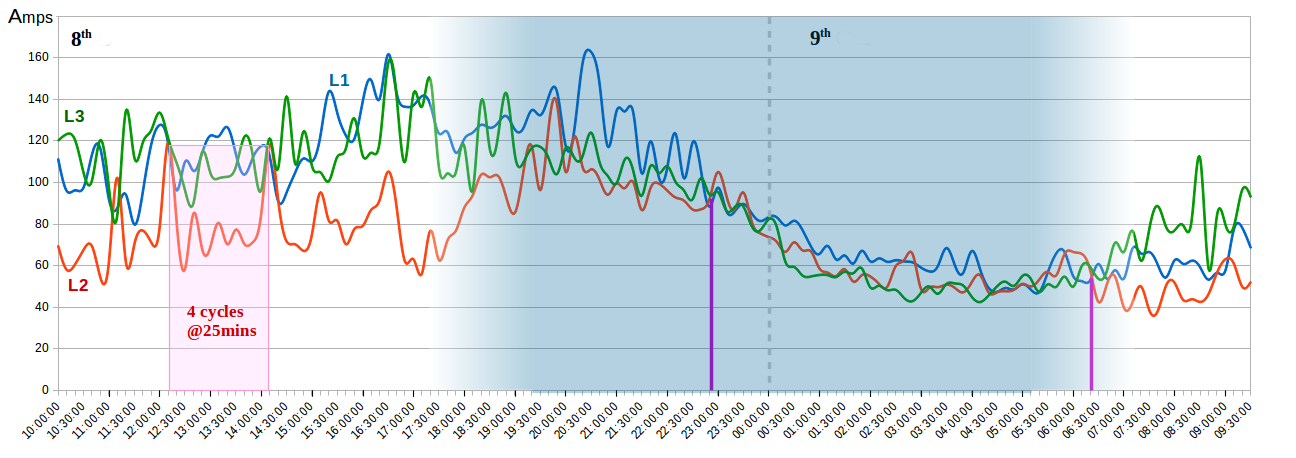
A typical domestic (single-phase) heat pump can take 30-35A when starting, which drops down to less than 10A once the compressor has got the fluids up to working pressure.
Plus there's a spike as the compressor motor starts which lasts around 1/10th second whilst the magnetic flux builds up.
So any inverter with a HP as a load must be able to deliver that output surge current whilst keeping the voltage within the required envelope.
What's the maximum continuous current and the surge current capability of the inverter within your Hyundai?
If you're 'running an extension lead', what's its current rating or conductor specification?
Save energy... recycle electrons!
Page 4 / 4
Prev

SPONSORS

Degrees of Separation
Latest Posts
-

RE: How will removing the standing charge on gas bills benefit heat pumps?
The BUS grant funding for 2026/27 will run out at the c...
By Rob of York , 2 hours ago
-
RE: The Changing Jet Stream Could Challenge UK Air Source Heat Pumps
Thanks @susannasaunders for reviving the topic I find i...
By springswood , 3 hours ago
-
RE: New Build 3 Phase or 1Phase
Not so any more.... 1: It's now the...
By Transparent , 16 hours ago
-
@editor Ouch, sorry to re start the tick. I had assume...
By DavidB , 2 days ago
-
RE: Say hello and introduce yourself
@e-a-west as the good Major said, welcome to the forums...
By Mars , 2 days ago
-
RE: How much of your renewable and home setup would still work if the internet went down?
Yes I actually have a copy of a tool that whenever a ce...
By EtchedPixels , 2 days ago
-
RE: Indevolt Batteries UK Support & Info Thread
@editor Hi, To resolve this, please tap on the A...
By Indevolt Tech , 2 days ago
-
RE: Double or Triple Glazed Windows?
Posted by: @singlespeed With 9 years repairing windo...
By Rob of York , 3 days ago
-
@transparent we’re still running a secure version of PH...
By Mars , 3 days ago
-
RE: How quickly would you want/expect heat recovery to take from setback?
Much longer than that here. The heating isn't even on. ...
By bobflux , 4 days ago
-
RE: Passiv Smart Thermostat - Help & Forum Support
Obviously the weather is changeable but there's a defin...
By Singlespeed , 4 days ago
-
RE: Forum updates, announcements & issues
Get the Renewable Heating Hub heads-up on WhatsApp. I...
By Mars , 4 days ago
-
RE: Safety study for plug in batteries out to tender - looks like Q3 2027 at best before legal
@editor I pointed out to the one of the Fuse execs that...
By dansus , 4 days ago
-
RE: 15kw pump for 225m2 1990's house - over kill?
@seaviews As well as loft insulation, there are othe...
By Rob of York , 4 days ago


SPONSORS

