

Notifications
Clear all
Joining the Renewable Heating Hub forums is completely free and only takes a minute. By registering you’ll be able to ask questions, join discussions, follow topics you’re interested in, bookmark useful threads and receive notifications when someone replies. Non-registered members also do not have access to our AI features. When choosing your username, please note that it cannot be changed later, so we recommend avoiding brand or product names. Before registering, please take a moment to read the Forum Rules & Terms of Use so we can keep the community helpful, respectful and informative for everyone. Thanks for joining!

Topic starter
24/08/2024 10:10 am
Great reading and got me thinking overnight that I really need to see what’s up there at the minute. They couldn’t get the original ones to fit so went off for others that were more powerful and fitted less. My trust in them as you know is zero so checking might vibe a smart move. Need to await some dry weather it’s raining like the end of the world. GW !!

24/08/2024 10:56 am
You may wonder why it is that your inverter is rated for a maximum 3600W output,
and yet each of the two PV inputs can take up to 550v x 13.5A which comes to a whopping 7424KW
Firstly inverter manufacturers will have a range of models in their portfolio, each of which use the same solar-input circuitry.
3.6kW output is common the UK because it matches the maximum amount of export which is likely to be approved by your DNO.
Unless external factors come into play, the usual permitted G98 export rate is 16A (per phase), which equates to 3.68kW
However, there is good reason why you might wish to exceed the 3.6kW figure when selecting your solar panels.
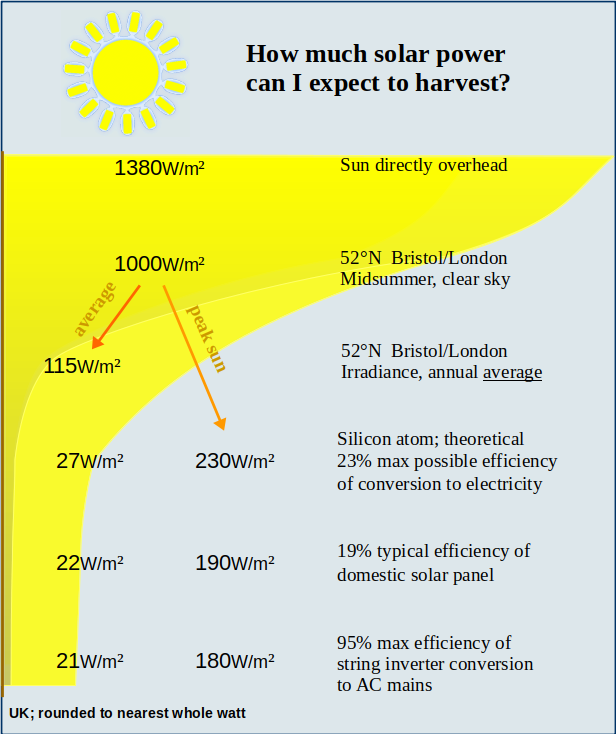
On a bright day but with the sky overcast, each panel's output will drop to approximately one-seventh of its maximum specification.
Having more panels means that your inverter will 'see' less drop-off.
There might also come a time when you wish to add a second inverter to charge batteries, but with no possible grid export.
That doesn't fall within the requirements to notify your DNO.
You can have any number of solar panels and inverters for a system which supplies the house "off-grid".
I have my rooftop solar panels divided into four different arrays.
The down-leads go to a couple of String Combiner boxes rather than straight to an inverter.
That arrangement allows me to change my mind in future without having to go back on the roof to rewire those arrays.
Here's the first iteration of a combiner box to which I connected three arrays:

And this is what it looked like in situ:

I've since installed yet more panels and added a second String Combiner box to provide greater versatility,
but let's not over-complicate the issue here.
Save energy... recycle electrons!
1

24/08/2024 11:03 am
Absolutely great advice my main takeaways are.
1. G99 for inverter ✅
2. New 95mm² cabling ordered with attachments - will probably go to cef to get them fixed and installed when new batteries get installed alongside asking for MCS. I'll question the fuse/circuit protection too for between the battery and inverter
3. New lagging ordered starting with externals (armaflex) along with 'glue' and tape for those tricky bits ✅
4. New lagging for internals ordered
5. Ashp inspection from heat geek installers for peace of mind before my service in October
6. Future projects ie self install solar and utilise the aux on the inverter to heat the water alongside back up
I think that's covered it for now costing about £500. It ain't cheap but hopefully a worthwhile investment for peace of mind
2 10kw Grant Aerona3
Heat loss calc 16.5 kw @ -2.8 degrees
4.32 PV
1
24/08/2024 11:36 am
I've just checked the PV-input specifications for your 3-phase 10kW inverter @bretix

Like @david999 you have two MPPT inputs,
but in your case they don't have the same specifications.
One of them is rated 26A current at 200-650v DC
whilst the other is 13A at 200-650v DC
Add the two maxima together and we arrive at a whopping 25.3kW.
Once again, this is far in excess of what the 10kW inverter would actually draw from those PV panels.
But it gives you a wide range of flexibility to play with.
Save energy... recycle electrons!

24/08/2024 11:42 am
@transparent fogot to answer this one naive as I am this is what I've got assuming now a 2 pole isolator will need to added?0

2 10kw Grant Aerona3
Heat loss calc 16.5 kw @ -2.8 degrees
4.32 PV
Topic starter
24/08/2024 11:59 am
@transparent I have so much to consider, currently the south facing panels manage quite well so far but as the winter approaches, as you mentioned not so well. I lose my power as it crosses the roof towards the north but would I want to capture that in summer or add more southwards for winter. Currently only using about 2 quid of electricity a day. Another battery perhaps but its the weight and although mine are modular I don’t want to sit another on top so perhaps one downstairs in kitchen, below those.
24/08/2024 12:11 pm
@ bretix This is type of fuse-holder which attempts to double-up as a contact breaker.
You pull the top handle towards you and the fuses get pulled out of the upper friction-clamp holder.
They are commonly used by professional installers, and are widely sold for use with storage batteries.
I still don't like them 🤨
Choosing fuses and contact breakers is akin to reading the terms of an insurance document.
There's lots of stuff that might mean nothing at all to you...
... but it really ought to convince you that you're covered against the threats which are foremost in your mind.
Let me make a couple of observations about what you've got installed, and then leave space for others to chip in.
1: As you open the holder by pulling the handle, the metal tags on the ends of the two fuses are still live, and pointing towards you.
Ok, so they're only presenting 52v, and you could put your fingers across them without incurring a shock.
But I could also drop a spanner across them and create a dead-short.
It could remain there sufficiently long that it welds itself in place.
Now you begin to understand why my battery racks have the cell-terminals facing outward rather than up.
If I drop a spanner across those terminals, it continues falling past them and on towards the floor!
2: Your fuse type is NH1

The worst case scenario is that the electronics in the inverter has a fault which presents a 'near short circuit'.
It will rapidly get hot and effectively catch fire.
My fuses are the safety feature to cut off the source of electrical energy from the batteries before that happens.
The speed of operation is their most important feature.
Your NH1 fuses are from the German manufacturer, Müller.
And the fuse 'rating' is 200A... so effectively 100A per battery.
If I place a short-circuit across a LiFePO4 battery, the instantaneous current is likely to be around 10kA.
Here's the current/time graph for that NH1 fuse:

Reading back to the y-axis from the tip of my red arrow gives me the operational time of 400mS.
Compare that with the equivalent graph for the Type-T fuses which I use, manufactured by Eaton/Bussman
You're looking for the 200FM curve, for which the 10kA point is actually off the bottom of the chart !

That Type-T fuse is going to blow-open in less than one-tenth of a millisecond.
There is no possibility of current being able to flow into a faulty inverter under a 'near short-circuit'.
There's a good reason for this.
The type T fuse 'wire' actually vapourises across its entire length.
It's surrounded by a chemical which induces that effect.
Other types of fuse break the circuit by first creating a hot-spot in the centre of the wire, and the arc then burning its way along the wire until the gap is large enough to break that arc.
The Type-T is a different approach...
... which I happen to like 😎
3. I use a separate fuse (and a 500A relay) for each battery.
That means I can take one battery out of use for 'maintenance' whilst still running on the other one(s).
Save energy... recycle electrons!
Topic starter
24/08/2024 12:43 pm
- @bretix although not the correct thread, in terms of heating your water you might consider a thermal panel, I have one and so does transparent and it might prove more effective for you than using solar panels.

24/08/2024 1:20 pm
@david999 that would probably be first foray into DIY solar...
2 10kw Grant Aerona3
Heat loss calc 16.5 kw @ -2.8 degrees
4.32 PV
Topic starter
24/08/2024 1:31 pm
I managed to get a look at the tab on the panels, hopefully decent ones.


24/08/2024 2:03 pm
@david999 I have Canadian Solar (some are 385 Watt and some 410 Watt) I actually chose Sunpower Axiom but they became ‘unavailable’ then 2nd. choice was REC, they became ‘unavailable’ too; Canadian Solar was then chosen and fitted, they have been fine for two years now. My complaint is with the lack of sun and plentitude of clouds… Toodles.
Toodles, heats his home with cold draughts and cooks food with magnets.
Topic starter
24/08/2024 2:40 pm


SPONSORS

Degrees of Separation

Latest Posts
-

RE: Heat pump branding. Clever, contemporary… or a bit too much?
I think Heat Geek have done an amazing job on their bra...
By Tomtheheatingengineer , 8 hours ago
-
RE: HeatGeek vs Octopus surveys: puzzling disparity - any ideas why?
I have just had 3 heat loss surveys, one by heat geek o...
By David , 8 hours ago
-
RE: Heat Geek Zero Disrupt: Are We Sleepwalking Into Another Race to the Bottom?
I think that's the key question. After all inverter uni...
By Prunus , 10 hours ago
-
RE: battery storage without solar
As of October 1st they need specific qualifications to ...
By EtchedPixels , 11 hours ago
-
RE: How should the Boiler Upgrade Scheme be reformed?
A unit which uses water to transfer the heat/chill from...
By Temperature_Gradient , 11 hours ago
-
RE: Renewables & Heat Pumps in the News
With regards to the BUS grant raid, I gave it more thou...
By ASHP-BOBBA , 11 hours ago
-
RE: Why are ASHP installs so expensive?
The whole system seems to work on the basis of...
By ian33a , 12 hours ago
-
RE: Missing flow temperature in Heat Geek proposal
Good plan. If you can get half hourly meter readings a...
By JamesPa , 17 hours ago
-
RE: Heat Pumps Without Grants: Would You Have Installed One & Will You Now?
@editor Most certainly. The heat pump was an ideal s...
By Abernyte , 17 hours ago
-
Although regulations may well vary from country to coun...
By Majordennisbloodnok , 17 hours ago
-
RE: Does anyone have experience of a smart water meter?
Yep I caught our slow leak from a £100 bill rise 8)
By EtchedPixels , 17 hours ago
-
RE: Do You Need a Buffer Tank or Low Loss Header for Underfloor Heating in a Large Property?
@jamespa in some cases, failing the Turing test might b...
By GrahamF , 21 hours ago
-
RE: Passiv Smart Thermostat - Help & Forum Support
@energystoragetech The heat capacity of some...
By JamesPa , 22 hours ago
-
RE: tepeo ZEB UK Support & Info Thread
Sorry you are correct, I was remembering figures from t...
By JamesPa , 1 day ago




SPONSORS

