

Notifications
Clear all
Joining the Renewable Heating Hub forums is completely free and only takes a minute. By registering you’ll be able to ask questions, join discussions, follow topics you’re interested in, bookmark useful threads and receive notifications when someone replies. Non-registered members also do not have access to our AI features. When choosing your username, please note that it cannot be changed later, so we recommend avoiding brand or product names. Before registering, please take a moment to read the Forum Rules & Terms of Use so we can keep the community helpful, respectful and informative for everyone. Thanks for joining!
Solar Photovoltaic (PV)
14
Posts
5
Users
5
Reactions
6,782
Views

20/03/2023 8:05 pm
we then inset it 15 minutes. I know from billing that the timing is accurate.
The timing is 'accurate' for you only because the offset being applied by your Electricity Smart Metering Equipment (ESME) falls within the first 15mins of the half-hour billing periods.
That is true for about 83% of users with Smart Meters.
The following graph demonstrates how the randomised timing system will be perceived by a notional set of 4000 users with Smart Meters.
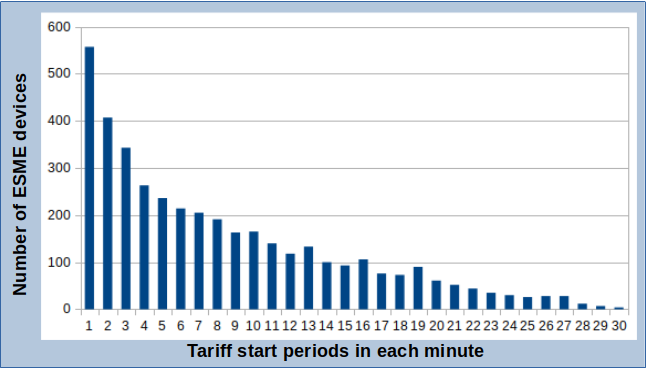
If the random number seeded into your ESME during manufacture had instead created a greater Randomised Offset to your Tariff Switch Table, then you would be paying for a portion of the electricity at the peak rate whilst recharging your batteries from 00:45.
That's why I wrote that your installer had "hedged your bets".
He guessed that the Randomised Offset applied to your Tariff Switch Table would be in the 83% of the population.
In your case he was correct.
there's no simple (yes I know people have coded stuff) streamlined way yet that I'm aware of to take dynamic pricing into a battery setup
I don't think anyone has coded this.
To do requires access to data held within the ESME.
That data is within the Secure Perimeter of the meter.
Writing code to access that information requires being a Party recognised by the SEC.
There is no SMETS command which can be transmitted across the National Smart Meter Network which allows remote access to data within the Secure Perimeter.
It is not possible for an Energy Supplier to know the time at which your Smart Meter commences a half-hour period with a cheaper tariff.
I have used terms in writing the above (italics), which are defined within the Smart Metering Equipment Technical Specification 2013/14.
This is in an attempt to have clarity, rather than to be obtuse!
Please feel free to ask for further explanation if you wish.
I'm happy to do so, provided it does not compromise the security of the UK energy supply.
Save energy... recycle electrons!
1
20/03/2023 8:14 pm
Returning back to the original point made by @retrobod -
You will now understand that it is the storage of the electricity produced by your solar panels which has become the important issue of the moment.
The amount you get paid for exporting to the grid has been falling over the last 20 years from 53p per kWh to as low as 4p.
You may want to discuss this with your Installers who have provided quotations.
It is very unlikely to be viable to install solar panels if you intend offsetting the capital cost against 'profit' from the Smart Export Guarantee (SEG).
There's no longer any profit to be made.
It all depends on why you feel that now is the time to install 4.25kW of solar panels.
Please do discuss this here.
We are particularly tolerant of points being raised by those who do not yet understand the principles. 🙂
Save energy... recycle electrons!
Page 2 / 2
Prev

SPONSORS

Degrees of Separation

Latest Posts
-

RE: Heat pump branding. Clever, contemporary… or a bit too much?
I think Heat Geek have done an amazing job on their bra...
By Tomtheheatingengineer , 7 hours ago
-
RE: HeatGeek vs Octopus surveys: puzzling disparity - any ideas why?
I have just had 3 heat loss surveys, one by heat geek o...
By David , 7 hours ago
-
RE: Heat Geek Zero Disrupt: Are We Sleepwalking Into Another Race to the Bottom?
I think that's the key question. After all inverter uni...
By Prunus , 9 hours ago
-
RE: battery storage without solar
As of October 1st they need specific qualifications to ...
By EtchedPixels , 10 hours ago
-
RE: How should the Boiler Upgrade Scheme be reformed?
A unit which uses water to transfer the heat/chill from...
By Temperature_Gradient , 10 hours ago
-
RE: Renewables & Heat Pumps in the News
With regards to the BUS grant raid, I gave it more thou...
By ASHP-BOBBA , 10 hours ago
-
RE: Why are ASHP installs so expensive?
The whole system seems to work on the basis of...
By ian33a , 11 hours ago
-
RE: Missing flow temperature in Heat Geek proposal
Good plan. If you can get half hourly meter readings a...
By JamesPa , 16 hours ago
-
RE: Heat Pumps Without Grants: Would You Have Installed One & Will You Now?
@editor Most certainly. The heat pump was an ideal s...
By Abernyte , 16 hours ago
-
Although regulations may well vary from country to coun...
By Majordennisbloodnok , 17 hours ago
-
RE: Does anyone have experience of a smart water meter?
Yep I caught our slow leak from a £100 bill rise 8)
By EtchedPixels , 17 hours ago
-
RE: Do You Need a Buffer Tank or Low Loss Header for Underfloor Heating in a Large Property?
@jamespa in some cases, failing the Turing test might b...
By GrahamF , 20 hours ago
-
RE: Passiv Smart Thermostat - Help & Forum Support
@energystoragetech The heat capacity of some...
By JamesPa , 22 hours ago
-
RE: tepeo ZEB UK Support & Info Thread
Sorry you are correct, I was remembering figures from t...
By JamesPa , 1 day ago




SPONSORS

