

Notifications
Clear all
Joining the Renewable Heating Hub forums is completely free and only takes a minute. By registering you’ll be able to ask questions, join discussions, follow topics you’re interested in, bookmark useful threads and receive notifications when someone replies. Non-registered members also do not have access to our AI features. When choosing your username, please note that it cannot be changed later, so we recommend avoiding brand or product names. Before registering, please take a moment to read the Forum Rules & Terms of Use so we can keep the community helpful, respectful and informative for everyone. Thanks for joining!
Air Source Heat Pumps (ASHPs)
2
Posts
2
Users
4
Reactions
1,412
Views

Topic starter
14/02/2025 10:08 pm
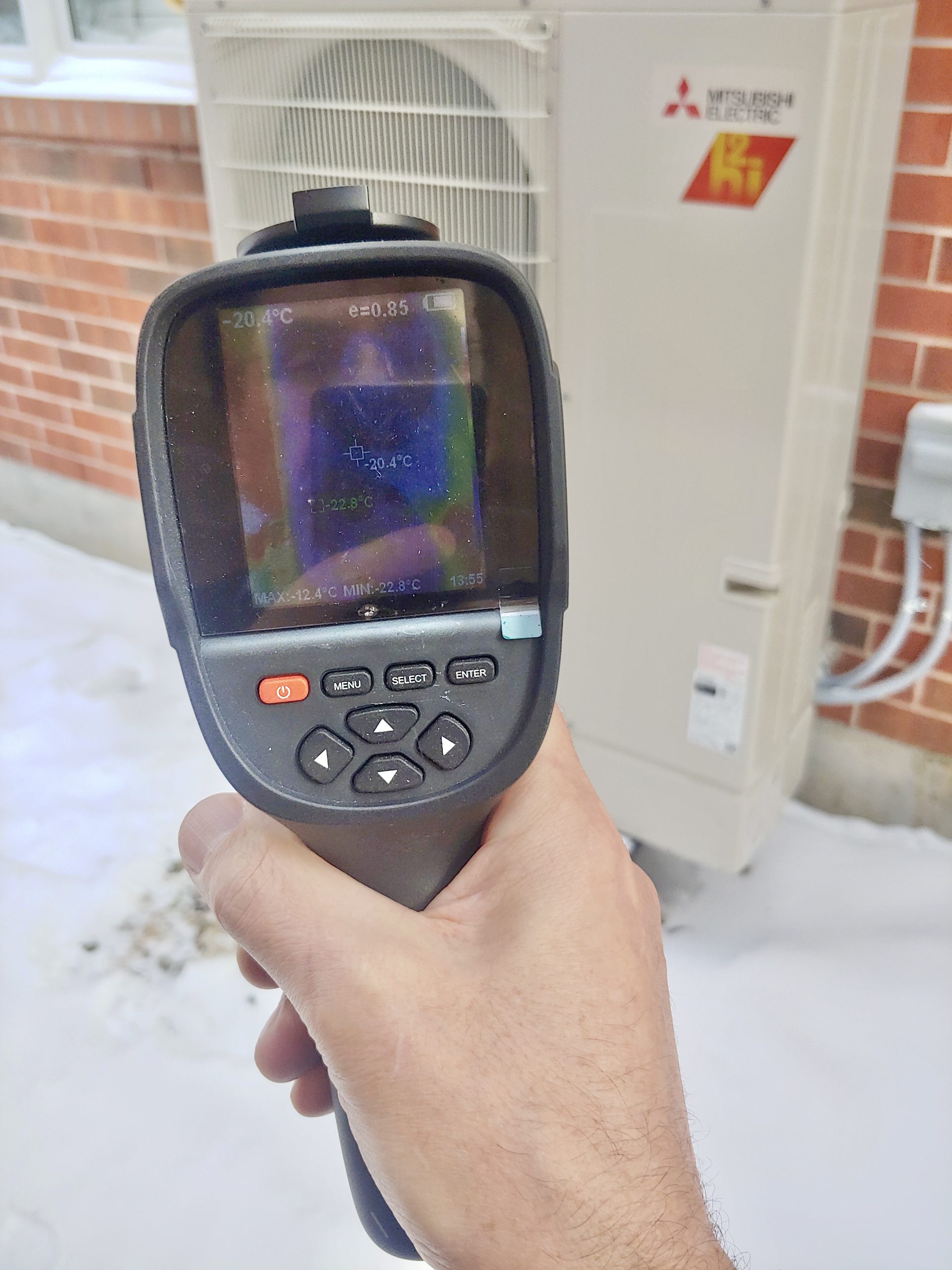
I’m a homeowner from Southwestern Ontario, Canada, about an hour west of Toronto. I live in a 280-square-metre (3,000-square-foot) suburban home that’s around 20 years old and reasonably well-insulated. Last October, I decided to take advantage of Canada’s Greener Homes Grant and rebate scheme to replace my natural gas furnace (see what a gas furnace is at the end of this article) with an air source heat pump. Here’s how it’s been going.
Why I Made the Switch
My old heating system was a 92% efficient natural gas furnace with an output of 29 kW (100,000 BTU). It was still working fine, but I wanted to reduce my carbon footprint and take advantage of the government incentives available for renewable heating. After some research, I settled on a Mitsubishi Zuba Central 12.3 kW (42,000 BTU) air source heat pump.
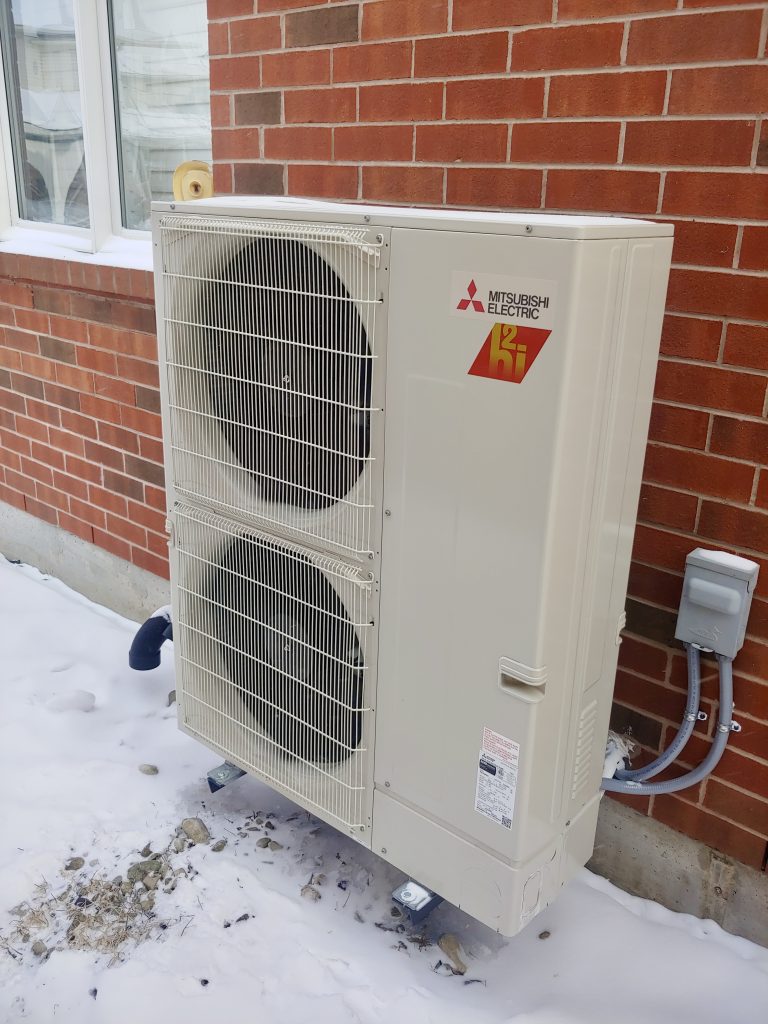
One thing that struck me was how much smaller the heat pump’s output is compared to the furnace it replaced. My heat loss calculation showed that my home needs 14 kW of heating on the coldest day of the year, so the heat pump is more than capable, even though it’s less than half the size of the old furnace. This made me realise how oversized most heating systems are, often installed to “play it safe” rather than optimise for efficiency.
The Installation Process
The installation cost around £10,800 (18,500 CAD), and I spent an additional £1,100 (2,000 CAD) upgrading my electrical panel to accommodate the 10 kW electric backup heater. The backup heater is there for extreme cold, but I’m happy to report that it only kicked in once all winter, and that was because my partner left the front door open for too long on a chilly February day.
Performance in Sub-Zero Temperatures
We had a particularly cold snap in January, with temperatures dropping to -20°C for a week. The heat pump handled it like a champ, keeping the house warm and comfortable without needing the backup heater. I was genuinely impressed by how well it performed in such extreme conditions.
In terms of efficiency, the heat pump has been a game-changer, especially during the milder “shoulder seasons” of spring and autumn. During these times, the system achieves a Coefficient of Performance (COP) of 3 to 3.5, meaning it’s much more efficient than the old gas furnace.
Energy Costs and Savings
From an energy use standpoint, the heat pump is far more efficient than the natural gas furnace it replaced. However, because of the relatively low cost of natural gas in Ontario compared to electricity, my energy bills for the 2023–2024 heating season were about the same as before. That said, I’m expecting better savings during the cooling season, as the heat pump is significantly more efficient than my old air conditioning unit.
Bonus Benefits: Cooling and Noise Levels
Speaking of cooling, the heat pump has been a revelation. It’s much quieter than my previous system. So quiet, in fact, that I can’t hear the outdoor unit running unless I’m standing right next to it. It also cools the house more effectively, thanks to its ability to run for longer periods at lower outputs. This makes a huge difference on very hot days.
Hot Water Heating
I also replaced my natural gas water heater with a Rheem ProTerra heat pump water heater, which has a 250-litre (65-gallon) capacity. It’s been fantastic at keeping up with demand for our household of four adults, and I haven’t noticed any difference in performance compared to the old gas unit. The only downside is the Rheem app, which is completely useless. To monitor energy usage, I’ve installed an Emporia Vue II energy monitor on the key circuits in my electrical panel.
The Bigger Picture
I’m one of the first in my neighbourhood to make the switch from natural gas to a heat pump. Out of roughly 400 detached homes, there are only two heat pumps so far (mine and one other). It’s been a positive experience overall, and I’m oddly looking forward to a colder winter this year to see how the system holds up and whether the backup heater truly needs to come on.
If you’re considering a heat pump but are worried about how it will perform in cold weather, I hope my experience shows that modern heat pumps are more than up to the task, even in sub-zero temperatures.
A Note for UK Readers: In Canada, most homes use forced-air heating systems (often called furnaces) rather than boilers. These systems heat air directly and distribute it through ductwork and vents, unlike UK boilers, which heat water and circulate it through radiators or underfloor heating. While the technology is different, the principles of switching to a heat pump are similar: both systems can be replaced with an air source heat pump to improve efficiency and reduce carbon emissions. The key takeaway is that heat pumps are highly effective even in cold climates, and their performance in Canadian winters should give UK homeowners confidence in their ability to handle milder British winters with ease.

3

15/02/2025 2:28 pm
Great article! It will certainly support the argument that the technology is up to the task and it can be poor installation practises that produce poor experiences.
I was impressed my 12Kw Samsung unit kept my building at 21C when we had a cold (mild for you) snap of -5C but this article boosts my confidence further 🙂
5 Bedroom House in Cambridgeshire, double glazing, 300mm loft insulation and cavity wall insulation
Design temperature 21C @ OAT -2C = 10.2Kw heat loss, deltaT = 8 degrees
Bivalent system containing:
12Kw Samsung High Temperature Quiet (Gen 6) heat pump
26Kw Grant Blue Flame Oil Boiler
4.1Kw Solar Panel Array
34Kwh GivEnergy Stackable Battery System
1

SPONSORS

Degrees of Separation

Latest Posts
-

RE: Heat pump branding. Clever, contemporary… or a bit too much?
I think Heat Geek have done an amazing job on their bra...
By Tomtheheatingengineer , 10 hours ago
-
RE: HeatGeek vs Octopus surveys: puzzling disparity - any ideas why?
I have just had 3 heat loss surveys, one by heat geek o...
By David , 10 hours ago
-
RE: Heat Geek Zero Disrupt: Are We Sleepwalking Into Another Race to the Bottom?
I think that's the key question. After all inverter uni...
By Prunus , 12 hours ago
-
RE: battery storage without solar
As of October 1st they need specific qualifications to ...
By EtchedPixels , 13 hours ago
-
RE: How should the Boiler Upgrade Scheme be reformed?
A unit which uses water to transfer the heat/chill from...
By Temperature_Gradient , 13 hours ago
-
RE: Renewables & Heat Pumps in the News
With regards to the BUS grant raid, I gave it more thou...
By ASHP-BOBBA , 13 hours ago
-
RE: Why are ASHP installs so expensive?
The whole system seems to work on the basis of...
By ian33a , 14 hours ago
-
RE: Missing flow temperature in Heat Geek proposal
Good plan. If you can get half hourly meter readings a...
By JamesPa , 19 hours ago
-
RE: Heat Pumps Without Grants: Would You Have Installed One & Will You Now?
@editor Most certainly. The heat pump was an ideal s...
By Abernyte , 19 hours ago
-
Although regulations may well vary from country to coun...
By Majordennisbloodnok , 19 hours ago
-
RE: Does anyone have experience of a smart water meter?
Yep I caught our slow leak from a £100 bill rise 8)
By EtchedPixels , 19 hours ago
-
RE: Do You Need a Buffer Tank or Low Loss Header for Underfloor Heating in a Large Property?
@jamespa in some cases, failing the Turing test might b...
By GrahamF , 23 hours ago
-
RE: Passiv Smart Thermostat - Help & Forum Support
@energystoragetech The heat capacity of some...
By JamesPa , 1 day ago
-
RE: tepeo ZEB UK Support & Info Thread
Sorry you are correct, I was remembering figures from t...
By JamesPa , 1 day ago




SPONSORS

