
Notifications
Clear all

Topic starter
08/12/2025 10:04 pm
History
Feb 25 - 9.5Kw 20 panel South Facing Solar Array and Tesla Powerwall 3 fitted - Octopus Intelligent Go - Best decision ever built up just under £500 credit before winter hit. No issues with any of the kit, other than in ability to configure the Tesla App as you wish and interface issues with Octopus in particular with the Intelligent Octopus. Have worked out alternate strategies to get around most of them
Our Combi Boiler (18 years old) packed up again in July - managed to get 60 seconds hot water - did get a work-around fix but in the mean time decided to pull the trigger and go for ASHP
Received 5 quotes (1 x local, Octopus, and two others) all through the grant - rejected Octopus out of principal very quickly, in the end went with Puraflow. I did have an issue with all the quotes in that they just provide bullet items and then here is your price to pay (less the grant). I have a nagging suspicion that quite a bit of the £7.5K grant adds to supplier’s margin. I fully understand there is design, and lots of extras, so why can't these be itemised? In the end after some negotiation I received and acceptable quote from Puraflow.
Design and Pre-Install - I would rate a 10/10 - had really good design visit and heat loss calculation per room and EPC survey. Received design documents and follow up calls. Install was simple as perfect position for Heat Pump outside back wall, very short run to Garage and Water Cylinder to be placed in position freed by the old Combi Boiler. Heat Loss calculation per room required 8 rad upgraded. Overall, the 162m2 4 bed detached house has just under 8KW heat loss - System agreed was a 10kW Midea R32 - 10 kW - MHC- V10W/D2N8 and 175L Telford Tempest Tank - 47C Flow for a SCoP of 4.2 and Water 50C
Install - 9/10 - total install only took 2 days. Plumbers on day 1 - basic install of the ASHP, removal of old Combi and install of Water Tank and replacement of the 8 radiators. All very good, clean. Only issue that loses 1 mark is one of the new radiators top plate was damaged.
Day 2 Electrical day - all good. System flushed and configured. Retrospective the handover was light and had the same most get - i.e. use Midea thermostat and using schedules to control temp. I thought this was OK and I did not know any difference. All rubbish was removed and house spotless so again very good.
Post Sales 1/10
First problem was misbehaving Midea APP - dropping connectivity with the wall unit - call logged - never received a fix. In end solved myself - will the usual reboot of the wall unit - these fixes it for 5 or 6 days before connection is lost again.
Second Problem is after 4 weeks still not received the replacement cover for the radiator - last promise was delivery Friday. It is minor but irritating. I have received a couple of calls, but my impression is they are focused on sales and not support.
New Problem - I have now been trawling this fantastic forum and know realise I have an inefficient configuration - Note I have been happy with the general function and our house has been toasty and water great and even efficiency not bad. I have frigged my efficiency by using schedules to maximise my overnight 7p, also have 13.5KW to play with during the day, plus whatever the Solar produces. After reading this forum I then checked my COP and noted it was barely 3 most of the time and then I read about Weather Compensation, and this opened my mind.
As per one of the previous posters I learnt how to go into Service Mode and made note of my old settings and edited the curve to be 32C at 14C and still 50 and -2C. Today i bit the bullet and and turned my Thermostat up to 27C and disabled all my schedules so the ASHP will run continuously. So far so good - my small temp gages are sitting at 19.5 C which is perfect for us. Heat Pump taking <1KW per hour and COP reporting over 4 (13C outside so not a strenuous test)
I have not edited anything else, I know there is a setting somewhere you can change the curve. I assume this impact how much hotter the water flow is per 1 C rise in outside temperature. If there is a MIDEA expert this would be great to know. I have found some vids on Youtube. Note I have all rad ITVS set to max and only one zone. We do have a great big wood burner that I have now hardly used!
Puraflow have let themselves down from their previous excellent presales and install service. It is a shame I feel left alone to learn and configure my system.
Have I done the right thing to use a WC curve? Until I read this forum, I was reasonably happy and had never even heard of a WC curve. I am lucky in having the EV tariff and big battery and some solar. This time of year, get about 200KW per month depending upon sun.
1


09/12/2025 8:37 am
Welcome to the forums @stevet.
You should absolutely be using weather compensation, and @cathoderay will probably be best equipped to discuss things related to weather compensation on your Midea unit.
Get a copy of The Ultimate Guide to Heat Pumps
Subscribe and follow our YouTube channel!
1
09/12/2025 9:23 am
@stevet — a second welcome to the forum.
Some comments:
Heat Loss calculation per room required 8 rad upgraded. Overall, the 162m2 4 bed detached house has just under 8KW heat loss - System agreed was a 10kW Midea R32 - 10 kW - MHC- V10W/D2N8 and 175L Telford Tempest Tank - 47C Flow for a SCoP of 4.2 and Water 50C
I started to sense something may not be right here. It looks like you may have avoided an exaggerated heat loss (which is all too common) but having had 8 rads replaced presumably to the right size for a lower flow temp, then 47°C flow seems a little on the high side. Just flagging this at this stage.
First problem was misbehaving Midea APP
The app is crap (as indeed are many others). It uses flaky wifi (which you have to set up using even flakier Bluetooth) to send your data to Midea's servers, and in return you get minimal data badly presented, plus a few buttons to press. It offers no real control at all.
As per one of the previous posters I learnt how to go into Service Mode and made note of my old settings and edited the curve to be 32C at 14C and still 50 and -2C. Today i bit the bullet and and turned my Thermostat up to 27C and disabled all my schedules so the ASHP will run continuously. So far so good - my small temp gages are sitting at 19.5 C which is perfect for us. Heat Pump taking <1KW per hour and COP reporting over 4 (13C outside so not a strenuous test)
You have done exactly the right thing. Although you can use a ToU tariff 'bank' heat overnight, to me this is the tariff tail wagging the comfort dog (if that makes sense). Continuous running is much more comfortable. Going into the FOR SERVICEMAN menu on the wired controller is the way to set the weather compensation curve, exactly as you have done (it can also be done remotely over a wired modbus connection, but that is very definitely the next level up). Use the room stat as an on/off switch: set very high in winter to be on all the time, as you have done, and then maybe 12°C in the summer, to be off all the time. A COP of over 4 at 13°C outside is in the right ball park, it might be possible to nudge it up a bit, but I wouldn't loose sleep over it. All that now remains is to see what happens in cold weather. Your COP will plummet, that is normal, but over the long term if it averages out OK then so be it. The number that really matters is the IAT (indoor air temperature, which is a proxy for your comfort level). If that is OK, and the costs bearable, then all is well.
I have not edited anything else, I know there is a setting somewhere you can change the curve. I assume this impact how much hotter the water flow is per 1 C rise in outside temperature.
There isn't another 'setting somewhere' that changes the curve, you have already changed the curve: 32 @ 14 / 50 @ -2 means the flow will be 32°C when it is 14 outside (in fact it will average about 32, Midea's almost always cycle, so the actual flow temp will go above and below the set flow temp) and 50°C when it is -2 outside. The 'curve' follows a straight line between those two end points, the OAT (outside air temp) range is 16 (14 to -2) and the flow range is 50 - 32 = 18, thus for every degree change in OAT the flow temp will change bu 18/16 = 1.125°C.
The only other 'setting' I can think of is setting the unit to use weather compensation (Weather Set Temp / ... / select curve 9 which is the custom WCC you have already set) but looks like you have already done that.
One zone, open loop etc, all good.
Have I done the right thing to use a WC curve?
Yes!
Midea 14kW (for now...) ASHP heating both building and DHW
1

09/12/2025 9:04 pm
@stevet you have come to the right place. The knowledge on this forum surpasses that of most installers, particularly when it comes to configuring and monitoring your ashp. Your installers sound particularly bad if they didn't even attempt to set a WC curve. I'd also be interested to know what your external lagging looks like on a 2 day install as that takes some doing, to install with proper care within that timeframe. The good news seems to be that you've got an appropriately sized unit and what seems to be sufficient rad changes, and thus the makings of an efficient system if commissioned properly.
There's a few of us on here who have the midea ashp. Good unit let down by non user friendly controls and an abysmal app, as you have discovered. I had exactly the same problems you are describing and thus deleted it.
All of your figures for your house are remarkably similar to ours. In fact pretty much identical. Floor space, heat loss and design flow temp at -2. We have the 12kW unit, possibly because I'm not sure the 10kw was available then, so the next one down was 8kW which wouldn't have been sufficient. 4 radiators changed by installers. 2 since changed by myself in rooms that weren't getting up to temp.
If it helps, our WCC settings are 49 at -4, and 28 at 15. There is a setting on the midea which will automate heating off at a certain outdoor temp (ours is set as 17. Works well and saves a bit of turning on and off in the transitional periods of the year).
I'd suggest you should be getting a COP of closer to 5 in this sort of milder weather. Ours is running a combined COP of around 4.9 today.
The only good video on youtube I could find in relation to the mideas was the one you've probably found which talks through how to set the curve. Very little else on there.
Regarding controls options, how to change things remotely should you so desire, and indeed monitoring- there are a few options so as Cathoderay suggests come back if you wish and we can explain more. What I have learnt over the last couple of months or so is just how effective the weather compensation curve can be at keeping your house at a steady temperature without any room influence. It will likely take a bit of tweaking, and remember any tweaking in serviceman settings will turn everything off so you'll have to turn space heating and DHW on again. That has caught a few of us out...
In fairness now I have everything set up correctly I don't need to change any settings really, and just use our controls and monitoring via the modbus to look at my different graphs multiple times a day plotting all my various parameters. Which oddly I find very satisfying. That may float your boat, or may not. If it does, there's a few options as said.
This post was modified 3 weeks ago 2 times by benson
1
Topic starter
09/12/2025 9:56 pm
Thanks very much for your help. As you say it is a process of trial and error. So far we are actually too toasty - 21C, we are comfortable at 19C so I have reduced down to 31C now at 15C so will see what this does. I have already noticed an increase in efficiency with less consumption which is good news. Thanks for confirming I have taken the right action, it does mess with your head pumping up the thermostat to 25C , however it does work!. I agree with the overnight tarrif observation as you end up with a bloody hot bedroom in the middle of the night!. I will continue to monitor and edit the settings, quite fun really. As many have mentioned I bet there are hardly any suppliers that provide in depth technical help and go down the lazy route.
1
10/12/2025 8:22 am
So far we are actually too toasty - 21C, we are comfortable at 19C so I have reduced down to 31C now at 15C so will see what this does.
This is the right approach, tweak it a bit at a time and see how it goes. You will gradually move towards a weather compensation curve that is right (gets the right room temp) for 95% or more of the time. Depending on your home's exposure to sun wind and rain, you may or may not get solar gain when it is sunny, or wind chill (happens to buildings as well as people) when it is windy and especially if it is also wet. Entertaining can also push up the room temp, not just all those extra bodies, but also extra cooking etc. Usually any variations aren't extreme, and no action is needed.
it does mess with your head pumping up the thermostat to 25C , however it does work!.
It is counter-intuitive to use a thermostat (stat, stasis, keeping things the same) as an on/off switch, but that is what it becomes. Weather compensation is a very neat idea which as it happens works very well in practice. The basic idea is very straightforward: all other things being unchanged (which they are for almost all of the time), the major determinant of your home's heat loss is the OAT (outside air temperature), and what's more, it is in effect a linear (straight line) relationship, which means we can match the heat input to the heat loss by setting the flow temperature based on the OAT, the lower the OAT, the higher the flow temp and more heat gets delivered. We could, at least in theory, and if we had a lot of time, and an untold number of measurements, calculate what the WCC settings need to be, but in practice it is much easier to find the right settings by trial and error, hence the period of tweaking you are now in. As you say it can be fun getting it right, but don't let it get to be too much fun, there is a new diagnosis doing the rounds called HPDHD (Heat Pump Deficit Hyperactivity Disorder) in which new heat pump owners spend increasing long periods doing nothing but tweaking their heating controls, to the extent that it can put jobs and marriages at risk. Don't go down that route!
Midea 14kW (for now...) ASHP heating both building and DHW

10/12/2025 8:59 am
So far we are actually too toasty - 21C, we are comfortable at 19C so I have reduced down to 31C now at 15C so will see what this does.
As a starter for ten I'd lower the cold side of your curve. You say design flow temp of 47 at whatever the outside design temp was. Maybe I have assumed the -2 bit as that depends where you live in the country, and looks like MCS have lowered the figures a bit now as well.
Perhaps set 49 or 50 at -3 or -4 as you'll want a bit of leeway anyway with 'curve' extension beyond -2. Otherwise it will just be running at whatever you've set T1SetH1 at, at -2 and beyond and occasionally it will get colder than that.
This post was modified 3 weeks ago 2 times by benson
10/12/2025 9:10 am
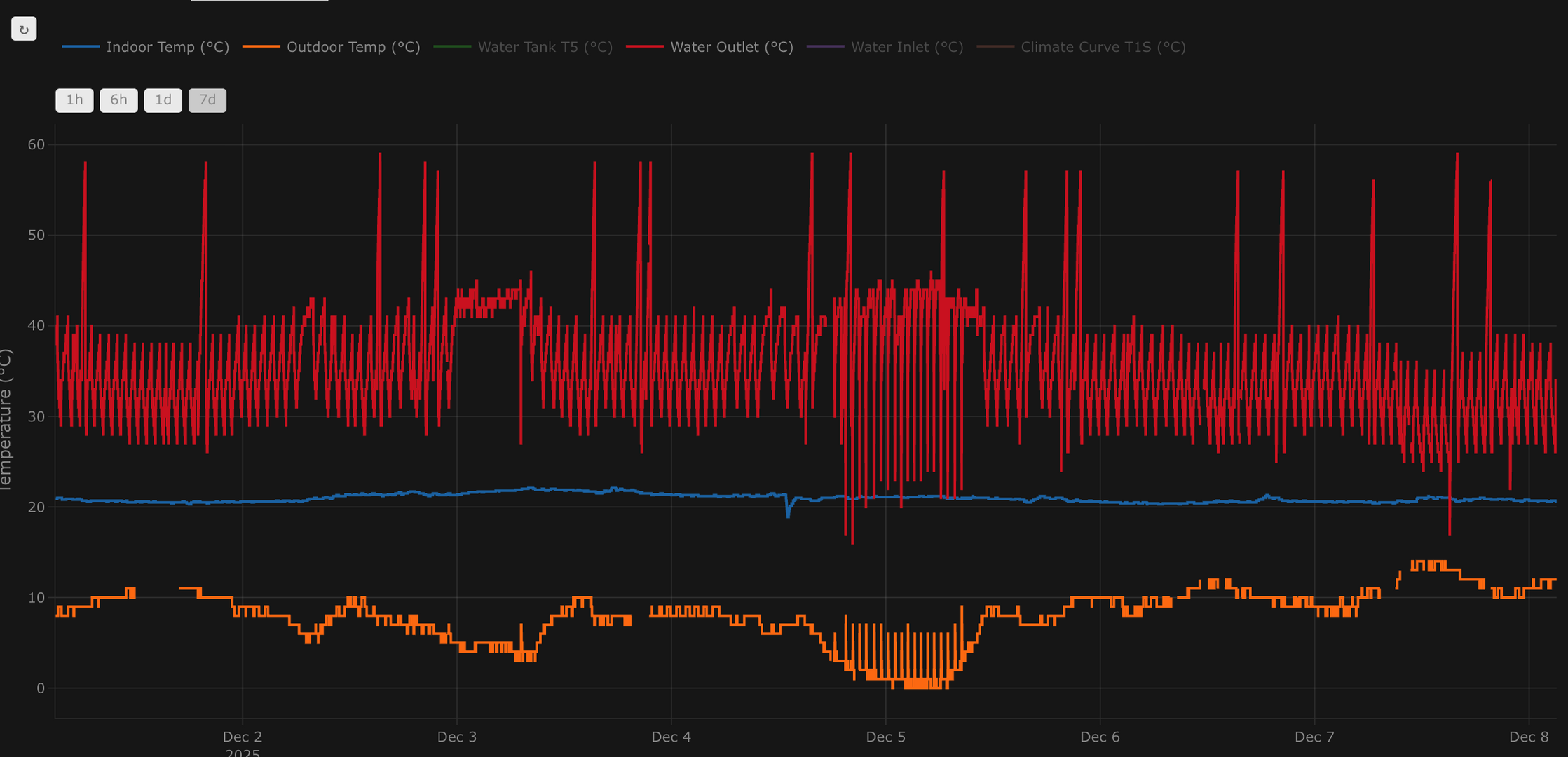
This also hopefully gives you an idea of what you should be able to achieve with no indoor thermostat influence. Our IAT (indoor air temp) stays between 20.5 and 22 which is perfect for us. It rises closer to 21.5/22 when colder outside, and 20.5 when a bit milder which is not necessarily by design but actually ideal.
The graph shows a 7 day range when we had a variety of weather conditions. The sharp dip in IAT you can see on 4th Dec is when we had a delivery of a load of kitchen appliances so the front door was open for 10/15 minutes, but soon got back up and plateaued again.
This post was modified 3 weeks ago by benson
1
10/12/2025 10:25 am
The sharp dip in IAT you can see on 4th Dec is when we had a delivery of a load of kitchen appliances so the front door was open for 10/15 minutes, but soon got back up and plateaued again.
That of course in not the typical recovery pattern, and to that extent, it might be a bit misleading. I suspect where you measure the IAT, and what doors were or weren't open are the keys to understanding that sharp dip and rise. Without some form of dynamic adjustment (my auto-adapt script, load compensation etc), a heat pump left to its own devices to reheat a whole home from that sort of dip will take several hours to recover. However, if the cooling was local, and the rest of the home remained at normal temperature, then I suspect air movement once external doors were closed and internal ones opened might easily achieve a quick recovery. The rest of the chart is an exemplary example of weather compensation doing its thing, and doing it well.
@stevet — auto-adaption and load compensation now that I have mentioned them are a sort of next level approach to weather compensation that perhaps more often than not isn't necessary. The idea is you adjust the curve in response to demand in the relatively short term. Homely will do it for a fee (useful for hands off people) or you can do it yourself, either manually via the wired controller, or automatically, as I do, using a script (mini computer program) that checks the actual IAT against the desired IAT and if they don't match, makes adjustment to the WCC to move them closed together. But the first step is always to get our default WCCs in the right place, only then do we consider auto-adaption, and only then if it is needed.
Midea 14kW (for now...) ASHP heating both building and DHW
10/12/2025 11:42 am
That of course in not the typical recovery pattern, and to that extent, it might be a bit misleading. I suspect where you measure the IAT, and what doors were or weren't open are the keys to understanding that sharp dip and rise.
Indeed- front door was open for a relatively sustained period of time, which is where this temp sensor is near to (hallway).
On rare occasions when entire house temp needs to be recovered for whatever reason and the standard WCC might not be up to the job due to particularly low OAT or it had dropped significantly, I'd just turn off weather comp and run it at a set flow temp (45 to 50 probably). As you allude to, we've actually found any form of auto adapt superfluous to requirements.
This post was modified 3 weeks ago by benson
1
Topic starter
10/12/2025 2:01 pm
Hi, you are quite correct we live in a small village that is also in a hollow so we frequently get quite severe frosts, typically 4C colder or more than our close-by city - Coventry. No concrete and very sheltered. So are you suggesting I reduce the -2 to -4 (I have adjusted the 50C down to 48) Currently my settings are -2C - 48C and 15C and 30C - the house it too hot, we are at 22C which is too hot for us. Could this be because it is very mild (12-14C) for the time of year. I have a Midea - how can i check my flow temperature, I am assuming it should be around 32-33C as OAT is about 12-13 today. Out house does not appear to be losing much heat! The daily energy is runnong at aorund 17KW (about 800w - 1KW per hour). I know the Midea App rounds up which is frustrating. I am using my Tesla App and Octopus to measure and see what is happening. As we have a full south facing roof we are generating 3-5KW which is great. I am not complaining as last year our house was freezing as was too mean to run the boiler so a nice problem to have.
@CathodeRay- yes my next step will be greater data analysis. I love my data. I have been reading with interest all the other posts, but as you say, happy currently to do the hands-on approach.
You do get addicted, if it not the Tesla App I am playing with it is Octopus - it is addictive.
10/12/2025 2:16 pm
yes my next step will be greater data analysis. I love my data. I have been reading with interest all the other posts, but as you say, happy currently to do the hands-on approach.
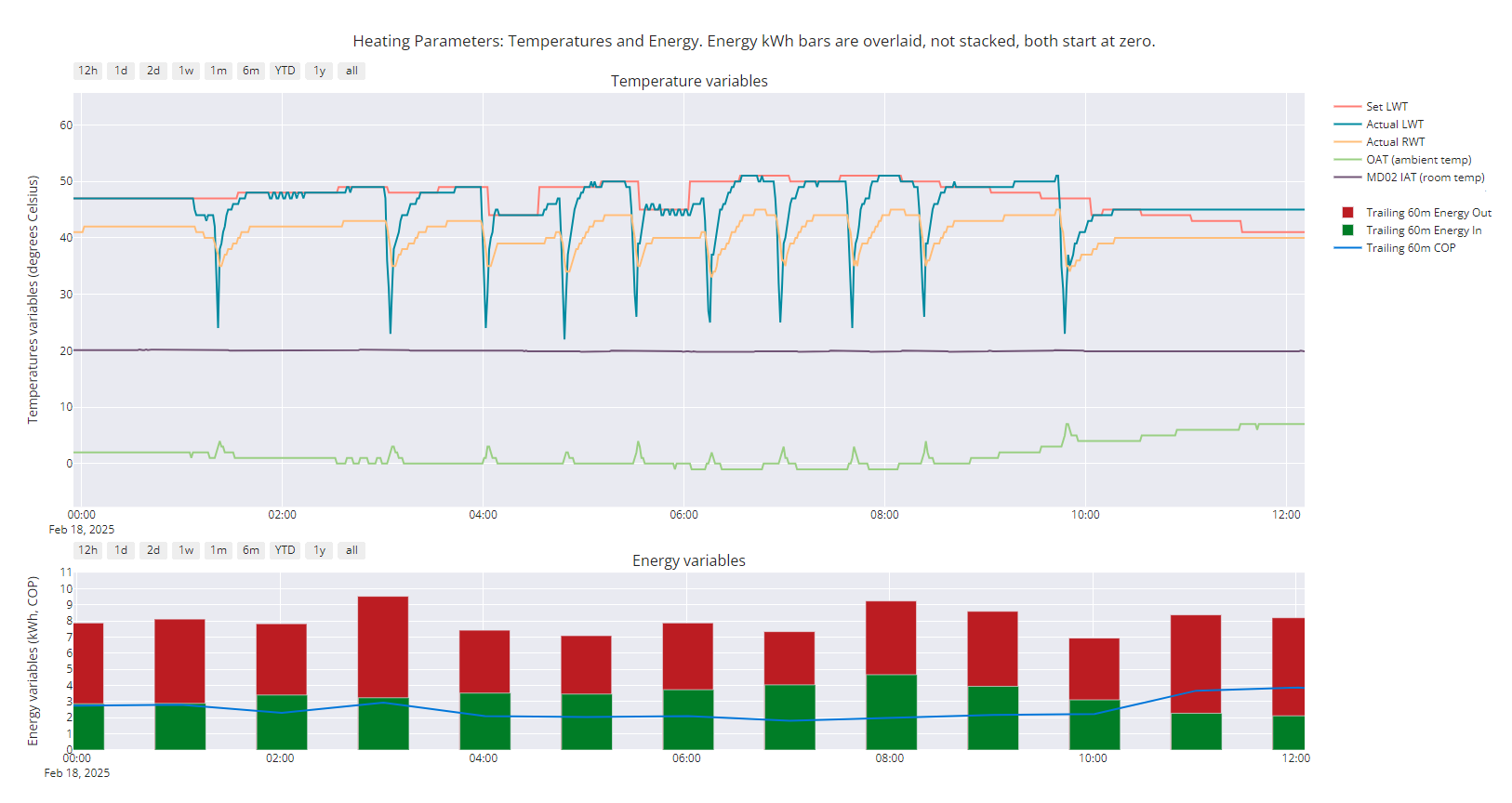
We are lucky, Midea wired controllers make setting up a wired modbus connection straight forward. If you want more data, lots more data, there are at least two approaches. The first is Home Assistant, a huge project that can connect to anything (electric toothbrush? no problem...) but it can be shall we say complicated to set up, and the DIY approach using python scripts, which is what I do. Both approaches have their pros and cons. You've probably seen examples elsewhere, but here is an example of the sort of charting I do showing some defrost cycles (LWT dips below RWT). Note also how volatile the COP is, around 2 during the defrost cycles, but back up to around 4 on the right hand side once things had warmed up a but. Also note how steady the IAT is - WCC doing its thing:
Midea 14kW (for now...) ASHP heating both building and DHW

Page 1 / 3
Next

Latest Posts
-
RE: Radiator sizing sanity check
@jamespa Do appreciate your assistance, without the ...
By Papahuhu , 13 minutes ago
-

Here is an update of the setback we operate on our syst...
By SUNandAIR , 54 minutes ago
-
RE: Grant ASHP 17.5 kw. weather curve
@chinkoa Sorry there are two separate thoug...
By JamesPa , 1 hour ago
-
RE: Solar Power Output – Let’s Compare Generation Figures
@transparent As easy as putting sparklers in champag...
By Papahuhu , 2 hours ago
-
RE: Testing new controls/monitoring for Midea Clone ASHP
As somebody with 30 years professional experience in co...
By Mosibi , 4 hours ago
-
@f1p Looks good, and will likely be something I use whe...
By Sheriff Fatman , 5 hours ago
-
RE: Cascade 2x Grant Areona 10kw ASHP - Ongoing setup issues
Either complete Bow Locks or at best a marginal effect....
By JamesPa , 7 hours ago
-
Hi all I’m looking to get some insight on what others...
By Renewables345 , 8 hours ago
-

RE: The Great British Heat Pump Owner Persona Survey: Let's Build Our Archetype!
@mosibi, go on then, complete the survey. Let's get the...
By Mars , 8 hours ago
-
RE: Water Hammer After Heat Pump Install
@jaynieq I wish you luck with this one. I think the ma...
By JamesPa , 10 hours ago
-
RE: Optimum new build house design for Heat Pump
From first principles I would say: Definitel...
By JamesPa , 1 day ago
-
RE: Weather compensation- why you should use it
As good a place as any to drop this video:/p>
By Mars , 1 day ago
-
RE: Forum updates, announcements & issues
@transparent D'Oh - I did look before I posted but I mi...
By dr_dongle , 1 day ago
-
Compatibility with Samsung AE080RXYDEH
I am new to all this. We have a SamsungAE080RXYDEH that...
By John999 , 1 day ago
-
RE: New Fogstar 15.5kWh upright solution
@batpred Maybe you should buy your additional batter...
By Bash , 1 day ago
-

RE: Data Accuracy Problem: Daikin 8kW Heat Pump's Onecta App vs MMI Power Consumption
@nursethescreens Yes, comfort and happiness of the fami...
By Toodles , 1 day ago
-
RE: Connecting Growatt SPH5000 over wired ethernet rather than wireless
Thanks folks. I had tried googling an ethernet lab adap...
By z8lccda , 2 days ago
-
RE: Changing from 4-port buffer to volumizer
@toodles I'm not concerned that the behaviour is not no...
By Andy1618 , 2 days ago
-
-
RE: Setback savings - fact or fiction?
I agree, and I think there are two things in play here....
By cathodeRay , 2 days ago