
Notifications
Clear all
Air Source Heat Pumps (ASHPs)
16
Posts
6
Users
11
Reactions
1,601
Views
Topic starter
14/11/2025 1:49 pm
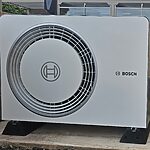
@ectoplasmosis Buderus is a subsidiary of the Bosch Group, so I assume the different badges are just meant to capitalise on brand recognition in different markets. It does seem to be a proper 'in house' developed unit.
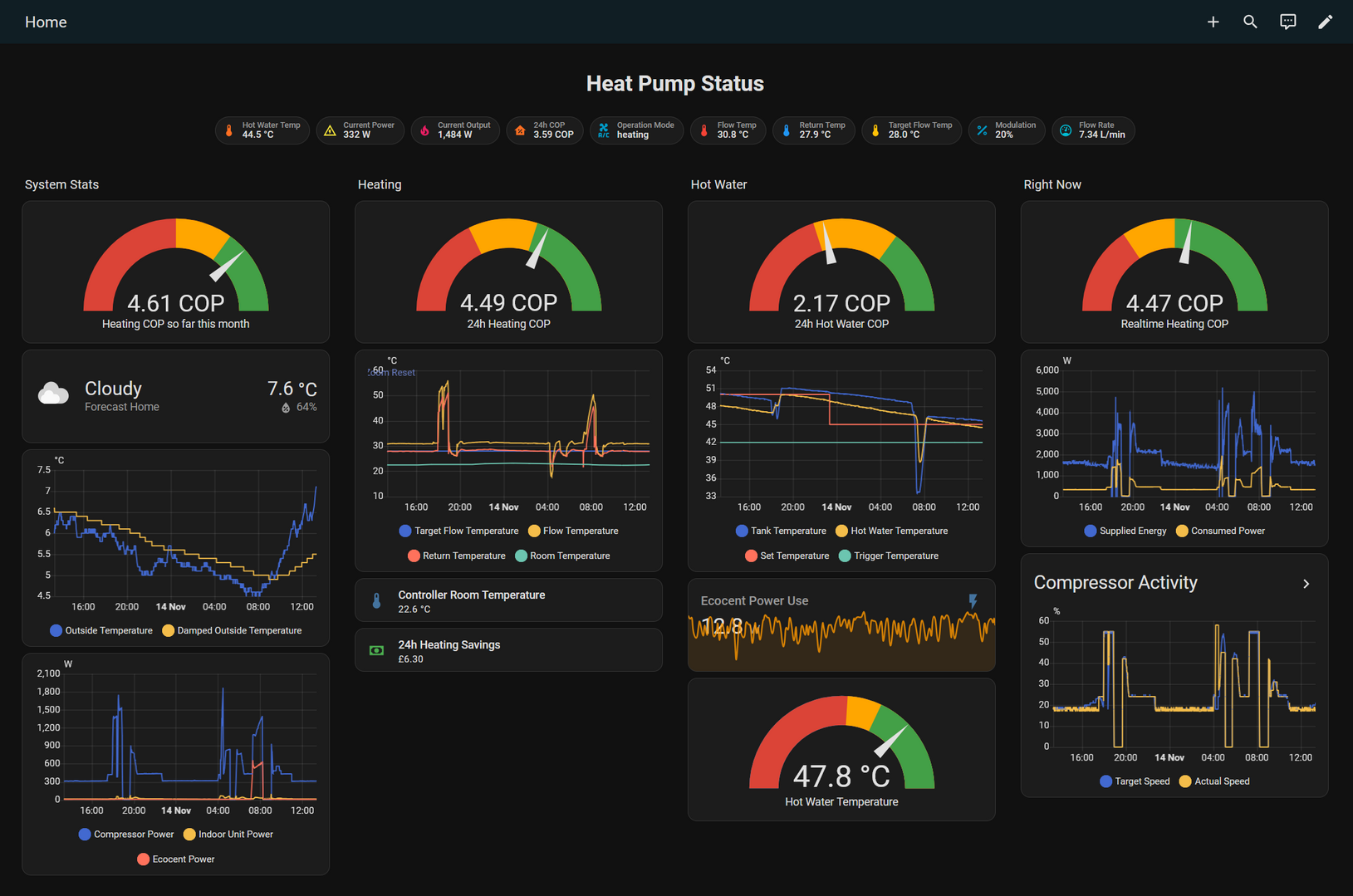
In other news, I've made big strides in improving our heating efficiency. I did this by adding an offset to the heating curve to bring it lower, then adding a minimum flow temperature of 28C. In order to stop the flat overheating at temperatures where the flow should be lower than 28C, I then added a fairly large room influence factor. This should be okay as the flat is well insulated and it takes a long time for temperatures to change significantly. Also, in the event that we do decide to leave all the windows and doors open, there's a maximum flow temperature of 40C configured.
This means that the heating will generally cycle on for a good few hours until the room influence grows enough (at around 1K over the target) that the unit turns off. It seems like if the target flow temperature (before the minimum flow limit is applied) is below 25 it just sets it to 0 and turns off until the room temperature falls enough that the room influence stops blocking the heating.
It remains to be seen how well this works across different parts of the performance curve, but for now we're comfortably around a COP of 4.5 while the outdoor temperature has been around 5.5C.
Sadly, it also seems the flow rate reported by the heat pump via the EMS isn't especially accurate. It looks like it could be off by as much as 25% when doing hot water, so I think any more detailed analysis will require a proper heat- or flow-meter.
Topic starter
05/02/2026 3:02 pm
December/January Update
Things have settled down now, and I haven't had to make any substantial changes to the system in the last couple of months, so we've got some better numbers to work with:

A £300 saving on just the last four months, with February projected to come in with a saving slightly lower than December. We're pretty happy with that.
We can also compare the old and new system at specific OAT, looking specifically at January:
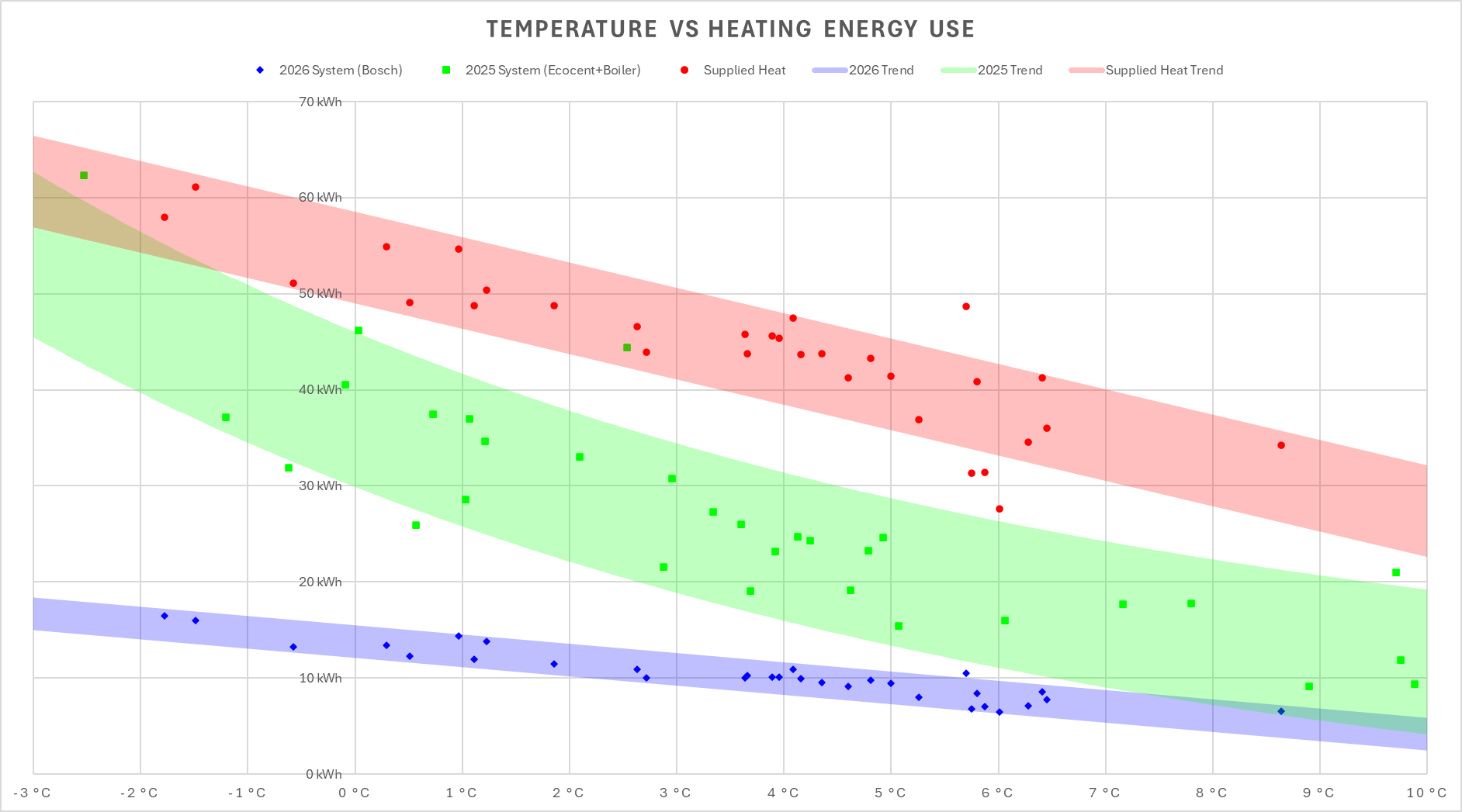
The average temperature for the month of January this year and last was remarkably similar: 3.6C
Last year did have a bit more variation, though, with the warmest day averaging 9.9C and the coldest day averaging -2.5C, compared to this year with a maximum daily average of 8.6C and a minimum average day of -1.8C. This is all measured with our own outdoor temperature sensor.
The similarity in the temperatures lets us do a rough comparison of how COP has changed from the old system (EAHP water heater + boiler) to the new system (monoblock heat pump + EAHP water heater). The new system had a monthly average COP of 4.28, and if we assume the old system had to do roughly the same amount of work last year, it would have achieved a COP of just 1.63.
What none of this captures, however, is just how much our experience has changed. The old system required my constant attention or else it would either get chilly, or very very expensive. It left us without ample hot water multiple times when the heating was needed overnight, and the temperature in the flat was frequently uncomfortably cool, with the bathroom often being pretty chilly in the morning (down to 17C or lower). We were also unable to control the system to the level of providing additional hot water for guests, or allowing the hot water to turn off when away on holiday (as the heating was reliant on there being hot water).
This winter, the flat has stuck solidly between 21.5C and 23C and I have not needed to tweak anything major at all. The bathroom is never cooler than 20C. The showers are always warm. This has resulted in more frequent and longer showers. I have also been able to connect everything to home assistant, and can easily top up hot water, quickly and cheaply, when we have guests, and can turn everything right down with the touch of a button when we go away for holiday, then have it come back on a day before we return to ensure maximum comfort.
The difference is night and day.
The outdoor unit has also stayed silent. The industrial aircon units on the roof of the Tesco across the road are far louder than our heat pump even when standing within a foot of the unit, and about the only indication of its operation are the occasional clouds of steam which rise from it when it does its defrost cycle.
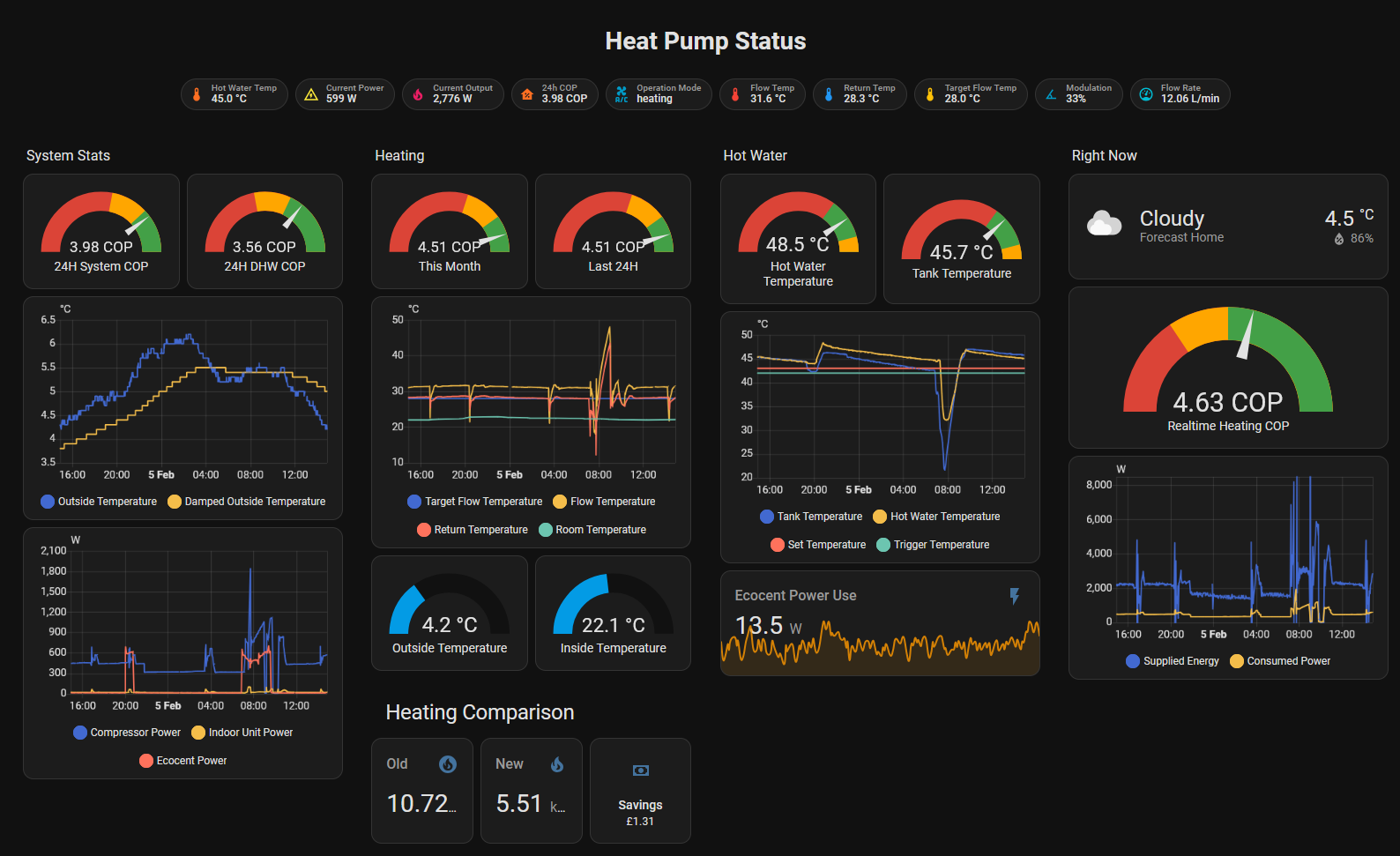
The only thing missing, really, is an accurate and reliable flow- or heat-meter so that I can confirm the numbers coming from the unit, but given the improvements we can see in our bills, I am not sure it is necessary.
This post was modified 1 day ago 2 times by Steelbadger
2

05/02/2026 5:09 pm
That’s great, @steelbadger. And if you’ve got Home Assistant working then the door is open for a lot more intelligent co-ordination with other kit like solar PV and battery, time of use tariffs, electric vehicle and so on. I can’t remember what you’ve said you do or don’t have but nonetheless the core of a very smart smart home is up and running. Well done.
105 m2 bungalow in South East England
Mitsubishi Ecodan 8.5 kW air source heat pump
18 x 360W solar panels
1 x 6 kW GroWatt battery and SPH5000 inverter
1 x Myenergi Zappi
1 x VW ID3
Raised beds for home-grown veg and chickens for eggs
"Semper in excretia; sumus solum profundum variat"
Topic starter
05/02/2026 11:04 pm
@majordennisbloodnok While getting Home Assistant running has been a fun little project (and also gave me the impetus to do things like set up home VPN access and a media server), there's not much opportunity for expansion on the home energy front. We're in a flat, so PV isn't really possible, and without PV the potential payoff time for a home battery is likely to be pretty long (well into the 'I really hope someone has done something about electricity pricing before then' zone). We also don't own a car, and without a drive or assigned parking space, arranging charging isn't really doable anyway.
It's possible that something could be done around ToU tariffs, it's true. But due to the relative size of our 'shiftable' and 'unshiftable' loads, I think the benefits would be fairly marginal. It's probably something I'll try to simulate/model for a while before I consider doing it for real.
1
Page 2 / 2
Prev

Latest Posts
-
RE: If a heat pump can only heat DHW to 50C then what? Issue with 18KW Heliotherm heat pump
Hi, Nothing yet. I've asked customer to measure flow...
By errmm , 3 hours ago
-

RE: High Temp Heat Pumps for fast warm-up of house
I don't know exactly how long it takes to heat up (and ...
By JamesPa , 4 hours ago
-
RE: Need help maximising COP of 3.5kW Valiant Aerotherm heat pump
OK. What Im seeing looks fairly normal TBH: 1 start ...
By JamesPa , 4 hours ago
-
RE: Vaillant Tech Support Flagged Low DT: UFH Return Cold, Suspected Zero Flow
@editor thanks for the tips which I will try before cal...
By DavidB , 6 hours ago
-
RE: Daikin 6kw setup with Dixell controller
@jamespa Many thanks for your reply, a very detailed an...
By CraigH , 6 hours ago
-
RE: Exploring the role of alternative clean heating solutions - Government Consultation
Despite reservations, I found some time to respond to t...
By Rusty , 6 hours ago
-

RE: New Vaillant aroTherm Plus in black - When will it come to the UK?
@crankplus, nope, still not, and I've followed up with ...
By Mars , 6 hours ago
-
RE: Octopus Cosy Heat Pump Owners & Discussion Thread
@agentgeorge Probably, but temperature change at -10 ha...
By AndrewJ , 7 hours ago
-

RE: External wall insulation - your experience
To be clear, my experience was very positive. The journ...
By Batpred , 9 hours ago
-

@foxesfan Re: ‘Servicing’ as @editor has covered in his...
By Toodles , 9 hours ago
-
RE: A Smarter Smart Controller from Homely?
@benson No idea why mine doesn’t work, all I see on ...
By Papahuhu , 10 hours ago
-
RE: Battery sizing - How low can you go!
It seems I am seeing something similar to what you do, ...
By Batpred , 11 hours ago
-
RE: Gaslighting in the heat pump industry – has anyone else experienced this?
Don’t know if this is relevant to this thread, but my A...
By Gruff2001 , 12 hours ago
-
RE: Bosch CS5800i 5kW - Experience So Far
@majordennisbloodnok While getting Home Assistant runni...
By Steelbadger , 1 day ago
-
RE: MCS - BS EN 12831-1:2017 – Heat Loss Survey
Since May 2025 it no longer a requirement in England to...
By JamesPa , 1 day ago
-
RE: Air source heat pump roll call – what heat pump brand and model do you have?
Forum Handel @jancold Manufacturer: Daikin Model: E...
By Jancold , 1 day ago
-
RE: Octopus Cosy 12 Heat Pump Regret: Incredibly Loud, Poor Heating & Constant Hum - Help!
@harriworld it was roughly 3am for an hour as that’s ...
By L2jad , 1 day ago
-
RE: Hoped for improvements not being realised on my Mitsubishi heat pump
I have been wondering that myself. The fact is that, ...
By JamesPa , 1 day ago
-
RE: Filtering Tap Water – Share Your Setup for Cleaner, Better-Tasting Water
I remember when I was in my early 20s I was introduced ...
By Majordennisbloodnok , 1 day ago
-

RE: Setback savings - fact or fiction?
But if it is recorded an an integer, which it seems it ...
By cathodeRay , 2 days ago