Which means the actual flow temp will be less than the set flow temp, and it is was probably also the case in the previous image. You need to catch it when it is not defrosting.
Midea 14kW (for now...) ASHP heating both building and DHW
Which means the actual flow temp will be less than the set flow temp, and it is was probably also the case in the previous image. You need to catch it when it is not defrosting.
This is when its not defrosting
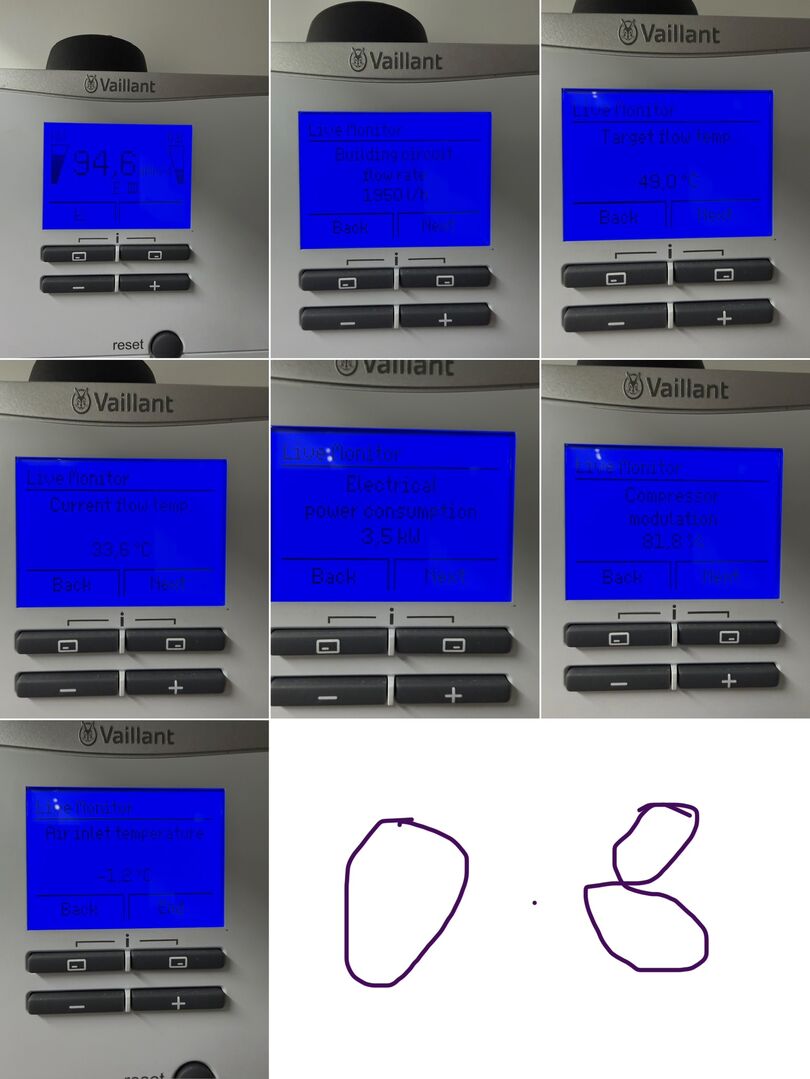
i don't know why its blurry the original is clear. current 33.6 and target 49 3.5kw, 81.8% modulation air inlet temp -1.2
Which means the actual flow temp will be less than the set flow temp, and it is was probably also the case in the previous image. You need to catch it when it is not defrosting.
This is when its not defrosting
i don't know why its blurry the original is clear. current 33.6 and target 49 3.5kw, 81.8% modulation air inlet temp -1.2
Thats really helpful as it clearly says target 49C. So unless the actual flow temp keeps going up we know there is a limitation somewhere. Moreover it says compressor modulation 80% strongly suggesting (if it doesnt go up) that the problem is too much loss/not enough output. Frankly I doubt it could ever get to 49 given you have UFH, just too much conduction into the slab, but lets see if it goes above 35.
This could be a case of undersized heat pump, lets see some more plots with the increased WC value and see what they tell us, plus a few more of these. How good is the insulation under your UFH. There is another thread where that is being discussed and there are is some contradictory (and to me at least, highly implausible) advice out there about how important it is (or is not) to insulate under UFH.
Just so we dont lose sight of the actual problem you are experiencing, can you remind us what it is. I thought it was upstairs not warm enough downstairs (with UFH) OK?
This post was modified 3 months ago 2 times by JamesPa
4kW peak of solar PV since 2011; EV and a 1930s house which has been partially renovated to improve its efficiency. 7kW Vaillant heat pump.
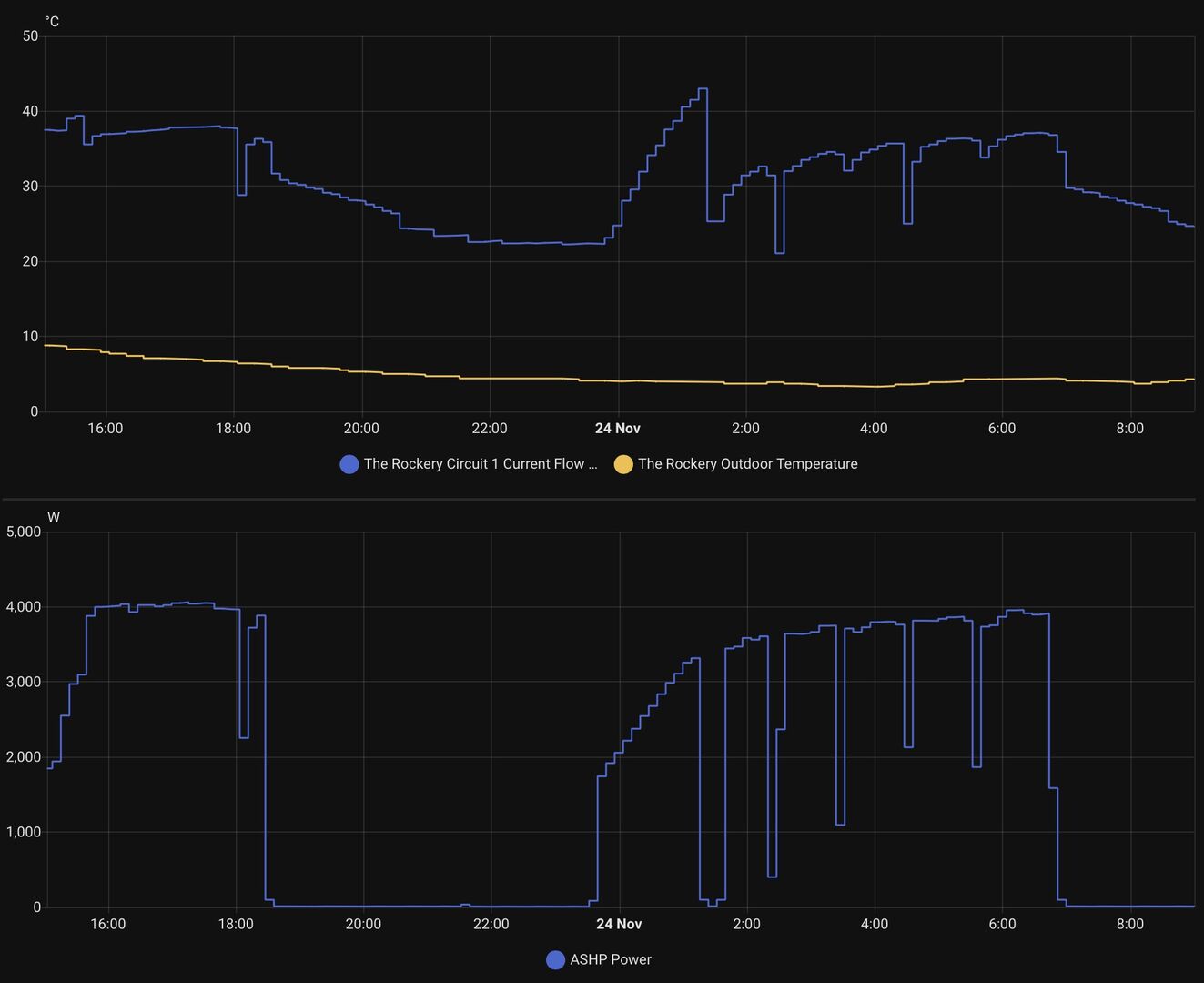
As @jamespa says, there is some sort of limitation, or rather imbalance. The difference between the set flow temp and actual flow temp isn't trivial, it is substantial.
I would go back to basics: what is your estimated heat loss, and how accurate is that estimate thought to be? What is the heat pump's rated output, and what is it's actual output? Are they or are they not matched?
That said, I have occasionally opined that there is only one number that matters, the IAT (indoor air temperature). It would be helpful to have that on the charts. I would also manually measure the actual flow temp as close to the heat pump as possible, to check you don't have a measurement error.
Midea 14kW (for now...) ASHP heating both building and DHW
Apologies, I was being lazy, the answers to some of my questions are already in the thread: 9.9kw loss at -2, 10kW heat pump. But the supplementary question remain, how accurate are those figures? For example, my 14kW badged heat pump only puts out around 11.2kW at zero OAT. Most heat pump show similar falls in output at low OATs, though some, including possibly Vaillants, don't. What has your actual output been in recent days, when the OAT has been around or just below zero? You need to get these basic numbers to assess what is going on.
Midea 14kW (for now...) ASHP heating both building and DHW
I would go back to basics: what is your estimated heat loss, and how accurate is that estimate thought to be? What is the heat pump's rated output, and what is it's actual output? Are they or are they not matched?
Apologies, I was being lazy, the answers to some of my questions are already in the thread: 9.9kw loss at -2, 10kW heat pump. But the supplementary question remain, how accurate are those figures? For example, my 14kW badged heat pump only puts out around 11.2kW at zero OAT.
Vaillant are pretty good maintaining their sticker output or better, so I don't thing the heat pump is the issue, but it may well be that the estimated heat loss is the issue.
I think I can make a good stab at whats going on based on everything thats been posted:
With a 35C target flow and your current operating regime the load imposed by the UFH is such as to max out the heat pump. That means that a target flow >35C, which is required for the radiators (it seems) is unachievable. So however high you set the flow temp it will max out around 35, because at that point the output from the UFH equals the output from the heat pump.
I don't know why that is but it could well be that the loss from the pipework to the ground has not been factored in (common tools calculate loss from room to the outside, Im not aware that they calculate loss from pipework to outside). At this point Im going to hazard a guess that the slab on which the UFH is set may be poorly insulated. There is a story going around the industry that its OK to do this, frankly I have always doubted that and, having done some more thinking and exploration, I simply don't believe it. The reasons I don't believe it are discussed in another thread on this forum. Incidentally if this is the case then the situation may get better as the season progresses and the ground under the house heats up.
So here are my suggested next steps
A) I think you were operating a setback, if that is still the case the first thing is to cancel the setback (ie run 24x7) so you give the heat pump a chance. It may be that rads at 35 will heat the upstairs sufficiently to do the job. If this results in an overheating downstairs then that can be dealt with
B) If that isnt sufficient, or I am wrong about the setback then, irrespective of whether my speculation in the bullet above is correct what we have to do is to find a way to increase the average surface temperature of the rads without increasing the average temperature of the UFH pipes. I can think of two ways:
Measure the deltaT across the radiator circuit, being careful to make the measurement on the return before it joins the UFH return. If its less than a couple of degrees then further balancing is not going to achieve much. If its a couple of degrees or more then there is a small gain to be had by increasing the flow rate through the radiators further (by reducing the flow through the UFH), thus reducing the deltaT, thus increasing the average surface temp and output of the rads
Mix down the temperature of the flow water to the UFH using the features of the manifold. This should allow you to set a higher flow temp, but because that only reaches the rads the heat pump wont be overloaded by the loss from the UFH.
Fit bigger rads
Any of these, particularly the second or third, may allow the upstairs and downstairs to be balanced. 1 and 2 should IMHO be explored first of all. However its possible that the demand of the house, including any loss from pipework to ground which may not have been included in the heat loss calculation, exceeds the heat pump output in which case the best achievable is to get both upstairs and downstairs equally underheated. If this is the case then supplementary heating will be required on the coldest day, or you need a bigger heat pump. There are various ways the former could be achieved.
Hope that helps!
This post was modified 3 months ago 2 times by JamesPa
4kW peak of solar PV since 2011; EV and a 1930s house which has been partially renovated to improve its efficiency. 7kW Vaillant heat pump.
@jeegnesh some small points to supplement what James wrote above.
First the easy answer on your OP. It is very normal to have huge electrical consumption on cold days but lots less on milder ones.
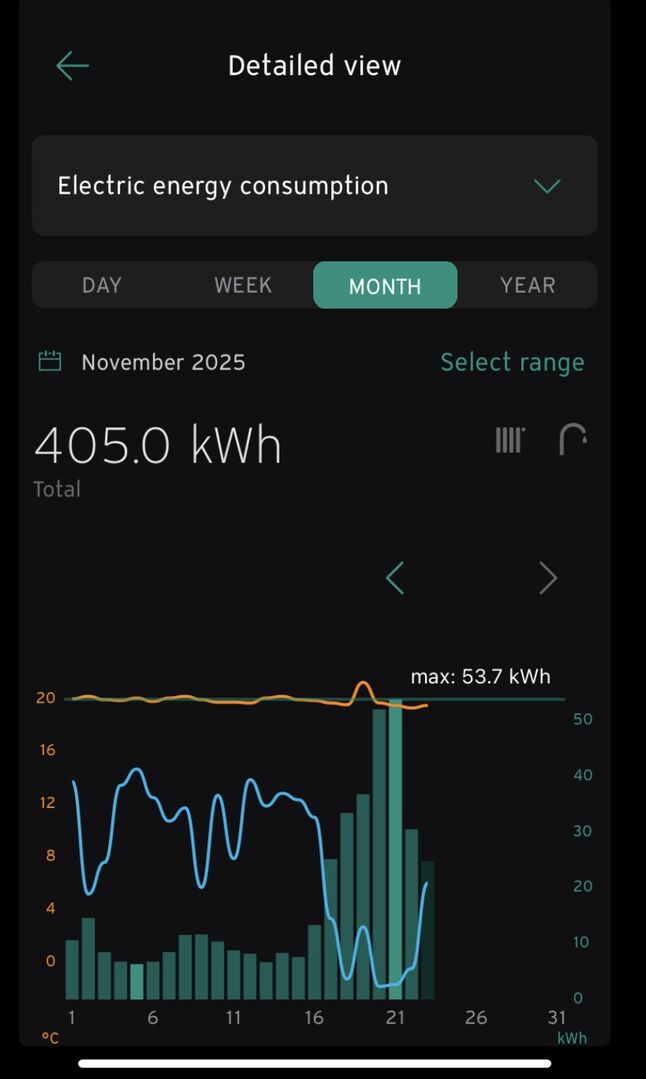
This is our November consumption
The early November very low but last week high, our COP of 3 when it’s 0-2 outside but 6 when mild giving month to date of 4.7. What matters is the inside temperature though! Our 7kW machine reaches 8kW according to its calculated power and our house needs that. Our supplementary heating is a log burner which blasts it out and gives the higher IAT at the start of the cold snap for a day (we didn’t bother again).
James might be right about the lack of insulation under your slab. The was a lot of stuff in design documents (architectural) before 2000 that insulation to ground was only needed within 1m from the outside walls. But ultimately it was resolved that this only applies to large warehouses and domestic properties were only edge effects and building regs were changed to insist on insulation under the whole ground slab. But it only needs the house builder to be confused “we’ve always done it like that mate” and you could indeed be trying to heat the ground. (It means they had to dig out less hole and dump less waste). In this worst case scenario you could stop using UFH and put in radiators instead downstairs, but that’s a last resort.
On setbacks I drop the temp back 2C overnight in mild weather but reduce that step to 1C in a cold snap because we’re right on the limit of capacity and the pump struggles to heat the house back up. We use expanded mode in the shoulder season (high solar load) but we’re on active now.
You've not said anything about the house history/build std nor how satisfied your missus is with the inside temperature both being important factors.
PS @editor this photo was clear in the original and fuzzy now
2kW + Growatt & 4kW +Sunnyboy PV on south-facing roof Solar thermal. 9.5kWh Givenergy battery with AC3. MVHR. Vaillant 7kW ASHP (very pleased with SCOP 4.7) open system operating on WC
James might be right about the lack of insulation under your slab. The was a lot of stuff in design documents (architectural) before 2000 that insulation to ground was only needed within 1m from the outside walls. But ultimately it was resolved that this only applies to large warehouses and domestic properties were only edge effects and building regs were changed to insist on insulation under the whole ground slab. But it only needs the house builder to be confused “we’ve always done it like that mate” and you could indeed be trying to heat the ground. (It means they had to dig out less hole and dump less waste).
I didn't know about that history. With the modern trend towards retrofitting UFH this means that we can expect a whole slew of failed heating installs, and with the Urban Plumber telling us it doesnt matter based on a false assertion about deltaT (which is stated in the video), there will be plenty of misled heating installers.
With the typical well oversized gas boiler brute force will probably mean that the house will be warm, but at a cost. With a 'well sized' ASHP the likely result is that it turns out to be undersized. Shelter from incoming recommended!
4kW peak of solar PV since 2011; EV and a 1930s house which has been partially renovated to improve its efficiency. 7kW Vaillant heat pump.
Sorry was out over the weekend, so lets start with the first part about the property and heating in a. bit more detail. It's an old house however was totally rebuilt somewhere around 2013/14 (before me) and had a Gas Boiler and Radiators throughout. The Gas boiler and tank was up in a small converted loft space in its own little room. The house was about just about acceptable with prices being lower we were running it quite hard in winter for that just about acceptable.
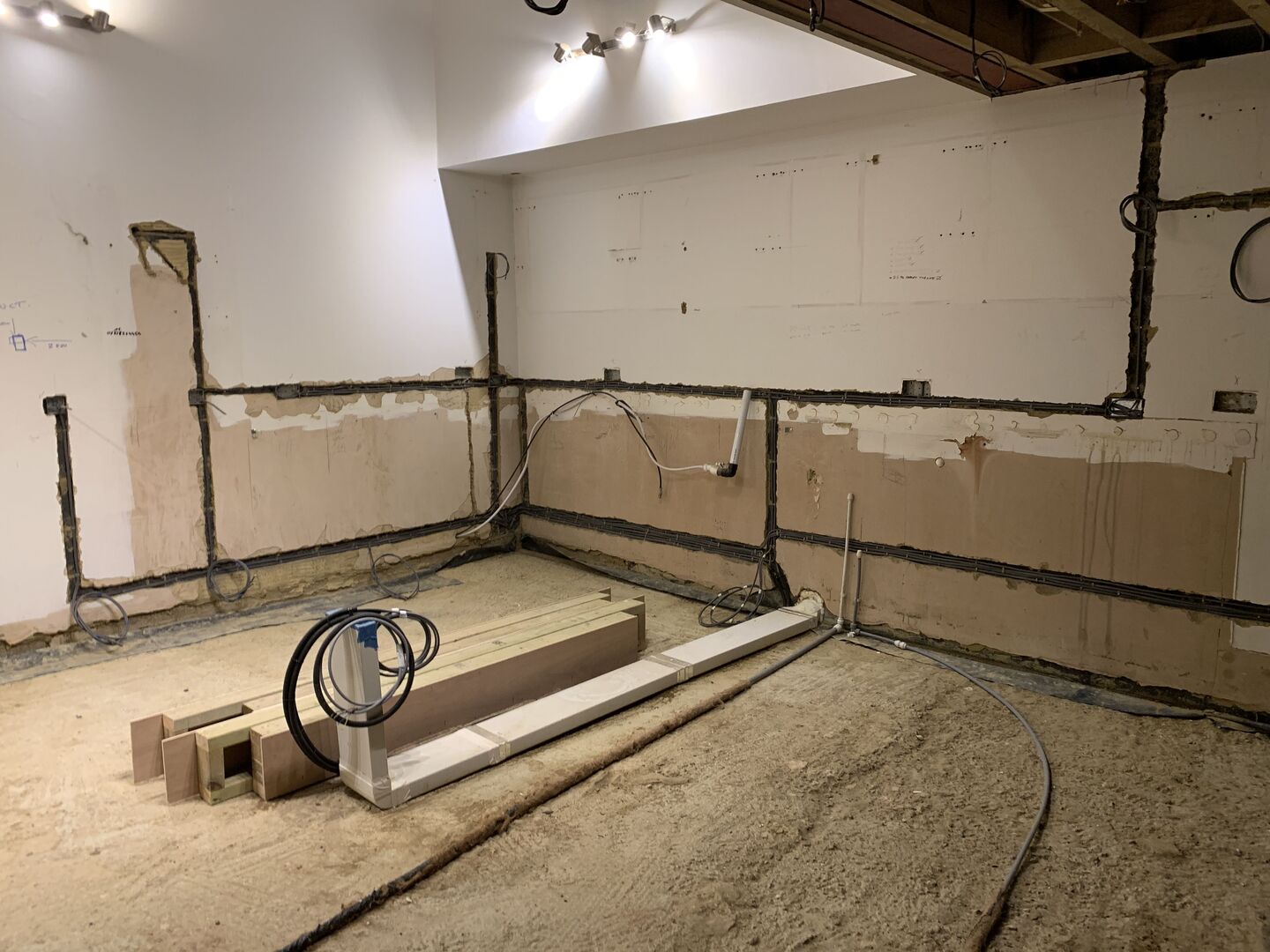
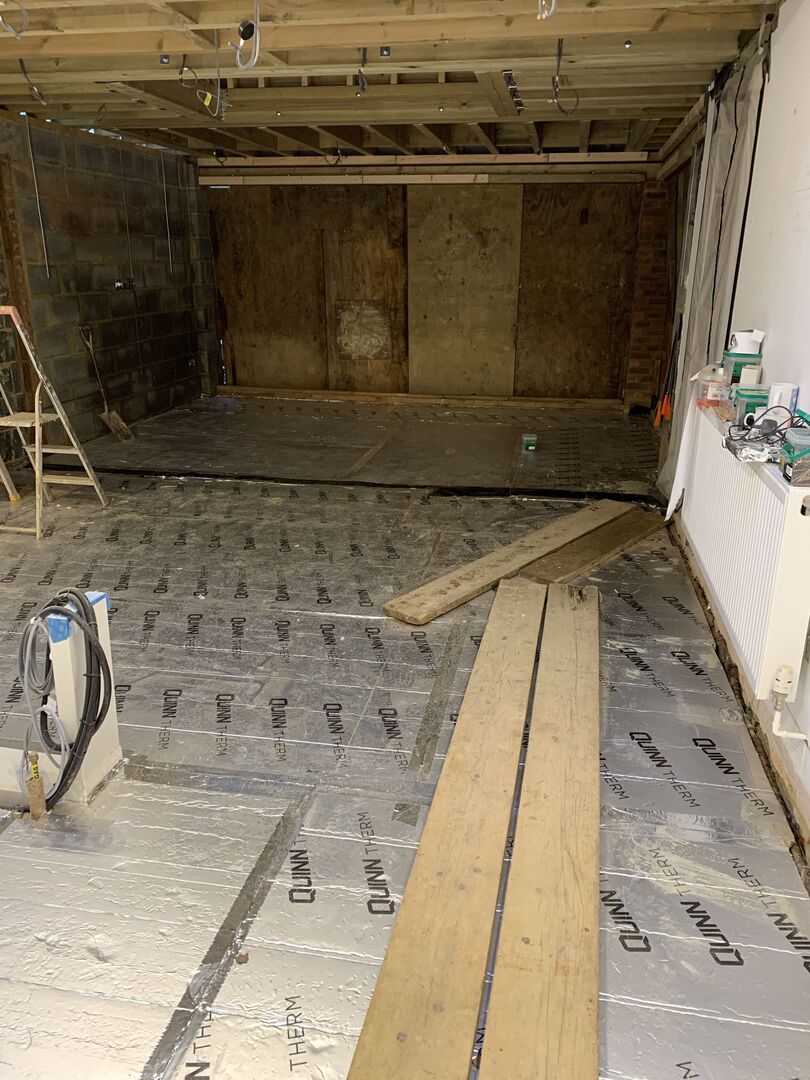
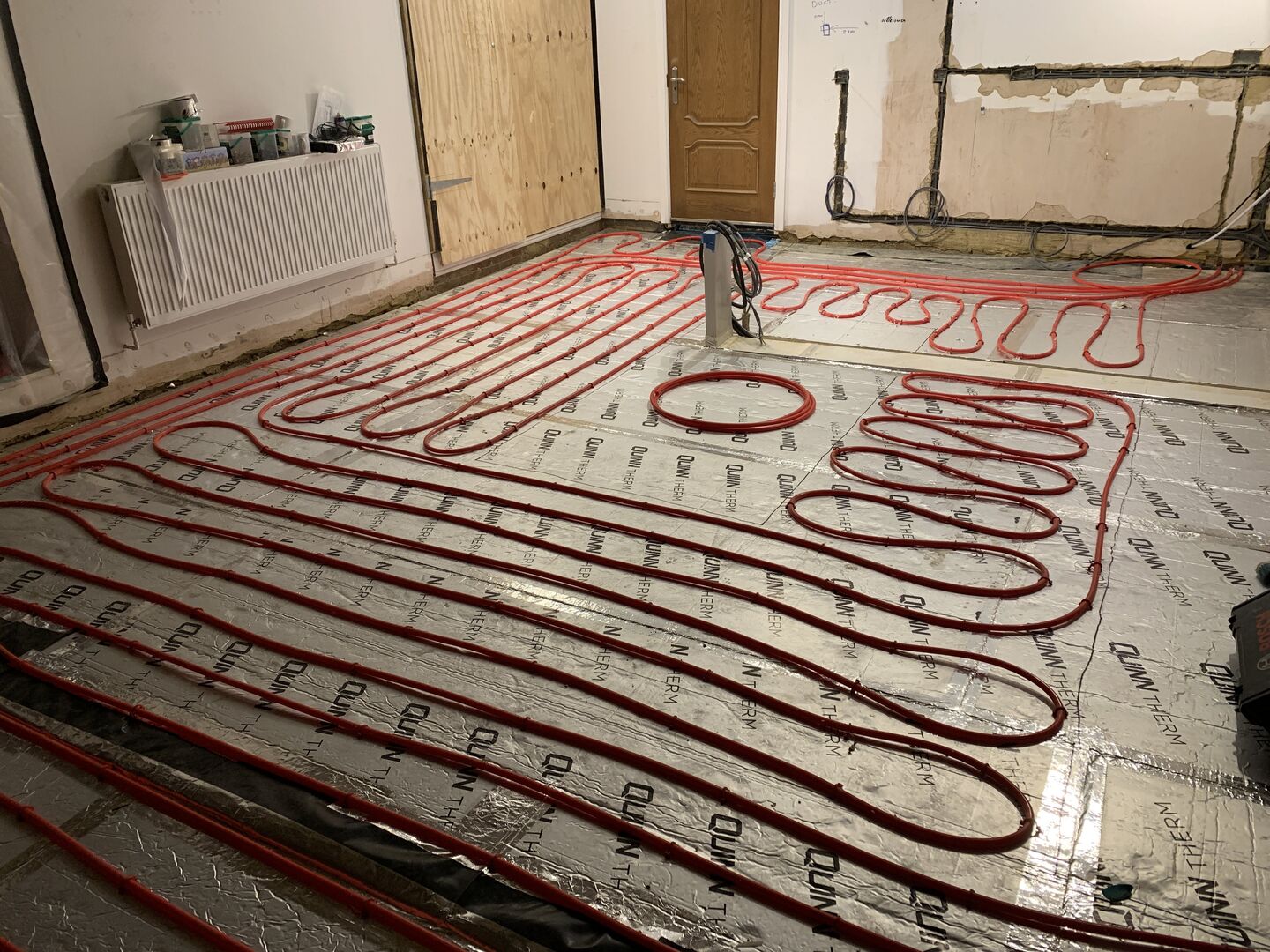
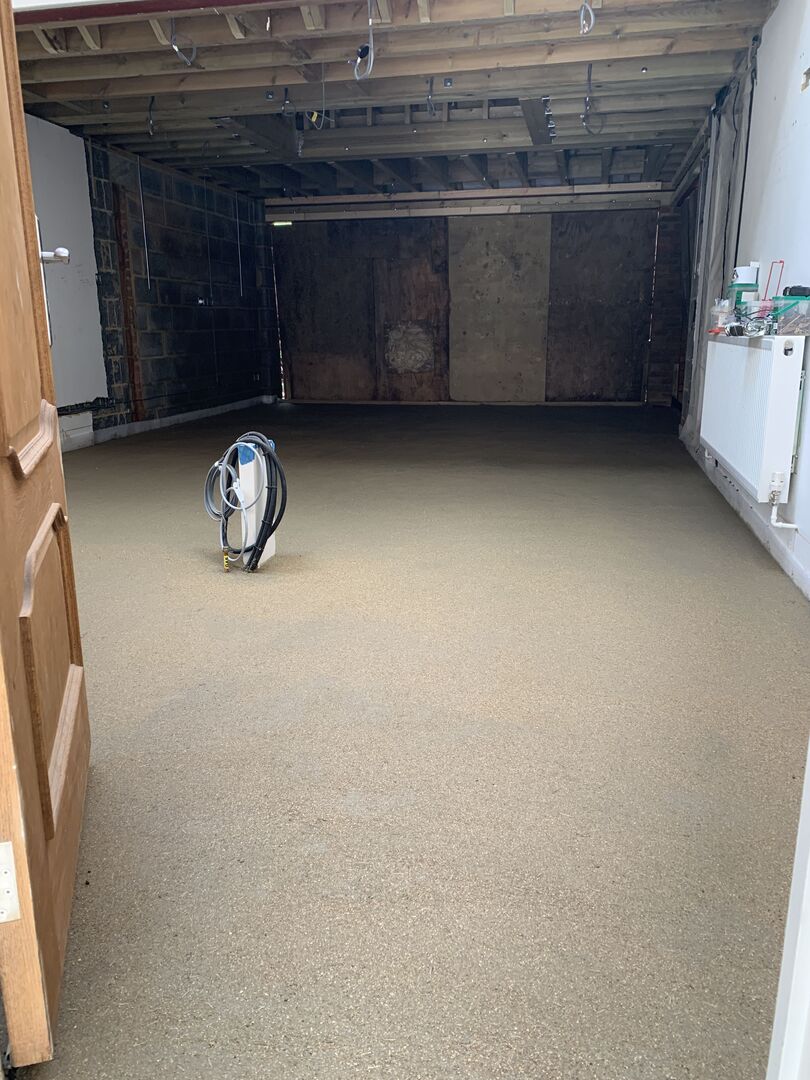
My first change was during a kitchen extension in 2018 we took that opportunity to install UFH in that area (note it also has a portion of very high ceiling which has 2 huge skylights and then obviously we put big glass doors (alot of glass). Pics attached, but base was concrete then 50mm insulation board (i now wish this was more, but i knew nothing back then), then pipes and screed -- due to location of other boiler, we ended up running this system with its own small combi which also fed the kitchen sink with hot water. There was a definite improvement in this area and as the years went by the bills went up and up and up, but again would not say it was it was ideal but acceptable.
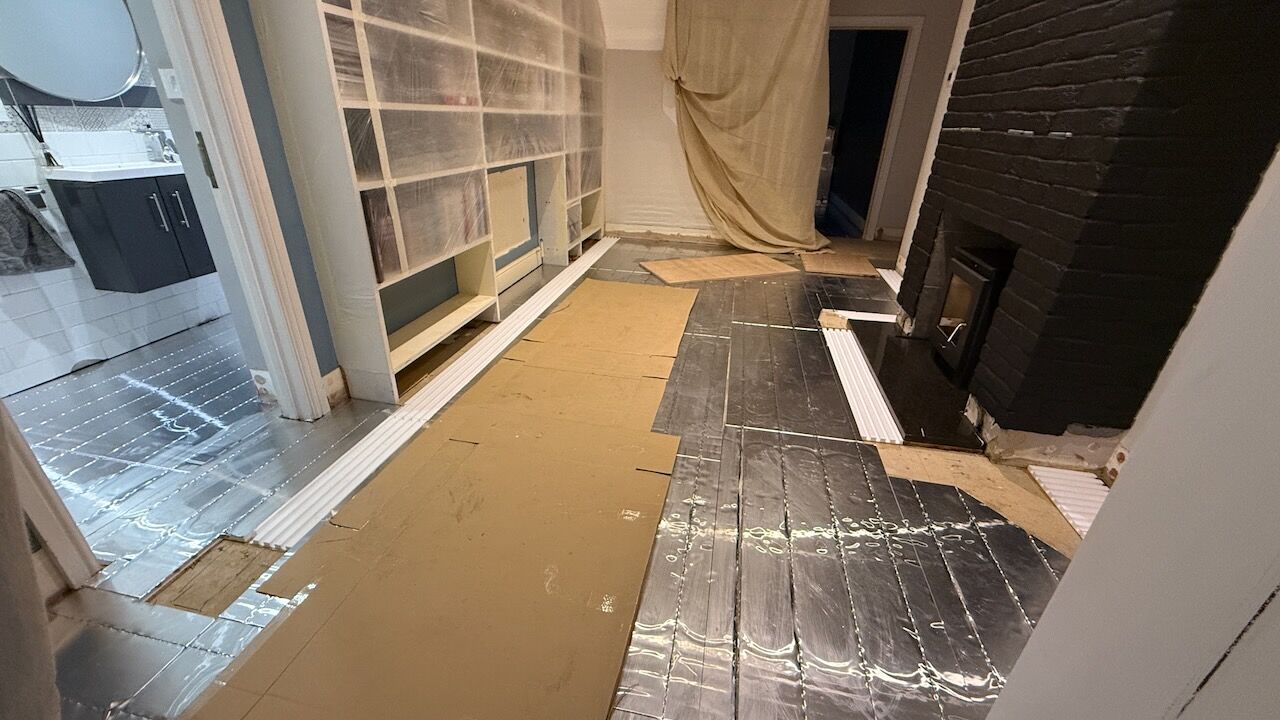
Now last year we deicided to go Heap Pump and at the sametime converted the rest of the ground floor to UFH, the rest of the ground floor unlike the kitchen is a suspended ceiling and my installer told me about this amazing insulation board was thin but the rating was like a much thicker board (wunda 20mm), plus we checked under and the suspended ceiling was insulated with celotex between the beams AND I had airex air vents installed to replace the air bricks, so airflow underneath would be only what was required.
The upstairs remains as radiatiors during the heat loss I think maybe 1 had to be changed the rest were deemed fine, all doubles in the first place. Heat loss was calculated at 9.9kw apparently a huge part was the kitchen with its space, height and glass.
So that's where we are now and I would say we are very happy for any mild cold, so autumn and spring we are happy, the only concern we have is that when we hit winter and the temps are in the -N to say about 2/3c it seems the heat pump is not pushing out enough heat. I would say if it could push 40c in that cold we would be fine.
Let me know if you want any further details on the install side, meanwhile another post coming with this weekends behaviour kinda interesting.
13.6kw Solar, 40kw Battery, 10kw Heat Pump and EV Cars
So I did turn up a couple of radiators balacing valves as I felt they were cooler to try and get them all to the same, plus no idea why put I also moved the UFH flow rates a touch up, the new board based stuff at most is on 2, the kitchen I've literally opened fully as that area due to the screed needs everything it can get as its a huge slab.
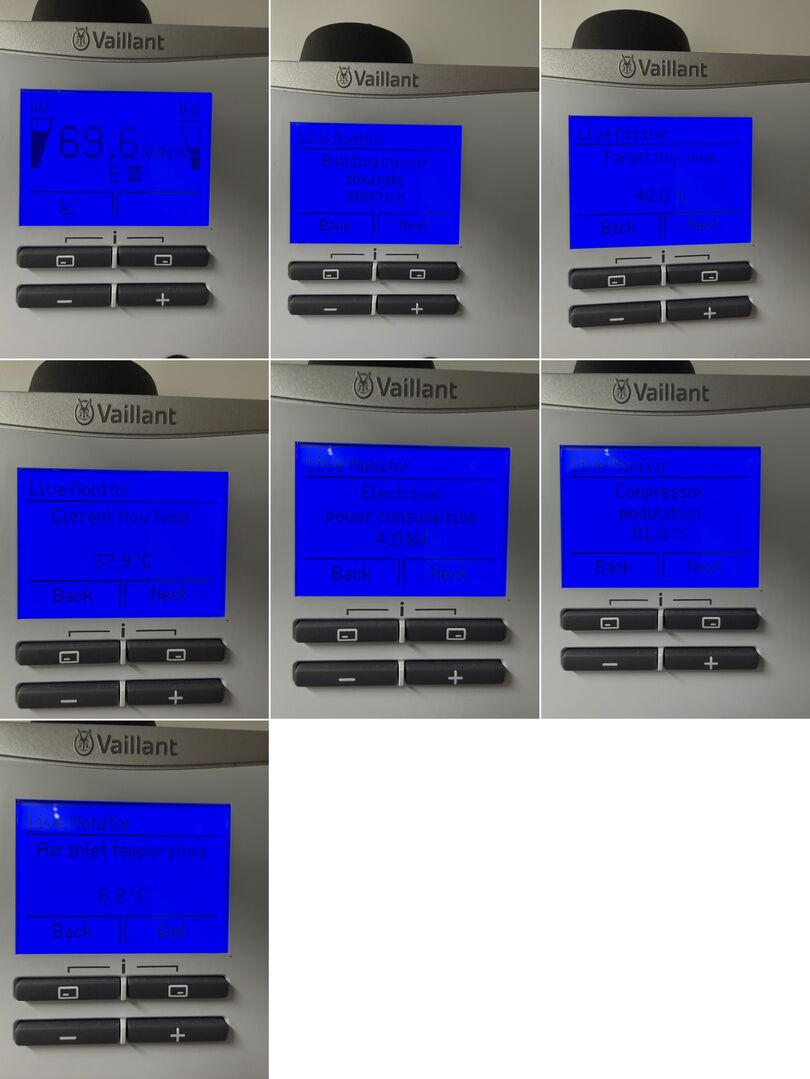
The outside temperature warmed up and what I saw is that the flow temp could now reach up to 38c which is nice but still this is below the target (42c), it never hits target
in case its blurry -- 2007l/h, target 42c, current 37.9c, 4.0kW, 81.8% mod, AIT 6.8c
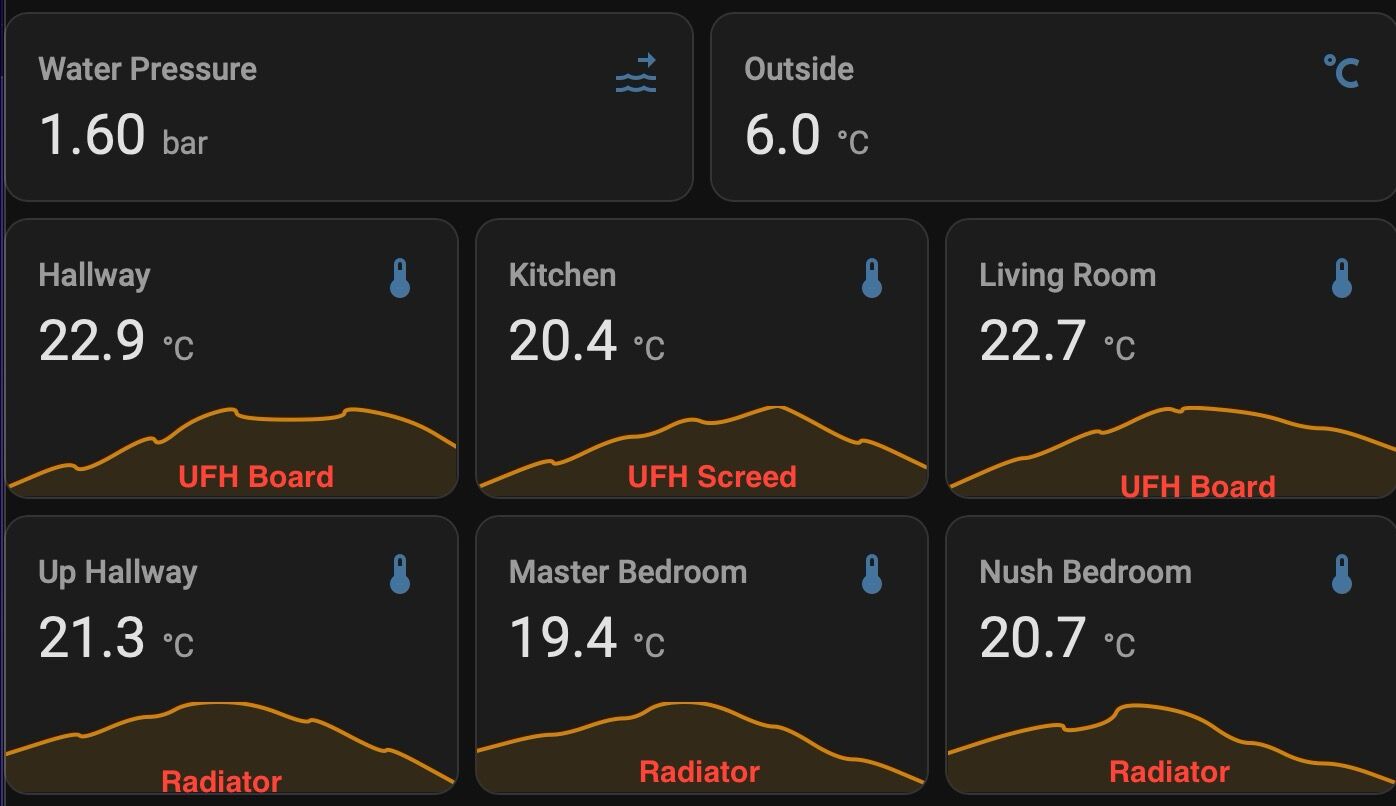
And then back to the point what am I trying to achieve exactly, basically I want the system to be capable of reaching 40/41/42c when the temp is say below 3c. The new board based UFH works brilliant even at lower temps, the rads and the screed based UFH however needs these temperatures at lower temps and so struggles. Attaching a pic showing the different temperatures, strongly linked to the type of heating:-
13.6kw Solar, 40kw Battery, 10kw Heat Pump and EV Cars
Thanks for the extra info, it helps with the picture
Just to confirm what is the make up of the downstairs flooring/insulation (you speak of suspended ceiling, do you means suspended floor and what exactly is the insulation?
Are you operating a setback at all. It looks like it and TBH I think cancelling the setback may enable you to heat everything to the level you require with a reduced flow temperature and quite likely for the same or less money? Its taking 4 hrs to recover from the setback and thats just indicative that you have depleted the fabric significantly and so the heat pump, which will have been designed on the assumption of 24*7 operation, cant recover when its cold outside.
42C is very high for UFH, unless you have the spacing wrong you dont need that and it looks like you may not need it for your rads either if you operate 24x7 You certainly need to try eliminating the setback (and if necessary adjusting the WC curve down) before going any further, then reassess. The objective is not to reach 42C flow temperature, its to heat the house at whatever flow temperature that needs!
This post was modified 3 months ago 3 times by JamesPa
4kW peak of solar PV since 2011; EV and a 1930s house which has been partially renovated to improve its efficiency. 7kW Vaillant heat pump.
Whoops I meant suspended floor, which has celetox it was either 100 or 150mm between beams, and then floorboard, then 20mm wunda insulation boards which has the the pipes embeded into them, then ditra mat and finally 8-9mm tile. The heat comes thru this brillantly and lasts.
OK let me have another go at this continous running, i'm just scared that its going to 65-80kw of daily usage as in the cold it always running at close to full pelt. So I can bring the curve down can you tell me what else I need to do please regards timer programme, and modes.
13.6kw Solar, 40kw Battery, 10kw Heat Pump and EV Cars