
Notifications
Clear all

Topic starter
03/12/2025 9:56 pm
Sorry, this is long (1 year’s ownership).
I bought a new property with a Grant 13kW ASHP installed. It’s been quite the experience so far, sadly. At the time, I was new to heat pumps and didn’t have a clue.
The system failed on move-in day, the coldest day of the year (November 2024), with temperatures between 0 to -1 degrees. We slept in a house with a screaming heat pump and an indoor temperature of 17 degrees, and it stayed like that for days while we tried to heat the house.
Day 1 – Move-in day: The installer (plumber) changed the ASHP controller and heat pump PCB as recommended by Grant Tech Support.
Day 3 – The heating system died. It turns out the cylinder immersion heater kept tripping the RCD. An electrician diagnosed it as faulty, isolated it, and got things working without it. Two weeks later, the installer came and replaced it.
The system continued to fail at heating the rooms, despite our best efforts. It performed terribly at anything below 5 degrees.
Eventually, the coldest days of 2025 (January 10-12) came along, with temperatures dropping to -5. The heat pump stopped producing heat, and the house cooled to 17 to 18.5 degrees (our target was 21), depending on the room. Mid-afternoon I went outside to check if the heat pump was working and saw one slow-moving fan, with icicles on the tip of the other. Icicles were also forming at the bottom of the unit, where it discharges, and there was ice underneath the unit. All the fins were white with solid frost. I figured it was frozen, so I poured two massive watering cans of warm water over the back and side of the unit, which got it going again.
I called a well-regarded (according to reviews) local Grant-registered and trained heating engineer. Here’s what he found:
- The system was largely uncommissioned.
- The immersion was set to run continuously (leading to eye-wateringly expensive electricity bills from November to February).
- The water target was set to 60°C, but the heat pump wouldn’t be able to achieve that target.
- All pumps were set to max, even for underfloor heating. He turned that one down to half.
- Adjusted the weather compensation from the default (turned up the lower end by 3°C, he said).
- Identified that the system was missing a strainer, a flowrate valve, and had zero glycol. I got this all corrected by builder at no extra cost.
- The heat pump couldn’t keep up, so it went into a defrost loop? Which caused the cold radiators and underfloor heating (UFH).
- The system was never registered with Grant, so no warranty. I got agreement with the builder (who didn’t know), so it wasn’t a disaster.
- No documented designs or calculations were available. When I asked the installer for them, they didn’t exist.
I was so shocked by the report that I called Grant and found out the installer was Grant certified and registered. Fun times. There was some bad luck involved, but the installer isn’t a bad guy (really!).
I found this forum 3 weeks ago, and it’s already helped me understand a few things. I’ve made some adjustments and am looking forward to the coming winter with some trepidation. I also called Grant on October 24th for a service and inspection, but I’m still waiting for a call back to book it in. As I said, fun times L
1


04/12/2025 8:45 am
Welcome to the forums @solenoid.
It’s a rough first year, but sadly it’s not unusual, and you’ve done the right thing by documenting everything.
Before I reply in more detail, is this a new build you’ve purchased?
This post was modified 1 month ago by Mars
Get a copy of The Ultimate Guide to Heat Pumps
Subscribe and follow our YouTube channel!

04/12/2025 9:31 am
Welcome to the forums. I wrote this reply and posted it in the original thread before I saw @editors response here. I hope I havent jumped the gun and apologise if I have!
When you get a heat pump you need to forget almost everything you learned about running a boiler (much of which was wrong even for boilers). Heat pumps like to be run low and slow and external controls such as thermostats, zone valves and TRVs can kill performance and cause problems such as you are seeing with defrosts, so should almost always be disabled or certainly minimised. What you certainly do not want is a plethora of thermostats, zone valves, TRVs etc fighting each other for control. This is unfortunately too often the case.
Sadly very few heating engineers understand heating, the industry has become lazy over the past decades and essentially relied on leaky houses, cheap energy, oversized boilers and external controls to bail them out. Builders of course are even worse. With houses that are no longer leaky and energy that is no longer cheap, oversized boilers (or heat pumps) and multiple competing control systems no longer cut the mustard. FWIW, in another thread on this forum, a householder is struggling because his house is so well insulated that conventional thinking about heating control is absolutely guaranteed to fail, the heating industry simply, for the most part, doesn't get it!
Unfortunately Grant have a history of trying to make heat pumps (which they dont themselves manufacture) look and run like gas boilers so that their installers can 'deal' with them and the company is only slowly, so far as can be judged from this forum, dragging themselves out of this pit. Personally, based on what I hear on this forum, I would always ask for a second opinion about anything a Grant engineer says. Thats a pity because the pumps that they rebadge are, by repute, perfectly fine.
To help with your understanding can I suggest you read this introduction which explains some of the fundamentals.
Below I will comment on what the Grant engineer says and then suggest next steps. Im assuming that the heat pump isnt faulty of course.
----------------------
To comment specifically on the observations you repeat
The immersion was set to run continuously (leading to eye-wateringly expensive electricity bills from November to February).
The immersion shouldnt run at all, the heat pump is there to heat the DHW. The only possible exception is a weekly run for legionella sanitisation, although some modern heat pumps do that themselves anyway in which case the immersion is for backup in case of failure.
The water target was set to 60°C, but the heat pump wouldn’t be able to achieve that target.
If thats the target for DHW he is right. 48 is a good target, 60 is plain stupid.
All pumps were set to max, even for underfloor heating. He turned that one down to half.
Possibly sensible, how many pumps do you have?
Adjusted the weather compensation from the default (turned up the lower end by 3°C, he said).
Not sure how turning the lower end up would help but he is right that adjusting the Weather Compensation is key - see below
Identified that the system was missing a strainer, a flowrate valve, and had zero glycol. I got this all corrected by builder at no extra cost.
Correct except arguably the glycol which reduces performance unnecessarily. Anti-freeze valves are arguably better, but opinions differ so can let this one go.
The heat pump couldn’t keep up, so it went into a defrost loop? Which caused the cold radiators and underfloor heating (UFH).
The question is why, which doesn't seem to have been answered. Its certainly NOT undersized! Most likely is insufficient active system volume due to TRVs or zone valves shutting down - again see below
The system was never registered with Grant, so no warranty. I got agreement with the builder (who didn’t know), so it wasn’t a disaster.
noted
No documented designs or calculations were available. When I asked the installer for them, they didn’t exist.
Unless your house is north of 400sq m or doesnt conform to building regs insulation standards, the heat pump is certainly well oversized, which unfortunately is likely to penalise efficiency. The builder should produce the calculations and swap it for the smaller model when these show that its oversized!
--------------------
In terms of getting it working both comfortably and efficiently you need basically to adjust the weather compensation curve so that it just heats the house with the heat pump on 24x7, all the zones open and all thermostats/trvs set to max so they have no effect. This also ensures that the whole system is always in circuit, which should (unless there is a fault) avoid defrost doom loops. The routine goes something like this:
- Set all thermostats/trvs to max, ensure all zone valves etc are open
- Turn off any room influence on the heat pump controller so its operating purely on weather compensation
- Adjust the weather compensation curve to be something like (these are pure guesses because we know nothing about the design)
- for ufh: 35 @ your design outside temperature, 25@20C. Design outside temperature is often -2 or -3 depending on where you are
- for rads: 45-50 @ your design outside temperature, 30@20C
- Operate the heat pump 24x7
The house will now almost certainly overheat so:
- Turn down the flow temp at the low OAT end of the weather compensation curve until the house temperature is just right. You need to do this slowly, making a change no more than once every 24 hours. As you get close change the setting a degree at the time, waiting 24hrs between changes
If rooms settle at different temperatures, balance the UFH loops/radiators on the LSVs or flow valves. If you want some rooms cooler you can turn the LSVs or flow valves down a bit further in those rooms only.
Note that you adjust the overall house temp by changing the weather compensation curve, the relative room temps by adjusting the LSVs/flow valves.
Once it is operating stably in the above mode (ie emitters completely open, pure weather compensation, 24x7 operation) some further tweaks can be made, but until this basic set up is established its unlikely to work efficiently or well.
I appreciate that the above may be challenging at this stage and really the installer should have dome at least the basics of this (its quite difficult to do it spot on without actually living in the house). However rest assured that there are plenty on here who have adjusted their set ups and achieved excellent results*. Please feel free to read around a bit and ask lots of questions! If you can tell us something more about the house (size, is it ufh throughout, what if any controls are there, is there a buffer tank or low loss header) someone or I may be able to be a bot more specific
* with the one concern that your heat pump is, as stated above, almost certainly oversized
This post was modified 1 month ago 9 times by JamesPa
4kW peak of solar PV since 2011; EV and a 1930s house which has been partially renovated to improve its efficiency. 7kW Vaillant heat pump.
1

04/12/2025 10:04 am
@solenoid do you have the new smart controller or the old style controller? I have the same heat pump with the old style controller and mine is also oversized, if you have the old style controller it is fairly easy to set up some basic settings to start off with. There is a dedicated Grant owners forum on Facebook that has some great advice that is Grant specific, but the people on here have a huge wealth of knowledge of heat pumps in general. This is the old style (also known as the Chofu) controller.
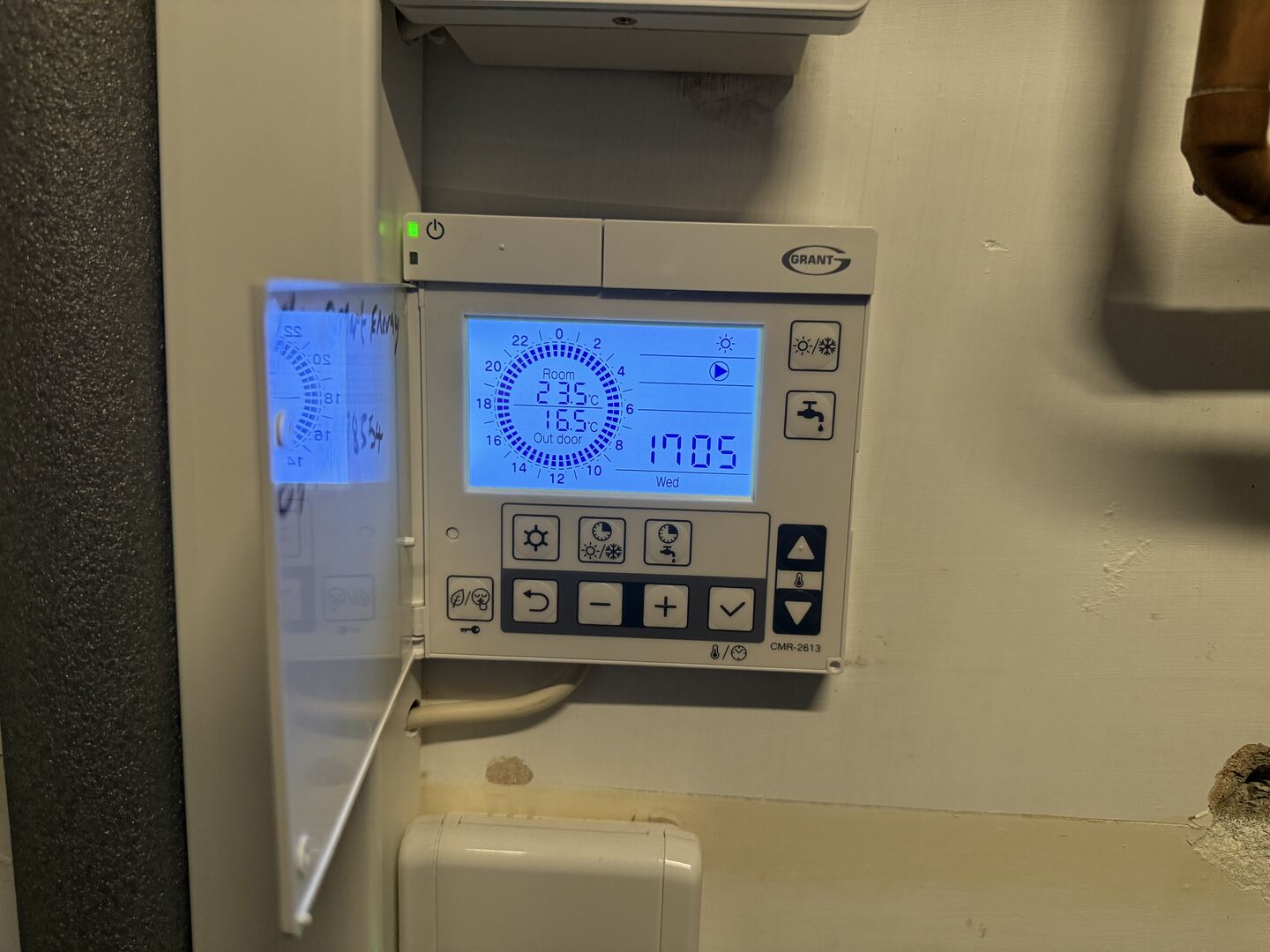
Kind Regards
Si
——————————————————————————
Grant Aerona3 13kW
13 x 435w + 13x 480w Solar Panels
Sigenergy 10kW Inverter
16kW Sigenstor battery

04/12/2025 2:34 pm
Welcome @solenoid. I have a Grant Aerona R32 10kW ASHP. The ASHP itself has been uber-reliable, it has never really missed a beat. The Chofu [built in Japan] Grant Aerona R32 unit is pretty robust. Not class leading efficiency, but good, and reliable. Grant UK seem to be able to source parts very quickly for them. My commissioning and hand-over were another issue mind. Lots of learning, lots and trial and error, but all running sweetly now. Most of your issues seem to have arisen directly from installer incompetence and mistakes with the system design and commissioning as opposed to the ASHP. This is true wit the majority of 'my heat pump doesn't work' stories. The ASHP can only do what it is programmed to do.
This forum, plus the Grant owners group on FB, will be very useful contacts should you need technical advice and support. You are yet another owner who has had the ASHP PCB replaced by Grant - this seems staggeringly common. I have read that there was a known fault with a batch of R32 units regarding the circulating pump control and PCBs seem to have been replaced perhaps to resolve that.
The Grant Aerona will lose thermal capacity in winter when routinely defrosting. Same for all ASHPs. Your 13kW unit might end up being closer to 8 or 9kWh of actual thermal energy supplied to the house once the time for defrost and the recovery time afterwards is considered. Systems with low water circuit volume, or which have large parts of the circuit closed off due to multiple zone controls, are particularly prone to have issues with defrosting and clearing all the ice off the coil. You need sufficient volume in circuit at sufficient a temperature to provide the thermal energy the ASHP needs to defrost. Having all the heating circuit open all of the time, to maximise the volume in circuit, is best. That needs the weather compensation to be working well and the flow to each zone well balanced however. Both can be a process of trial and error if they are not properly commissioned. As James mentioned, the best person to set the WC correctly is you as homeowner, and that needs you to be familiar with how to adjust and set the WC parameters. There's a video I prepared on the FB group showing how to access, check and adjust them for the R32 Aerona, and another owner has kindly done the same for the R290 Aerona with 'smart controller'.
I don't normally run my radiator CH 24/7. it runs up to 18hrs a day. But when a particularly cold spell is due, I do over-ride to 24/7.
04/12/2025 3:08 pm
Having all the heating circuit open all of the time, to maximise the volume in circuit, is best. That needs the weather compensation to be working well and the flow to each zone well balanced however. Both can be a process of trial and error.
@solenoid Its probably worth adding that, done well, going through this process is likely to offer a noticeable improvement in comfort relative to systems you may be used to; its worth the effort for this reason alone (as well as making the system work more efficiently). Its quite a revelation to live in a house where every room is at a (more or less) stable temperature 24*7 without bothering to touch any controls and without the thermal gradients that occur in houses with high temperature (ie generally boiler based) heating. My wife, who is not at all technical, certainly appreciates it as do I.
This post was modified 1 month ago by JamesPa
4kW peak of solar PV since 2011; EV and a 1930s house which has been partially renovated to improve its efficiency. 7kW Vaillant heat pump.
1

Topic starter
05/12/2025 8:19 pm
Thank you for the details, having read through I understand the concept. I do not know enough to do some of this at this stage, and would need to make some changes back to dumb TRVs upstairs first for example.
While I can get the builder to fix obvious problems I am not yet confident enough to change a load of things at this stage I would hate for anything and have my intervention be blamed by the installer, so I will need to learn a bit more.
I have purchased the book so I will have a look when it arrives! hopefully build some confidence. Its worth saying, although my system is not optimised it is working much better and much more comfortably since Heating Engineer came and made some changes. As of now I run it all the time as best as TRVs and room thermostats allow and removed setbacks, as well as a few other tweaks.
This post was modified 1 month ago by Mars
Topic starter
05/12/2025 8:21 pm
@grantmethestrength thank you, yes its one of these. I actually found the manual last week on this forum! All I can say is the manual is not written for user, but I have gone through some of the config and noted the settings so I can figure out defaults vs what was changed.
05/12/2025 8:39 pm
@solenoid definitely worth keeping notes of what changes you made and the results you get. I found having cheap wireless hygrometers in each room has helped (I bought these but there are tons of cheaper ones on Ali-express: https://amzn.eu/d/5yVeCHL). I also bought a bunch of these that can be used to help measure the flow and return temps on the radiators I just velcro strap them onto the pipes ( https://amzn.eu/d/bKDG9dm) again Ali-express are probably cheaper.
I have compiled a (relatively) full list of the parameters for the Chofu/Grant on my github repository which may or may not help.
Kind Regards
Si
——————————————————————————
Grant Aerona3 13kW
13 x 435w + 13x 480w Solar Panels
Sigenergy 10kW Inverter
16kW Sigenstor battery
Topic starter
05/12/2025 9:58 pm
@allyfish Thank you for this, it is reassuring to here that you have got your installation to where it needs to be, and the Heat pump is reliable. I will check out the FB sources as well when I get a moment. Also interesting about the PCB, I did not see that info anywhere on the web. With regards to the system losing thermal capacity, I was recently reading the manual for the Grant combined low loss header/volumiser which is also in my setup (which I will note and share when I get a moment to get the names of all of it). Based on the manual I believe its setup up as a volumiser (not 100% sure) which I hope would help during a defrost cycle if I understand its function.
06/12/2025 8:56 am
@solenoid it sounds like you are making progress. No need to hurry these things and please feel free to ask any questions.
4kW peak of solar PV since 2011; EV and a 1930s house which has been partially renovated to improve its efficiency. 7kW Vaillant heat pump.
1


Latest Posts
-
RE: Setback savings - fact or fiction?
Given the weather has been relatively stable, the empir...
By Batpred , 35 minutes ago
-
New Daikin 11kW Altherma 3M install - is it working as it should?
I had the system installed by Octopus in October last y...
By Synthbuilder , 47 minutes ago
-

RE: Rate the quality of your heat pump design and installation
🤣 what exactly did he dismiss and why?
By Mars , 1 hour ago
-
RE: Post-Traumatic Heat Pump Stress Disorder
@jamespa Hi James - thanks so much! That sounds like ut...
By johnbroome , 1 hour ago
-
RE: Heat pump not reaching flow temperature
@jamespa system design was for 40 degrees FT at -2 degr...
By DaveC , 2 hours ago
-
RE: GSHP WOES! Midland based engineer recommendations?
@editor That is very kind! Thank you so much.
By johnbroome , 2 hours ago
-
RE: Considering MLCP (Multi-Layer Composite Pipe) for ASHP
@iotum, this is a really good question and you’re right...
By Mars , 2 hours ago
-

RE: ASHP Energy Consumption: Aira 12kW heat pump
@wally Hi I am not sure how large your house is b...
By TechnoGeek , 3 hours ago
-
Please help with the settings ecodan
I have a 160 square meter house, first floor 6 radiator...
By nose1972 , 3 hours ago
-
RE: Predicted Heat Loss & Needs from MCS calcs vs EPC vs actual
I've been thinking along similar lines to @tim441 from ...
By Sheriff Fatman , 3 hours ago
-

Thanks, @technogeek. Good to hear about the accuracy. ...
By Majordennisbloodnok , 4 hours ago
-
RE: Advice for a novice on Mitsubishi Ecodan 6kW
In my case it was a very specific pattern of behaviour ...
By Sheriff Fatman , 4 hours ago
-
RE: Vaillant aroTherm not heating with many faults
@ashp-bobba Yeah I'll give it a go, will check filter...
By Anon67 , 4 hours ago
-

RE: RDSAP10 effect on existing heat pump EPC rating?
@transparent Perhaps the names at the end of the docume...
By Toodles , 4 hours ago
-
RE: Heatpunk Floor plan issues
@jamiejones85 A2A they will design on dynamic heat loss...
By ASHP-BOBBA , 5 hours ago
-
RE: Fan unit Making terrible noise HELP!!
can you post a video looking inside, at and through the...
By ASHP-BOBBA , 6 hours ago
-
RE: Power outages and storms: A surprisingly good DNO experience
Agreed, which is no more nor less than a customer shoul...
By Majordennisbloodnok , 23 hours ago
-
RE: Running from backup generaor in powercut?
@batpred In our case, 3 times each day when the Octopus...
By Toodles , 23 hours ago