

Notifications
Clear all
Joining the Renewable Heating Hub forums is completely free and only takes a minute. By registering you’ll be able to ask questions, join discussions, follow topics you’re interested in, bookmark useful threads and receive notifications when someone replies. Non-registered members also do not have access to our AI features. When choosing your username, please note that it cannot be changed later, so we recommend avoiding brand or product names. Before registering, please take a moment to read the Forum Rules & Terms of Use so we can keep the community helpful, respectful and informative for everyone. Thanks for joining!

Topic starter
02/11/2023 11:19 am
No i really dont. But i'm not getting very good advice from Brian the supplier. If i can confirm Sunsynk will work with a Can-Bus-Protocol-Pylon at 500K then I will go for that option instead.

02/11/2023 4:01 pm
If i can confirm Sunsynk will work with a Can-Bus-Protocol-Pylon at 500K then I will go for that option instead.
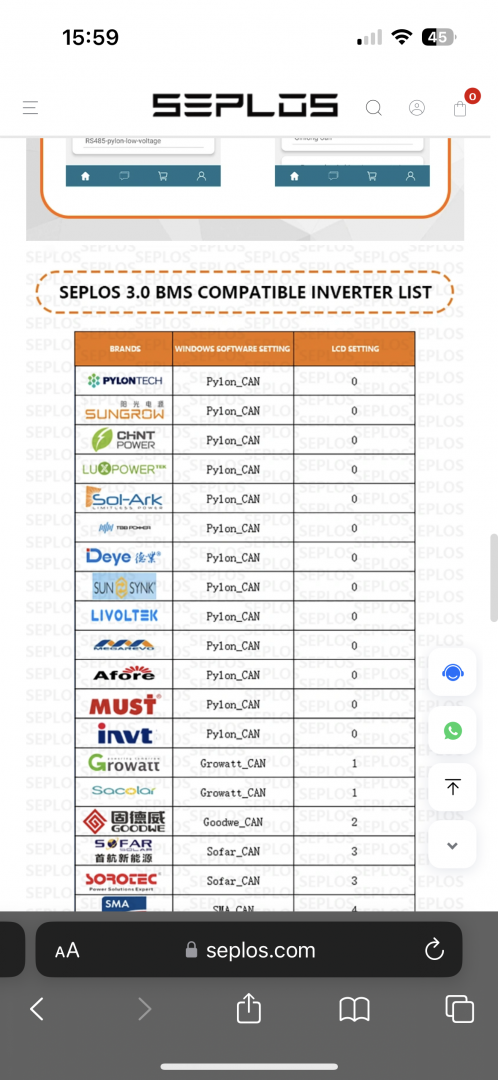
Note that Sunsynk inverters are made by Deye but have some custom firmware and a sales agreement preventing Deye from selling in Europe South Africa and the like. Having said that this new Seplos BMS (version 3?) supports Deye and Sunsynk. See their website

02/11/2023 5:03 pm
We just got a seplos mason 280L kit - I think the BMS has 10E written on it. I can confirm that natively it does talk to the sunsynk.


02/11/2023 7:48 pm
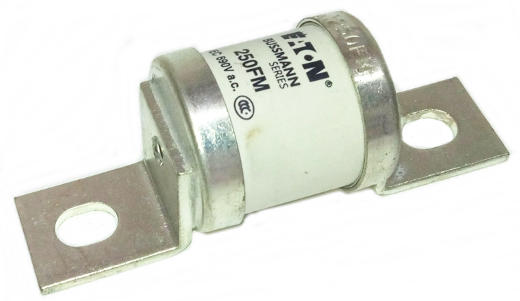
@makia2023 - those Blue Sea Class-T fuses are fine, but slightly on the expensive side.
They're a lot more common in North America than here in Europe.
Blue Sea fuses have a very short body-length.
So once you have fuse-holders to fit them, you really do have to stick with that brand.
Note that the BS88 tabs on a Blue Sea fuse come straight out from the ends of the fuse body.
Most Type-T fuses have the tabs offset from the centre line. Ie they can sit flat on a surface.
Remember that the specified current on the fuse isn't significant.
It's highly unlikely to 'blow' just because the inverter draws 50% over the fuse rating.
The BMS would act faster to shut off the output mosFETs.
So if it costs you the same to get a 200A Type-T rather than a 150A one, then do so.
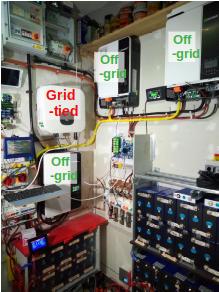
The Growatt SPF5000ES off-grid inverter is the model I'm most familiar with.
I presently use three in parallel.
The SPF5000 is most often the cheapest off-grid inverter available, although prices fluctuate wildly as the supply chain can be erratic.
I don't quite understand why Voltacon sell the SPF5000ES.
Apart from the model name & number, it's almost identical to their own Conversol inverter.
As you'll realise, @chickenbig and I have differing views regarding the pros and cons of 'grid-tied' versus 'off-grid' strategies.
I have both types of inverter here.
The 3.6kW grid-tied unit has remained after I decommissioned an 8kWh storage battery which it was intended to supply.
I also enjoy ongoing exchanges of news/information from companies within the energy sector, and those who define the regulations which govern it.
Consequently, I can take a long-term view of what's most likely to happen over the next 10 years.
I live and work in an area where there is going to be an ever-increasing surplus of electricity from renewable sources.
This will continue to exceed the capacity of the regional part of the Transmission Grid (400kV) until at least 2035.
During that timeframe, we will be offered nodal-pricing.
That means the cost per unit will be lowered not only according to time (ToU tariff), but also according to how much surplus generation in my local area would otherwise be discarded.
So in my position, the price paid for electricity exported to the grid is going to remain low.
But the relative cost of importing electricity will significantly decrease.
That makes an off-grid strategy much more financially viable.
Without even taking into account my own solar panels, I can buy-in low-price electricity from the grid to charge batteries.
If I lived in another part of the UK, the same reasoning might not be applicable.
Also, it is now 17 hours since the height of Storm Cierán passed by, and this is what my regional power-cuts map still looks like:
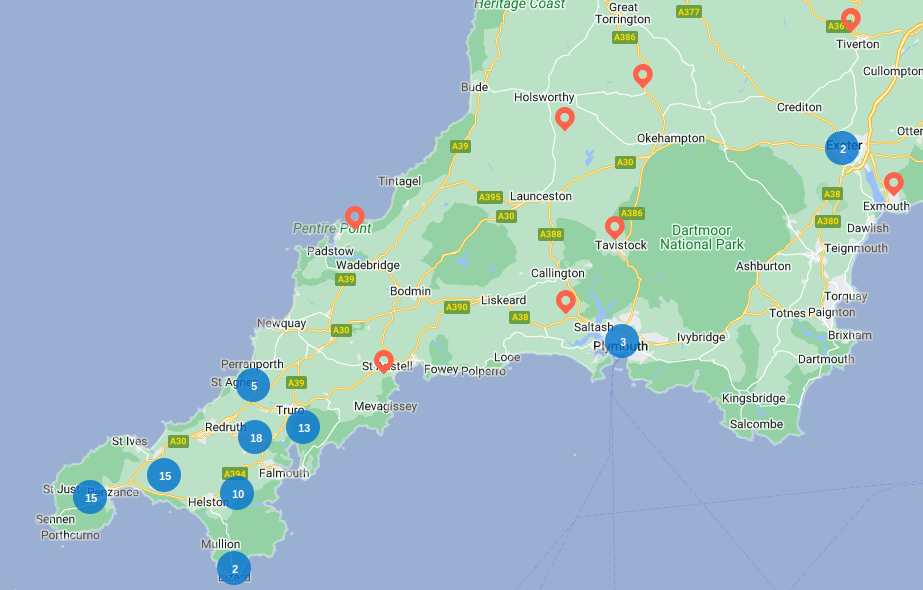
My off-grid system provides a level of resilience against outages which the grid-tied system cannot.
Save energy... recycle electrons!
02/11/2023 7:52 pm
But i'm not getting very good advice from Brian the supplier.
I don't know the background to that comment,
but I would hope you're able to get all the advice you need from within this forum!
What's the issue?
Save energy... recycle electrons!
Topic starter
02/11/2023 8:27 pm
@transparent just the supplier doesn't seem to know the BMS too well. I'm very happy with this forum as it has been a life saver
02/11/2023 8:40 pm
Just press on ahead @makia2023 and let's deal with the BMS preferences once things are running.
I presently have two batteries with BMS units (from different manufacturers), and another two batteries with no BMSs but both using Active Balancers.
You can configure the battery high/low voltages on your inverter anyway.
Having BMS units which offer the same voltage protection functionality is belt & braces.
The main reason you'll want a BMS is for monitoring cell voltages (in case one goes duff) and doing cell balancing.
Yes, they purport to offer a State of Charge (SoC) reading, but I haven't been happy with the accuracy on any of the five BMS units I've used so far.
So let's ignore that for the moment.
I'm still looking at solutions to obtaining an accurate SoC (within 10%), and we can discuss that later.
Save energy... recycle electrons!

02/11/2023 9:22 pm
My off-grid system provides a level of resilience against outages which the grid-tied system cannot.
I did consider an off grid type system - it's simpler in a way, no need to ask permission if all you do is take power from the grid. And it does have a massive advantage if the grid is flaky. It likely ends up being more expensive with bigger inverters to cover demand peaks, and what to do with spare PV in summer?
Sunsynk and Victron and Tesla I think offer "islanding", which is perhaps a halfway house - all the home electricity normally passes through a relay and CT in the inverter. This CT can be nulled by the inverter pulling power from a home battery - but if there's a power cut the inverter can go fully off grid by turning off that relay.
In our case we very rarely get power cuts (maybe 10minutes a decade), so it doesn't seem that useful to us - I took the view that the power electronics was more likely to fail than the mains supply. If we now we get a blackout in this storm I will be regretting that decision...
Topic starter
03/11/2023 7:56 am
Ok. Batteries are boxed, so just waiting for them to dispatch with the battery boxes.
I'm still playing with how best to set this up inverter wise. Perhaps 3x 3.6kw inverters is a better option. I'm going to look it prices again today.
03/11/2023 8:03 am
As you'll realise, @chickenbig and I have differing views regarding the pros and cons of 'grid-tied' versus 'off-grid' strategies.
To be fair, I think our contexts differ, which pushes us towards favouring different solutions. Being a townie, having limited electrical engineering experience, limited willingness to make custom components, limited space and an other half somewhat dubious of the reliability of anything I touch rather constrains my solution space. I looked into running an off-grid system using the Growatt SPF-500ES but the peak power requirements pushed for multiple inverters and very high currents. This combined with a lack of suitable space within the house (as the Growatt inverter fans are rather loud) dissuaded me from going down this route. I have no doubt that off-grid systems make sense in some contexts.

SPONSORS
Degrees of Separation
Latest Posts
-

RE: The Changing Jet Stream Could Challenge UK Air Source Heat Pumps
@susannasaunders I can help you with some of the fun...
By Rob of York , 25 minutes ago
-
RE: How will removing the standing charge on gas bills benefit heat pumps?
The BUS grant funding for 2026/27 will run out at the c...
By Rob of York , 5 hours ago
-
RE: New Build 3 Phase or 1Phase
Not so any more.... 1: It's now the...
By Transparent , 19 hours ago
-
@editor Ouch, sorry to re start the tick. I had assume...
By DavidB , 2 days ago
-
RE: Say hello and introduce yourself
@e-a-west as the good Major said, welcome to the forums...
By Mars , 2 days ago
-
RE: How much of your renewable and home setup would still work if the internet went down?
Yes I actually have a copy of a tool that whenever a ce...
By EtchedPixels , 2 days ago
-
RE: Indevolt Batteries UK Support & Info Thread
@editor Hi, To resolve this, please tap on the A...
By Indevolt Tech , 3 days ago
-
RE: Double or Triple Glazed Windows?
Posted by: @singlespeed With 9 years repairing windo...
By Rob of York , 3 days ago
-
@transparent we’re still running a secure version of PH...
By Mars , 3 days ago
-
RE: How quickly would you want/expect heat recovery to take from setback?
Much longer than that here. The heating isn't even on. ...
By bobflux , 4 days ago
-
RE: Passiv Smart Thermostat - Help & Forum Support
Obviously the weather is changeable but there's a defin...
By Singlespeed , 4 days ago
-
RE: Forum updates, announcements & issues
Get the Renewable Heating Hub heads-up on WhatsApp. I...
By Mars , 4 days ago
-
RE: Safety study for plug in batteries out to tender - looks like Q3 2027 at best before legal
@editor I pointed out to the one of the Fuse execs that...
By dansus , 4 days ago
-
RE: 15kw pump for 225m2 1990's house - over kill?
@seaviews As well as loft insulation, there are othe...
By Rob of York , 4 days ago


SPONSORS

