

Notifications
Clear all
Joining the Renewable Heating Hub forums is completely free and only takes a minute. By registering you’ll be able to ask questions, join discussions, follow topics you’re interested in, bookmark useful threads and receive notifications when someone replies. Non-registered members also do not have access to our AI features. When choosing your username, please note that it cannot be changed later, so we recommend avoiding brand or product names. Before registering, please take a moment to read the Forum Rules & Terms of Use so we can keep the community helpful, respectful and informative for everyone. Thanks for joining!
Energy Storage
16
Posts
7
Users
9
Reactions
13 K
Views

Topic starter
21/02/2023 10:53 am
It's worth noting that the destructive failure tests in the video were on battery cells not encased in any housing or enclosure.

21/02/2023 11:59 am
Just to highlight in general that many modern home storage battery systems are now Lithium Iron Phosphate cell technology, as distinct from Lithium Ion. A view on the comparative risks of failure of the two cell technogies would be extremely helpful. Related guidance to date seems to have been directed towards Lithium ion.
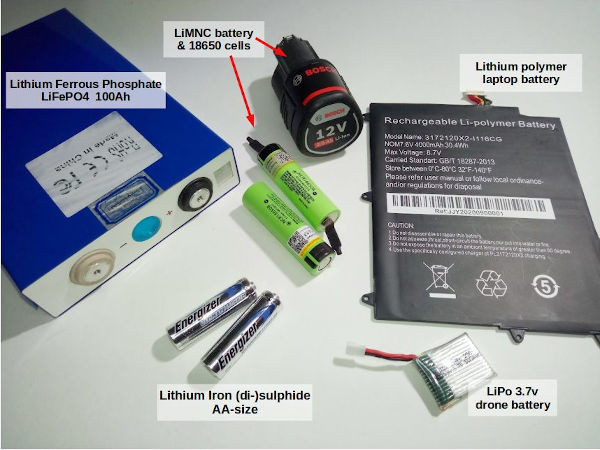
I agree. The term 'Lithium Ion' is being used when the speaker/writer is actually referring only to one specific chemistry... usually LiMNC (Manganese, Nickel, Cobalt). These have low mass per unit of storage capacity (Joules or kWh), and are found extensively in EVs, domestic power-tools and electric skateboards.
It is the LiMNC technology which produces the spectacular fires and explosions, so often the subject of news reports and YouTube videos.
There are around half-a-dozen other lithium battery chemistries which are likely to be encountered by domestic users who read forums like this.
Of those other possibilities, LiFePO4 cells and LTO (Lithium Titanium-oxide, or 'Lithium Titanate') are of interest for use in static home-storage batteries. They can be made with high capacities of 300Ah and above. Lithium Ferrous Phosphate offers a nominal 3.2v per cell, and LTO is 2.5v. As the technology is new, LTO prices are currently high, but they have much faster charge capability.
Lithium Polymer (LiPo) is found in 'thin' laptops, and favoured for drones and model aircraft. Depending on the polymer used, they offer 3.7-4.2v.
Lithium Iron Sulphide (LiFeS2) is found in non-rechargeable cells, and offers the same 1.5v as the equivalent alkaline batteries. They are therefore direct drop-in replacements both for high-drain items like photographic flashlights, and long-life devices such as smoke-detectors, hearing aids and test instruments. (Please try not to call these cells Lithium Iron, because that's very confusing, even if true!)
Save energy... recycle electrons!
2

21/02/2023 5:52 pm
Glad to see that people are responding, just wanted to make sure safety is considered from the science point of view.
@Transparent The term 'Lithium Ion' is being used when the speaker/writer is actually referring only to one specific chemistry... usually LiMNC (Manganese, Nickel, Cobalt).
Lithium Ion is the collective term for the type of cell, with a battery being constructed from multiple cells. EV's use several types of cell including lithium iron Phosphate. The key issue is energy density regardless of the type if any cell fails. Failure has multiple causes, some of which can be promoted by charging malfunctions or BMS issues for instance. None of this means that battery storage is bad, it is bad practice that I am concerned about. Also possible second life usage, OK in theory, if you know the history of each cell within the battery.
@Alleyfish the batteries were not in a case so that observations could be made, but these were modules i.e. multiple cell assemblies. Not sure cell failure can be contained given the forces and energy involved and depending on the type they usually have burst caps.
@Jeff if toxic gas is being emitted (Note this is a vapour cloud) you definitely dont want to try to run through it without really good PPE, plus ignition threshold is very low due to hydrogen content.
My motto is, the best way to fix a problem is to avoid it in the 1st place.
Hope this helps
21/02/2023 7:18 pm
Yes @dak51 that was my point. Lithium Ion is an overall term for many different types of cell chemistry.
I feel it's bad practice to use the generic term whilst using examples that are drawn from only one of the possibly chemistry configurations.
That error occurs throughout the BESS Research Paper which you'd referenced earlier. That shouldn't occur in an official guidance document.
The key issue is energy density regardless of the type if any cell fails.
Sorry, that can't be correct.
The fires/explosions which arise from thermal and mechanical stresses applied to LiMNC cells are of a significantly greater level of threat because the chemicals self-combust. They perpetuate a reaction even in the absence of air.
Although the LiMNC chemistry does indeed have the highest energy density amongst the commonly-available Li-ion family, that is not the basis of why that type of cell is particularly dangerous.
For comparison, consider the points made in the following YouTube video in which a LiFePO4 cell is deliberately damaged mechanically
I haven't come across any other video or photograph showing anything like the level of heat and flame which High Tech Lab were able to coax out of this particular 105Ah LiFePO4 cell. It takes a considerably 'violent' assault on the cell to instigate the resulting fire!
Even so, the flames emitted by that LiFePO4 puncture test could be readily quenched by a household fire extinguisher.
The same may not be true for a fire caused by over-charging a LiMNC cell, for example.
Smothering it in dry-powder or a layer of CO2 will only cut off the source of oxygen.
But it doesn't require oxygen to perpetuate the fire! 😖
There are two issues which were given scant regard in the BEIS Research Paper, but are relevant to others here who might be attempting a Battery Storage installation:
1: If a fire were to occur in a house as a result of a failure with a typical LiFePO4 system, then it will more likely arise from a fault in the attached inverter(s) than the battery cells themselves.
2: The possibility of such a fire occurring can be readily countered by using a (fast reacting) DC fuse of Type-T. This effectively removes the source of electrical energy from whatever fault has created a low-resistance 'short circuit' within the inverter electronics.

The photo above shows Type-T 250A fuses (arrowed) being installed on a battery/inverter combiner board.
The layers of system protection devices in the photo (fuse, double-pole MCB and isolator-relay) are to protect against various possible causes of over-current which might otherwise allow energy to be dissipated in the connected electrical apparatus.
Despite what you read widely stated on the internet, they are not there to protect the battery!
If a low-resistance path causes an instantaneous surge of several hundred/thousand amps to flow, then the LiFePO4 cells will quite happily supply it, and will mostly likely survive intact.
That 's what lithium cells designed to do!
Save energy... recycle electrons!

Page 2 / 2
Prev

SPONSORS
Degrees of Separation
Latest Posts
-

RE: The Changing Jet Stream Could Challenge UK Air Source Heat Pumps
There are a collection of tools around on the internet ...
By EtchedPixels , 6 hours ago
-
RE: 15kw pump for 225m2 1990's house - over kill?
@seaviews I have read you latest response re buffer ...
By JamesPa , 7 hours ago
-
RE: How will removing the standing charge on gas bills benefit heat pumps?
The BUS grant funding for 2026/27 will run out at the c...
By Rob of York , 18 hours ago
-
-
@editor Ouch, sorry to re start the tick. I had assume...
By DavidB , 2 days ago
-
RE: Say hello and introduce yourself
@e-a-west as the good Major said, welcome to the forums...
By Mars , 2 days ago
-
RE: How much of your renewable and home setup would still work if the internet went down?
Yes I actually have a copy of a tool that whenever a ce...
By EtchedPixels , 3 days ago
-
RE: Indevolt Batteries UK Support & Info Thread
@editor Hi, To resolve this, please tap on the A...
By Indevolt Tech , 3 days ago
-
RE: Double or Triple Glazed Windows?
Posted by: @singlespeed With 9 years repairing windo...
By Rob of York , 4 days ago
-
@transparent we’re still running a secure version of PH...
By Mars , 4 days ago
-
RE: How quickly would you want/expect heat recovery to take from setback?
Much longer than that here. The heating isn't even on. ...
By bobflux , 5 days ago
-
RE: Passiv Smart Thermostat - Help & Forum Support
Obviously the weather is changeable but there's a defin...
By Singlespeed , 5 days ago
-
RE: Forum updates, announcements & issues
Get the Renewable Heating Hub heads-up on WhatsApp. I...
By Mars , 5 days ago
-
RE: Safety study for plug in batteries out to tender - looks like Q3 2027 at best before legal
@editor I pointed out to the one of the Fuse execs that...
By dansus , 5 days ago


SPONSORS
