There have been a lot more applications for storage and the like near this substation (by the m1 motorway) that were rejected over the last 5 years..
Hopefully this is the exception to a swift approval of applications that will lead to a drop in electricity prices. I am sure I am not the only one interested in the data that demonstrates these times are past us. 😊
And we have the 500 documents for a substation to allow "mooring" undersea cabling to the Suffolk coast... I wonder how long that took
There have been a lot more applications for storage and the like near this substation (by the m1 motorway) that were rejected over the last 5 years..
Hopefully this is the exception to a swift approval of applications that will lead to a drop in electricity prices.
1: I can't see how adding BESS sites like this can result in a fall in electricity prices.
A 49.9MW storage site is basically a cash cow. The owners buy electricity when it's cheap, then sell it at a profit during a period of peak demand.
So long as the public don't invest in their own in-home storage, those demand peaks will continue.
The effort needs to be put onto lowering the demand-peak, not installing commercial BESS on the grid.
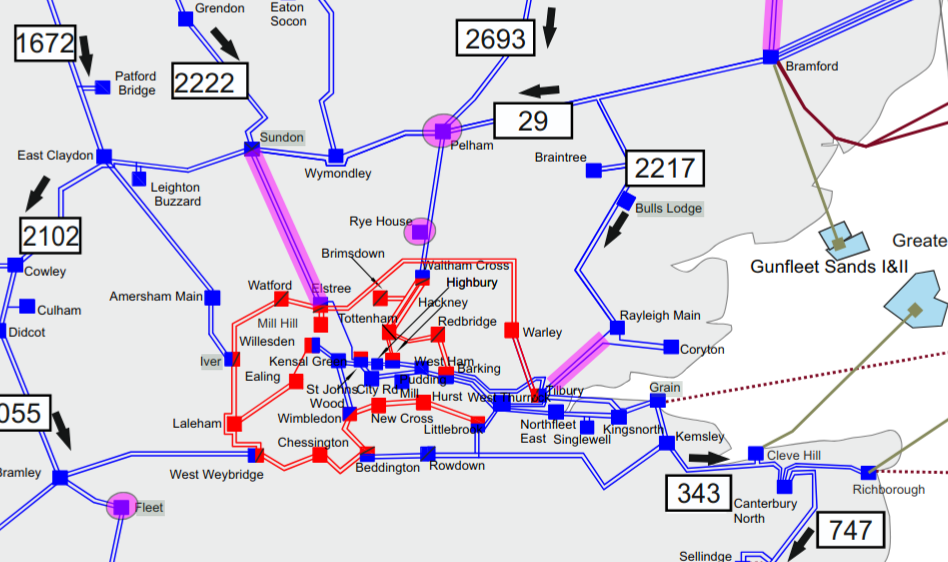
2: Whatever arguments may have resulted in previous planning applications being rejected, it is the case that a commercial BESS connecting to Elstree Grid Supply Point (GSP) presents a threat to the grid.
Elstree is a crucial link between the 400kV Transmission routes from the north (blue) and the 275v electricity ring (red) which encircles Greater London.
The map above is the 2025/26 map from ETYS (Electricity Ten Year Statement, published in 2024) Pink highlighted assets are those under constraints and subject to reinforcement/upgrade.
As you can see from the Power Flow figures in rectangles, each of those transmission lines from the north is delivering around 2GW to 2.5GW to meet demand.
A BESS at Elstree of the size originally proposed (around ½GW) would account for a high proportion of that supply route.
Its sudden loss would cause a voltage drop 'shock' which would lower voltages in the north London area below the statutory threshold. All other G98/G99 Embedded Generation in the area would disconnect from the grid. The loss of that embedded generation (such as domestic solar) would result in a supply shortfall which would need to be met from other GSPs on the 275v ring.
Demand on the other Transmission routes would rapidly increase.
It was just such a sudden loss of (150MW) embedded generation which caused the Outage on 9th August 2019 in that same area. That resulted in power being lost to 1m homes due to Load Shedding. Hospitals, Airports and the East Coast Mainline lost power because their standby assets were inadequate.
I wouldn't want to see BESS any larger than 50MW being connected to Elstree.
This post was modified 4 months ago by Transparent
There have been a lot more applications for storage and the like near this substation (by the m1 motorway) that were rejected over the last 5 years..
Hopefully this is the exception to a swift approval of applications that will lead to a drop in electricity prices.
1: I can't see how adding BESS sites like this can result in a fall in electricity prices.
A 49.9MW storage site is basically a cash cow. The owners buy electricity when it's cheap, then sell it at a profit during a period of peak demand.
To be absolutely clear, I have no personal interest in these types of proposals.
I could be wrong, but I believe the previous rejections were not due to grid management concerns. The common theme has been local opposition for changing the natural environment near them.
I do not feel qualified to comment on whether it would be good for grid management. NESO would have been consulted and would probably be a partner. That first large proposal would even need "major connections" to the 400k grid.
My view is that, generally, in a market economy organisations and people should be incentivised to take risks and seek a reward, according to good market rules.
As for the link to energy prices:
If enough storage could be put in place with contracts appropriately structured, the peak of electricity prices (daily, weekly, monthly, etc depending on size) could be removed, specially for residents in smaller properties that will not be able to implement own energy storage solutions.
8kW Solis S6-EH1P8K-L-PLUS hybrid inverter; G99: 8kw export; 16kWh Seplos Fogstar battery; Ohme Home Pro EV charger; 100Amp head, HA lab on mini PC
The government have said we are going to save money with long duration storage under the cap and floor mechanism, with learning coming from a first set of storage sites, we are currently down to 77 shortlisted sites.
"Long duration electricity storage (LDES) will be pivotal in delivering a smart and flexible energy system that can integrate high volumes of low carbon power, heat, and transport. LDES provides flexibility in the energy system, helping to replace the need for unabated gas generation, whilst also diversifying our technology mix to provide optionality for meeting our 2035 power sector decarbonisation targets. LDES will allow us to better utilise domestically produced electricity by allowing us to store excess electricity for times of high demand, minimising waste. Deploying up to 20 gigawatts (GW) of long duration electricity storage is estimated to result in system savings of up to £24bn1, representing a saving to consumers of 3.3% of the total system costs."
The savings are assessed by looking at what will happen if we don't have LDES. So like a lot of net zero things it doesn't necessarily mean our bills will be lower than they are now, just lower than than they would have been if we didn't have LDES.
There have been a lot more applications for storage and the like near this substation (by the m1 motorway) that were rejected over the last 5 years..
Hopefully this is the exception to a swift approval of applications that will lead to a drop in electricity prices.
1: I can't see how adding BESS sites like this can result in a fall in electricity prices.
A 49.9MW storage site is basically a cash cow. The owners buy electricity when it's cheap, then sell it at a profit during a period of peak demand.
So long as the public don't invest in their own in-home storage, those demand peaks will continue.
The effort needs to be put onto lowering the demand-peak, not installing commercial BESS on the grid.
2: Whatever arguments may have resulted in previous planning applications being rejected, it is the case that a commercial BESS connecting to Elstree Grid Supply Point (GSP) presents a threat to the grid.
Elstree is a crucial link between the 400kV Transmission routes from the north (blue) and the 275v electricity ring (red) which encircles Greater London.
The map above is the 2025/26 map from ETYS (Electricity Ten Year Statement, published in 2024) Pink highlighted assets are those under constraints and subject to reinforcement/upgrade.
As you can see from the Power Flow figures in rectangles, each of those transmission lines from the north is delivering around 2GW to 2.5GW to meet demand.
A BESS at Elstree of the size originally proposed (around ½GW) would account for a high proportion of that supply route.
Its sudden loss would cause a voltage drop 'shock' which would lower voltages in the north London area below the statutory threshold. All other G98/G99 Embedded Generation in the area would disconnect from the grid. The loss of that embedded generation (such as domestic solar) would result in a supply shortfall which would need to be met from other GSPs on the 275v ring.
Demand on the other Transmission routes would rapidly increase.
It was just such a sudden loss of (150MW) embedded generation which caused the Outage on 9th August 2019 in that same area. That resulted in power being lost to 1m homes due to Load Shedding. Hospitals, Airports and the East Coast Mainline lost power because their standby assets were inadequate.
I wouldn't want to see BESS any larger than 50MW being connected to Elstree.
Interesting to see home energy storage being pushed as part of a potential ECO5 when ECO4 finishes in April 2026.
@jeff Keeping the ‘smash & grab’ installers who get away with using dubious methods out of the scheme ought to be a priority this time too! (Once bitten etc). Toodles.
Toodles, heats his home with cold draughts and cooks food with magnets.
@jeff Keeping the ‘smash & grab’ installers who get away with using dubious methods out of the scheme ought to be a priority this time too! (Once bitten etc). Toodles.
Unfortunately there are people and companies throughout net zero not offering value for money, optimal solutions and in some cases offering poor quality.
The savings are assessed by looking at what will happen if we don't have LDES. So like a lot of net zero things it doesn't necessarily mean our bills will be lower than they are now, just lower than than they would have been if we didn't have LDES.
It makes sense to me. LDES would reduce the dependency of the grid on fossil fuel sources during long periods of no wind, low PV production, therefore constraining price increases (since net 0 will lead to further reductions in fossil fuel based generation).
My thinking is investments on large scale storage that would also deliver power during peak day hours would reduce the number of days when the electricity prices are dictated by the (expensive) fossil fuel generators.
I am sure other forum members have a better view...
8kW Solis S6-EH1P8K-L-PLUS hybrid inverter; G99: 8kw export; 16kWh Seplos Fogstar battery; Ohme Home Pro EV charger; 100Amp head, HA lab on mini PC
@jeff the E.ON article reaffirms my belief that homes should be financially supported to install batteries which can be controlled by the local network operator for charging cycles
1. It provides a more distributed resilience for a renewables based supply. Spain is a classic example of what we do not want to happen.
2. Avoids, to some extent, having to upgrade the 11KVA network (correct me if I am wrong @transparent, is very very expensive to upgrade) because different areas can be charged at different times helping to keep a more balanced grid and not overload the 11KVA network.
3. Batteries can have a major impact on domestic bills, hence why I am currently embarked on installing a large battery system with some solar.
5 Bedroom House in Cambridgeshire, double glazing, 300mm loft insulation and cavity wall insulation
Design temperature 21C @ OAT -2C = 10.2Kw heat loss, deltaT = 8 degrees
Bivalent system containing:
12Kw Samsung High Temperature Quiet (Gen 6) heat pump
26Kw Grant Blue Flame Oil Boiler
4.1Kw Solar Panel Array
34Kwh GivEnergy Stackable Battery System