

Notifications
Clear all
Joining the Renewable Heating Hub forums is completely free and only takes a minute. By registering you’ll be able to ask questions, join discussions, follow topics you’re interested in, bookmark useful threads and receive notifications when someone replies. Non-registered members also do not have access to our AI features. When choosing your username, please note that it cannot be changed later, so we recommend avoiding brand or product names. Before registering, please take a moment to read the Forum Rules & Terms of Use so we can keep the community helpful, respectful and informative for everyone. Thanks for joining!
Ground Source Heat Pump (GSHPs)
12
Posts
4
Users
3
Reactions
2,851
Views

Topic starter
11/06/2024 3:20 pm
Hi there,
I am half-way through the build of a 550m2 house which has UFH throughout, no radiators. Heating is via a 17kW GSHP.
My question is - how best to heat the domestic hot water? If I run the heat pump at 30 degrees for the UFH and maximum efficiency, will I need to rely on an immersion heater for getting the DHW up to 55 deg? Alternatively if I run the heat pump at 50 degrees, then I need to waste power reducing this for the UFH. What is the best approach?
On a related ponit - the heat pump manufacturer has specced a large buffer tank (700 litre?) adjacent to the heat pump. Is this really necessary? The UFH circuits will provide sufficient load all the time to stop the heat pump short cycling, so I don't see why a buffer tank is required.
Any advice welcome...

11/06/2024 3:43 pm
Greetings, and welcome.
1: I'm unsure why you'd want 50°C to supply DHW.
If I buy a mixer-valve to protect against the danger of sending scalding water to a bath, then the usual default setting is for it to deliver 42°C at its output port. You can then change this, typically plus/minus 8°C by using a screwdriver, but few people do.
Equally, the default setting for output from a mixer-bar shower is 38°C.
You then press a button if you want to move the knob to a higher temperature.
Personally I prefer 36°C.
So if you're considering 50°C output for GSHP, then you must have a pretty inefficient cylinder/thermal store to deliver the DHW !
2: If your HP manufacturer is planning on a whopping 700-l buffer, then I'll suggest that the 17kW GSHP is rated too high!
The buffer tank is a fudge to help cool the water sufficiently before it returns to the heat-pump.
You need a less powerful heat-pump.
It it already installed?
Others are about to join in here and comment. Who's around? - @allyfish ? @kenbone ?
They will no doubt be asking for your GSHP model number and the heat-loss calculations for the amazing 550m² house. 😎
So you have a little while to scuttle around and find that info!
Save energy... recycle electrons!
1
Topic starter
11/06/2024 4:28 pm
@transparent Many thanks for this - I understand your comments re. the hot water temp. Let's say I run the DHW at 42c, this still too hot for the UFH system so the question is whether to use the heat pump JUST for the UFH at 30c (or thereabouts) and have the DHW on a completely separate system and heated via immersion?

11/06/2024 4:40 pm
The heat pump does not provide CH and DHW heating at the same time, there should be a diverter valve installed. The heat pump would then run at lower temperatures and more efficiently when supplying the UFH and at higher temperatures and lower efficiency when heating the DHW. Once per week it may be necessary to heat the DHW to 60C using the immersion heater for the final say 50C to 60C. You could also consider DHW heating by a solar PV system for much of the year.
Is the 700 litre tank actually a buffer or a thermal store?
It is possible that because of the size of your home you will require several zones and several water pumps, which may be one reason why a buffer tank has been specified. Having a buffer tank within an heat pump system is not always the most ideal, it will require careful commissioning and control.

Topic starter
11/06/2024 4:59 pm
@derek-m Thanks, that makes a lot of sense. The overall design for this system has been done by the heat pump manufacturer and I'm just trying to get my head around how it is supposed to work with optimum efficiency.
11/06/2024 5:08 pm
Then please keep asking the questions, however naive you think they might be!
I'm intrigued by some of what you say:
Why is the UFH required to receive water at 30°C?
- Is that a 'design temperature' dictated by the HP manufacturer?
- Or is it that the floor surface is made of something exotic which deforms at 36°C ? 🤔
Is this majestic 17Kw GSHP a single-phase unit?
And, if so, then how did you manage to get consent from your Distribution Network Operator (DNO) to have it installed?
Oh.... and we absolutely love photos 😉
Save energy... recycle electrons!
1
11/06/2024 5:09 pm
@derek-m Thanks, that makes a lot of sense. The overall design for this system has been done by the heat pump manufacturer and I'm just trying to get my head around how it is supposed to work with optimum efficiency.
I would suggest that you ask the system designer for a schematic diagram detailing the system layout and details of all the major components.
If you then require any clarification, forum members will be happy to advise.
Topic starter
11/06/2024 5:23 pm
@transparent The flooring in the house is a mixture of ceramic tile and engineered oak planks. I believe the specified max working temp for the flooring is 30c (or thereabouts), but I need to check.
The heat pump is 3-phase, and this whole discussion came about because the M&E people say we are maxing out the 3-phase 100A supply. My assumption is that the 17kW figure is the heat output NOT the electricity input; Therefore at a COP of 4.0 the electricity demand from the heat pump shouldn't be more than 5kW.


12/06/2024 6:38 pm
@mch Quite So! Toodles.
Toodles, heats his home with cold draughts and cooks food with magnets.
12/06/2024 7:54 pm
The flooring in the house is a mixture of ceramic tile and engineered oak planks. I believe the specified max working temp for the flooring is 30c
I have the same combinations.
I've used three different sources of engineered oak over the past decade+ of restoration and extension work.
All of them recommended that top surface of the planks shouldn't be above 28°C
The water in the pipes is obviously a fair bit above that. It leaves the manifolds at around 43°C.
My engineered oak is 22mm thick, with the upper wear-layer of 6-8mm depending on the supplier.
I also have two different floor substrates:
- 100mm thick concrete
- suspended floor with aluminium heat-spreader plates between the joists
Both substrates have some areas with engineered oak, and some with ceramic tiles.
So I have real hands-on experience of all the combinations.
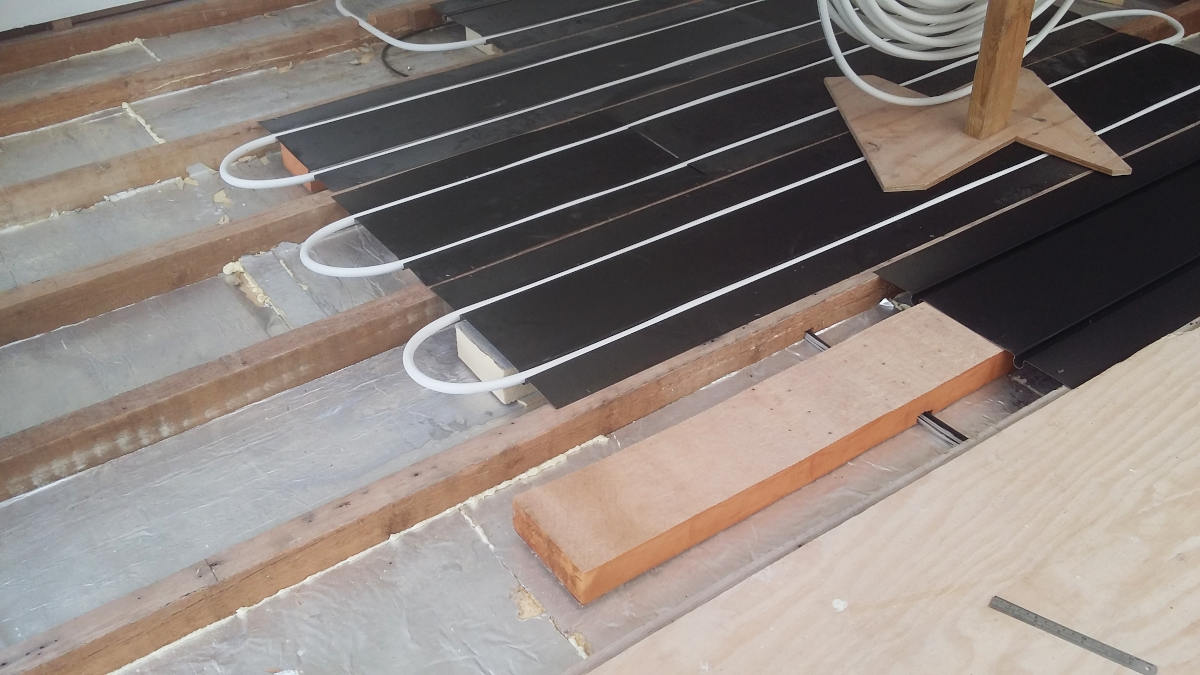
Here are heat-spreader plates above a suspended floor:
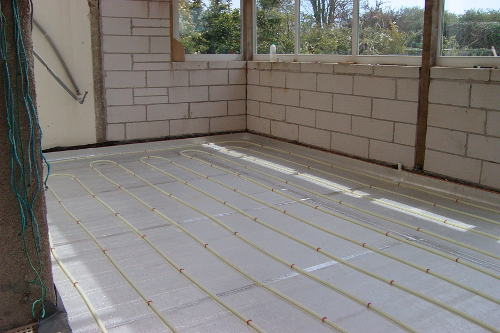
Here's a 9m x 4m extension with UFH pipes clipped to the insulation layer prior to pouring the concrete pad:
I have one area where the engineered oak boards span across from suspended floor to a solid concrete floor.
Here it is looking across the joists of the suspended floor:
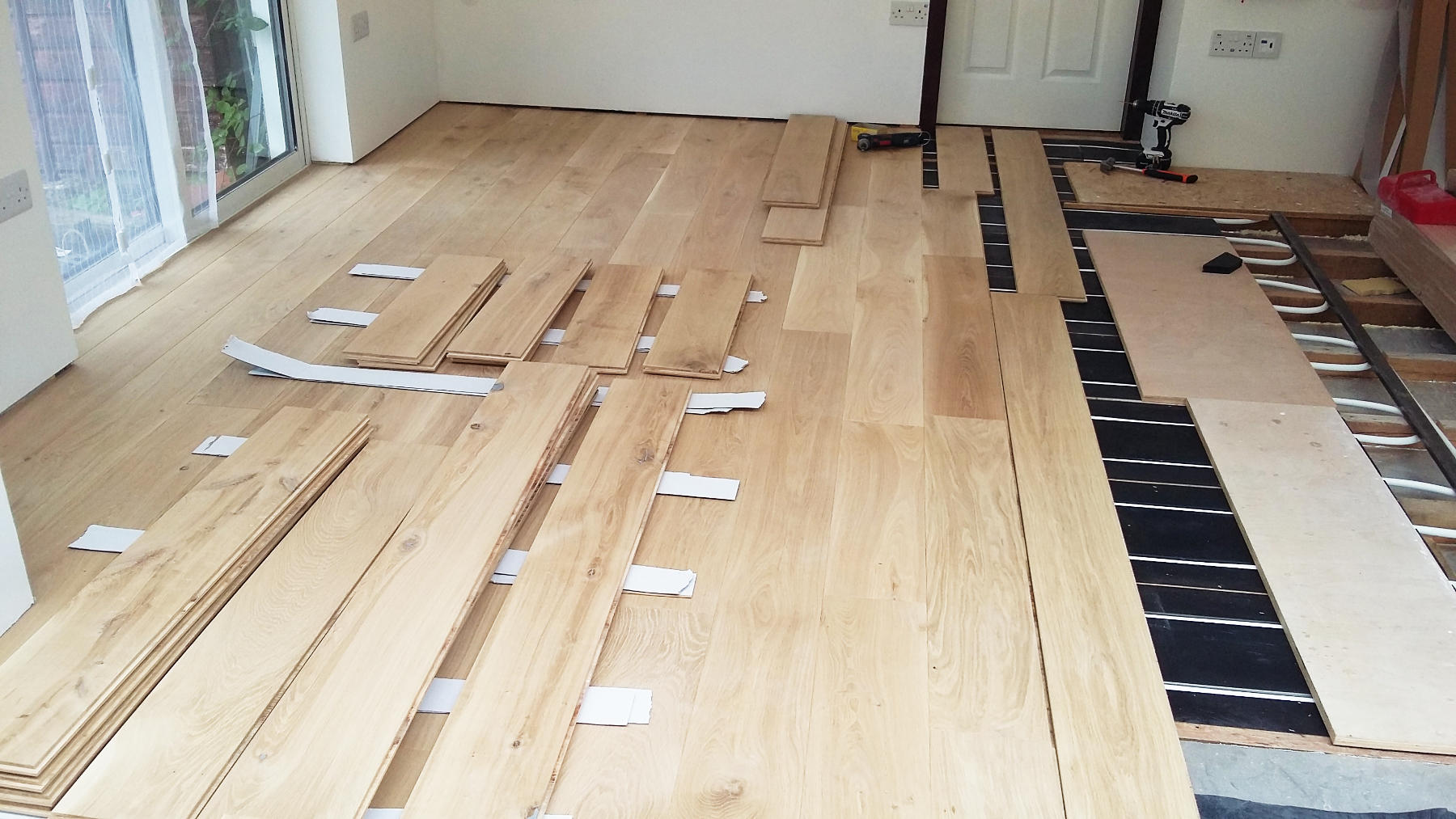
And here we're looking into the other direction across the concrete pad:

I had (free) technical support from Bostik who provided advice on sealing the surface, and supplied a flexible adhesive which copes with any undulations on the concrete.
No contracters were involved.
That's why I've had no issues with quality! 😋
the M&E people say we are maxing out the 3-phase 100A supply. My assumption is that the 17kW figure is the heat output NOT the electricity input; Therefore at a COP of 4.0 the electricity demand from the heat pump shouldn't be more than 5kW.
This is one of my specialities.
Give me a tad more information to go on.
Can I have a photo of your Consumer Unit(s) with the trips visible?
Which Distribution Network Operator serves your region?
Did the installer or yourself obtain consent for LCT (Low Carbon Technology) from your DNO before agreeing which GSHP would be fitted?
Yes, the 17Kw is the heat-output rating of the GSHP, but the electrician has to specify the cabling and fuses/trips which will cope with the switch-on surge. Depending on the model, this could be around 25A per phase. That high current persists until the compressor has brought the circuits up to full operating pressure. Only then does it fall down to the level which you use to calculate the COP.
Save energy... recycle electrons!
1
Topic starter
13/06/2024 9:53 am
@transparent Thanks very much for the detailed reply & pics, that is very helpful.
On the electricity supply, my main contractor & M&E consultant had the 3-phase supply & meter installed, I have no reason to suppose they did not have the correct approvals. I know there were some detailed discussions but I was not directly involved. The build is still only halfway through and first fix is just starting, we don't have the consumer unit installed yet.
The whole electrical demand calculation is complicated and, as I understand it, the guidance for "load diversification" doesn't really cover systems with heat pumps yet. So we have to take an educated guess as to what the realistic max load on the system will be. You are correct that the heat pump lists a peak demand of 25A, but as you say, this will only happen the first time the system is started up from cold?
Thanks!
13/06/2024 11:16 am
A 3-phase 17kW GSHP still sounds on the large side to me.
We don't know your SAP calculations, but I'm a little surprised that a new-build home with UFH has so much heat loss, even at 550m².
the guidance for "load diversification" doesn't really cover systems with heat pumps
True. Load diversification only applies to circuits which have more possible connection points than the number of appliances which would be connected.
Just because I have a power-ring with 15 double-socket outlets on it doesn't mean it will ever have 30 appliances operating on it simultaneously. 🤨
However, a heat-pump (and its associated immersion heater) will have a dedicated supply.
We also don't know the manufacturer or model of the proposed GSHP, so I've looked around the internet to find likely ones.
Almost all of them stipulate a 32A fuse, and a switch-on surge of 30A per phase.
Here's a spec-chart of the IVT 3-phase GSHPs, which are manufactured by Bosch:
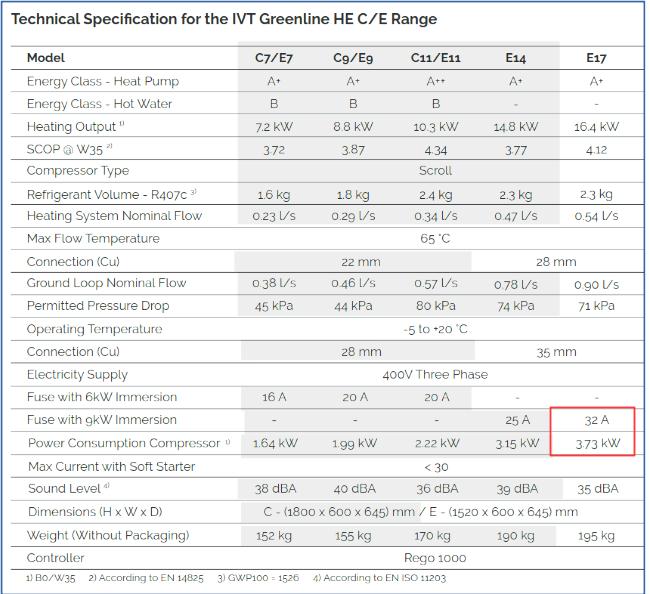
I've greyed out the specs which apply to the smaller models in the range.
You are correct that the heat pump lists a peak demand of 25A, but as you say, this will only happen the first time the system is started up from cold?
Well, ideally, yes.
But on this forum we've never yet heard of a heat-pump which is switched on once, correctly configured by the installer, and then continues to operate without 'cycling' on/off. 🤔
Invariably the installer puts thermostats into rooms or zones of the house.
When all rooms are 'up to temperature' then the heat-pump switches off.
Ie they treat it just like it's a boiler!
Every time the GSHP cycle switches it on again, it will draw 30A per phase until the compressor has raised the pressure in the circuits either side of the heat-exchanger.
PS. Keep asking the questions.
Everything you're querying is exactly what we'd like all heat-pump owners to ask!
Save energy... recycle electrons!

SPONSORS

Degrees of Separation
Latest Posts
-

RE: Indevolt Batteries UK Support & Info Thread
@editor Hi, To resolve this, please tap on the A...
By Indevolt Tech , 3 hours ago
-
RE: How will removing the standing charge on gas bills benefit heat pumps?
@toodles GIGO always stands! My Cosy 6, as you can...
By Watcher , 12 hours ago
-
RE: How much of your renewable and home setup would still work if the internet went down?
Interestingly we had an internet outage about a month a...
By Rob of York , 18 hours ago
-
RE: Double or Triple Glazed Windows?
Posted by: @singlespeed With 9 years repairing windo...
By Rob of York , 18 hours ago
-
@transparent we’re still running a secure version of PH...
By Mars , 22 hours ago
-
RE: How quickly would you want/expect heat recovery to take from setback?
Much longer than that here. The heating isn't even on. ...
By bobflux , 2 days ago
-
RE: Passiv Smart Thermostat - Help & Forum Support
Obviously the weather is changeable but there's a defin...
By Singlespeed , 2 days ago
-
RE: The Changing Jet Stream Could Challenge UK Air Source Heat Pumps
@rob-of-york I must admit that when we had a Daikin hea...
By Toodles , 2 days ago
-
RE: Forum updates, announcements & issues
Get the Renewable Heating Hub heads-up on WhatsApp. I...
By Mars , 2 days ago
-
RE: Safety study for plug in batteries out to tender - looks like Q3 2027 at best before legal
@editor I pointed out to the one of the Fuse execs that...
By dansus , 2 days ago
-
RE: 15kw pump for 225m2 1990's house - over kill?
@seaviews As well as loft insulation, there are othe...
By Rob of York , 2 days ago
-
RE: BT cuts you off, Plusnet blames Openreach... welcome to “seamless” broadband switching
Both of which (in most cases) use Openreach for the las...
By JamesPa , 2 days ago
-
RE: Renewables & Heat Pumps in the News
Yes, this is a swiss and german standard I believe, Vai...
By Batpred , 2 days ago
-
RE: Octopus Cosy 12 Heat Pump Regret: Incredibly Loud, Poor Heating & Constant Hum - Help!
@editor FWIW my problem was resolved, eventually, after...
By BigFish , 3 days ago


SPONSORS

