
Notifications
Clear all
Air Source Heat Pumps (ASHPs)
246
Posts
16
Users
36
Reactions
12.7 K
Views
Topic starter
09/12/2025 1:27 pm
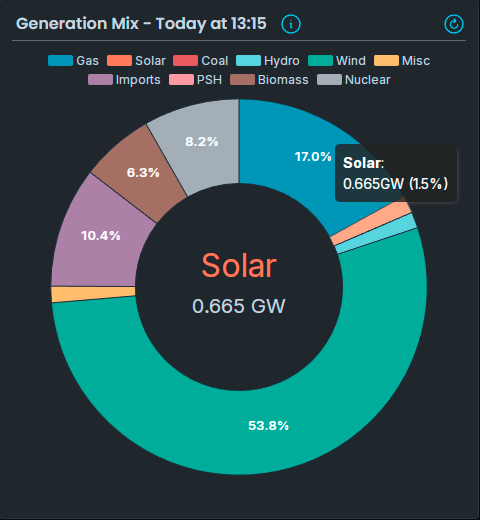
@jamespa — pickling the little grey cells in hopped water is nothing compared to the effects of using AI! The thing that stuck me about the AI response was the Morning Peak (defined rather oddly as 0600-1200, is midday really in the morning peak?) gCO₂/kWh is the same as the overnight (0000-0600) rate, both are said to be 80-100 gCO₂/kWh, which seems rather unlikely to me. Another things is the reliance on using solar to explain differences, when solar generation is typically a rather trivial contributor. Wind generation on the other hand is currently high because of Storm Bram (Bram? Where do they get these names from?):
Midea 14kW (for now...) ASHP heating both building and DHW

09/12/2025 1:27 pm
…it would be interesting to compare the average carbon intensity by time of day. I cant lay my hand on that statistic but it must exist somewhere!
I’ve been capturing carbon intensity into Home Assistant for quite some time. There was a hiatus with the API that resulted in my having to ditch what I had and start again, but I’ve got all the data for my region since 1st June (hourly readings) which I can send to you if you want.
105 m2 bungalow in South East England
Mitsubishi Ecodan 8.5 kW air source heat pump
18 x 360W solar panels
1 x 6 kW GroWatt battery and SPH5000 inverter
1 x Myenergi Zappi
1 x VW ID3
Raised beds for home-grown veg and chickens for eggs
"Semper in excretia; sumus solum profundum variat"
1
Topic starter
09/12/2025 1:33 pm
which I can send to you if you want.
Or perhaps post something here, suitably anonymised, though we already know is SE England? For folks using ToU tariffs and concerned about their carbon footprint, surely such information is gold dust?
Midea 14kW (for now...) ASHP heating both building and DHW
09/12/2025 3:35 pm
which I can send to you if you want.
Or perhaps post something here, suitably anonymised, though we already know is SE England? For folks using ToU tariffs and concerned about their carbon footprint, surely such information is gold dust?
No need for anonymisation; SE England is as granular as it gets for that API.
Here's the data.
I've just downloaded it from Home Assistant and uploaded as is. Anyone wanting to do any analysis on it will probably have to mess about with the date/times, though; Excel doesn't seem to like ISO standards quite that much.
105 m2 bungalow in South East England
Mitsubishi Ecodan 8.5 kW air source heat pump
18 x 360W solar panels
1 x 6 kW GroWatt battery and SPH5000 inverter
1 x Myenergi Zappi
1 x VW ID3
Raised beds for home-grown veg and chickens for eggs
"Semper in excretia; sumus solum profundum variat"
Topic starter
09/12/2025 5:08 pm
@majordennisbloodnok — thanks. The date/times will get treated as text strings as they have letters within them, at least in some spreadsheets, it is all a bit of lottery what happens. Replacing the T with a space and Z into nothing ("") might name them turn into date/times. LibreOffice Calc treats them as text. doing the T and Z cleanup turned them into dates.
I have to say I am most impressed by the decimal precision in the some of the 'state' column values!
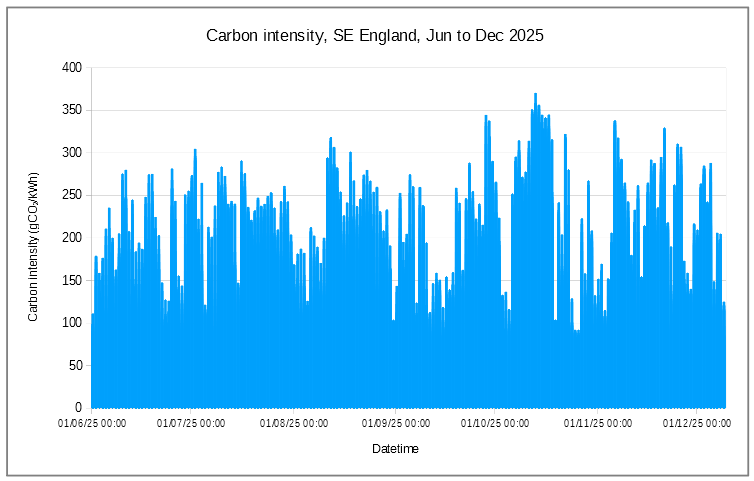
Here is a basic plot for the whole series. I think it rather puts the kibosh on the AI answer (AI range 70 to 150, actual range 30 to 369, at least for SE England) unless I have missed something obvious:
Midea 14kW (for now...) ASHP heating both building and DHW
09/12/2025 6:04 pm
@majordennisbloodnok — thanks. The date/times will get treated as text strings as they have letters within them, at least in some spreadsheets, it is all a bit of lottery what happens. Replacing the T with a space and Z into nothing ("") might name them turn into date/times. LibreOffice Calc treats them as text. doing the T and Z cleanup turned them into dates.
...
Agreed. The Excel alternative is to use the datevalue and timevalue functions along with the left and mid functions to extract the relevant parts of the date/time, turn them into dates and times and then smush them together as a single date/time value. Why Microsoft can't accept that ISO standards are there for a reason I don't know; they manage it with their databases. Never mind, I'll get back down from my hobby horse now.
...
I have to say I am most impressed by the decimal precision in the some of the 'state' column values!
...
Yes, a classic case of very precise but not necessarily accurate - these are estimates of carbon intensity after all, so precision to 14 decimal places is rather overkill
...
Here is a basic plot for the whole series. I think it rather puts the kibosh on the AI answer (AI range 70 to 150, actual range 30 to 369, at least for SE England) unless I have missed something obvious:
...
No, nothing obvious missed. Personally, I have my HA gauge showing green up to 100, yellow from there to 190 and red anywhere above that. 150 is most certainly not an upper bound at all, and I can't remember a day when the needle hasn't been in the red at some point.
105 m2 bungalow in South East England
Mitsubishi Ecodan 8.5 kW air source heat pump
18 x 360W solar panels
1 x 6 kW GroWatt battery and SPH5000 inverter
1 x Myenergi Zappi
1 x VW ID3
Raised beds for home-grown veg and chickens for eggs
"Semper in excretia; sumus solum profundum variat"
Topic starter
09/12/2025 7:47 pm
I will do the analysis on my data for November and post the results here once the analysis is done.
I have now done the analysis, but not for November 2025, because I forgot I wasn't running a setback then. Instead I did it for a period in March - April 2025 when overall I had reasonably stable conditions, but with 2100 to 0300 overnight setbacks, and a reasonable spread of OATs (outside air temperatures). This is what the basic data look like:
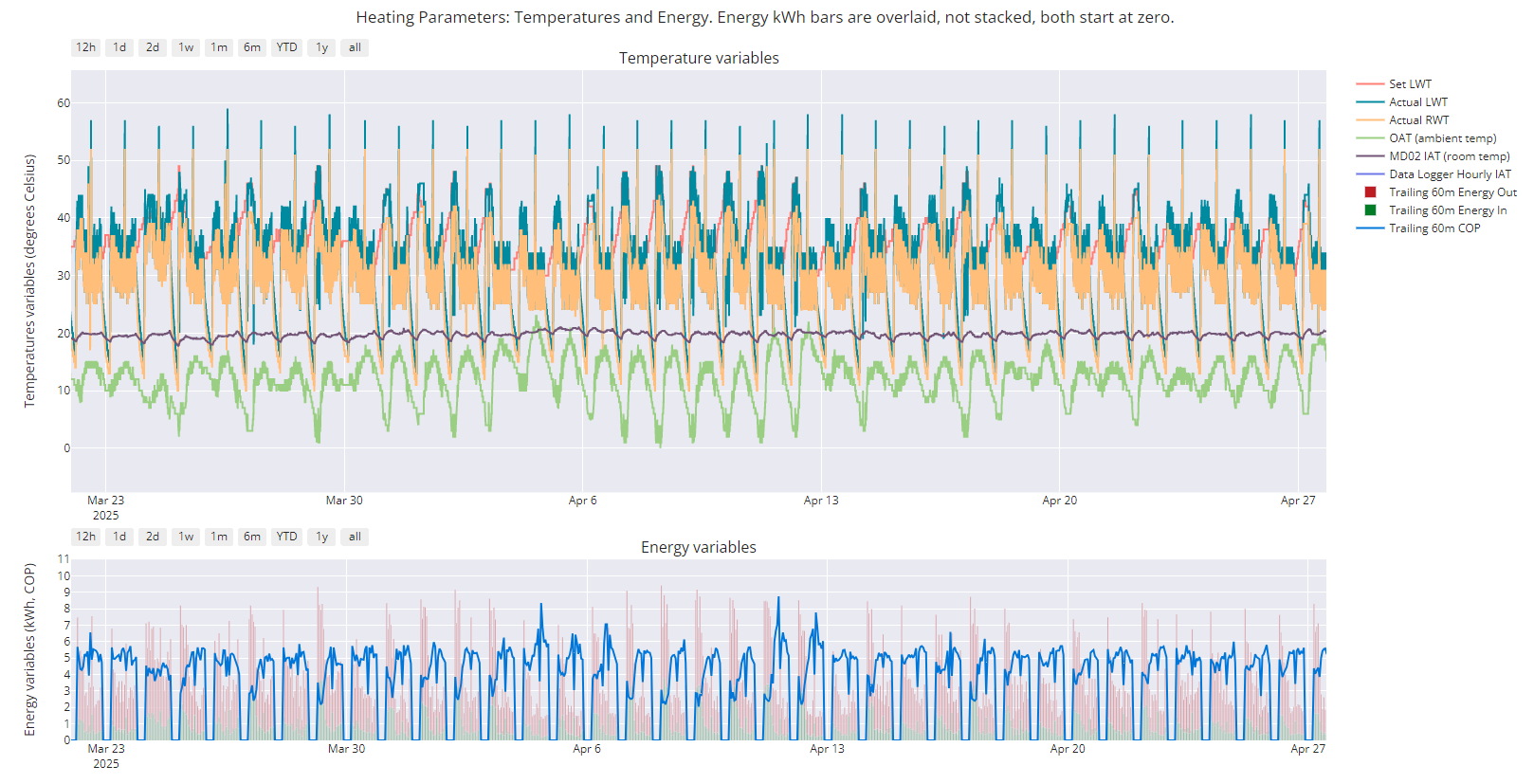
You can clearly see the setbacks, both in the MD02 IAT (room temp) and energy in and out. You can also just about make out the IAT recovery happened tolerably quickly on most days, with a mean IAT over the entire period of 19.7°C. You can also see the higher energy use (in the green bars, but of course also reflected in the red bars) during the recovery periods, but some of that is due to the usually lower OAT in the early morning.
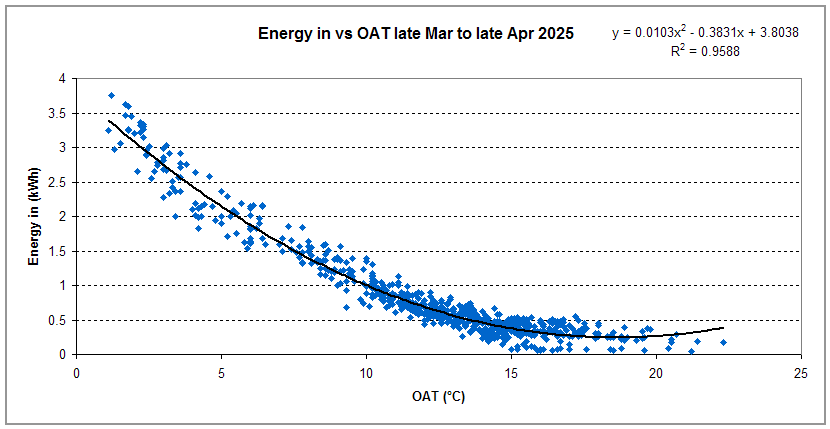
Now to the observed vs expected analysis. Recall that we are trying to work what the expected energy use would have been had I not had a setback, and we will then compare that to the observed energy use. We already have the observed values, they are in the data. To calculate the expected values, I started by doing a regression analysis of the OAT values against the energy in values for the hours when the heating was on, ie I have excluded the setback hours, because they will bias the result. This will give us the regression equation for the line, which I consider is best treated as a polynomial, ie is is not a straight line, but rather a curve, because the energy needed at lower OATs is disproportionately higher because of the lower efficiency at lower OATs (you need to put in more kWh in per kWh out at lower OATs). The plot, regression line and regression equation (top right) look like this (R2 at 0.9588 is also reassuringly high):
Next, I took the regression equation, and put it in a new column called Expected, and used it to calculate the expected energy in for the OAT for each hour. As a sanity check, I then plotted both the observed and the expected values on the same chart, expecting to see the expected values lying pretty much in the middle of the observed values, which is what I got. Note that the observed values sitting on the X axis are the setback hours, then have simply dropped out of the main plot because there was no energy in during those hours:
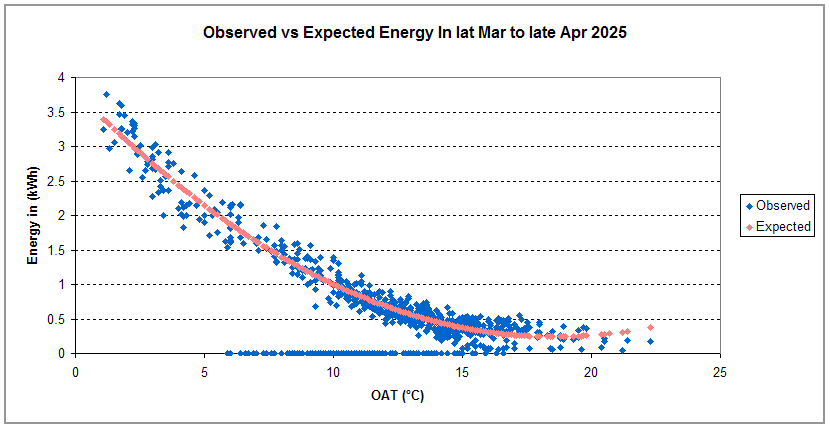
Given that looks credible, ie the expected values lie where I would expect them to be, I then summed the total energy in for the observed column, which tells me what I actually used, with the setback running, and then did the same things for the expected column, which is an estimate of what I would have used without the setback. The results are:
Observed Energy Use with a setback: 567kWh
Expected Energy Use had I not had a setback: 769kWh
On this analysis, to which all the normal caveats apply — it's one particular period in one particular setting, and I may have made some terrible mistake in the analysis, though I don't think I have — I appear to have saved around 202kWh, or 26% of the energy that I would have used had I not had a setback. Some of that saving will have accrued because the mean IAT was a bit lower, but I rather doubt that accounts for much. The actual mean IAT over the entire period was 19.72°C. If I rather crudely remove the effects of the setbacks on the IAT by saying that any IAT less than 19.7 will be revised upwards to 19.7°C, then the mean comes out only a little higher, at 19.91°C. Even if we were to say a there would be a 1°C rise in IAT and that would use uses an extra 10% of energy, then that still leaves an unexplained 16% saving.
I attach the zipped spreadsheet in case anyone wants to inspect my workings:
Edited to remove white space and correct some typos
This post was modified 2 months ago by cathodeRay
Midea 14kW (for now...) ASHP heating both building and DHW
1

10/12/2025 3:54 pm
interesting post. so at the moment ive got Havenwise controlling my heating which doesnt have a setback option. if i go back to using the Vaillant app only and have a daytime setpoint of 20.5c what would be the best night setback to save energy?

10/12/2025 4:08 pm
@adamk my suggestion would be to try
-1deg say 1 hour before normal bedtime. And back to 20.5deg 1 hour before getting up
Tweaking both temperature and timings to suit your heat loss/usage etc
Its unlikely you'd use a setback of more than 2 deg - it takes too long to come back to temp if you lose that much heat
Listed Grade 2 building with large modern extension.
LG Therma V 16kw ASHP
Underfloor heating + Rads
8kw pv solar
3 x 8.2kw GivEnergy batteries
1 x GivEnergy Gen1 hybrid 5.0kw inverter
Manual changeover EPS
MG4 EV
1

10/12/2025 4:14 pm
Dont forget that, as @tim441 points out earlier, if you have a cheap night-time rate a set forward (ie setting a higher temperature at night) may save some money, albeit at the expense of a bit of energy. If you do and Havenwise know about your tarrif I believe that they take account of this.
4kW peak of solar PV since 2011; EV and a 1930s house which has been partially renovated to improve its efficiency. 7kW Vaillant heat pump.
2
10/12/2025 4:40 pm
Dont forget that, as @tim441 points out earlier, if you have a cheap night-time rate a set forward (ie setting a higher temperature at night) may save some money, albeit at the expense of a bit of energy. If you do and Havenwise know about your tarrif I believe that they take account of this.
i did try tariff optimisation but it tried cooking us. missus liked it but it was setting the indoor to 28c during the cheap rate electric, fortunately it never managed to get that hot.
ive got batteries so need to optimise the out of cheap rate usage more than the night time. reducing the night time just helps reduce my overall cost.

10/12/2025 4:51 pm
@cathoderay i’m getting different results, using this method:
calculate the average kWh/inside outside deltaT Kelvin (sum(kWh in)/sum(deltaT), that comes out at 0.082. kWh/K.
Then multiple that with the deltaT if you had no cutback (sum(kWh)/sum(20-outside t)). And that gives a barely different total kWh in. Concidering that the average average inside t is 19.9 that’s no surprise.
its not a big surprise, as you house is well insulated and the saving is basically the reduced inside temp vs. Outside temp and that’s around 1K at the end of the night. So probably 6h*1K/2*0.082kW=0.246 kWh saving per night.

Latest Posts
-
RE: If a heat pump can only heat DHW to 50C then what? Issue with 18KW Heliotherm heat pump
Hi, Nothing yet. I've asked customer to measure flow...
By errmm , 4 hours ago
-
RE: High Temp Heat Pumps for fast warm-up of house
I don't know exactly how long it takes to heat up (and ...
By JamesPa , 5 hours ago
-
RE: Need help maximising COP of 3.5kW Valiant Aerotherm heat pump
OK. What Im seeing looks fairly normal TBH: 1 start ...
By JamesPa , 6 hours ago
-
RE: Vaillant Tech Support Flagged Low DT: UFH Return Cold, Suspected Zero Flow
@editor thanks for the tips which I will try before cal...
By DavidB , 8 hours ago
-
RE: Daikin 6kw setup with Dixell controller
@jamespa Many thanks for your reply, a very detailed an...
By CraigH , 8 hours ago
-
RE: Exploring the role of alternative clean heating solutions - Government Consultation
Despite reservations, I found some time to respond to t...
By Rusty , 8 hours ago
-

RE: New Vaillant aroTherm Plus in black - When will it come to the UK?
@crankplus, nope, still not, and I've followed up with ...
By Mars , 8 hours ago
-
RE: Octopus Cosy Heat Pump Owners & Discussion Thread
@agentgeorge Probably, but temperature change at -10 ha...
By AndrewJ , 9 hours ago
-

RE: External wall insulation - your experience
To be clear, my experience was very positive. The journ...
By Batpred , 11 hours ago
-

@foxesfan Re: ‘Servicing’ as @editor has covered in his...
By Toodles , 11 hours ago
-
RE: A Smarter Smart Controller from Homely?
@benson No idea why mine doesn’t work, all I see on ...
By Papahuhu , 12 hours ago
-
RE: Battery sizing - How low can you go!
It seems I am seeing something similar to what you do, ...
By Batpred , 13 hours ago
-
RE: Gaslighting in the heat pump industry – has anyone else experienced this?
Don’t know if this is relevant to this thread, but my A...
By Gruff2001 , 13 hours ago
-
RE: Bosch CS5800i 5kW - Experience So Far
@majordennisbloodnok While getting Home Assistant runni...
By Steelbadger , 1 day ago
-
RE: MCS - BS EN 12831-1:2017 – Heat Loss Survey
Since May 2025 it no longer a requirement in England to...
By JamesPa , 1 day ago
-
RE: Air source heat pump roll call – what heat pump brand and model do you have?
Forum Handel @jancold Manufacturer: Daikin Model: E...
By Jancold , 1 day ago
-
RE: Octopus Cosy 12 Heat Pump Regret: Incredibly Loud, Poor Heating & Constant Hum - Help!
@harriworld it was roughly 3am for an hour as that’s ...
By L2jad , 1 day ago
-
RE: Hoped for improvements not being realised on my Mitsubishi heat pump
I have been wondering that myself. The fact is that, ...
By JamesPa , 1 day ago
-
RE: Filtering Tap Water – Share Your Setup for Cleaner, Better-Tasting Water
I remember when I was in my early 20s I was introduced ...
By Majordennisbloodnok , 1 day ago
-
RE: Setback savings - fact or fiction?
But if it is recorded an an integer, which it seems it ...
By cathodeRay , 2 days ago