@jamespa yes I see what you mean. I think what was on my mind is how to read the impact of the eventual drop in return temperature water. What I’ve noticed is that some radiators are very close to the primary pipe end and so the cooldown is quite quick to appear on the graph. Lots of things happening at different times.
Exactly. I think it would be naive to view the heating system as a simple FIFO delay line because there are multiple paths through it. Nevertheless 200l takes 10 mins (in my system) so a simple argument says its that long before what went in 10 mins ago is fully flushed through - although maybe not - if the water coming in is colder it may track along the bottom of radiators and just go straight through - who knows and certainly it differs by system and if you have a buffer its anyone's guess. One way or another though the effects could reverberate for some time and unpacking it at this level may not even be possible.
I confess I haven't followed the full discussion over defrost so Im not sot sure where this takes us, other than to warn us to be careful about conclusions which rely on coincidence (and possibly even sequence) of timings.
4kW peak of solar PV since 2011; EV and a 1930s house which has been partially renovated to improve its efficiency. 7kW Vaillant heat pump.
If the OAT is rising then less heat will be lost by the property and hence during the recovery less heat will be needed to be generated by the heat pump.
Of course weather compensation will lower the LWT as the OAT rises, but that rise in that chart is over 12 hours, while an individual defrost lasts minutes. For all but one, possibly two, of the defrosts shown above, the OAT is stable, in which case any effects during the defrost eg slower recovery ramp up won't be attributable to a rising OAT via the WCC won't apply because the OAT hasn't changed.
The energy in (electricity) and energy out (heating/cooling of the water) is recorded, what other energy do you suggest? Solar gain could be playing a part in some of these defrosts but there are no clear indications of increased solar gain during the the relatively short defrost periods.
I was just re-phrasing a question I have asked a number of times before: if we accept the conservation of energy principle, as of course we do, and yet the energy in and out balance shows a deficit (the energy lost during a defrost/setback is not fully replaced during the recovery, yet the IAT remains stable), then are we perhaps missing some other energy flow/effect? I certainly don't think it is solar gain, as you say defrosts are too short for solar gain to have any discernable effect and furthermore many defrosts happen at night or in dull weather. But could there be something like solar gain in play, that is something that doesn't show up in the energy in/out data as measured? That is the question I am asking. One possible candidate is heat (energy) stored in the building's fabric.
MID is an EU directive on measuring instruments, it means that the sensors used are certified to be to a level of accuracy and so some confidence can be placed on their readings. Unlike, for example, the thermistors used by heat pump manufacturers to measure water temperature that are typically only accurate to 0.5C and are attached to the outside of the pipework and not in the water. The metering is more consistent and accurate than any other easily available source, manufacturers will have better monitoring in their labs but they don't share that data.
I know what MID monitoring is at a formal regulatory/commercial level, my question is how do we know the individual heatpumomonitor.org installations are up to scratch? In most but not all cases these installations will not serve any commercial function, they are just done for the individual owner's interest, just as, in fact, I do my monitoring for my own interest. No one but me has checked my setup, I could be monitoring all the right things, but not necessarily in the right order,or whatever, and no one, including me,would be any the wiser. Or perhaps even worse, I might deliberately set out to deceive. The question I am asking, which remains valid, is how do we know that all of those 600+ data sets (which falls to only 200+ data sets if we only include full MID monitoring with at least a years worth of data) available on the heatpumpmonitor.org were collected using valid monitoring setups? The answer may be we don't, and never will, but it is not unreasonable to assume most if not all are OK, but nonetheless be mindful of the possibility they may not be OK.
How representative are the contributors to this forum? Are we representative of the multitude of people who own a heat pump? I doubt it.
This, the n=1 problem, comes up all the time. All of the charts we are considering in the present discussion are all n=1 charts: how one particular heat pump behaved in relation to one particular building a particular set of ambient conditions. Are we who do the monitoring representative of all heat pump owners? I would go further than 'I doubt it' and say with some confidence of course we are not. For starters, we monitor our heat pumps, which the others don't do. It is also, I suggest, more likely that we do what we can to optimise our systems. If true, that means we are definitely not representative, and our systems are probably not representative. Does that mean we should give up posting results and discussing them? I don't think so, because although non-representative, we may learn general lessons that are more generally applicable.
So the goal is to show what is possible and what good looks like, what is so wrong with that? The evidence is the mass of data available from the 600+ heat pumps, which is 600x more data than any one of us has individually. And the probability of 600+ systems being closer to representative, or just your or my system alone?
It's a reasonable thing to do, and it is to their credit they make it explicit, but it is marketing, not science. It is not very different to a pharmaceutical company showing their latest drug works. It's all about intent. And then there is the problem of efficacy vs effectiveness (what can be achieved in the lab vs what can be achieved in the real world). Even if a group heat pump enthusiasts with detailed monitoring can demonstrate impressive results, it does not necessarily follow the same impressive results will be achieved in the real world. The problem is selection bias: the people doing the monitoring are self selected. Not only are they enthusiasts, they are also I suggest more likely to post positive results, and not post negative results, another well known cause of bias. And finally, the proper n equals number is not 600+, it is 200+ for full MID with at least a years worth of data. Given there are around 200,000 to 300,000 (bit of a scandal no one really knows) heat pump installations in the UK (source: MCS 250,000 certified installations in Aug 2024 plus maybe another 50,000 for 2025, government grant assisted installations 183,294 in Sept 2025), taking a middle estimate of 250,000 installations, the n=200 is around 0.08% of all heat pumps. And, as I say, that 0.08% is self-selected.
That doesn't mean we should not collect publish and analyse the data, of course we should. But at the same time we should incline towards being sceptical (not in any nasty way, more in an objective way) rather than credulous.
That's cumulative over a year, the sum of heat delivered in a year at 5C is far greater than at -5C because 5C OAT occurs much more often.
No doubt you are right, but nowhere does it say it is cumulative, and I am nonplussed about what such a charts adds to our understanding, given we already know that the cumulative annual energy produced at an OAT of 5°C will be greater than that produced at an OAT of -5°C. Just because you can produce a chart, it doesn't mean you should produce a chart.
And from there you can zoom and pan, plus press the SHOW DETAIL button to get more info and switch on more info like COP and flow rate.
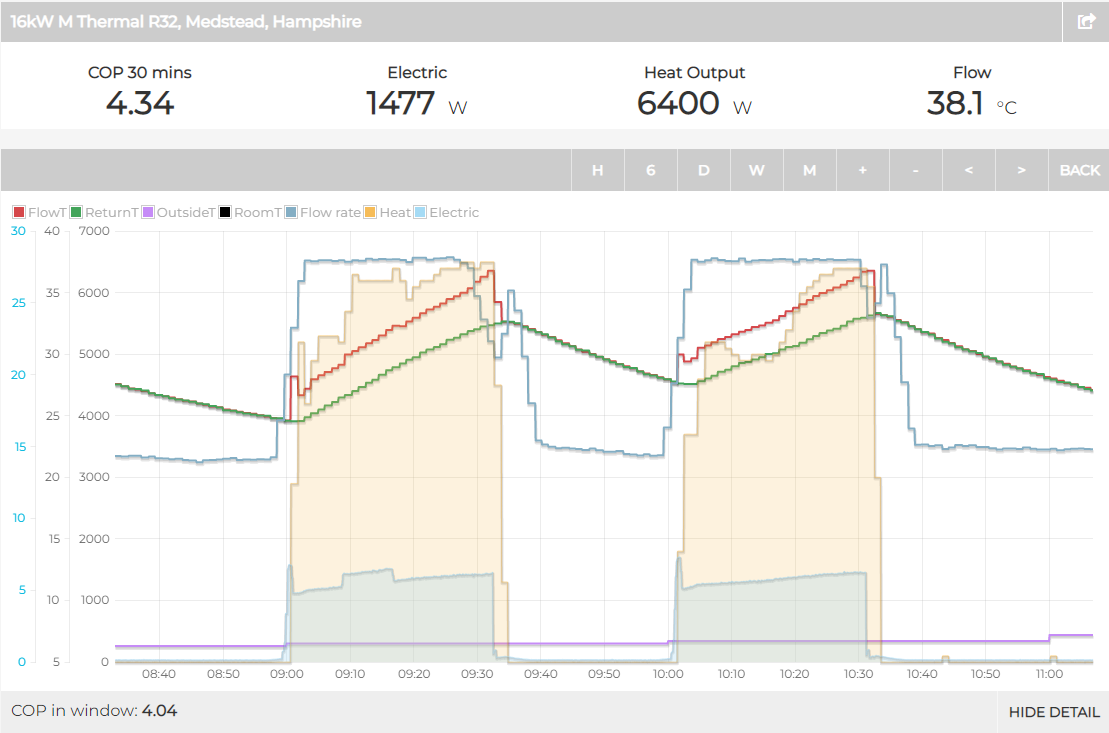
Thanks for the instructions, I can now see the detail, eg this for the 16kW Midea installation I looked at earlier:
This shows normal Midea hourly cycling from a couple of days ago, and allowing for the different presentation (I chart the temperature and energy variables separately on my normal charts), is very similar to my charts, which is of course a good thing, insofar as each data set independently confirms the other.
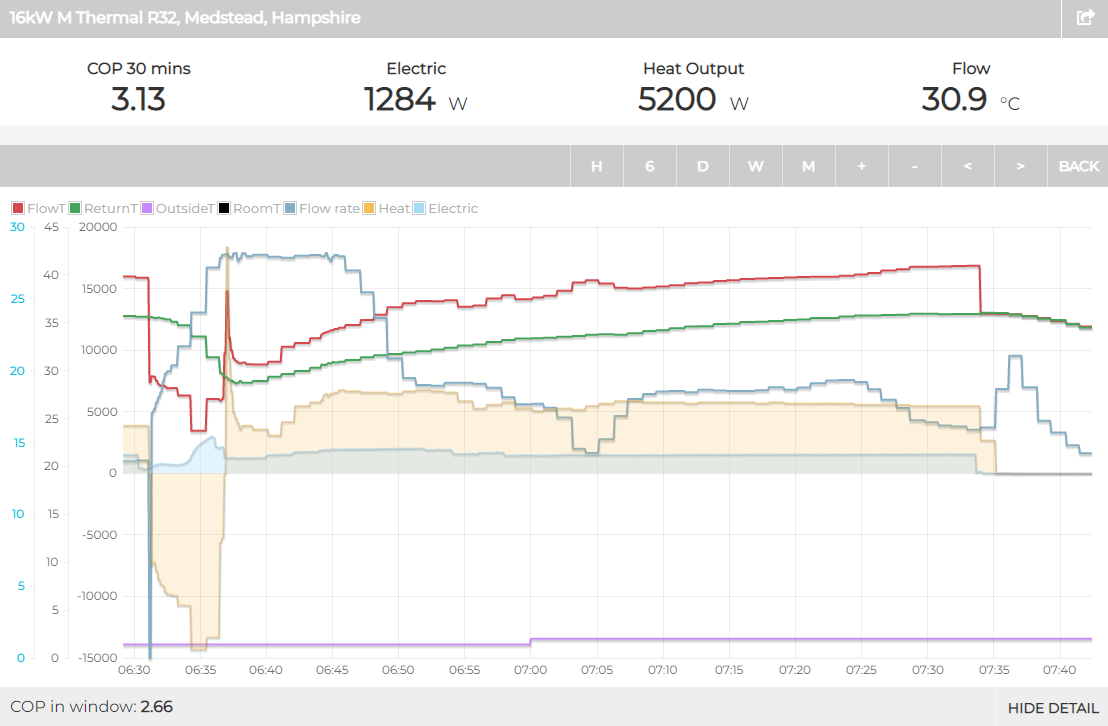
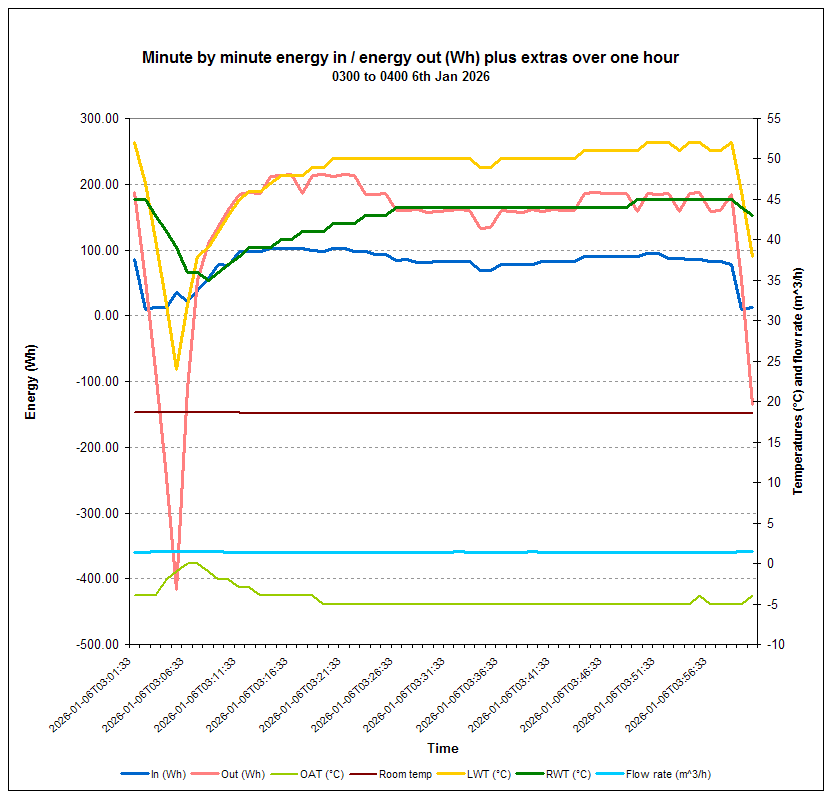
However, defrosts are different in detail. Here is one from the same unit a few days earlier:
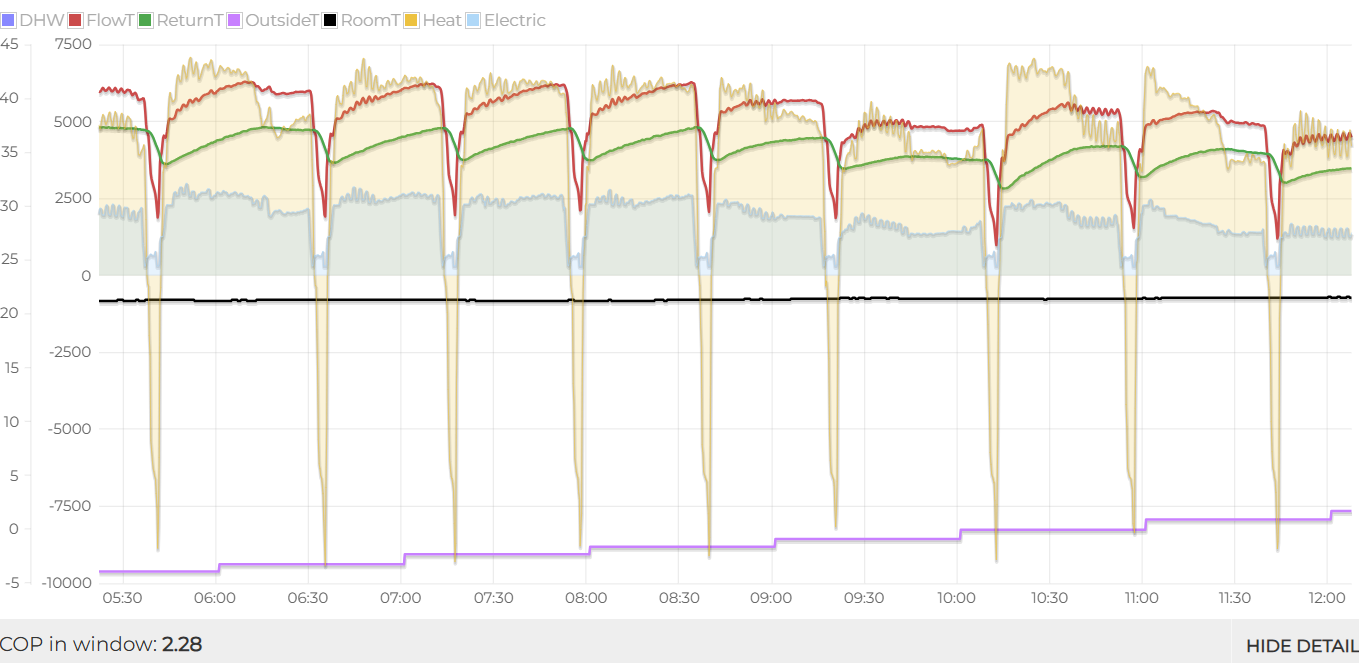
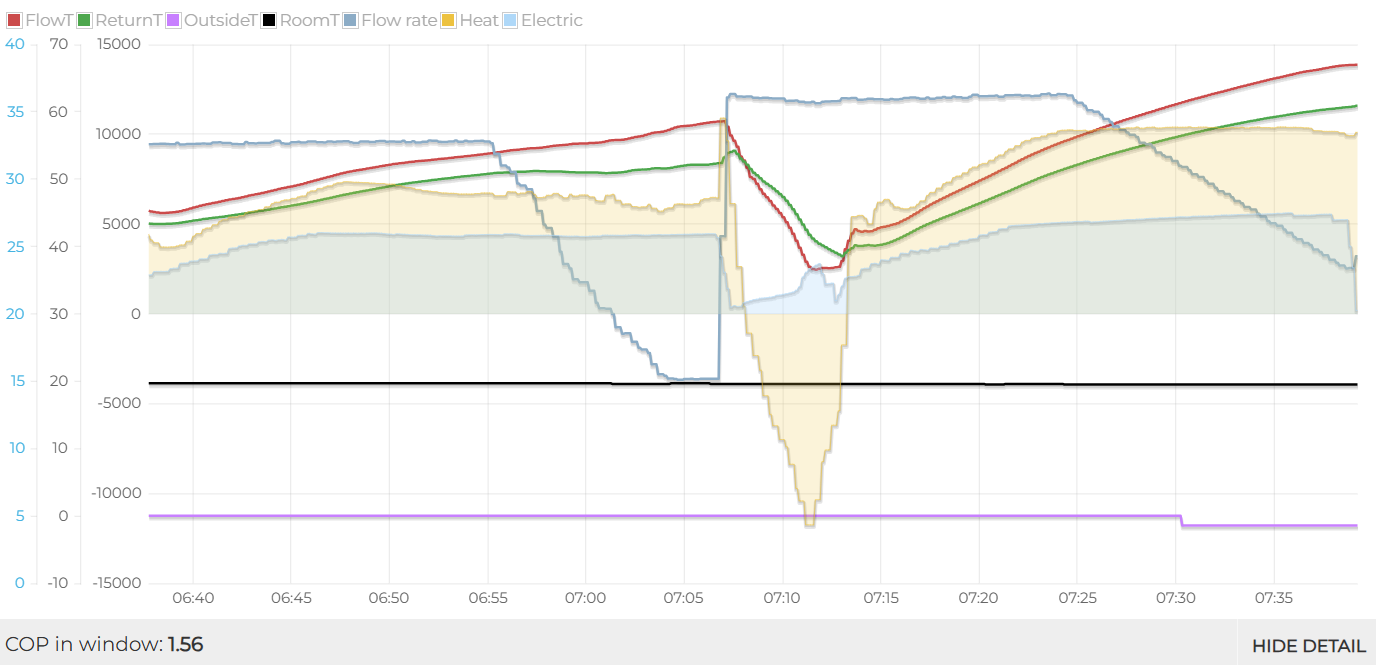
and here is mine again, with broadly the same variables:
The overall story is similar, but the details is different, in particular the recovery bump in energy in happens at different times, during the defrost itself in the upper chart, after the defrost in the lower chart. The other obvious difference is the flow rate, wide variation in the upper chart, effectively none in the lower chart. These differences need to be reconciled. It would also be interesting to do area under the curve calculations against an estimated energy in without a setback for the energy in, and see how they compare.
They show what is really going on, using temp sensors with 0.1C accuracy and logging data several times a minute. Sadly your data uses the manufacturers thermistors for temperature (only 0.5C accurate, so system dT could really be 10-20% different) and logged only every minute (?), so in a 5-7 minute defrost you only have 5-7 data points and so miss quite a lot of detail.
All of the systems tell a credible story, just with more fidelity than most people are used to.
Yes, my data is only every minute, so yes, less fidelity, but I am not going to burst into tears over that, or wail over the fact that I use the Midea sensors, which I have frequently said may be subject to all sorts of different influences. It is a compromise: I think I get 'good enough data' without adding the expense and complexity of full MID monitoring. The checks I use for 'good enough' are the heat pump only independent kWh meter for energy in, the analogue flow meter for flow rate, and IR readings (which I know are far from perfect) for flow and return temps.
I have made it clear I personally find aspects of the heatpumpmonitor.org's approach tiresome, but I should not let that get in the way of the fact they do bother to collect a lot of data, and, once you know how to access it (the fact this isn't immediately obvious is an example of tiresomeness), they do publish a lot of that data, all of which is very much to their credit. It is time for me to stop being grumpy, and start looking at the data with a fresh set of eyes.
Midea 14kW (for now...) ASHP heating both building and DHW
So in my above theory where I thought the reheat was possibly from the compressor I believe the reheat activity in section B is purely from the Return Water flowing through the PHE without any heat from the compressor. However by the time the process reaches the 2 minutes at point C there have been occasions where small amounts of extra heat is starting to be created. And in the new graph above you can see definite signs of increased energy in the 2 minutes of the area C.
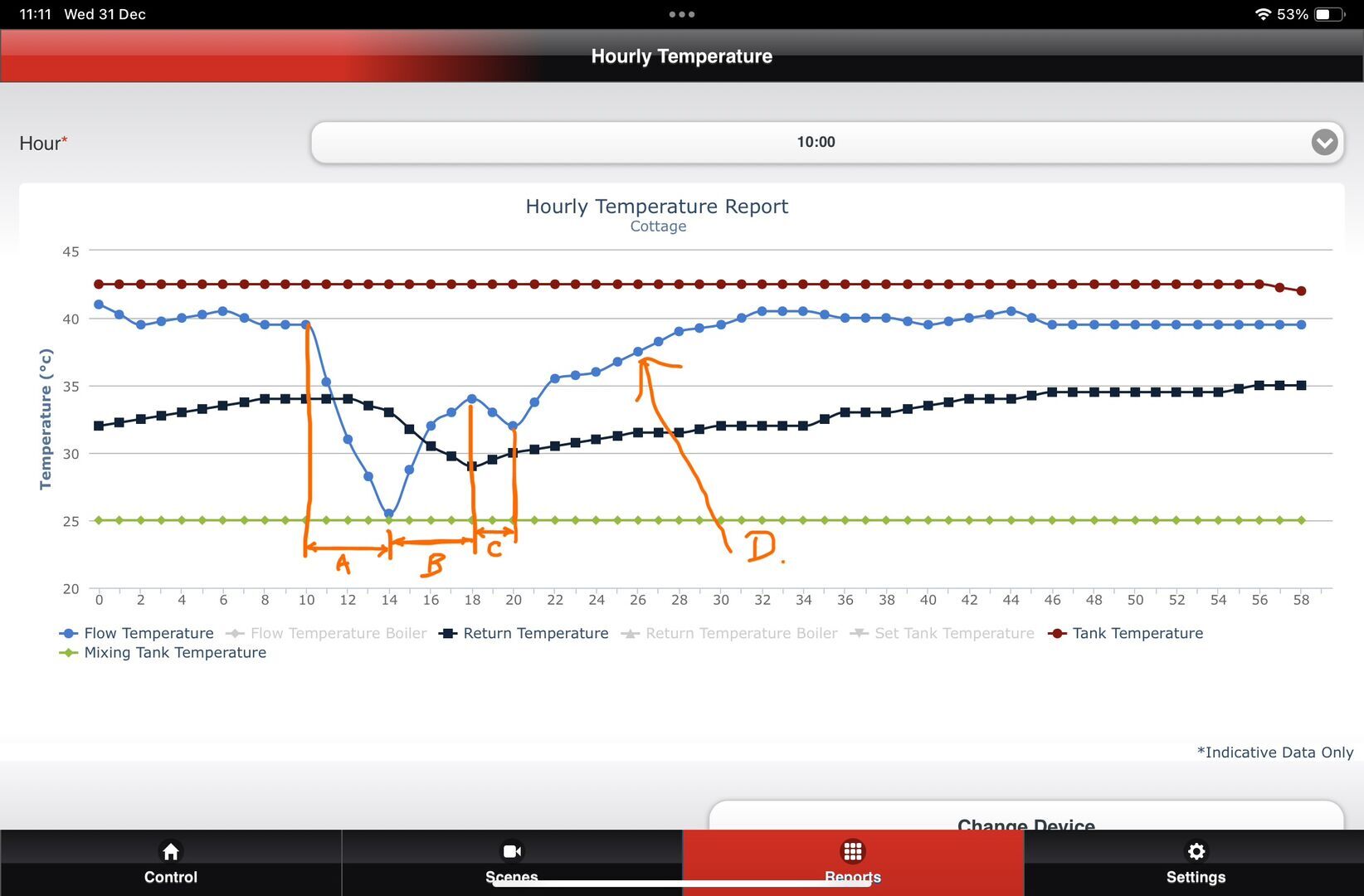
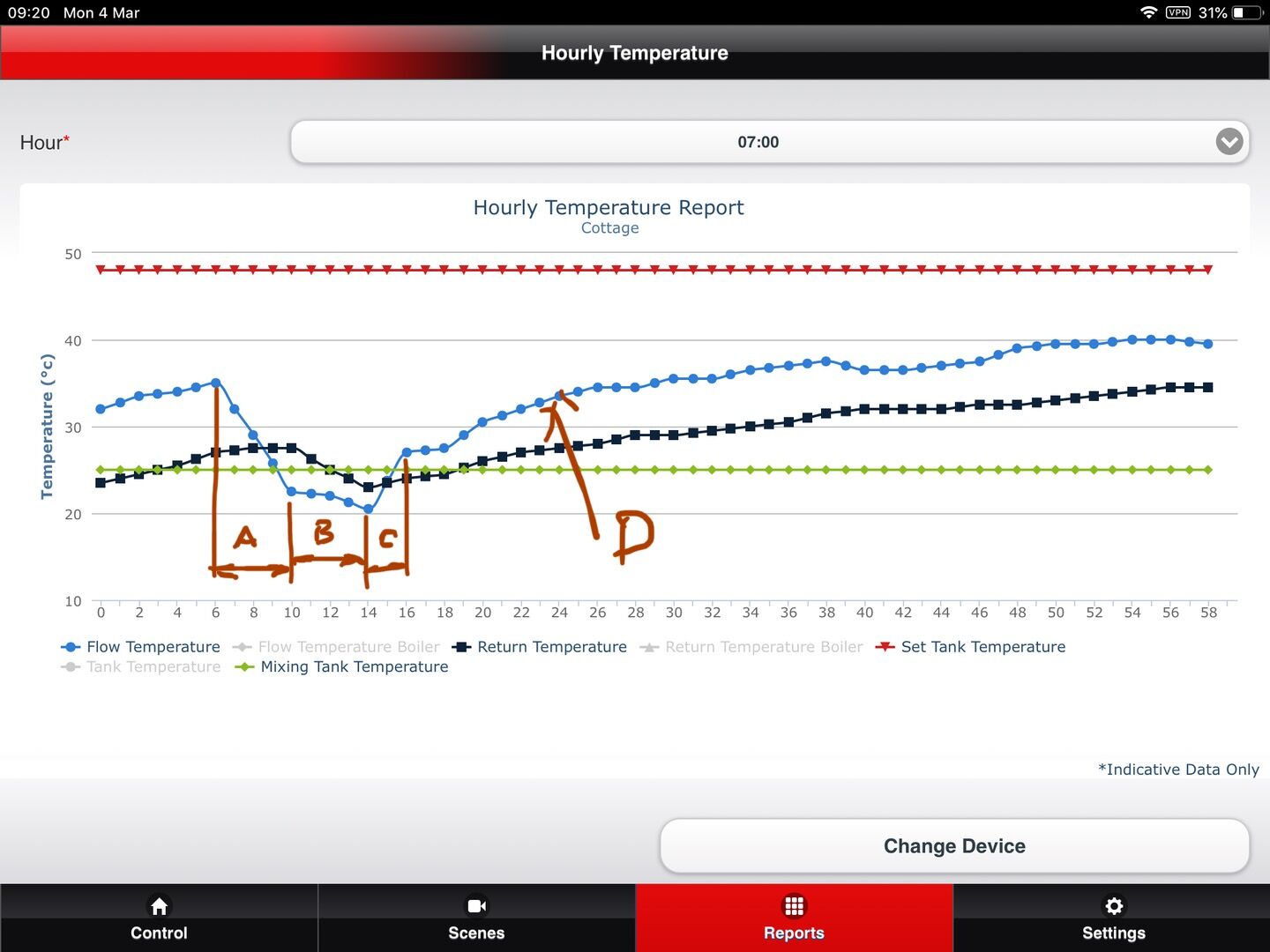
Hi I’ve reposted the two contrasting defrosts from the above post and re labelled them so the contrasting defrost periods can be compared. They are described as :-
Period A = 4minute defrost
Period B = 4 minute return water reheat.
Period C = 2 minute sometimes active boost sometimes inactive period.
Period D = apparent ramp up to target flow temp.
here is the first graph I posted which is a typical of our defrosts showing good heat transfer before the return water temp drops - the resulting temperature drop caused by the defrost. There is no active boost seen in Period C.
In the above graph the return water temperature is high enough to reheat the plate heat exchanger and raise the flow temperature at the LWT thermistor more than 8c rise. This would allow the compressor to take over heating at the normal return temperature however this is just before the cold slug of water has arrived which has been circulating the radiators.
The next graph shows the defrost when it occurred just after the morning startup. It went straight into defrost 15 minutes into the morning startup. The return temperatures were still climbing and we’re not high enough to add any raised flow temperature after the defrost.
In fact the 4 minute period-B which in usual circumstances should be reheating only serves to reduce the flow temperature still further. However at period C there would appear to be some method where supplementary heat is added to raise the flow temperature. Is this the compressor releasing heat earlier than usual? Or is it always capable of adding heat this early after a defrost?
I guess this is also a glimpse into how a lack of system volume affects operating temperatures during defrosts, puts a strain onto the compressor and can cause a heat pump to struggle to recover.
Can I ask you to explain what you see as the energy attributable to the defrost and defrost Recovery. To my mind there are some energy activities which are just as likely to be applied by the set target flow temperature and that the target is a manually set target.
My view is that if it is the target flow temperature of the WC CURVE that operates after the defrost it could easily hide the extra energy needed to replace lost operating time simply because the weather curve is set to reach the target during defrosts.
There has also been lost time of heating taken up by the defrost and reset. This amounts to approx 20% heating time per hour based on one defrost per hour. My thoughts are that the system has to operate at a slightly higher temperature to properly recover and simply returns to Weather Compensation control as in position D on the graph I posted above. And continues to heat until the target flow temperature is reached. Do you see a different scenario to this?
The cold slug of water which has entered the heating system over the 8 or 10 minutes would obviously not have occurred had there not been a defrost. So it would be interesting to know where this appears in the recovery process.
I covered the energy flows, with the numbers, in great detail in https://renewableheatinghub.co.uk/forums/postid/56298/ . The energy used by the defrost (and the energy not delivered to the house during the defrost, etc.) was accounted for in the post-defrost recovery period, based on the IAT having remained constant and conservation of energy being preserved.
On another perhaps smaller point, the defrost commences by using stored energy in the form of high pressure refrigerant. This is refrigerant which is already pressurised and would normally be used to transfer heat into the building -Instead of heating the ice and pavement. Isn’t this more energy lost to the heating of the home and needs to be repaid to home heating. I think you said you can account for the energy used in the defrost but what accounts for the lost pressurised refrigerant?
What are your thoughts
The compressed refrigerant between the compressor and the 4-way valve will now go directly to the evaporator coils (thus starting the defrost process) and the refrigerant between the 4-way valve and the PEX will flow back to the compressor (from where it will flow on to the evaporator coils). So the energy won't be wasted.
If the OAT is rising then less heat will be lost by the property and hence during the recovery less heat will be needed to be generated by the heat pump.
Of course weather compensation will lower the LWT as the OAT rises, but that rise in that chart is over 12 hours, while an individual defrost lasts minutes. For all but one, possibly two, of the defrosts shown above, the OAT is stable, in which case any effects during the defrost eg slower recovery ramp up won't be attributable to a rising OAT via the WCC won't apply because the OAT hasn't changed.
The OAT in the above is from a Mett Office API and representative rather than the actual OAT, hence the staggered rise in temperature - the real OAT doesn't rise in discrete steps.
But could there be something like solar gain in play, that is something that doesn't show up in the energy in/out data as measured? That is the question I am asking. One possible candidate is heat (energy) stored in the building's fabric.
That's entirely possible, a property with a large thermal mass might be able to "ride out" a defrost better. But considering this over a multi-hour period, if the thermal mass was to allowed to cool (the system running a deficit) then it is likely that the IAT will start to drop. But in the example above we don't see that, so therefore is seems likely that the thermal mass is also reheated post-defrost.
I know what MID monitoring is at a formal regulatory/commercial level, my question is how do we know the individual heatpumomonitor.org installations are up to scratch?
The sensors are certified to a good standard, the installation instructions include where to and where not to install the sensors, the recording is done on a Pi with a custom PCB attached (the PCB details and design are in their repo) and the software is open source (and in their repo). Are all up-to-scratch, maybe not, but there's nothing very difficult about the installation or setup, so the vast majority will be.
This, the n=1 problem, comes up all the time. All of the charts we are considering in the present discussion are all n=1 charts: how one particular heat pump behaved in relation to one particular building a particular set of ambient conditions.
For popular models there are many systems on OEM, so the n becomes 10-15 if you wish to compare and contrast.
It's a reasonable thing to do, and it is to their credit they make it explicit, but it is marketing, not science. It is not very different to a pharmaceutical company showing their latest drug works. It's all about intent. And then there is the problem of efficacy vs effectiveness (what can be achieved in the lab vs what can be achieved in the real world). Even if a group heat pump enthusiasts with detailed monitoring can demonstrate impressive results, it does not necessarily follow the same impressive results will be achieved in the real world.
It's mostly engineering (collecting and presenting data), with indirect marketing and a potential for science from the data set created. The data isn't lab data, it's real world as these are real systems in real houses in the real world. How is a group of heat pump enthusiasts demonstrating the effectiveness of low flow temperatures from (mostly) open loop systems that have been well designed and installed not real world?
The problem is selection bias: the people doing the monitoring are self selected. Not only are they enthusiasts, they are also I suggest more likely to post positive results, and not post negative results, another well known cause of bias. And finally, the proper n equals number is not 600+, it is 200+ for full MID with at least a years worth of data. Given there are around 200,000 to 300,000 (bit of a scandal no one really knows) heat pump installations in the UK (source: MCS 250,000 certified installations in Aug 2024 plus maybe another 50,000 for 2025, government grant assisted installations 183,294 in Sept 2025), taking a middle estimate of 250,000 installations, the n=200 is around 0.08% of all heat pumps. And, as I say, that 0.08% is self-selected.
The monitoring logs and posts all the results - they are live feeds, there's no filtering of just the positive stuff! Which is quite clear from the SCOPs of the systems, from 5.2 down to 2.2 for the 200+ with MID monitoring. Okay, if you are only going to consider the 200+ with full MID then is your system, like the other 400, to be disregarded? 0.08% is still much better than 0.0004% (which is also self-selected) that represents one system.
That's cumulative over a year, the sum of heat delivered in a year at 5C is far greater than at -5C because 5C OAT occurs much more often.
No doubt you are right, but nowhere does it say it is cumulative, and I am nonplussed about what such a charts adds to our understanding, given we already know that the cumulative annual energy produced at an OAT of 5°C will be greater than that produced at an OAT of -5°C. Just because you can produce a chart, it doesn't mean you should produce a chart.
Maybe it could say it's cumulative but it's got two date pickers, so it's the values between those dates. Also, just because you don't get anything from the chart doesn't mean others won't.
However, defrosts are different in detail. Here is one from the same unit a few days earlier:
and here is mine again, with broadly the same variables:
The overall story is similar, but the details is different, in particular the recovery bump in energy in happens at different times, during the defrost itself in the upper chart, after the defrost in the lower chart. The other obvious difference is the flow rate, wide variation in the upper chart, effectively none in the lower chart. These differences need to be reconciled. It would also be interesting to do area under the curve calculations against an estimated energy in without a setback for the energy in, and see how they compare.
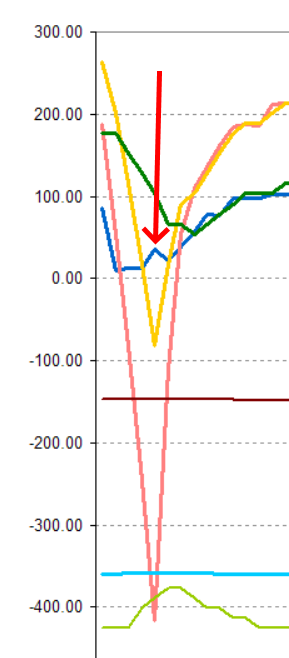
The power in bump seems to be during the defrost in both cases, the red arrow pointing to the input power bump between the drop and rise in yellow flow temp line:
Also the other Midea on OEM is much the same:
The other Mideas clearly have variable flow rates, presumably PWM controlled pumps?
I have made it clear I personally find aspects of the heatpumpmonitor.org's approach tiresome, but I should not let that get in the way of the fact they do bother to collect a lot of data, and, once you know how to access it (the fact this isn't immediately obvious is an example of tiresomeness), they do publish a lot of that data, all of which is very much to their credit. It is time for me to stop being grumpy, and start looking at the data with a fresh set of eyes.
The UX/UI of OEM is a bit dated but it works and it's consistency of presentation (of many systems) is a distinct positive.
The OAT in the above is from a Mett Office API and representative rather than the actual OAT, hence the staggered rise in temperature - the real OAT doesn't rise in discrete steps.
But if it is recorded an an integer, which it seems it often is, and certainly is on my system, then steps will appear. The other key thing about the Midea 'Ambient' is that it isn't the true ambient, it is the AIT (air intake temperature) because the sensor is in the body of the heat pump, near the air intake. There has been considerable debate about how much this matters (put another way, is it a good proxy for the actual local OAT?), and whether the recorded baseline is below the true local OAT, and if so, by how much, because the heat pump puts out cooled air, which it does, but how much finds its way round to the back?
How is a group of heat pump enthusiasts demonstrating the effectiveness of low flow temperatures from (mostly) open loop systems that have been well designed and installed not real world?
It's not real world in the sense that 'heat pump enthusiasts demonstrating the effectiveness of low flow temperatures from (mostly) open loop systems that have been well designed and installed' are the exception rather than the rule. I am not saying they shouldn't do it, or that the results are meaningless, but I do caution against generalisation to Joe Blogs. Take cars for example, a mini tuned by an enthusiast is not going to tell you much about the performance of an ordinary mini, because the human context is different. The same applies to heat pumps.
The monitoring logs and posts all the results - they are live feeds, there's no filtering of just the positive stuff! Which is quite clear from the SCOPs of the systems, from 5.2 down to 2.2 for the 200+ with MID monitoring. Okay, if you are only going to consider the 200+ with full MID then is your system, like the other 400, to be disregarded? 0.08% is still much better than 0.0004% (which is also self-selected) that represents one system.
The selection bias happens earlier, when the individual decides (self-selects themselves) to monitor their system to full MID standards over extended periods of time and post the results on heatpumpmonitor.org. They are not a random representative sample of all heat pump owners. And no I have not said that the other 400 should disregarded, only that their results should be seen in context (and that includes me, and yes, I am also self-selected).
The power in bump seems to be during the defrost in both cases, the red arrow pointing to the input power bump between the drop and rise in yellow flow temp line:
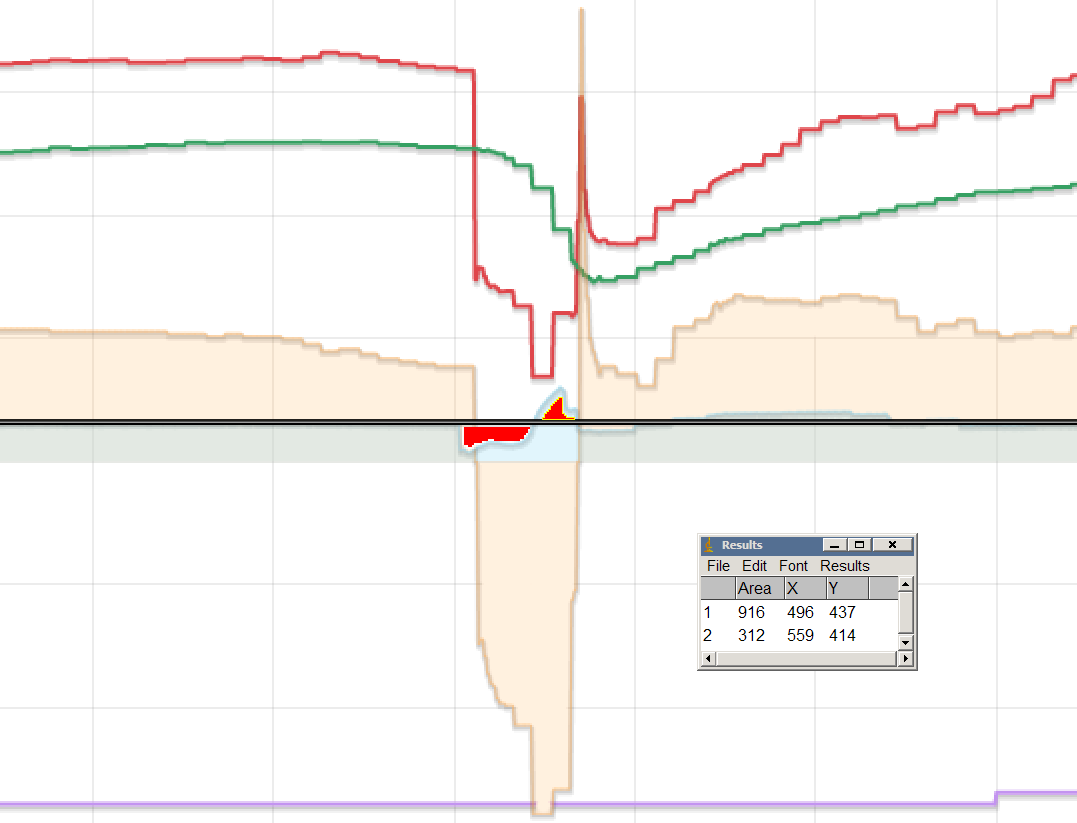
I agree, there is a 'shark's fin in both charts during the defrost, but it is still not clear to me when the recovery happens, or for that matter how much is recovered. My chart is above, here is the Medstead one, with areas under the curve (pixel counts in ImageJ) against baseline (horizontal black line), first for the energy in:
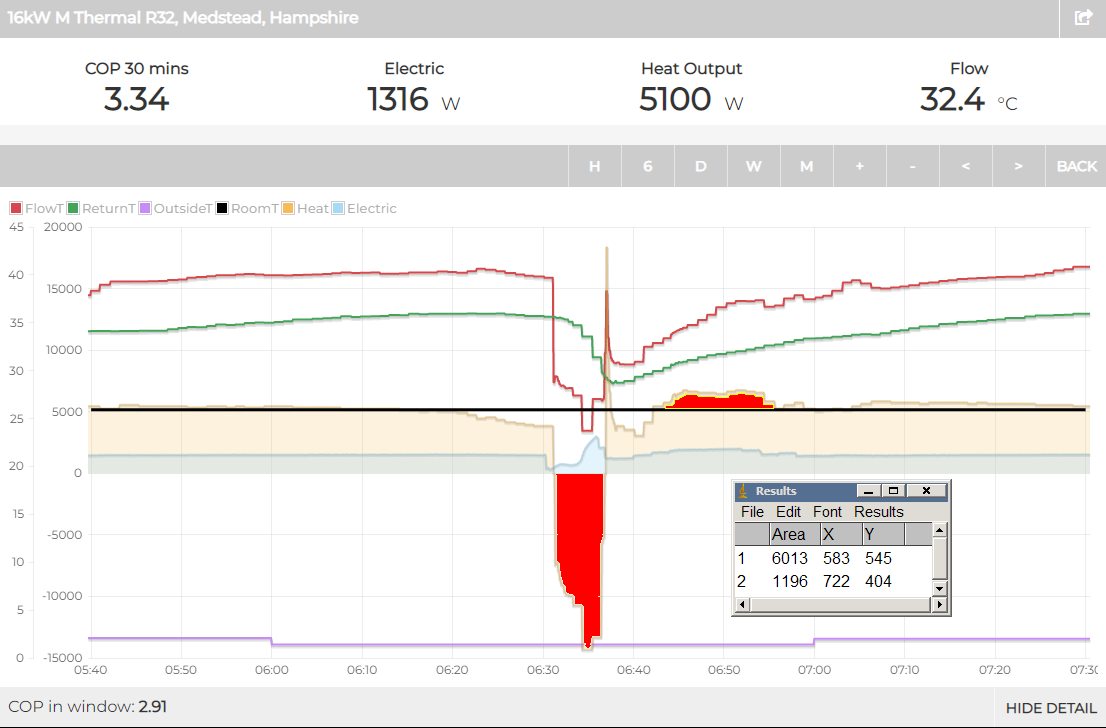
and then energy out (I used a more conservative zero baseline for the defrost):
These aren't high precision analyses, but they don't need to be, the recovery deficits are gross in both cases. How do we make sense of that? Unfortunately the IAT is not available, maybe that fell?
The other Mideas clearly have variable flow rates, presumably PWM controlled pumps?
I can only see two Midea installations on heatpumpmonitor.org, the Medstead one (R32)and a commercial experimental one (R290), and yes, both show variable flow rates. Mine does vary, but almost exclusively between two fixed values, which seem to coincide with the on/off periods of normal cycling. Other Midea owners have observed much the same. A while back I disconnected the PWM lead on my heat pump circulating pump to see what difference that made, and the answer was none, which includes it didn't speed up to max (the expected behaviour). Note that I also have that analogue flow meter, I can check the Midea wired controller flow rate against the analogue meter, and within the limitations of such checking, they agree. I and the others who at the time attempted to understand what was going on never really did get to the bottom of why my and some other Midea units exhibit this behaviour. The units that do modulate flow rate presumably do do it through PWM.
Midea 14kW (for now...) ASHP heating both building and DHW