
Notifications
Clear all


Topic starter
12/02/2026 2:38 pm
The difference between Tukes and MCS, as far as I can see, is that MCS is optional, and has no power to enforce anything. Tukes is a government safety authority with statutory powers to impose bans and issue fines, not just a industry-led certification scheme.
Ah, so what you’re saying is Finland has an actual regulator… and we have a PDF certificate generator.
That does rather highlight the difference. Tukes sounds like it can walk into a situation, lift the bonnet and if it doesn’t like what it sees, shut it down and fine someone before lunch. MCS, by contrast, feels more like it can suggest that perhaps everyone reflects on their paperwork and tightens their pipe clips.
You’re absolutely right though... statutory teeth change behaviour. When there’s real enforcement power, standards tend to stop being aspirational and start being mandatory.
Finland: national authority with fines and bans.
UK: please ensure your paperwork is filed in triplicate.
I know which model I’d rather see holding a few installs to account.
Get a copy of The Ultimate Guide to Heat Pumps
Subscribe and follow our YouTube channel!
1

12/02/2026 2:46 pm
The difference between Tukes and MCS, as far as I can see, is that MCS is optional, and has no power to enforce anything. Tukes is a government safety authority with statutory powers to impose bans and issue fines, not just a industry-led certification scheme.
Ah, so what you’re saying is Finland has an actual regulator… and we have a PDF certificate generator.
That does rather highlight the difference. Tukes sounds like it can walk into a situation, lift the bonnet and if it doesn’t like what it sees, shut it down and fine someone before lunch. MCS, by contrast, feels more like it can suggest that perhaps everyone reflects on their paperwork and tightens their pipe clips.
You’re absolutely right though... statutory teeth change behaviour. When there’s real enforcement power, standards tend to stop being aspirational and start being mandatory.
Finland: national authority with fines and bans.
UK: please ensure your paperwork is filed in triplicate.I know which model I’d rather see holding a few installs to account.
We get what we collectively vote for, that's how democracy works!
Since the end of the 2nd world war the Government in power, for which we collectively voted, has been broadly anti-regulation for roughly 53 out of the 80 years. Im not saying that's bad or good, just that its the case. This cant be undone quickly even if there were a sustained will to do so consistently supported by voting choices, which seems unlikely.
Caveat Emptor.
This post was modified 1 week ago 5 times by JamesPa
4kW peak of solar PV since 2011; EV and a 1930s house which has been partially renovated to improve its efficiency. 7kW Vaillant heat pump.
1

12/02/2026 2:59 pm
The difference between Tukes and MCS, as far as I can see, is that MCS is optional, and has no power to enforce anything. Tukes is a government safety authority with statutory powers to impose bans and issue fines, not just a industry-led certification scheme.
I almost wish I could agree. MCS is actually virtually mandatory for heat pump type of work. But it does not want to be forced to enforce anything..
It is essentially that the ability to grant professional ID cards has been given to a private company called MCS. When the government provides a financial contribution for a heat pump install, the only organisation that they accept as vetting the suitable companies is MCS. So a monopoly at that level. From what I read they deployed training and a glorified tick-boxing exercise. Some tradespeople apply what they learn, others don't..
8kW Solis S6-EH1P8K-L-PLUS hybrid inverter; G99: 8kw export; 16kWh Seplos Fogstar battery; Ohme Home Pro EV charger; 100Amp head, HA lab on mini PC

12/02/2026 3:16 pm
But it does not want to be forced to enforce anything
In my opinion, it's useless then. If you are considered to have authority over who can do the work, and are intended to be a form of vetting for those people, what's the point of then not having or wanting the authority to ban people from ever working again when they screw up? Where is the stick?
My blog where I write about all the systems in place and decisions made for my off-grid house at 63 degrees north in Finland.
1
12/02/2026 3:20 pm
But it does not want to be forced to enforce anything
In my opinion, it's useless then. If you are considered to have authority over who can do the work, and are intended to be a form of vetting for those people, what's the point of then not having or wanting the authority to ban people from ever working again when they screw up? Where is the stick?
Actually I disagree, IMHO its worse than useless because it gives the impression that the customer is protected when in fact they are not (but the installer is protected). Oh and it adds significantly to the cost of installs and makes it more difficult for the only workforce we have that can possibly scale up our heat pump roll out, namely local plumbers who depend on their reputation, to get involved .
I think I read that MCS was introduced into the picture because the EU insisted that government subsidies must be accompanied by regulation/oversight which of course the Government of the day wanted to be 'light touch' (and probably zero cost). I cant provide a reference for this however so I may be wrong.
It became fully independent of Government is about 2018. The current government has said recently that it has increased the level of oversight, but its unclear whether that has yet had any practical effect.
This post was modified 1 week ago 7 times by JamesPa
4kW peak of solar PV since 2011; EV and a 1930s house which has been partially renovated to improve its efficiency. 7kW Vaillant heat pump.
2
Topic starter
13/02/2026 9:54 am
We get what we collectively vote for, that's how democracy works!
Since the end of the 2nd world war the Government in power, for which we collectively voted, has been broadly anti-regulation for roughly 53 out of the 80 years. Im not saying that's bad or good, just that its the case. This cant be undone quickly even if there were a sustained will to do so consistently supported by voting choices, which seems unlikely.
Yes, that’s a fair point, but there’s a difference between being 'anti-regulation' in principle and allowing critical sectors to default to self-regulation in practice.
History shows how that tends to play out. The lead-up to the 2008 financial crisis is the obvious example. Financial institutions were effectively allowed to mark their own homework under the assumption that market discipline would be sufficient. It wasn’t. The clean-up ended up being far more intrusive and expensive than steady, competent regulation would have been in the first place.
The renewables sector has some parallels. We’ve created a framework where access to public subsidy and market participation is gated through a single certification body. MCS is not a statutory regulator in the way something like Tukes in Finland is (or the way I understand Tukes to operate). It doesn’t have the same enforcement authority, transparency obligations or public accountability mechanisms. Yet, through its integration with government incentive schemes, it effectively operates as a mandatory checkpoint. That creates a de facto monopoly... not through open market competition, but through policy design.
When the same organisation then both defines compliance standards and acts as the gateway to market access, and when participation in government schemes is conditional on that certification, you end up with a system that can look like regulation without quite being regulation.
I agree with you that unwinding long-term regulatory philosophy isn’t something that happens overnight though.
Get a copy of The Ultimate Guide to Heat Pumps
Subscribe and follow our YouTube channel!
13/02/2026 10:28 am
Yes, that’s a fair point, but there’s a difference between being 'anti-regulation' in principle and allowing critical sectors to default to self-regulation in practice.
I don't think there is a difference in practice. If the culture is minimum regulation then the approach taken is to regulate the minimum possible (or less) as lightly as possible and to leave it to the industry to do most of the work. In practice this is likely to mean, in mind st cases, things that are safety (or national security) critical only, and even those will get the minimum attention. There is nothing safety critical about the performance of heating systems, not are they critical to national security any more than a whole host of unregulated matters, so why regulate them at all?
I would argue that this is the culture the electorate have consistently voted for and having voted for that one can't cherry pick areas to be excluded from the culture because it happens to suit any given person on any given day, because another person on another day would cherry pick a different area and thus cherry picking goes against the principle held by the government that the the electorate voted for.
Choices have consequences and the choice to vote for a government (for 53 out of 80 years since WW2) that is ideologically disposed against regulation is a choice that collectively the people of the United Kingdom have made. I would go further and suggest that, having consistently made that choice, people must accept the consequences even if, in their particular circumstances, the outcome of doing so is detrimental to them. If anyone doesn't agree with that then they are effectively saying that we aren't responsible for the choices we make, which is clearly not a sustainable position.
This post was modified 7 days ago 3 times by JamesPa
4kW peak of solar PV since 2011; EV and a 1930s house which has been partially renovated to improve its efficiency. 7kW Vaillant heat pump.
2
13/02/2026 12:24 pm
Yes, that’s a fair point, but there’s a difference between being 'anti-regulation' in principle and allowing critical sectors to default to self-regulation in practice.
I don't think there is a difference in practice. If the culture is minimum regulation then the approach taken is to regulate the minimum possible (or less) as lightly as possible and to leave it to the industry to do most of the work. In practice this is likely to mean, in mind st cases, things that are safety (or national security) critical only, and even those will get the minimum attention. There is nothing safety critical about the performance of heating systems, not are they critical to national security any more than a whole host of unregulated matters, so why regulate them at all?
In England, the culture has always tended to be about minimum regulation from the state. And when a private company is involved, it is not regulation, that company needs to reach out to legislators, etc to get laws enacted or changed (and that also helps it to stay in business).
For example, at a large scale, electricity, etc is seen as national critical infrastructure. This is why companies like MCS like to rely on professional associations like NICEIT (that have a connection to H&S and are related to CNI) In that area, regulation tends to be taken seriously. It is the commercial and performance aspects that are always out.
So the effective monopoly of MCS related to the approval of government grants is not regulation of the market. Of course anyone that has that certificate will focus on highlighting that if a consumer takes a tradesperson for work they independently manage, they would miss on the seal of approval and you may have problems.
That moves the focus away from the fact that MCS is not guaranteeing anything for the consumer. People that are more vulnerable than the average (and the reasons for that are not always obvious) are the ones experiencing the worst issues of lack of regulation.
8kW Solis S6-EH1P8K-L-PLUS hybrid inverter; G99: 8kw export; 16kWh Seplos Fogstar battery; Ohme Home Pro EV charger; 100Amp head, HA lab on mini PC

13/02/2026 6:03 pm
There is nothing safety critical about the performance of heating systems
Maybe not at a national level, but for individuals a poorly performing heating system might well become very 'safety critical' if their health is already compromised. More illness, more hospital admissions, more premature deaths.
I actually favour less day to day regulation, but at the same time think there needs to be much better what we might call backstop regulation. Less emphasis on forms in octuplicate, but at the same time we also need regulators with real teeth backed up by legislation who can do more than just slap the wrists of rogue individuals and companies. The recent Warm Homes guff about this (see highlight) gives no cause for comfort:
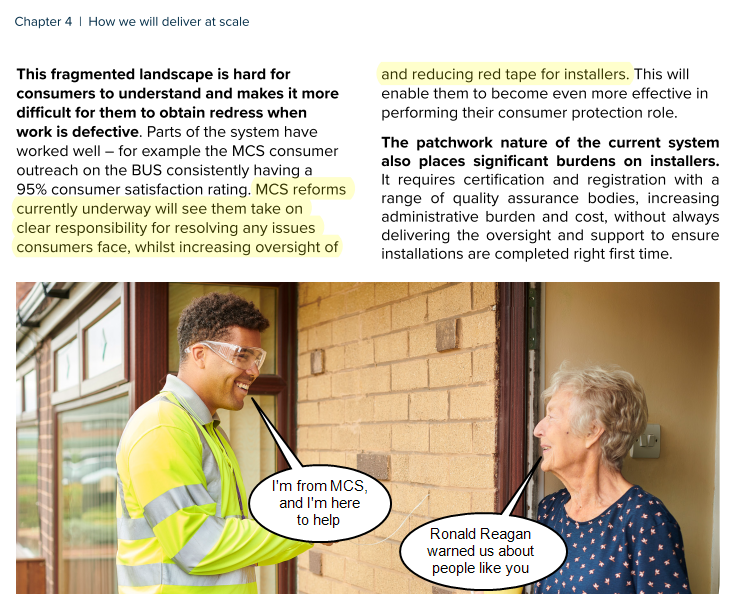
Not only is this bad grammar (as written, it means the (MCS) reforms (plural), not MCS (singular), will take on the responsibility), it also manages to include an oxymoron in the same sentence (increasing oversight of and reducing red tape for). But more to the point, there is no mention of holding MSC to account. It can take on, even be forced to take on, clear responsibility, until it is blue in the face, but if it is not formally held to account for its complaint resolution activities, then it can carry on as before, forever re-arranging the paperclips.
Midea 14kW (for now...) ASHP heating both building and DHW
1
13/02/2026 6:25 pm
Maybe not at a national level, but for individuals a poorly performing heating system might well become very 'safety critical' if their health is already compromised. More illness, more hospital admissions, more premature deaths.
True, but in an anti regulation culture that's a problem for the individual not the government.
As I say we collectively vote for soft touch or no regulation. Sometimes this means that individually we suffer the consequences.
4kW peak of solar PV since 2011; EV and a 1930s house which has been partially renovated to improve its efficiency. 7kW Vaillant heat pump.
13/02/2026 6:41 pm
My view from what I see and read is simple.
MCS co-designs and lightly oversees glorified boxticking exercises with good tolerance for poor execution. They are the essential facade in this light regulation scene. Politicians unwilling or unable to argue for the discipline and infrastructure that could underpin tried and tested consumer protection methods are implicitly supporting it.
Should anyone be able to name 10 politicians amongst the current 600 or so that have a physics or maths degrees, I would be amazed.
Arguably MCS also supports price gauging and provides a stable basis for anti competitive behaviour.
Buyers beware.
8kW Solis S6-EH1P8K-L-PLUS hybrid inverter; G99: 8kw export; 16kWh Seplos Fogstar battery; Ohme Home Pro EV charger; 100Amp head, HA lab on mini PC
13/02/2026 8:00 pm
the essential facade
Exactly. To the casual observer, it looks like there is independent regulation, but there is nothing substantial behind the facade, just some goons re-arranging the paperclips. Just the sort of thing Sir Humphrey from Yes Minister would dream up.
Hacker: You mean MCS isn't there to protect the public?
Sir Humphrey: Good God no! It's there to make people feel protected when in fact they are not being protected.
Midea 14kW (for now...) ASHP heating both building and DHW
3

Latest Posts
-
RE: Testing new controls/monitoring for Midea Clone ASHP
@cathoderay yes that is it in a nutshell. I am keepin...
By benson , 2 minutes ago
-
@painter26 — as @jamespa says, it's for filling and re-...
By cathodeRay , 49 minutes ago
-
RE: Humidity, or lack thereof... is my heat pump making rooms drier?
I'd be happy with what you have (so would millions of o...
By Deltona , 2 hours ago
-
RE: Oversized 10.5kW Grant Aerona Heat Pump on Microbore Pipes and Undersized Rads
@uknick TBH if I were taking the floor up ...
By JamesPa , 11 hours ago
-
RE: What determines the SOC of a battery?
@batpred Your BMS parameters will be the same as m...
By Bash , 12 hours ago
-
RE: Getting ready for export with a BESS
I would have not got it if it was that tight
By Batpred , 13 hours ago
-
RE: Setback savings - fact or fiction?
I also need to correct something I said by mistake earl...
By cathodeRay , 13 hours ago
-
RE: Electricity price predictions
@judith Thanks for sharing, and nice to see how the ...
By Batpred , 14 hours ago
-
RE: Need help maximising COP of 3.5kW Valiant Aerotherm heat pump
@judith thanks Judith. Confirmation appreciated. The ...
By DavidB , 16 hours ago
-
RE: Recommended home battery inverters + regulatory matters - help requested
That makes sense. I thought better to comment in this t...
By Batpred , 17 hours ago
-
Bosch CS5800i 7kW replacing Greenstar Junior 28i
My heat pump journey began a couple of years ago when I...
By Slartibartfast , 17 hours ago
-
RE: How to control DHW with Honeywell EvoHome on Trianco ActiveAir 5 kW ASHP
The last photo is defrost for sure (or cooling, but pre...
By JamesPa , 19 hours ago
-
RE: Plug and play solar. Thoughts?
Essentially, this just needed legislation. In Germany t...
By Batpred , 19 hours ago
-
RE: A Smarter Smart Controller from Homely?
@toodles Intentional opening of any warranty “can of wo...
By Papahuhu , 20 hours ago
-
RE: Safety update; RCBOs supplying inverters or storage batteries
Thanks @transparent Thankyou for your advic...
By Bash , 22 hours ago
-
RE: Air source heat pump roll call – what heat pump brand and model do you have?
Forum Handle: Odd_LionManufacturer: SamsungModel: Samsu...
By Odd_Lion , 22 hours ago
-
RE: Configuring third party dongle for Ecodan local control
Well, it was mentioned before in the early pos...
By F1p , 2 days ago
-
RE: DIY solar upgrade - Considering adding more panels
I know this is a bit old, but it made me wonder what co...
By Batpred , 2 days ago
-

RE: New Vaillant aroTherm Plus in black - When will it come to the UK?
@majordennisbloodnok Daikin, take note! (In fact, I hav...
By Toodles , 2 days ago
-
RE: Midea ASHP – how to set weather compensation
@mk4 — good work! First, I agree, no evidence of cycl...
By cathodeRay , 2 days ago
-

RE: Solis inverters S6-EH1P: pros and cons and battery options
I don't know about Solis inverters. It isn't a featur...
By Transparent , 2 days ago
-
Daikin Altherma 3 H HT - Freeze Prevention Threshold
Hi. We have an Altherma 3 HT (18kW I think) which, now ...
By RICHARDF5033 , 2 days ago
-
RE: Passiv Smart Thermostat - Help & Forum Support
@petch We are not yet compatible with the R290 from Gra...
By Will H , 2 days ago