

Notifications
Clear all
Joining the Renewable Heating Hub forums is completely free and only takes a minute. By registering you’ll be able to ask questions, join discussions, follow topics you’re interested in, bookmark useful threads and receive notifications when someone replies. Non-registered members also do not have access to our AI features. When choosing your username, please note that it cannot be changed later, so we recommend avoiding brand or product names. Before registering, please take a moment to read the Forum Rules & Terms of Use so we can keep the community helpful, respectful and informative for everyone. Thanks for joining!

Topic starter
23/01/2025 9:52 am
Hi all. Consider the following scenarios to support a modest ASHP (with glycol) with a simple setup of single circulation pump through a decent 3-way diverter valve to mid-sized cylinder and two heating circuit runs with mixed emitters operating as one zone and returning through mag filter and flow sensor.
28mm copper from/to ASHP, DN25 pump, 22mm cylinder connection, 2 x 22mm push-fit to 15mm rads and UFH manifold w/ 15mm UFH loops:
- all remaining components DN25
- all remaining components DN20
- a mix (e.g. DN25 3-way, DN20 flow sensor)
Before I read John Cantor's site, my understanding was that the smallest internal diameter of just one component in a circuit essentially reduced the whole performance everywhere on that circuit to that diameter, however if I've understood his words correctly, even putting a nominal single run of larger-diameter (straight) pipework improves overall performance (by reducing head - thereby increasing flow?).
So my initial questions are:
- should one aim to put the widest pipework *wherever physically* possible, reducing to the smaller diameters at the components that cannot be changed (e.g. rads pipework under floors), OR does wider pipework only make a difference for particular components/usage/minimum distance (e.g. more than 300mm, 2m, etc)?
- are there any components in particular that would benefit from larger internal diameters - e.g. if water flows through 22mm connections for hot water and space heating, is there merit in using a 28mm 3-way or flow sensor or mag filter?
- what sort of performance improvements/limitations would one expect based on the answer?

23/01/2025 4:50 pm
I find this an interesting question as I did a similar thing after reading John Cantors site. I have 28mm to my 5kW heat pump which then reduces to the previously existing 22mm copper then to 22mm plastic with 15mm plastic tails to each of the radiators. I used the steel inserts in the plastic pipe as they are a lot thinner than the plastic.
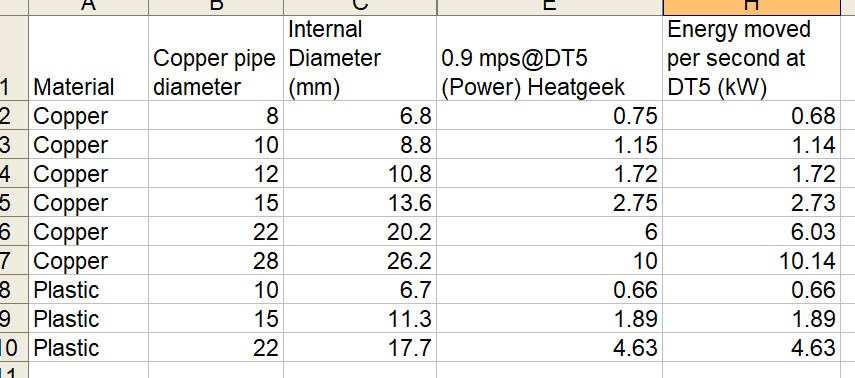
The upshot is I dont seem to have any flow issues and the SCOP is currently 4.3, which I am very happy with. My take is as long as the pipe diameter can take the heat load everything seems hunky dory. I calculated the heat energy the plastic pipes could take using some simple maths and checked it with the copper figures from heat geek just to make sure I wasnt doing anything stupid
House-3 bed partial stone bungalow, 5kW Samsung Gen 6 ASHP (Self install)
6.9 kWp of PV
10kWh DC coupled battery
Blog: https://thegreeningofrosecottage.weebly.com/
Heatpump Stats: http://heatpumpmonitor.org/system/view?id=60
2

23/01/2025 5:11 pm
The hydraulic friction losses are in proportion to the square of the flow velocity x length. For example the friction loss of a given flow through 22mm dia pipe is 62% higher than through 28mm pipe. Higher velocities increase the risk of noise as do changes in velocity. Whether pipe size and friction loss affects performance will depend on if the circulating pump is controlled to maintain the flow rate needed to transfer sufficient heat.
Topic starter
23/01/2025 5:17 pm
Thanks for the reply, @bontwoody
with 15mm plastic tails to each of the radiators. I used the steel inserts in the plastic pipe as they are a lot thinner than the plastic.It's no doubt me, but I've tried a handful of times and can't figure out what this means - sorry, could you write it another way so I can understand, please?
Which it sounds like yours can; well done with the SCoP!The upshot is I dont seem to have any flow issues and the SCOP is currently 4.3, which I am very happy with. My take is as long as the pipe diameter can take the heat load everything seems hunky dory.
Would you be able to share the calcs / methodology to confirm diameter/heat load compatibility?
What would your calcs have been had you replaced what 22mm you could with 28mm pipe, and/or components that had increased internal diameters?

Topic starter
23/01/2025 5:28 pm
Cheers for your post, @JohnR
The hydraulic friction losses are in proportion to the square of the flow velocity x length. For example the friction loss of a given flow through 22mm dia pipe is 62% higher than through 28mm pipe.Implying that wherever a larger internal diameter can be applied, the friction loss is greatly reduced and therefore a good idea?
Indeed, so with larger diameters, velocities are reduced and therefore so is the noise; how does one determine when the number of velocity changes is beneficial against actual velocities, I wonder...Higher velocities increase the risk of noise as do changes in velocity.
Is this 'simply' assuming, if the appropriate pump is in place, bigger pipe size is good, or is it more nuanced than that, John?Whether pipe size and friction loss affects performance will depend on if the circulating pump is controlled to maintain the flow rate needed to transfer sufficient heat.
23/01/2025 5:46 pm
I just mean that from the 22mm copper or plastic pipe spine, each radiator have 15mm plastic down to it. I use John Guest plastic pipe but prefer the Hep2O steel inserts instead of the JG plastic ones.
For the calculations I just took the internal diameter of the pipes and calculated the area (Pi r squared). Then calculated the volume of water passing per second at 9 mps flow (which is what heat geek recommend). The energy contained in one litre of water for a 5 degree C loss is 20900 Joules (4180 J/degree).
As I only have a 5 kW heat pump and 22mm plastic can move 4.63 kW, even with some small pipe restrictions I was pretty confident it would work, which turned out to be the case. Note that 15mm plastic can move 1.89 kW so as long as each radiator is emitting less than that it should be fine.
As the calcs are done at a flow rate of 0.9 mps there should be no problems with noise as @JohnR points out. (unless I have misunderstood something). My water pump is PWM controlled BTW so can adapt to maintain the correct flow.
House-3 bed partial stone bungalow, 5kW Samsung Gen 6 ASHP (Self install)
6.9 kWp of PV
10kWh DC coupled battery
Blog: https://thegreeningofrosecottage.weebly.com/
Heatpump Stats: http://heatpumpmonitor.org/system/view?id=60
23/01/2025 6:46 pm
Implying that wherever a larger internal diameter can be applied, the friction loss is greatly reduced and therefore a good idea?
Less friction means less effort by the pump. The primary circuit for my 7kW Arotherm+ heat pump uses 28mm pipe and is running happily. The extra volume of water must help with the defrosting cycle.
Indeed, so with larger diameters, velocities are reduced and therefore so is the noise; how does one determine when the number of velocity changes is beneficial against actual velocities, I wonder...
One can get bogged down in calculations. There's probably a table somewhere that gives equivalent pipe lengths for bends, valves and reducers/expansion.
]Is this 'simply' assuming, if the appropriate pump is in place, bigger pipe size is good, or is it more nuanced than that, John?
My reference point is my own system which seems to be giving above average performance and I relied on the installer to get it right. There's 28mm pipe between heat pump and buffer tank and then 22mm connecting to the pre-existing radiator system (22mm pipe splitting into downstrairs and upstairs circuits). There are others here who have better knowledge of what is good practice.
Topic starter
23/01/2025 7:25 pm
a table somewhere that gives equivalent pipe lengths for bends, valves and reducers/expansion.@JohnR, I think I've seen something like this for plastic - in essence, each 90deg elbow/T etc creates the equivalent resistance of 0.5m of straight pipe.
Are there any components in between that aren't DN25 minimum? e.g. 3-way, 2-port, pump, etc?There's 28mm pipe between heat pump and buffer tank and then 22mm connecting to the pre-existing radiator system...
To reflect on my original post, it feels to me as though 28mm through the circulation pump and 3-way to the heating circuits is most-beneficial because I could take 28mm-worth of flow to the first rads tee that splits into two distinct 22mm pipe runs therefore 28mm / 2 better than 22mm / 2 or, to put another way, with 22mm up to that tee I'd be restricting flow unnecessarily?
The flow sensor and mag filter I'm less sure - the mag filter I have apparently restricts flow very little and as the return water has been through mostly 22mm before it, I don't see much benefit in replacing with 28mm equivalents (though I'd question why 28mm/DN25 flow sensors aren't standard/easy to source).
Someone tell me otherwise!
23/01/2025 9:27 pm
To reflect on my original post, it feels to me as though 28mm through the circulation pump and 3-way to the heating circuits is most-beneficial because I could take 28mm-worth of flow to the first rads tee that splits into two distinct 22mm pipe runs therefore 28mm / 2 better than 22mm / 2 or, to put another way, with 22mm up to that tee I'd be restricting flow unnecessarily?
That looks to me to be a sound approach: Use the bigger pipe size to where the flow splits to the two heating circuits.
Topic starter
23/01/2025 9:38 pm
@johnr The question at that point is, as posed in the OP, for those to go back through 22mm flow sensors and a mag filter to the return to the outdoor unit, (what) are we gaining anything?
23/01/2025 10:10 pm
The question at that point is, as posed in the OP, for those to go back through 22mm flow sensors and a mag filter to the return to the outdoor unit, (what) are we gaining anything?
I've just been and checked: My 28mm pipework includes a 22mm mag filter (with isolator valves) and works fine. Think of it as a short section of single carriageway road on what is otherwise a dual carriageway. It's an impediment but much better than a lot of single carriagway road.
23/01/2025 10:21 pm
“Think of it as a short section of single carriageway road on what is otherwise a dual carriageway. It's an impediment but much better than a lot of single carriagway road.”
Actually that’s a terrible analogy 🙂 the cars would go no faster than the single carriageway if both lanes were full.
Can I think of a better one? Nope 😂
House-3 bed partial stone bungalow, 5kW Samsung Gen 6 ASHP (Self install)
6.9 kWp of PV
10kWh DC coupled battery
Blog: https://thegreeningofrosecottage.weebly.com/
Heatpump Stats: http://heatpumpmonitor.org/system/view?id=60
1
Page 1 / 2
Next

SPONSORS

Degrees of Separation
Latest Posts
-

RE: Are there any comparisons of DHW heat stores around?
@etchedpixels Since I was encouraged to move to a co...
By SarahEmmm , 14 minutes ago
-
RE: Electrical works for air to air heat pump
Good afternoon, Subject to which brand and c...
By ASHP-BOBBA , 41 minutes ago
-
RE: The Changing Jet Stream Could Challenge UK Air Source Heat Pumps
@hml1827 1962 / 3 winter is remembered by me as my last...
By Toodles , 50 minutes ago
-
RE: 15kw pump for 225m2 1990's house - over kill?
@seaviews I have read you latest response re buffer ...
By JamesPa , 17 hours ago
-
RE: How will removing the standing charge on gas bills benefit heat pumps?
The BUS grant funding for 2026/27 will run out at the c...
By Rob of York , 1 day ago
-
-
@editor Ouch, sorry to re start the tick. I had assume...
By DavidB , 3 days ago
-
RE: Say hello and introduce yourself
@e-a-west as the good Major said, welcome to the forums...
By Mars , 3 days ago
-
RE: How much of your renewable and home setup would still work if the internet went down?
Yes I actually have a copy of a tool that whenever a ce...
By EtchedPixels , 3 days ago
-
RE: Indevolt Batteries UK Support & Info Thread
@editor Hi, To resolve this, please tap on the A...
By Indevolt Tech , 4 days ago
-
RE: Double or Triple Glazed Windows?
Posted by: @singlespeed With 9 years repairing windo...
By Rob of York , 4 days ago
-
@transparent we’re still running a secure version of PH...
By Mars , 4 days ago
-
RE: How quickly would you want/expect heat recovery to take from setback?
Much longer than that here. The heating isn't even on. ...
By bobflux , 5 days ago
-
RE: Passiv Smart Thermostat - Help & Forum Support
Obviously the weather is changeable but there's a defin...
By Singlespeed , 5 days ago








SPONSORS

