
Notifications
Clear all

19/11/2025 9:39 pm
@jamespa I chose Octopus as they will be in business far longer than any individual company, their heat pump uses R290, which is supposed to be state of the art better than R134, will see how the HP manages this second winter that I’ve owned it
Very sound reasons imho. My current feel, albeit based almost entirely on hearsay and what they say, is that they have a good mass market offering. Two years ago they wouldn't do my property but if they had done they would definitely have been in the running. I have yet to hear of anyone who is seriously unhappy with octopus.
This post was modified 3 months ago 2 times by JamesPa
4kW peak of solar PV since 2011; EV and a 1930s house which has been partially renovated to improve its efficiency. 7kW Vaillant heat pump.

20/11/2025 2:05 pm
I have yet to hear of anyone who is seriously unhappy with octopus.
Head over to unofficial FB Cosy user group, yesterday was a bloodbath, and today not looking much better. Some positive stories too though tbf, so it's not all bad.

Topic starter
20/11/2025 2:24 pm
Head over to unofficial FB Cosy user group, yesterday was a bloodbath, and today not looking much better. Some positive stories too though tbf, so it's not all bad.
In fairness that's a very small sample size (of problems/no problems.) It's also a hot bed of people advising on things they don't really understand to give that advice and people receiving advice who don't really know whether it is good or bad (how many people are asking "what are your settings?" for example). Even on this site, it felt like I've been getting good advice but I've been trying to ascertain the impact on a Cosy 9 specifically before acting on it: people with problems/questions should really be in touch with the After Care team.
1
Topic starter
20/11/2025 2:28 pm
@jamespa I would guess it's a deliberate choice due the compressor selection, it's minimum stable compression ratio is probably close when at 34C.
Any lower than this drives down the discharge pressure and R290 is already high volatility (low condensing pressure at mild temps).
As that ratio drops oil return becomes... Unreliable. Lol. It's relying on the velocity of the refrigerant to get oil back to the compressor.
I am not sure if emnerson have a oil injection tech like Panasonic?
In any case it's a scroll compressor so modulation at low end is effected because it can’t reduce swept volume anywhere near as much as a rotary.
Given the cold weather performance I am seeing it's a very good trade off.
@swills Is this the reason that the lowest flow temperature the Cosy 9 can reach is set at 35c? How critical in this implementation then is flow rate and how is that impacted by closing down LSVs (and, I suppose, TRVs)?
This post was modified 3 months ago by AndrewJ
Topic starter
20/11/2025 2:30 pm
@jamespa I would guess it's a deliberate choice due the compressor selection, it's minimum stable compression ratio is probably close when at 34C.
Any lower than this drives down the discharge pressure and R290 is already high volatility (low condensing pressure at mild temps).
As that ratio drops oil return becomes... Unreliable. Lol. It's relying on the velocity of the refrigerant to get oil back to the compressor.
I am not sure if emnerson have a oil injection tech like Panasonic?
In any case it's a scroll compressor so modulation at low end is effected because it can’t reduce swept volume anywhere near as much as a rotary.
Given the cold weather performance I am seeing it's a very good trade off.
@swwils Is this the reason that the lowest flow temperature the Cosy 9 can reach is set at 35c? How critical in this implementation then is flow rate and how is that impacted by closing down LSVs (and, I suppose, TRVs)?
20/11/2025 2:33 pm
I have yet to hear of anyone who is seriously unhappy with octopus.
Head over to unofficial FB Cosy user group, yesterday was a bloodbath, and today not looking much better. Some positive stories too though tbf, so it's not all bad.
Yes but (a) you are talking Facebook and (b) it was the coldest day of the year so far so hardly surprising (+ all the things you say above)
4kW peak of solar PV since 2011; EV and a 1930s house which has been partially renovated to improve its efficiency. 7kW Vaillant heat pump.
Topic starter
20/11/2025 2:42 pm
@jamespa Yes, I now get that the 50c top end of the wc range is too high, though I I can still try dropping the setting back for 5 nights (55 to 50) and see where that lands me. If it is still too high, I’ll follow your advice and tweak the target temp up…is that right?
Now, it has got me thinking. Looking at my existing curve, at todays AOT of around 2c, my FR should be around 42/43c, a good 9c above yours. Thinking back to a comment by TJ (the Octopus bod who pops up occasionally) the target ought be about ‘FR+15c’, which suggests that at AOT of 2c and a target indoor temp of 20c, then my FR ought to be aound 35c.
Does this sound about right? I have no possible way of achieving that using WC however, although it is possible if I set a static setpoint. But do I really want to do that? No.
Thanks again for your input.
@kevh TJ actually recommends the warm weather value should be +15c above target temperature so if you are aiming for indoor temp of 20c, then that value would be 35c. So same value but I'm not sure if that is what you meant really when you use "FR"

20/11/2025 3:10 pm
@jamesPA TJ actually recommends the warm weather value should be +15c above target temperature so if you are aiming for indoor temp of 20c, then that value would be 35c. So same value but I'm not sure if that is what you meant really when you use "FR"
I may be getting my knickers in a twist. I plotted my wc curve (34/55) and at yesterday’s aot it indicated a FR of around 43c.
Am I interpreting the curve wrongly?
But yes, thanks for putting me right on TJ’s +15c idea. That suggests that my warm end setting of 34/35 is ok, so I’ll fucus on the cold end.
My system is not struggling af all to keep the house at 20c, so pulling the high end down a bit shouldn’t impact overall heat levels but will hopefully reduce my energy consumption, which has doubled these past three nights and the COP in down from above 4 to barely 3.2.
This post was modified 3 months ago by KevH
Topic starter
20/11/2025 3:43 pm
@jamesPA TJ actually recommends the warm weather value should be +15c above target temperature so if you are aiming for indoor temp of 20c, then that value would be 35c. So same value but I'm not sure if that is what you meant really when you use "FR"
I may be getting my knickers in a twist. I plotted my wc curve (34/55) and at yesterday’s aot it indicated a FR of around 43c.
Am I interpreting the curve wrongly?
But yes, thanks for putting me right on TJ’s +15c idea. That suggests that my warm end setting of 34/35 is ok, so I’ll fucus on the cold end.
My system is not struggling af all to keep the house at 20c, so pulling the high end down a bit shouldn’t impact overall heat levels but will hopefully reduce my energy consumption, which has doubled these past three nights and the COP in down from above 4 to barely 3.2.
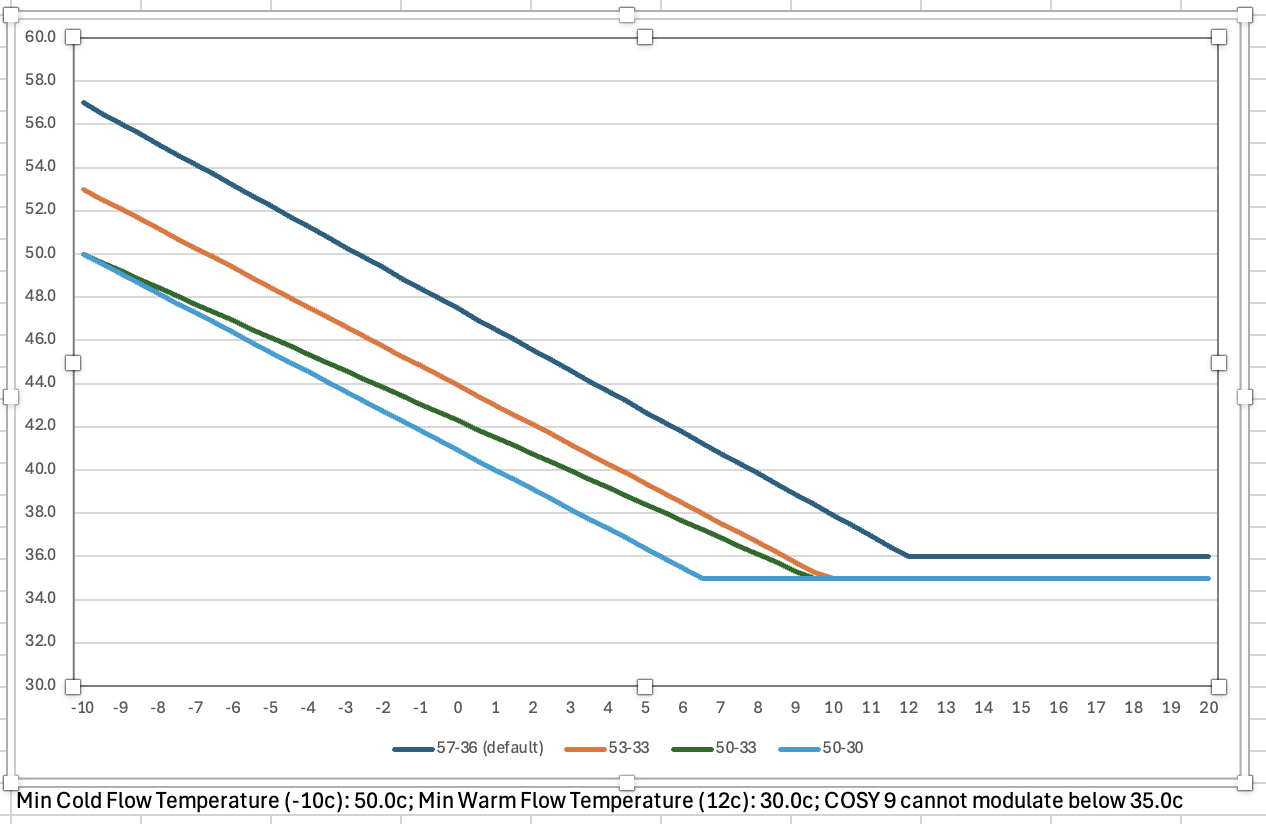
@kevh I read "FR" as flow rate. The WC curve plots Flow Temperature against Outside Air Temp and it's worth bearing in mind Octopus don't publish this, we're all going off the basis that it's linear between the two points, confirmed as -10c and +12c. This is what I created so if it's different to yours then I'd be interested to compare as I don't know, obviously, that mine is right!
Your COP will reduce as the OAT falls, it's just the way it is. It's why we don't focus on that number and would look at SCOP which is a whole year's worth. However, I definitely agree with TJ that chasing SCOP isn't the best approach and that a focus on running cost is more important. Energy consumption is likely to go up: all things being equal, I would expect that what you use at 4c OAT is double what you use at 8c OAT but it is no doubt not that linear or simple. Can you see last years gas consumption for November to compare against: if electric consumption for the whole month is < gas consumption / 4 you're spending less; you're probably even-stevens if it is < gas consumption / 3.4. Actually maybe November isn't a good comparison as the first two weeks this year were fairly mild and I can't remember what November last year was like - perhaps try it in December. In any case, it is the overall full year's cost you need to focus on really.
20/11/2025 7:19 pm
My system is not struggling af all to keep the house at 20c, so pulling the high end down a bit shouldn’t impact overall heat levels but will hopefully reduce my energy consumption, which has doubled these past three nights and the COP in down from above 4 to barely 3.2.
Not surprised by that. FWIW my Vaillant has done more or less exactly the same. Its COLD out there! With those figures I get an overall SCOP of 4, good enough easily to beat gas prices, more comfortable, greener. What more does anyone want? If you can reduce FT and maintain house temp you should improve further
4kW peak of solar PV since 2011; EV and a 1930s house which has been partially renovated to improve its efficiency. 7kW Vaillant heat pump.
Topic starter
21/11/2025 8:42 am
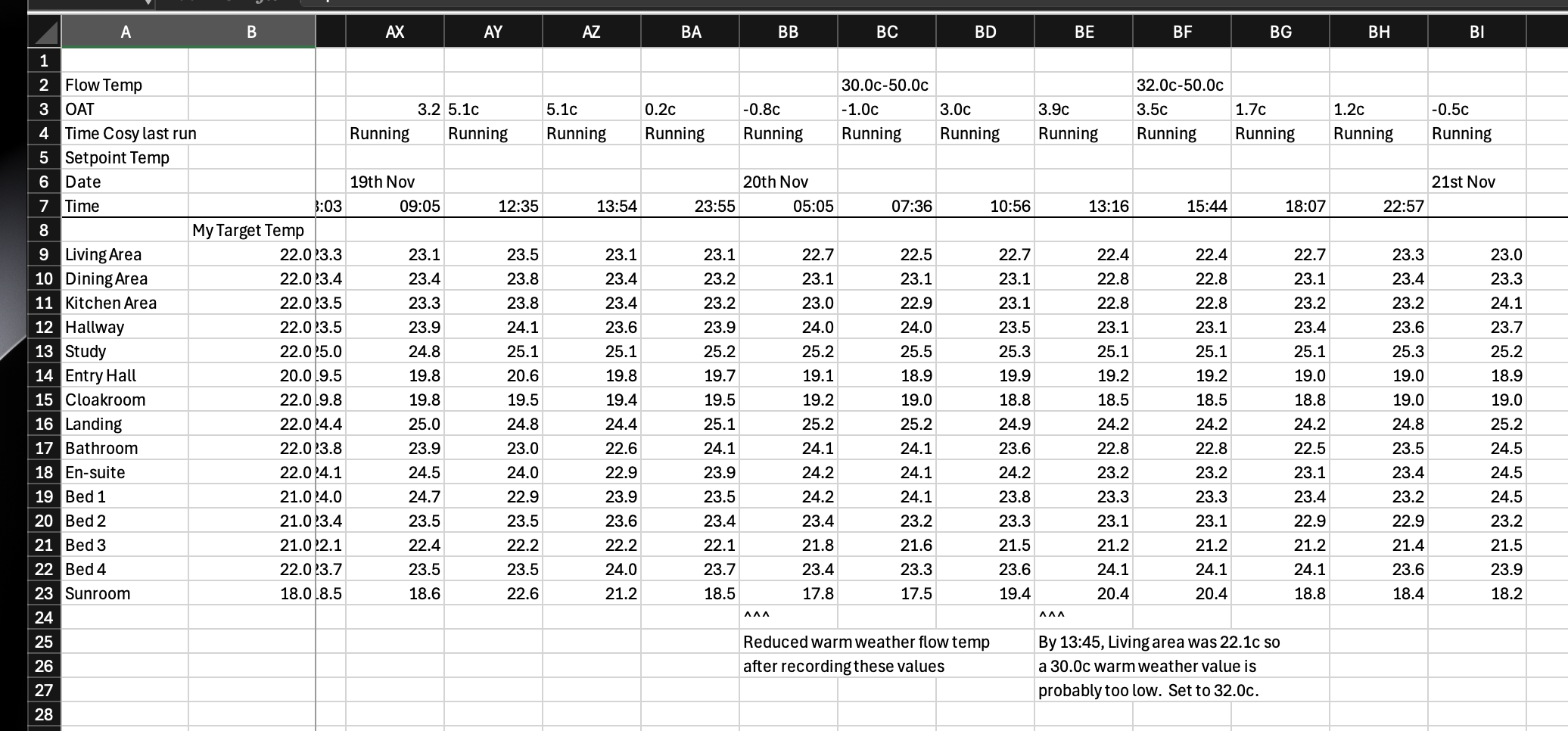
Here's some more data, from the last 3 days for comparison. The house is still being heated to pretty much the same temperatures. When I dropped the Warm Temp max flow temp down to 30.c it had a noticeable effect in that the Living Area temperature (Primary Pod) initially rose (solar gain??? not sure) but then started to drop away quite quickly and hadn't stopped when it reached 22.1c. It seemed like this just wasn't a sustainable value so I bumped it back up to 32.0c.
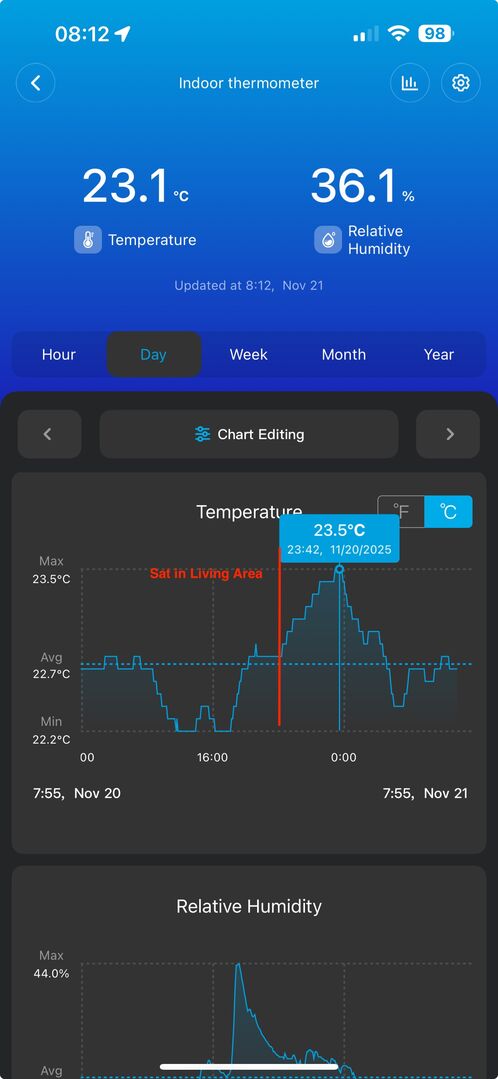
For additional info, I'm also showing the Living Area room temp for yesterday from a logging thermometer next to the Primary Pod (reads +0.1c over the PP). You can see the effect of us just being in the room with the TV on which is why it's difficult to site a thermostat there. Unfortunately, other area in the house tend to stay warmer so moving the PP would still result in the same overall issue of thermostatically controlled heating - when at temp, just being in the house is enough to keep the heating off. Putting it into colder rooms would just mean the other rooms would overheat.
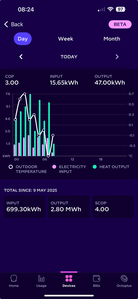
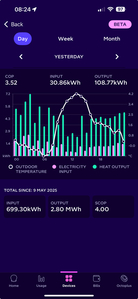
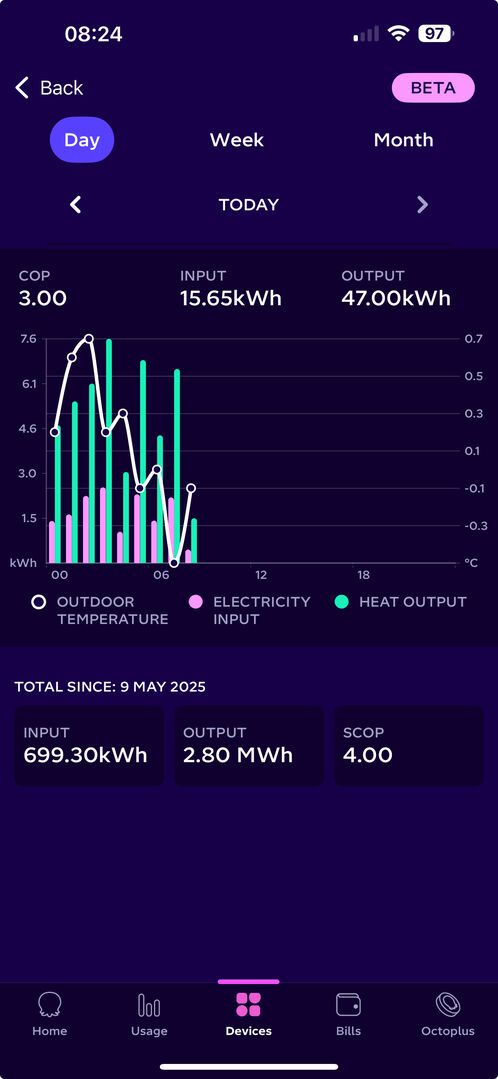
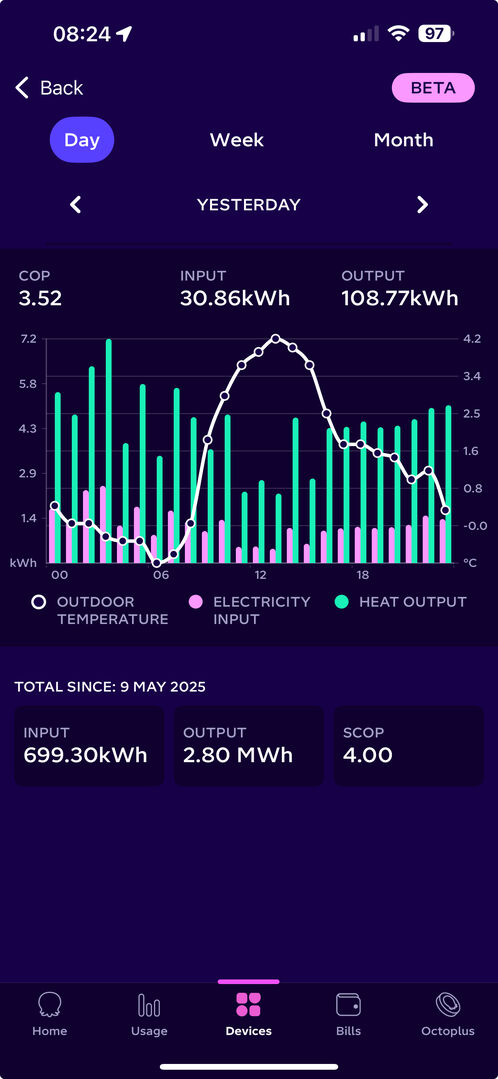
I've also attached the usage stats from yesterday and today. They aren't very detailed but it's all I get. At 7am, the recorded temp was -0.5c. In the hour from 7am to 8am, the Cosy pulled 2.222kWh of energy, ditto between 5am and 6am when it was -0.1c. Water heating runs 2am to 3:30am, generally finished within the hour though.
I'm going to see if I can get the min Cold Temp flow temp changed to allow a value less than 50c today.
For my sanity:
- In the two hours between 05:30 and 07:30, the battery discharged 4.5kWh of energy. The general background load, without heating, is around 0.4kWh, probably more like 0.3kWh at this time of the day, so it looks like I'm drawing on 3.7kWh to 3.9kWh of energy with the Cosy 9. It did see battery consumption running at around 3kW; at one point in ramped down to around 1.6kW and then pretty quickly rose back up to around 3kW. I've seen this since 8am as well and at 08:30 the house has consumed around 6kW out of the battery. Does this seem normal or is the Cosy pulling too much energy?
- I can't see the flow temps or flow rates but I still haven't worked out whether there are values/ranges for these that could be problematic. Octopus balanced the radiators to DeltaT 5c around the middle/end of October. Could I have screwed something up with all the "balancing" I've done - I haven't made any LSV adjustment since the morning of 17th Nov. I don't know if there's a need to have a minimum DeltaT between flow and return at the HP and I don't have the means to measure it. That information may be in the installer menu and Octopus may be able to tell me so I will enquire.
- It seems impossible to maintain a consistent temperature. I know differences are only being measured in tenths of centigrade but I sort of expected that the flow temp would settle and a fairly consistent temp would be maintained. Of course this could just be due to human activity in the house but what would be a normal variation range?
21/11/2025 9:00 am
In the two hours between 05:30 and 07:30, the battery discharged 4.5kWh of energy. The general background load, without heating, is around 0.4kWh, probably more like 0.3kWh at this time of the day, so it looks like I'm drawing on 3.7kWh to 3.9kWh of energy with the Cosy 9. It did see battery consumption running at around 3kW; at one point in ramped down to around 1.6kW and then pretty quickly rose back up to around 3kW. I've seen this since 8am as well and at 08:30 the house has consumed around 6kW out of the battery. Does this seem normal or is the Cosy pulling too much energy?
Firstly you are getting your units mixed up which is a little confusing. kW is power (how fast you are driving), kWh is energy (how far you have gone). Literally kWh is kW times hours.
So if your battery discharged 4.5kWh (energy) in 2 hrs and the average background draw is 0.4kW, the average power drawn by the heat pump is (4.5-(2*0.4)/2 = 1.85kW. With yesterdays temperatures probably not unreasonable.
It did see battery consumption running at around 3kW; at one point in ramped down to around 1.6kW and then pretty quickly rose back up to around 3kW. I've seen this since 8am as well and at 08:30 the house has consumed around 6kW out of the battery. Does this seem normal or is the Cosy pulling too much energy?
Without knowing whether you are talking about power or energy its difficult to comment, assuming you are talking power (kW) then expect the Cosy to spike up during defrosts or when doing DHW. Your total house draw will also spike up if you switch any heating element on (washing machine, dishwasher, oven, kettle). My house (including an EV granny charger) can go as high as 10kW if I pull all the stops out - which I tried once when there was an incentive to consume as much electricity as possible, but regular spikes typically dont exceed 6kW.
I can't see the flow temps or flow rates but I still haven't worked out whether there are values/ranges for these that could be problematic. Octopus balanced the radiators to DeltaT 5c around the middle/end of October. Could I have screwed something up with all the "balancing" I've done - I haven't made any LSV adjustment since the morning of 17th Nov. I don't know if there's a need to have a minimum DeltaT between flow and return at the HP and I don't have the means to measure it. That information may be in the installer menu and Octopus may be able to tell me so I will enquire.
What makes you think that you might have done? Hopefully you havent screwed all the LSVs down and at least one is fully open. No need for min deltaT, but there is a minimum flow rate requirement so thats the thing to check.
It seems impossible to maintain a consistent temperature. I know differences are only being measured in tenths of centigrade but I sort of expected that the flow temp would settle and a fairly consistent temp would be maintained. Of course this could just be due to human activity in the house but what would be a normal variation range?
Human activity, solar gain, heating appliances, wind chill all have an effect. If your house has a high thermal mass it will ride these out, if it doesnt have a high thermal mass then less so. The key question is - are you comfortable?
As you get closer to what you want take even more time between changing WC parameters. 2 days may be needed once you are to within about a degree of the required position.
This post was modified 3 months ago 3 times by JamesPa
4kW peak of solar PV since 2011; EV and a 1930s house which has been partially renovated to improve its efficiency. 7kW Vaillant heat pump.

Latest Posts
-

RE: Electricity price predictions
Sorry to derail this thread ‘slightly?’ but back to the...
By Toodles , 9 seconds ago
-

RE: Humidity, or lack thereof... is my heat pump making rooms drier?
Without knowing it, @andrewj, you've laid down the gaun...
By Majordennisbloodnok , 19 minutes ago
-
RE: Testing new controls/monitoring for Midea Clone ASHP
@tasos and @cathoderay thanks. I have some history grap...
By benson , 23 minutes ago
-

I am having my existing heat pump changed to a Vaillant...
By trebor12345 , 56 minutes ago
-
Our Experience installing a heat pump into a Grade 2 Listed stone house
First want to thank everybody who has contributed to th...
By Travellingwave , 1 hour ago
-
RE: Setback savings - fact or fiction?
@cathoderay The input power is largely determined by...
By RobS , 2 hours ago
-

RE: Solis inverters S6-EH1P: pros and cons and battery options
Just to wrap this up here for future readers: The S...
By Batpred , 4 hours ago
-
RE: Struggling to get CoP above 3 with 6 kw Ecodan ASHP
Welcome to the forums.I assume that you're getting the ...
By Sheriff Fatman , 4 hours ago
-
RE: What determines the SOC of a battery?
I agree. Fogstar confirmed that the Seplos BMS does ...
By Batpred , 4 hours ago
-
RE: Say hello and introduce yourself
@editor @kev1964-irl This discussion might be best had ...
By GC61 , 6 hours ago
-

@painter26 — as @jamespa says, it's for filling and re-...
By cathodeRay , 9 hours ago
-
RE: Oversized 10.5kW Grant Aerona Heat Pump on Microbore Pipes and Undersized Rads
@uknick TBH if I were taking the floor up ...
By JamesPa , 20 hours ago
-
RE: Getting ready for export with a BESS
I would have not got it if it was that tight
By Batpred , 22 hours ago
-
RE: Need help maximising COP of 3.5kW Valiant Aerotherm heat pump
@judith thanks Judith. Confirmation appreciated. The ...
By DavidB , 1 day ago
-
RE: Recommended home battery inverters + regulatory matters - help requested
That makes sense. I thought better to comment in this t...
By Batpred , 1 day ago
-
Bosch CS5800i 7kW replacing Greenstar Junior 28i
My heat pump journey began a couple of years ago when I...
By Slartibartfast , 1 day ago
-
RE: How to control DHW with Honeywell EvoHome on Trianco ActiveAir 5 kW ASHP
The last photo is defrost for sure (or cooling, but pre...
By JamesPa , 1 day ago
-
RE: Plug and play solar. Thoughts?
Essentially, this just needed legislation. In Germany t...
By Batpred , 1 day ago
-
RE: A Smarter Smart Controller from Homely?
@toodles Intentional opening of any warranty “can of wo...
By Papahuhu , 1 day ago
-
RE: Safety update; RCBOs supplying inverters or storage batteries
Thanks @transparent Thankyou for your advic...
By Bash , 1 day ago
-
RE: Air source heat pump roll call – what heat pump brand and model do you have?
Forum Handle: Odd_LionManufacturer: SamsungModel: Samsu...
By Odd_Lion , 1 day ago
-
RE: Configuring third party dongle for Ecodan local control
Well, it was mentioned before in the early pos...
By F1p , 2 days ago
-
RE: DIY solar upgrade - Considering adding more panels
I know this is a bit old, but it made me wonder what co...
By Batpred , 2 days ago