
Notifications
Clear all

Topic starter
23/01/2026 8:36 am
There has been much discussion about 4 port (and occasionally 3 port) buffers on this forum and the general conclusion is that they are rarely if ever necessary in a domestic setting, risk significantly degrading system performance and make diagnosis of faults more difficult. There are some installers who dispute this conclusion, but none have been willing to justify their position with a coherent (or indeed any) explanation nor to appear on the two podcasts @editor has run on the subject, despite being invited and encouraged to do so.
In summary the advice is to avoid both 3 and 4 port buffers in almost all circumstances and, if an installer proposes fitting one, ask for a logical explanation, test it here (to filter out BS), and in almost all cases look elsewhere.
For clarity by 'buffer' I mean a tank fitted between flow and return (ie in parallel with the emitters). A 2 port tank fitted in either flow or return (ie in series with the emitters), is usually called a volumiser, oes not suffer from these problems and may usefully increase system volume without any risk of performance compromise.
We haven't discussed 2 port buffers (ie a 2 port tank between flow and return) much because they are very rare, but the matter has recently come up in another thread. At first I wasn't sure how to respond but then thought about it and now offer the following analysis (the conclusion of which is again - avoid) for peer review. If anyone thinks I have got it wrong I am happy to be corrected or indeed to enter discussion so we can settle the matter.,
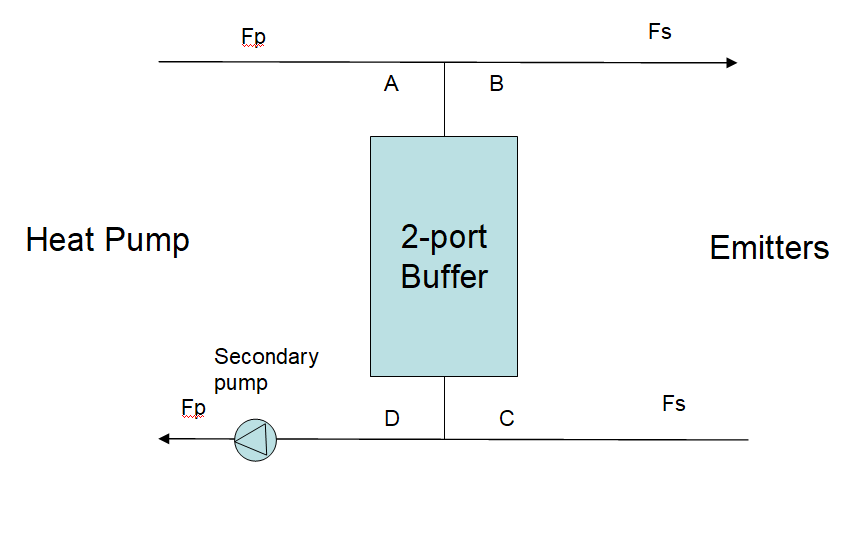
The above diagram illustrates the 2 port buffer arrangement such as in the installation reported by @mike-camelot. In this scenario what was billed as a volumiser (in the flow or in the return) was in fact plumbed as a 2 port buffer (ie like the above diagram) and subsequently defended by the installer.
Note that, although the buffer represents a shunt between flow and return, water will still flow in the secondary, the water flows will distribute themselves between the two 'routes' through the system to equalise pressure drops, resulting in potentially different flow rates through the primary and secondary, represented by Fp and Fs respectively. These will be determined buy the speed (head) of the pumps in the ASHP and the secondary, and the relative resistance of the loops. They may change if (a) the heat pump modulates its pump speed to achieve a particular DT (some do, some dont) or (b) the emitter resistance changes because of valves opening and shutting.
Ta, Tb, Tc, Td represent the water temperatures at points A, B, C, D
There are three scenarios
- If Fp=Fs, ie the circuits are balanced, all the water flowing from the heat pump also flows through the emitters and the system operates as if there were no buffer. In this case there is no distortion, no mixing, and the DT across the emitters will be the same as in a system without a buffer. However no water flows through the buffer which, as a result, does not heat up (in practice it will almost certainly heat up slowly), compromising its function as a volumiser.
- If Fp >Fs then some of the flow is diverted through the buffer. This will increase Td relative to Tc, because some of the return water is diluted by the flow. Ta will equal Tb so the flow temperature to the emitters will not be reduced relative to case (a) but, because there is a lower rate of flow in the secondary, DT across the emitters will be increased. This will reduce the average surface temperature of the emitters which will in turn reduce their output leading to a requirement to increase flow temperature relative to case 1, reducing efficiency by roughly 1.5% for each degree that DT (=Ta-Tc) rises above the nominal 5C for which most heat pump systems are designed.
- If Fp<Fs then some of the return is diverted through the buffer. This will reduce Tb relative to Ta because the flow water is diluted by recirculating return water. DT across the emitters will be the same as in case (1) but, because the flow has been diluted and is thus cooler, the output will be reduced, leading to a requirement to increase flow temperature relative to case 1, reducing efficiency by roughly 3% for each degree degree that Tb is lower than Ta.
In summary case 1 reduces or eliminates the effectiveness of the buffer as a volumiser. Cases 2 and 3 result in the need to increase flow temperature thus compromising efficiency. In practice all 3 cases may occur from time to time in any given system if the heat pump modulates its water pump as a function of output, or the system is zoned so the secondary resistance changes. In both case 2 and 3 there is the additional concern that the heat pump 'sees' a different DT to that seen by the emitters. Since some heat pumps modulate their water pump to control DT, this is clearly undesirable.
So why fit a 2 port buffer at all? Well because it acts as a shunt, it fools the heat pump into thinking that there is a high flow rate whatever the state of the secondary and thus stops 'low flow' errors. This will 'proof' the system against multiple zones simultaneously shutting down and avoid installer call outs. However the latter shouldn't happen in a properly designed properly operated system where the majority of the emitters are operated open loop. Furthermore the same effect, but without the undesirable side effects, could be achieved by fitting a pressure operated shunt which opens only when there is excess pressure in the secondary.
In conclusion, for at least the majority of houses where a single water pump (eg the one included in the body of most heat pumps) has sufficient head to achieve the required flow rate with the emitters open, I can see only harm in fitting a 2 port buffer as a substitute for a volumiser.
This topic was modified 4 weeks ago by Mars
4kW peak of solar PV since 2011; EV and a 1930s house which has been partially renovated to improve its efficiency. 7kW Vaillant heat pump.
2


23/01/2026 3:46 pm
In all my chats about this stuff with installers the consensus has always leaned towards open-loop setups where feasible, with volumisers recommended only if volume's genuinely short and buffers avoided in homes unless there's a specific quirk like manufacturer mandates.
But let's build on some scenarios using maths I was introduced to during the Heat Geek Mastery course to compare 2-port and 4-port buffers, and open loop systems using the same assumptions for consistency: a 10kW heat demand at mild conditions (say 7C ambient), designed for a 35C flow temperature (Ta), 30C return (Tc), 5C ΔT, and a baseline COP of 4.0.
Flow rates work out to about 0.48 l/s for that (from Q = m * c * ΔT, with c = 4.18 kJ/kg°C, so m = 10 / (4.18 * 5) = 0.48 l/s).
Starting with the open-loop baseline (no buffer), just the heat pump directly connected to the emitters with its internal pump handling the lot.
In an ideal world the system stays balanced because emitters are mostly open-loop, with no/minimal zoning or TRVs that don't slam shut en masse.
So, flow holds steady at 0.48 l/s, ΔT at 5C, no mixing or distortion, emitters get the full 35C flow, average surface temp around 32.5C (for a 20C room) and output hits the mark without needing to crank Ta up. COP stays at 4 (no penalties) and the heat pump sees the true system ΔT for accurate modulation. If resistance does spike temporarily (say a zone closes), a well-specced pump might adjust speed to maintain flow.
In short, this is the gold standard for efficiency as advocated by most of the best installers in the UK, as long as the pump's head is up to it… zero extra energy for secondary pumping, no standing losses from a vessel and no temperature dilution.
Now, layering in your 2-port buffer thoughts @jamespa, as a shunt it introduces that potential for flow diversion, which forces compensatory tweaks to Ta and eats into COP more aggressively in unbalanced scenarios. In case 1 (Fp = Fs = 0.48 l/s), it's effectively like open-loop: no shunt flow, Ta = Tb, Tc = Td, ΔT 5C across both, emitters output full whack at 35C, COP 4.
But as you noted, the buffer barely warms (maybe gradually via conduction), so it flops as a volumiser, and if the heat pump modulates pump speed for ΔT, it might hunt a bit if the buffer adds resistance. Still, no real efficiency ding here beyond any extra pump energy if there's a secondary one.
For case 2 (let's make it more punishing: Fp = 0.48 l/s > Fs = 0.3 l/s, as could happen with multiple zones closing or higher resistance from scaling/dirt), excess 0.18 l/s shunts through the buffer, warming the return so Td > Tc by a hefty 3C (dilution factor (Fp - Fs)/Fp = 38%, times 5C ΔT = 1.9C, but rounding up to 3C for a realistic bigger imbalance in variable systems).
The heat pump sees a much tighter ΔT (say 3C), but emitters face drastically lower flow, bumping their ΔT to 10C (ΔT = 10 / (4.18 * 0.3) = 8C.
Average emitter temp plummets to 30C, slashing output by roughly 15% (assuming linear scaling with temp delta to room, from 12.5C to 10C), so to hit 10kW you'd raise Ta by about 3C to 38C. That dents COP by 9% (3% per C), down to 3.64… far worse than milder cases, and over a heating season if imbalances like this occur even 10-20% of the time (common in zoned setups) it could shave 5-10% off overall efficiency.
Case 3 ramps up the punishment even more (Fp = 0.3 l/s < Fs = 0.48 l/s, say the HP aggressively modulates down on low load), pulling 0.18 l/s return through the buffer to dilute the flow: Tb < Ta by a punishing 4C (dilution (Fs - Fp)/Fs = 38%, times 5C = 1.9C, but scaling to 4C as blending worsens in dynamic conditions). Heat pump sees a wider ΔT (say 8-10C), emitters get full flow but at a chilly 31C effective, dropping average temp to 28.5C and output by 25% (delta to room down to 8.5C).
Compensate by raising Ta 5C to 40C, costing a brutal 15% on COP (3% per C), to 3.4, aligning with your steeper estimate for flow dilution, as this directly guts emitter performance. If zoning or modulation triggers this regularly, efficiency tanks further, plus the mismatched ΔT could force short-cycling or errors, adding hidden losses like 10% more energy from restarts.
Shifting to the 4-port buffer for comparison, it's hydraulically separated with dedicated primary and secondary loops (so always a secondary pump, adding 30-60W constant draw, which alone could nibble 0.2-0.3 off COP equivalent over a season via extra electricity) and the mixing dynamics often hit even harder than the 2-port due to full decoupling, leading to greater blending losses in practice.
The equations mirror yours James: if Fp > Fs, Tb = Ta (full hot flow to emitters), but Td = [Fs * Tc + (Fp - Fs) * Ta] / Fp (much warmer return to HP); if Fp < Fs, Tb = [Fp * Ta + (Fs - Fp) * Tc] / Fs (heavily diluted flow), Td = Tc.
So, in case 1 (balanced), it's like open-loop or matched 2-port: no distortion, COP 4, but the buffer adds losses and pump energy, and it doesn't volumise as well without flow through it.
In case 2 (Fp > Fs, same punishing 0.48 vs 0.3 l/s), emitters ΔT balloons to 10C as before, needing +3C Ta for compensation, COP to 3.64, but the HP sees an even warmer return (primary ΔT down to 2-3C), fooling it into ramping down too soon if ΔT-controlled, potentially dropping output prematurely and forcing more frequent cycling, which could add another 5-10% efficiency penalty from instability. Plus, during defrost, the 4-port often blends in colder water more aggressively, prompting installers to set higher baseline flow temps (say +2-3C overall), compounding the hit to a seasonal COP equivalent of 3.4 or lower.
Case 3 (Fp < Fs, 0.3 vs 0.48 l/s) parallels but punishes more: diluted Tb by 5C or even up to 7C in severe blending (systems with poor pump matching), +5-6C Ta needed (to 40-41C), COP plummeting 15-18% to 3.4-3.28, and the HP faces extreme primary ΔT (10-12C), risking flow errors or pump over-speed. The full separation means you might run wider secondary ΔT for rads, but in reality, it leads to chronic over-spec'ing of flow temps to mask blending losses, often 4-5C across the buffer through mixing alone, per various case studies, pushing seasonal COP down 15-25% versus open-loop, to 3-3.4 equivalent.
Those extra pump and vessel losses (standing heat loss of 0.5-1kWh/day in a 50-100 litre tank) compound it, probably adding another 5-10% hit.
I hope my maths is correct, but even if it isn’t, it should give some perspective to the issues posed by buffers… open-loop wins hands-down for efficiency in most homes: steady COP 4 in our example with no extras.
The 2-port buffer mimics it when balanced but introduces 9-15% COP drops (to 3.64-3.4) in imbalances.
The 4-port does much the same on distortion but adds pump overhead and greater blending risks, often slashing seasonal COP further to 3-3.4 equivalent or below.
Both 2- and 4-buffers 'solve' low-flow issues but at a steep cost that's avoidable with good design, pressure bypasses or keeping things open.
Phew. I’m exhausted now.
Get a copy of The Ultimate Guide to Heat Pumps
Subscribe and follow our YouTube channel!
3

Latest Posts
-
RE: Electricity price predictions
i only know about Intelligent Octopus Go ToU, where acc...
By SKD , 24 minutes ago
-
RE: What determines the SOC of a battery?
@batpred I didn't write the Seplos BMS software, I a...
By Bash , 59 minutes ago
-

RE: Humidity, or lack thereof... is my heat pump making rooms drier?
Without knowing it, @andrewj, you've laid down the gaun...
By Majordennisbloodnok , 1 hour ago
-
RE: Testing new controls/monitoring for Midea Clone ASHP
@tasos and @cathoderay thanks. I have some history grap...
By benson , 2 hours ago
-

I am having my existing heat pump changed to a Vaillant...
By trebor12345 , 2 hours ago
-
Our Experience installing a heat pump into a Grade 2 Listed stone house
First want to thank everybody who has contributed to th...
By Travellingwave , 2 hours ago
-
RE: Setback savings - fact or fiction?
@cathoderay The input power is largely determined by...
By RobS , 3 hours ago
-

RE: Solis inverters S6-EH1P: pros and cons and battery options
Just to wrap this up here for future readers: The S...
By Batpred , 5 hours ago
-
RE: Struggling to get CoP above 3 with 6 kw Ecodan ASHP
Welcome to the forums.I assume that you're getting the ...
By Sheriff Fatman , 5 hours ago
-
RE: Say hello and introduce yourself
@editor @kev1964-irl This discussion might be best had ...
By GC61 , 7 hours ago
-
@painter26 — as @jamespa says, it's for filling and re-...
By cathodeRay , 11 hours ago
-
RE: Oversized 10.5kW Grant Aerona Heat Pump on Microbore Pipes and Undersized Rads
@uknick TBH if I were taking the floor up ...
By JamesPa , 21 hours ago
-
RE: Getting ready for export with a BESS
I would have not got it if it was that tight
By Batpred , 23 hours ago
-
RE: Need help maximising COP of 3.5kW Valiant Aerotherm heat pump
@judith thanks Judith. Confirmation appreciated. The ...
By DavidB , 1 day ago
-
RE: Recommended home battery inverters + regulatory matters - help requested
That makes sense. I thought better to comment in this t...
By Batpred , 1 day ago
-
Bosch CS5800i 7kW replacing Greenstar Junior 28i
My heat pump journey began a couple of years ago when I...
By Slartibartfast , 1 day ago
-
RE: How to control DHW with Honeywell EvoHome on Trianco ActiveAir 5 kW ASHP
The last photo is defrost for sure (or cooling, but pre...
By JamesPa , 1 day ago
-
RE: Plug and play solar. Thoughts?
Essentially, this just needed legislation. In Germany t...
By Batpred , 1 day ago
-
RE: A Smarter Smart Controller from Homely?
@toodles Intentional opening of any warranty “can of wo...
By Papahuhu , 1 day ago
-
RE: Safety update; RCBOs supplying inverters or storage batteries
Thanks @transparent Thankyou for your advic...
By Bash , 1 day ago
-
RE: Air source heat pump roll call – what heat pump brand and model do you have?
Forum Handle: Odd_LionManufacturer: SamsungModel: Samsu...
By Odd_Lion , 1 day ago
-
RE: Configuring third party dongle for Ecodan local control
Well, it was mentioned before in the early pos...
By F1p , 2 days ago
-
RE: DIY solar upgrade - Considering adding more panels
I know this is a bit old, but it made me wonder what co...
By Batpred , 2 days ago