

Notifications
Clear all
Joining the Renewable Heating Hub forums is completely free and only takes a minute. By registering you’ll be able to ask questions, join discussions, follow topics you’re interested in, bookmark useful threads and receive notifications when someone replies. Non-registered members also do not have access to our AI features. When choosing your username, please note that it cannot be changed later, so we recommend avoiding brand or product names. Before registering, please take a moment to read the Forum Rules & Terms of Use so we can keep the community helpful, respectful and informative for everyone. Thanks for joining!
29/09/2024 8:13 pm
If this is the case and you were previously using 10MWh per annum in oil, then your heat pump is running very inefficiently not at a COP of 3, or something else has changed.
We discussed this at length before, some time ago, and something has changed: the way I heat my house, going from timed oil CH to mostly (sometimes I have 6 hour overnight setback) always on heat pump heating.
Midea 14kW (for now...) ASHP heating both building and DHW
29/09/2024 8:15 pm
Not doubting the data, just trying to reconcile your oil consumption with your heat pump consumption whilst assuming your house loss has remained the same.
Hopefully my immediate past post has clarified things. The previous discussion started if I recall correctly precisely because there was a discrepancy between oil and heat pump energy use which I couldn't make sense of.
Midea 14kW (for now...) ASHP heating both building and DHW

29/09/2024 8:19 pm
If this is the case and you were previously using 10MWh per annum in oil, then your heat pump is running very inefficiently not at a COP of 3, or something else has changed.
We discussed this at length before, some time ago, and something has changed: the way I heat my house, going from timed oil CH to mostly (sometimes I have 6 hour overnight setback) always on heat pump heating.
Thanks. I am sorry that, with multiple simultaneous threads, I can't remember everything!
How quickly and how much did your house cool when you were on oil? For how long was the heating off.
4kW peak of solar PV since 2011; EV and a 1930s house which has been partially renovated to improve its efficiency. 7kW Vaillant heat pump.
29/09/2024 8:23 pm
By average I mean average the heat input not average the data. If you have thousands of data points all from periods where you only heat for 3hrs, the data is good but the heat input measured as instantaneous power isn't representative of the total energy delivered over a timescale comparable with the warm up time of the house.
As I said in the original post that had the chart, it came from the setback discussion thread, and if you look at the title of the chart, it is data from the control periods, ie when not running a setback. Each point is the last hour's averge OAT/energy in.
Midea 14kW (for now...) ASHP heating both building and DHW

29/09/2024 8:25 pm
How quickly and how much did your house cool when you were on oil? For how long was the heating off.
Will give an answer tomorrow, probably not very detailed, as my time using oil for CH is but a dim glow in the far distance that gets smaller with every month that passes.
Midea 14kW (for now...) ASHP heating both building and DHW
1
29/09/2024 8:36 pm
How quickly and how much did your house cool when you were on oil? For how long was the heating off.
Will give an answer tomorrow, probably not very detailed, as my time using oil for CH is but a dim glow in the far distance that gets smaller with every month that passes.
No problem. Something doesn't make sense and it would be good to get to the bottom of it.
The divide by 2000 approach (open university says 2200) comes from a simple conservation of energy calculation, based on a typical UK climate, and the assumption that, in any setback/timed heating the house cools by only a few degrees and not anywhere close to reaching OAT. It also assumes that the heat pump is operated reasonably efficiently so it delivers it's rated output to the house (or alternatively that you measure the output to the house not the input)and that the room temperature is around 20C.
If those assumptions are true then the method should be pretty robust because the laws of thermodynamics are pretty robust, the average climate varies surprisingly little from year to year, and setbacks where the house temperature doesn't drop too much only reduces consumption by a modest amount even with fossil burners. If any of the assumptions are not true (I may have missed one or two) then of course it may be misleading, but if this is the case then it may suggest an action that could be taken to improve matters.
4kW peak of solar PV since 2011; EV and a 1930s house which has been partially renovated to improve its efficiency. 7kW Vaillant heat pump.
30/09/2024 8:39 am
Something doesn't make sense and it would be good to get to the bottom of it.
I agree. I've found the thread - appropriately enough called 'A conundrum...' - where I raised this question before. It may have been before you joined the forum. From the opening post:
"So far so good, but here's the conundrum. Let's convert the energy used to energy produced - ie energy actually delivered to the house - using reasonable efficiencies of 80% for oil, 100% for standard mains electric heaters and 320% for the heat pump:

How can can it be that the heat pump needs to deliver vastly more kWh to the house to achieve broadly the same levels of heating and comfort that I got before with oil CH? Put another way, in effect, a heat pump doubles and trebles my heat loss."
I was bothered by the fact that when you look at the energy delivered to the house (as opposed to energy in, consumed, or used), I appeared to need far more kWh delivered using a heat pump compared to first oil and then standard mains electricity. Although crude (just weekly use, with some assumptions for how oil was actually used, as I only had annual consumption figures), the data are 'good enough' to be able to say what the chart shows is a real thing. Far more energy was and is delivered to the house running a heat pump compared to the energy delivered using oil central heating or standard mains electricity. Comfort levels with oil and heat pump heating were similar, and acceptable, but not with standard mains electricity, as I only heated the room I was in and the rest of the house was freezing in cold weather. It was all rather Dickensian in that period.
I can't find the post that delivers the answer, it may be in another thread, but the conclusion we came to that I remember today is that the chart does represent the true state of affairs, far more heat is delivered to the house when using a heat pump compared to oil, and this happens because of the way a heat pump is run, 24 hours a day, compared to timed heating with oil. The net effect is that the house stays hotter for longer with a heat pump, and that is why the energy delivered is higher. Or perhaps more accurately, more heat is delivered, so the house stays hotter for longer. Bottom line is the two running states are not comparable.
The oil heating certainly was on a timer, I think (it is a long time ago...) two periods, morning and evening, maybe six hours each. There are no records I can use to verify that, but whatever it was, it was timed. Comfort was fine, I don't recall the house ever felt cold with oil heating, though it must have cooled during the night (less nocturia (gents night time trips to the loo) for me in those days so didn't notice) and day (usually out and about in those days).
I do think this is an important finding that hasn't really had enough air time. If you switch from timed fossil fuel heating to a heat pump, your savings may be less than expected, or may in fact disappear, or costs may even increase, because you will be obliged, because of a heat pumps inherent poor recovery abilities, to run the heat most if not all of the time. Yes, your house will be warmer, for longer (and there are other benefits, eg less condensation), but at a cost. On top of that, a kWh of electricity is more expensive that a kWh of oil, and that further increases costs. And then there was the energy crisis...
All in all, I probably spend two to three times more on heat pump heating these days compared to what i used to spend on oil heating. Some of this will of course be due to the increased cost of energy, but not all, with the rest of the increase coming from the change in the way I run my heating, from a strictly timed regime to a more liberal (and expensive) on most or all of the time regime.
I suggest this is why the divide by 2000 rule of thumb doesn't work very well, it fails to take into account many people will change - will be obliged to change - the way they heat their house, from timed to continuous heating, when they change from a fossil fuel to a heat pump, and the rule of thumb fails to take that into account.
Midea 14kW (for now...) ASHP heating both building and DHW
30/09/2024 9:39 am
I do remember the discussion.
It would be interesting, at least for me, to try to rationalise the figures. I suspect multiple factors may be in play*. A couple more questions, apologies if you already answered these in a previous thread.
Do you have any direct measurements of energy delivered to the house? The heat pump may tell you. Obviously inferring from an assumed cop is dangerous to say the least?
Is your heat pump still the 14kW (presumably sticker capacity) one in your footnote?
Do you have any buffer tank, plate heat exchanger or llh in circuit?
What is your ft at -1 (which I believe you said was the design OAT).
Are you running purely on WC or do you have any on/off thermostats or other 'smart' controls?
With this info and some assumptions about your oil heating pattern based on the info you recall, I can do some back of the envelope calculations to see if the difference can be explained (and if it can, whether there is scope for optimisation).
----------------
* To understand why I think multiple factors must be at play here is a very simple calculation of the effect of part time heating. Assume that your oil heating was on 12 hrs per day (not necessarily in contiguous periods) and off 12 hrs per day (likewise not necessarily contiguous). Lets further assume that the house cools immediately during the off period(s) by half the difference between IAT and OAT (which would be a massive cooling in the depths of winter), and also recovers instantaneously. This would only reduce the house energy demand by 25% which is not on its own enough to explain the discrepancy. Since immediate cooling is unlikely, the actual reduction will certainly be less than this. So unless you were doing something more extreme than this scenario, the part time heating cannot alone explain the observed data
4kW peak of solar PV since 2011; EV and a 1930s house which has been partially renovated to improve its efficiency. 7kW Vaillant heat pump.
30/09/2024 10:37 am
Most of your questions have been answered elsewhere, but far easier and more compact to repeat the answers here rather than trawl though past posts. Note that my heat pump 'journey'/'pathway'/'experience'/whatever modern nonsense word you want to use has evolved somewhat over time, and I now have much more sophisticated monitoring that I did in the early days, when data was much more limited. My current monitoring includes minute by minute recording of most if not all pertinent variables, mostly from the heat pump via modbus. The then either chart that minute by minute data, or sum it over intervals eg an hour and chart that. It goes without saying that as most of the data comes from Midea, some of it may have been 'cooked' by Midea before making it available (as for example VAG did with dieselgate), though some of the variables are amenable to third party checks.
Do you have any direct measurements of energy delivered to the house? The heat pump may tell you. Obviously inferring from an assumed cop is dangerous to say the least?
Yes, but it is Midea based, though derived in two ways: (1) Midea keep a running total of lifetime total energy produced, hourly readings of that data allow me to calculate hourly, or any other longer interval, energy out (delivered) and (c) I also calculate the hourly energy delivered from the flow rate, LWT/RWT delta t and SG of the circulating fluid (which has some glycol in it). The two methods produce similar but not identical results, also worth noting the first option (total lifetime energy out) is always and integer, so there will be some rounding errors that probably over time cancel out. The calculated energy out I usually do to two decimal places. Independent verification: no expensive invasive third party monitoring but (a) I can measure the LWT and RWT directly from the pipes with an IR thermometer plus black insulating tape and (b) there is an analogue flow meter in the circuit put in place at installation and it gives flow rates comparable to Midea's claimed flow rates. Bottom line: the energy out figures are probably 'good enough'.
Is your heat pump still the 14kW (presumably sticker capacity) one in your footnote?
Yes. You may also recall from past discussions it is also a 12kW and a 16kW unit, they are all the same hardware, the actual output is determined by setting dip switches. I have (for now) kept it on the 14kW setting. All of these ratings are the nominal fine day in spring outputs, as discussed elsewhere, actual output in cool/cold weather is often far less.
Do you have any buffer tank, plate heat exchanger or llh in circuit?
Just a plate heat exchanger, discussed to death in the past. I still have it because (a) I am loath to chop up the pipework and (b) I actually like the idea of separating the primary and secondary circuits (glycol only needed in primary circuit, secondary circuit crud (in fact there isn't much, but who knows when that might change) is kept out of the primary circuit etc). I accept the inevitable performance hit the PHE causes.
What is your ft at -1 (which I believe you said was the design OAT).
Are you running purely on WC or do you have any on/off thermostats or other 'smart' controls?
Running purely on weather compensation, with my DIY auto-adaption. No other 'smart' controls (except perhaps me), TRVs all fully open and room stat only used as an on/off stat (which includes setbacks when i have one). The ft (LWT) varies because I have an auto-adapt script that adjusts the LWT depending on the difference between the desired IAT and actual LWT. It is a sort of basic Homely/smart control with none of the weather whatiffery built in. The script (I've posted the whole thing somewhere) runs hourly and checks the difference between the desired IAT and actual IAT, and then shifts the LWT ends of the weather curve up or down one or two degrees as required, up to a maximum of three degrees. The default curve, which the heat pump runs on most if the time, is 56 @ -4 / 34 @ 15 (LWT 56 degrees C when OAT is -4 degrees etc). Because my heat pump almost always cycles slowly (once or twice an hour, the actual LWT is never constant, but it does sort of mostly much of the time average out at something like the set LWT. See the following chart for last 24 hours to 0600 this morning:
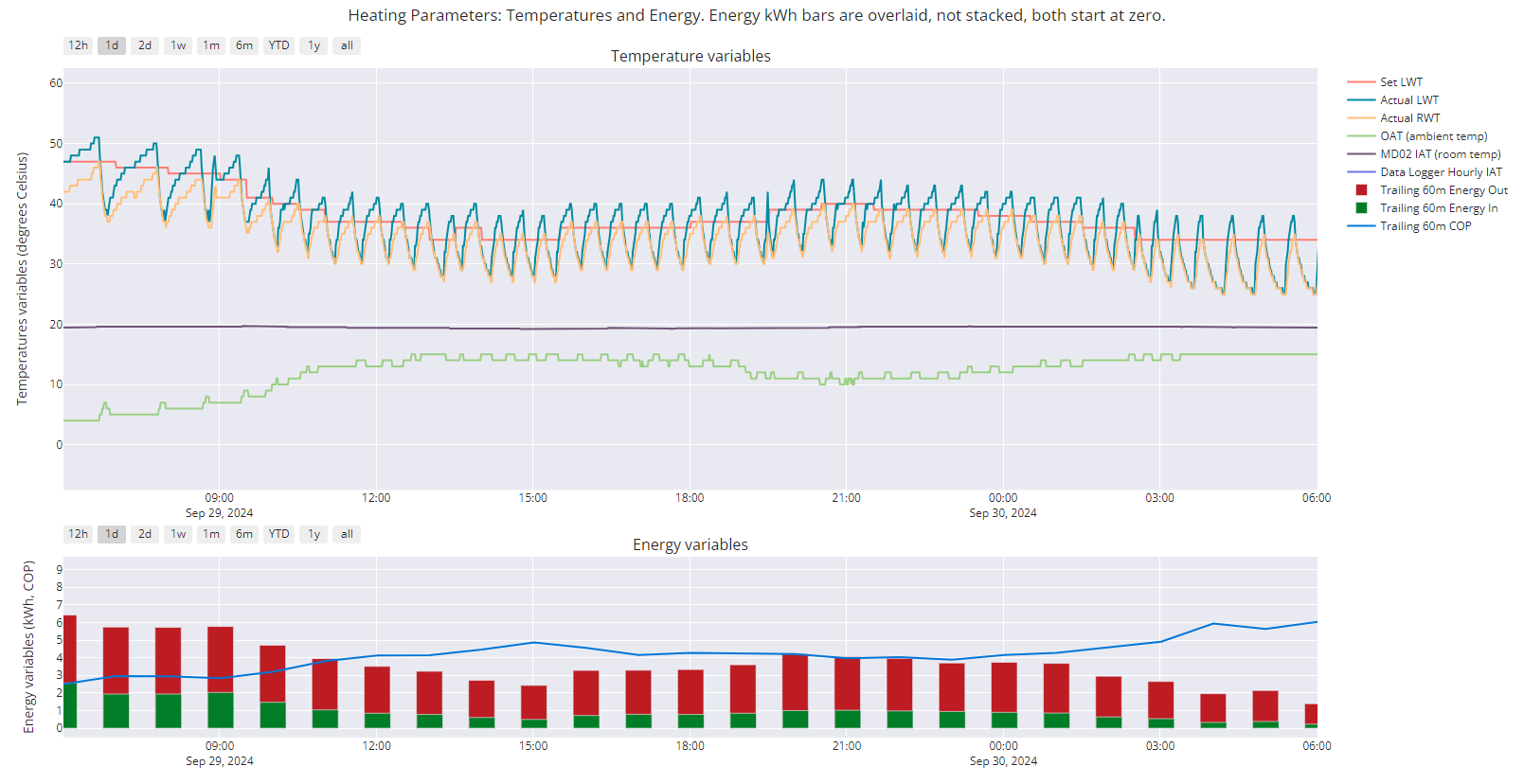
Happy to answer any questions about the various bits of information (and perhaps even teasers) in that chart.
Midea 14kW (for now...) ASHP heating both building and DHW
30/09/2024 11:20 am
Thanks. One more question, what is the source of your electricity meter readings and do they include anything other than the heat pump?
4kW peak of solar PV since 2011; EV and a 1930s house which has been partially renovated to improve its efficiency. 7kW Vaillant heat pump.
30/09/2024 11:56 am
what is the source of your electricity meter readings and do they include anything other than the heat pump?
I have three sources for energy in, and they all only cover the heat pump:
(1) Midea keep a tally of lifetime energy in (like the lifetime energy out) and that can be used to determine interval kWh use (but with rounding errors in the short term)
(2) Midea also report the current amps and volts in use by the heat pump, I can use that to get more accurate (not rounded) hourly energy in. This is the source for the green bars on the chart above
(3) I have an independent kWh meter that only supplies the heat pump (and so not the secondary circulating pump). Unfortunately this is not modbus enabled, so I have to read it manually, usually weekly when the heating is on. Nonetheless, it is presumably the most reliable source for energy in. It does not produce the same figures as found in the Midea sources, and there isn't a fixed error, it varies. However, the error isn't huge, as of this morning, the Midea total lifetime figure (source 1 above) is 19,412kWh in, the independent kWh meter shows 18,583kWh, suggesting that on average the Midea value over-estimates the likely true value by 4.46%. It is a bit odd that it is that way round!
Midea 14kW (for now...) ASHP heating both building and DHW

30/09/2024 1:19 pm
Back to the original question
Simulation using a gas boiler - looks like a good chance of sh*te in - sh*te out, if you are not careful. Not sure the boiler usage is much use unless you operate the house heating system on a like for like basis, same running profile and same WC curve.
Also most boilers are shockingly badly setup, boiler oversized, zoned to death and not at their best efficiency point either.
In similar running conditions we use slightly more energy from the heat pump compared to an extremely optimised gas boiler. Main difference is a gas boiler you look at gas only, the electrical power to boiler, controls and circulation pump(s) are ignored.
At one point I had, boiler pump, plate loading pump (on a big buffer), UFH pump and Solar pump all connected to the gas boiler system - the pumps could be pulling 3kWh on there own each day, not accounted for in the energy calculations of the gas boiler.
I now have the circulation pump in the ASHP only, doing about 0.5kWh a day, our total electric (heating DHW and standby power) for the ASHP heating system yesterday (9 deg average day) was 5.6kWh, so really not much different to the electric consumption of the gas boiler system ignoring the gas.
So I would say it very difficult to use one set of figures and make much sense of any set, unless you have a weather compensation setup running on gas etc. and then you need to be careful.


SPONSORS

Degrees of Separation

Latest Posts
-

RE: Renewables & Heat Pumps in the News
The irony is there's already an established internation...
By Temperature_Gradient , 1 hour ago
-
15kw pump for 225m2 1990's house - over kill?
Good evening. I am looking at switching from an oil-bas...
By seaviews , 11 hours ago
-
First you need to know how much thermal energy you'll n...
By bobflux , 11 hours ago
-
RE: How quickly would you want/expect heat recovery to take from setback?
@toodles Ah, that makes sense. Your using the TRV bo...
By Singlespeed , 12 hours ago
-
RE: Renewable Heating Hub Homeowners' Q&A Podcast
Come for the low-carbon homes. Stay for George Clarke’s...
By Mars , 2 days ago
-
RE: Octopus Cosy 12 Heat Pump Regret: Incredibly Loud, Poor Heating & Constant Hum - Help!
@razz, as we head into the heating season, I just wante...
By Mars , 2 days ago
-
RE: How should the Boiler Upgrade Scheme be reformed?
Not quite, regular A2W heat-pumps need a load of extra ...
By Temperature_Gradient , 3 days ago
-
RE: Heat Geek installations: share your experiences
one thing i learnt from reading people’s comments and e...
By Batpred , 4 days ago
-
RE: Cooling/heating with one unit
"The way we use A2A on a cheap overnight EV tariff is t...
By mrkfm , 4 days ago
-
RE: Do I add Air Con or MVHR to existing A2W ASHP?
We have ‘signed on the dotted line’ today for a Panason...
By Toodles , 4 days ago
-
RE: Heat pump branding. Clever, contemporary… or a bit too much?
...or it was there and was lost thanks to laziness and ...
By Majordennisbloodnok , 4 days ago
-
Bufferless design & control of Chinese air to water monoblock hybrid heat pump in Alberta, Canada
This post is about how I successfully configured a buff...
By Tony.Stolz , 4 days ago
-
The installer visited yesterday and suggested the noise...
By JamesChatz , 4 days ago
-
RE: HeatGeek vs Octopus surveys: puzzling disparity - any ideas why?
Your house sounds a lot like mine. 2 surveyors each sp...
By JamesPa , 4 days ago






SPONSORS
