

Notifications
Clear all
Joining the Renewable Heating Hub forums is completely free and only takes a minute. By registering you’ll be able to ask questions, join discussions, follow topics you’re interested in, bookmark useful threads and receive notifications when someone replies. Non-registered members also do not have access to our AI features. When choosing your username, please note that it cannot be changed later, so we recommend avoiding brand or product names. Before registering, please take a moment to read the Forum Rules & Terms of Use so we can keep the community helpful, respectful and informative for everyone. Thanks for joining!
Insulation
4
Posts
2
Users
0
Reactions
1,401
Views

Topic starter
26/02/2026 12:19 pm
I need help!!! (on a number of levels).
Just about to get 100sqm of UFH put in on the ground floor of our house via spreader plates on 400mm joists and wondering what is the best structural board to put on top. Logic tells me (my logic, so it might be dodgy) its best with some kind of screed board that will allow the heat to pass through to the final surface, porcelain tiles or rigid core lvt, something like Gypdeck Structural 18mm board.
My problem is, as i'm fast approaching 60, I might not live long enough to benefit from the ROI, I'm seeing prices from about £30 to £45 sqm for the screed type products, with standard flooring about £8sqm?
what's are your thoughts experience please?
thanks Simon.
This topic was modified 8 months ago by Mars

27/02/2026 2:13 pm
This is right up my street @sjc123456789
I have installed suspended floors with UFH in my own home in several stages:
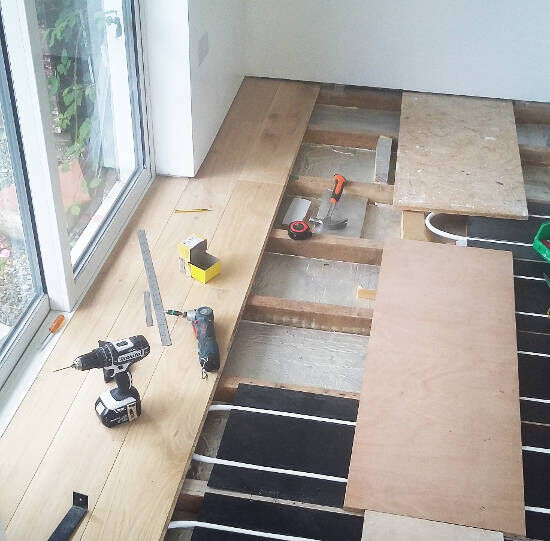
The majority of my floors use 20mm-thick engineered oak planks for the final surface layer.
I buy-in untreated planks (no lacquer) and then use a synthetic brush on a pole to completely seal the wood and joints with two coats of Osmo flooring oil.
I have used large-format porcelain tiles within one en-suite bathroom. That has a heavy stone walk-in shower tray which is bedded onto a dry screed above a plywood sheet. Thus the UFH coils go under both the floor-tiles and the shower-tray. That's worked ok, but the 25mm hardwood ply sheet was obviously costly!
Your 'problem' comes down to you choosing two types of finished flooring first, and then wanting the UFH to accommodate that choice. I did things the other way around. The engineered oak was the best option to go above the heat-spreader plates!
I'll assume that the option for rigid-core LVT won't be for a faux-wood effect.
Because if it is, then why not use real wood?!
I haven't previously met or used Gypdeck, but it's a type of cementitious board, and I understand those properties. Is your reticence due to its price?
What 'standard flooring' at £8sqm are you comparing with?
That's a low price for a type of sheet which could meet your requirements.
Are you expecting to place those porcelain tiles in a humid location, such as kitchen or bathroom?
This post was modified 8 months ago 2 times by Transparent
Save energy... recycle electrons!
Topic starter
27/03/2026 3:44 pm
@transparent Hi There, the LVT was something my wife had seen and liked. I think we've used it for Libraries when doing refurbishment work there and she thought it was better than the "hard" tiles.
Long store short, I think we're going back with porcelain tiles now - just need to decide which ones, but I will look at the engineered wood as well. Is there a good source to check up on thermal properties?
thanks Simon.
28/03/2026 12:04 pm
Whilst there are likely to be generic thermal conductivity statistics available for engineered wooden flooring, I'm unsure how any manufacturer could verify what is the figure for their particular product.
I've bought engineered oak flooring from four different suppliers over the years, and each had variations.
The top (oak) layer is predictable. It will be 'solid' and either 6mm or 8mm thick. The 'rustic effect', which I prefer, is cheaper because there will be random holes in the oak which are properly filled and leveled. Once the flooring oil is applied, they look just like knot holes.
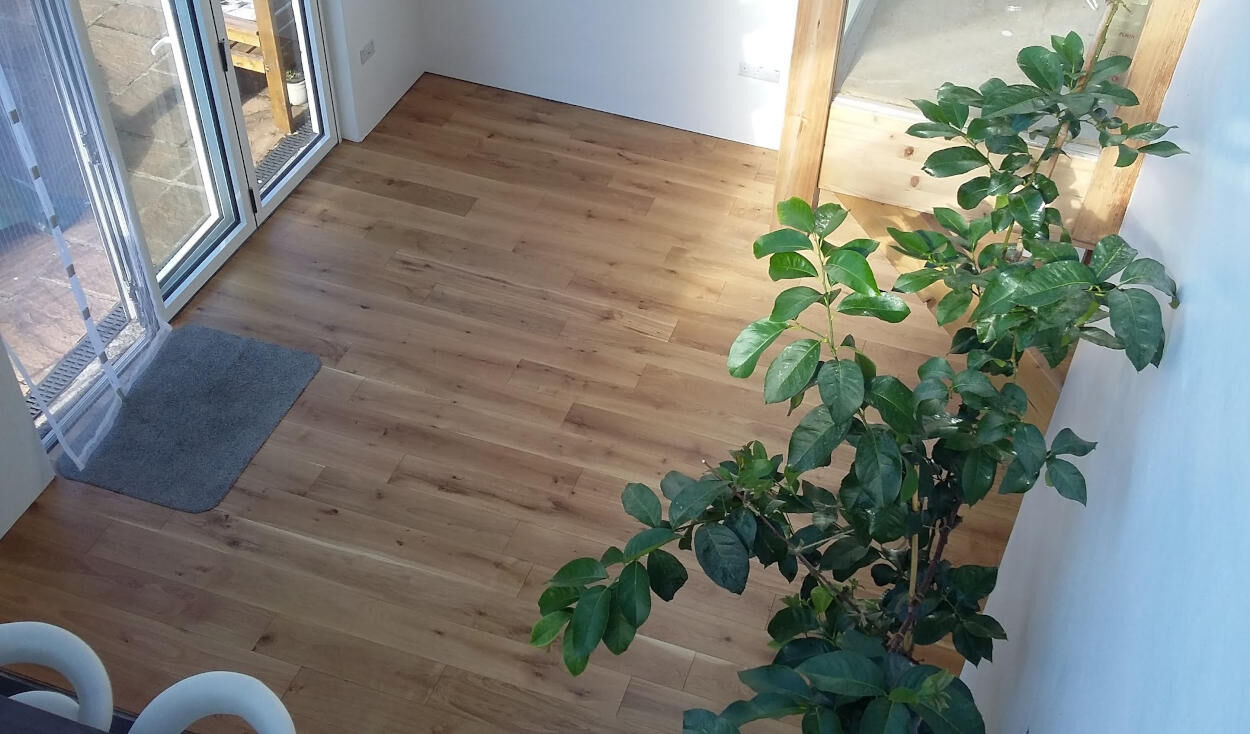
However, the lower part of engineered wooden flooring can vary a lot.
It's obviously ply, but it may not be 'solid'. When I cut through the planks at the wall-ends I might find substantial voids. Those air-filled pockets will obviously have some effect on the thermal conductivity.
So if you're selecting engineered wood planking from a timber yard, then it's important to pay as much attention to the back as you do to the front face.
The best oak flooring I've sourced was labelled with the brand-name "Wessex". It's 180mm-wide 'single plank', 20mm overall thickness incl a 6mm oak top layer. I've used that for both suspended flooring, and stuck directly onto a concrete sub-floor.
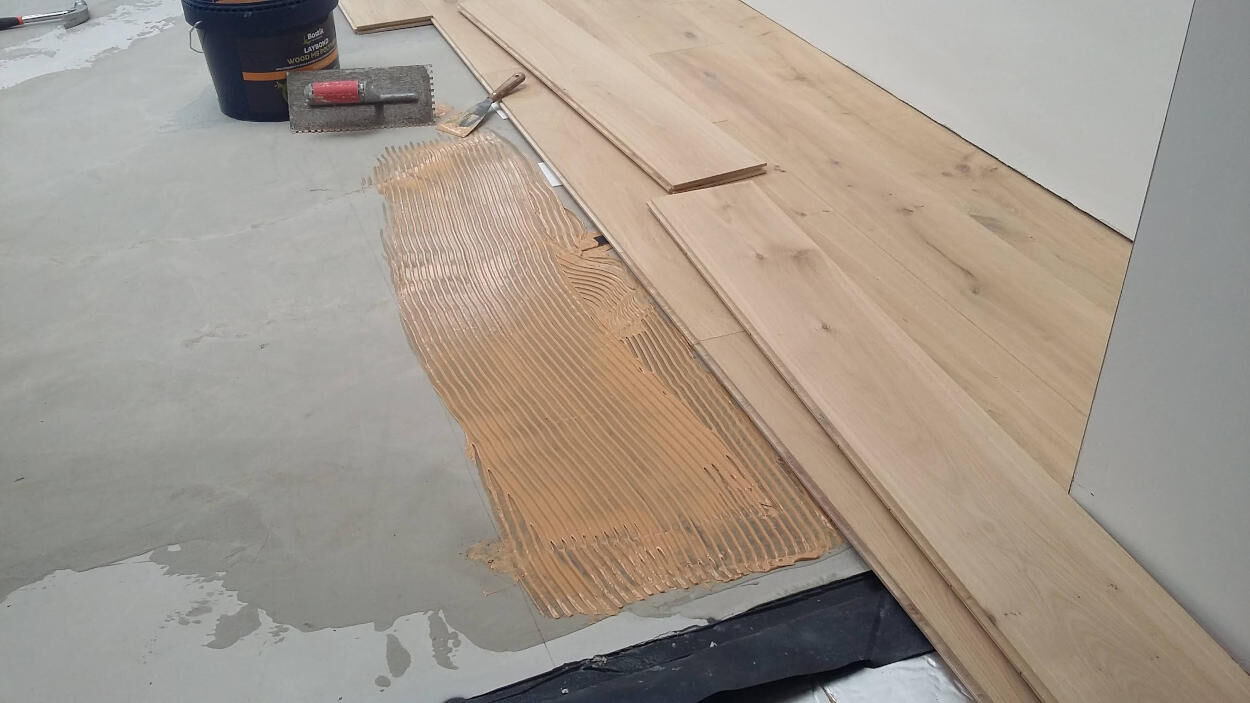
That 'glue' is Bostik Laybond, and the floor was first primed with a compatible PVA.
Although this is the "correct" adhesive for such an approach, it's only commonly used by professional installers, and there are only two outlets which will supply it. Fortuitously, Bostik have an excellent free technical support division, which I highly recommend.
Don't try laying flooring using whatever adhesive you happened to find on the shelf of Wickes or B&Q. They're not set up to cater for those of us with UFH, and won't have staff who understand thermal conductivity.
Porcelain tiles can be bedded onto a decent semi-flexible adhesive such as the NX range from Norcross. They offer a choice of setting-times, and layer-depths. My preference is for slower-set. It gives me plenty of time to 'wiggle' the tile onto the 5-splodges of adhesive and eliminate air pockets.
Use Tile-leveling clips, which are available with whatever inter-tile spacing you want. For large-format tiles, you'll need a 5mm - 8mm gap.
As I wrote earlier, I don't have experience of the Gypdeck sub-board, but I do see that a number of professional tile wholesalers offer 18mm sheets of NoMorePly, intended for spanning joists. You would need to ask if they would be prepared to sell to you as a self-builder without the need to provide credit references and open an account.
Ideally you need to attend a Homebuilding Exhibition where you talk directly to the manufacturers and handle samples of the product. Be prepared to buy this as a pallet-delivery which will directly offloaded from a lorry.
This post was modified 7 months ago 2 times by Transparent
Save energy... recycle electrons!


SPONSORS

Degrees of Separation

Latest Posts
-

RE: The Changing Jet Stream Could Challenge UK Air Source Heat Pumps
This info from the installer manual for Vaillant Aeroth...
By Rob of York , 1 hour ago
-
RE: How will removing the standing charge on gas bills benefit heat pumps?
The BUS grant funding for 2026/27 will run out at the c...
By Rob of York , 8 hours ago
-
RE: New Build 3 Phase or 1Phase
Not so any more.... 1: It's now the...
By Transparent , 21 hours ago
-
@editor Ouch, sorry to re start the tick. I had assume...
By DavidB , 2 days ago
-
RE: Say hello and introduce yourself
@e-a-west as the good Major said, welcome to the forums...
By Mars , 2 days ago
-
RE: How much of your renewable and home setup would still work if the internet went down?
Yes I actually have a copy of a tool that whenever a ce...
By EtchedPixels , 2 days ago
-
RE: Indevolt Batteries UK Support & Info Thread
@editor Hi, To resolve this, please tap on the A...
By Indevolt Tech , 3 days ago
-
RE: Double or Triple Glazed Windows?
Posted by: @singlespeed With 9 years repairing windo...
By Rob of York , 3 days ago
-
@transparent we’re still running a secure version of PH...
By Mars , 3 days ago
-
RE: How quickly would you want/expect heat recovery to take from setback?
Much longer than that here. The heating isn't even on. ...
By bobflux , 4 days ago
-
RE: Passiv Smart Thermostat - Help & Forum Support
Obviously the weather is changeable but there's a defin...
By Singlespeed , 4 days ago
-
RE: Forum updates, announcements & issues
Get the Renewable Heating Hub heads-up on WhatsApp. I...
By Mars , 4 days ago
-
RE: Safety study for plug in batteries out to tender - looks like Q3 2027 at best before legal
@editor I pointed out to the one of the Fuse execs that...
By dansus , 4 days ago
-
RE: 15kw pump for 225m2 1990's house - over kill?
@seaviews As well as loft insulation, there are othe...
By Rob of York , 4 days ago


SPONSORS

