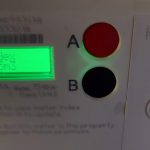
I hadn't expected that the Eastron meter would be given its own 3-ph breaker! Is that because the electrician decided to supply it by using thinner wires, I wonder?
I assumed they need to be connected to the supply to measure the volts to work out the kWh used so there needs to be a separate breaker. I guess it wouldn't need to be separate but the only other 3ph breaker is for the inverter. The board is much larger than it needs to be so there is plenty of space for another breaker. The right hand side of the board is fairly empty.
@batpred I'm looking to monitor 2 circuits on a single phase board so the type you are using is probably what I need. My son bought a 3ph Vue monitor from Amazon as a Christmas present which will monitor up to 16 circuits on this board. I assume a single phase monitor would still work on a 3 phase board for single circuits but wouldn't be as accurate if trying to measure circuits on more than one phase as the voltages vary slightly.
I assume a single phase monitor would still work on a 3 phase board for single circuits but wouldn't be as accurate if trying to measure circuits on more than one phase as the voltages vary slightly.
Hah!
I have monitors 'out on the grid' and you'd be surprised just how much variation there is between phases (voltage and current).
It begs the question as to how a 3ph inverter 'decides' to use the phases evenly when re-charging a battery from the grid. There would be a significant difference between a decision based on current than one based on kW.
The timeline below has four '240v' monitors at different locations, all supplied from the same Primary substation.
Ignore the red and purple lines because they're recording the output from two different inverters.
The other four lines show voltage variations all over the place. However, I've been doing this long enough to be able to detect which sequences are the consequence of variations on an 11kV supply, and which are due to changes being made by the DNO at the 33kV level (outside of the area being monitored).
I assume a single phase monitor would still work on a 3 phase board for single circuits but wouldn't be as accurate if trying to measure circuits on more than one phase as the voltages vary slightly.
I have monitors 'out on the grid' and you'd be surprised just how much variation there is between phases (voltage and current).
It begs the question as to how a 3ph inverter 'decides' to use the phases evenly when re-charging a battery from the grid. There would be a significant difference between a decision based on current than one based on kW.
This looks very interesting... using what would otherwise cause issues or be wasted.
Via the Solis modbus integration (so data going onto a pc via the solis modbus) and that I believe is coming from the meter that they supplied me with (via modbus as well - I think), I see the following data points for A. There's A, B, C so I think these are phases. In my single phase inverters, B and C are 0..
All the data can be charted..
If this was from a Tuya clamp, I would not trust the figures. But they are probably from the Eastron meter that Solis supplied.
To be clear, on my HA, this is flimsy, but perhaps that can be avoided..
8kW Solis S6-EH1P8K-L-PLUS hybrid inverter; G99: 8kw export; 16kWh Seplos Fogstar battery; Ohme Home Pro EV charger; 100Amp head, HA lab on mini PC
I assume a single phase monitor would still work on a 3 phase board for single circuits but wouldn't be as accurate if trying to measure circuits on more than one phase as the voltages vary slightly.
I have monitors 'out on the grid' and you'd be surprised just how much variation there is between phases (voltage and current).
It begs the question as to how a 3ph inverter 'decides' to use the phases evenly when re-charging a battery from the grid. There would be a significant difference between a decision based on current than one based on kW.
This looks very interesting... using what would otherwise cause issues or be wasted.
Via the Solis modbus integration (so data going onto a pc via the solis modbus) and that I believe is coming from the meter that they supplied me with (via modbus as well - I think), I see the following data points for A. There's A, B, C so I think these are phases. In my single phase inverters, B and C are 0..
All the data can be charted..
If this was from a Tuya clamp, I would not trust the figures. But they are probably from the Eastron meter that Solis supplied.
To be clear, on my HA, this is flimsy, but perhaps that can be avoided..
@batpred, I have been pulling what the inverter believes to be the grid voltage for quite a long time now, and it has been VERY useful. My DNO - UK Power Networks - has been having some issues recovering from a problem back in June last year, and this has meant some significant swings in voltage, all picked up by the inverter. As a result, I've been able to use the data held in HA as evidence for UKPN, and they have been prepared to rely on it as reliable grounds for despatching engineers (albeit the engineers would, of course, double check themselves once on site).
Given inverters with the ability to export to the grid must, by law, stop exporting if the voltage goes above 253V (or thereabouts, I believe), I'm pretty sure all inverter manufacturers take care to ensure their kit can be accurate in its measurement of voltage. As a result, what I get via modbus from my inverter is, I believe, easily accurate enough for my purposes.
105 m2 bungalow in South East England
Mitsubishi Ecodan 8.5 kW air source heat pump
18 x 360W solar panels
1 x 6 kW GroWatt battery and SPH5000 inverter
1 x Myenergi Zappi
1 x VW ID3
Raised beds for home-grown veg and chickens for eggs
"Semper in excretia; sumus solum profundum variat"
As you can see from the timeline graph, when your Solis inverter takes electricity from the grid to recharge a battery, it lowers the voltage... ... hence the fall of 11-volts at 00:30 this morning, followed by a further reduction to 224v by 01:00.
Measuring line voltage on the far end of a supply cable from a consumer unit isn't going to provide useful data about the grid. It tells me more about the size of copper cable connecting your inverter!
I assume a single phase monitor would still work on a 3 phase board for single circuits but wouldn't be as accurate if trying to measure circuits on more than one phase as the voltages vary slightly.
Given inverters with the ability to export to the grid must, by law, stop exporting if the voltage goes above 253V (or thereabouts, I believe), I'm pretty sure all inverter manufacturers take care to ensure their kit can be accurate in its measurement of voltage. As a result, what I get via modbus from my inverter is, I believe, easily accurate enough for my purposes.
Agreed. In the Solis S6, the readings are via a dedicated meter that connects to an RS 435 port. Some of the data is relevant for export.
I say this, as the inverter also provides direct electricity data via modbus, about the electricity from its various ports.
And in the case of @johnnybtriphasic Solis, the modbus integration would also add it for the other two phases.
The reason I said the voltages vary slightly is because the Solis inverter has a screen that shows the grid and inverter voltages for each phase, along with A and W. Also they are recorded in the Soliscloud, at the usual 5 minute intervals, a snap shot from this morning when the voltage varied the most between the phases
And I ahve just discovered that I can export that data from the Soliscloud.