

Notifications
Clear all
Joining the Renewable Heating Hub forums is completely free and only takes a minute. By registering you’ll be able to ask questions, join discussions, follow topics you’re interested in, bookmark useful threads and receive notifications when someone replies. Non-registered members also do not have access to our AI features. When choosing your username, please note that it cannot be changed later, so we recommend avoiding brand or product names. Before registering, please take a moment to read the Forum Rules & Terms of Use so we can keep the community helpful, respectful and informative for everyone. Thanks for joining!
Electricity, Tariffs, Monitoring, Electrics & Providers
25
Posts
7
Users
1
Reactions
146
Views

24/10/2026 10:33 pm
if you have a PV inverter and either sun or charged batteries, and the electricity provider is limited to 25kVA
Not so.
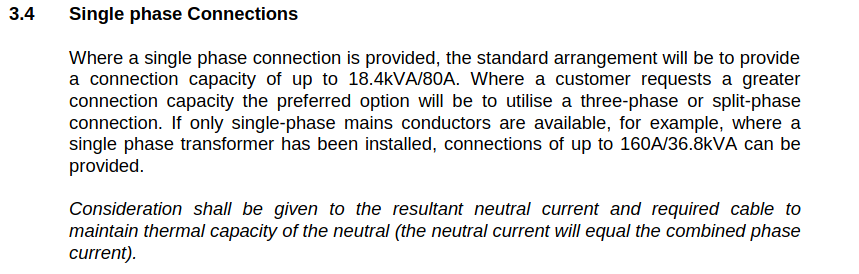
1: It's now the case that the Service Fuse will be 80A, not 100A.
Each DNO will have issued their own directive (known as a Standard Technique) which specifies this.
Read this one from National Grid (NGED).
For three phase domestic supplies, the Service Fuse will normally be 60A per phase for a domestic customer.
2: The "designated voltage" for 1ph is 230v.
DNOs are now starting to change the taps at Primary substations in order to reduce the usual 240v we have grown used to.
This change has still not been fully ratified, but is agreed on by members of the Electrical Networks Association (ENA).
80A x 230v comes to 18.4kVA.
3: If your continuous loading is calculated to exceed 60A (not the 80A fuse rating), there are circumstances by which the DNO can require you to accept a 3ph supply.
The reasons are complex, but pay particular attention to the Neutral current and you'll begin to understand the issues.
The whole point of 3ph is that the load on those phases should be even.
That being so, no current flows in the Neutral.
Deliberately designing a supply for a new house which causes large currents in the neutral will create thermal stress at the local substation.
That causes breakdown of insulation, and hence a higher risk of outages.
4: If the reason you are applying for a single-phase supply greater than 18.4kW, but not more than 23kVA is due to an EV charger, then that charger may not be fixed to the building.
The charger must be fixed to a separate/dedicated post, with the position dictated by airflow for cooling.
Talk with the Network Planner in the DNO Team assigned to your area.
They use a software calculator which takes into account a number of parameters which you won't know about.
This post was modified 1 hour ago by Transparent
Save energy... recycle electrons!
Page 3 / 3
Prev

SPONSORS

Degrees of Separation
Latest Posts
-

RE: New Build 3 Phase or 1Phase
Not so. 1: It's now the case that the Service Fuse wi...
By Transparent , 1 hour ago
-
RE: How will removing the standing charge on gas bills benefit heat pumps?
I think it has an enormous impact on air/air users. The...
By EtchedPixels , 8 hours ago
-
@editor Ouch, sorry to re start the tick. I had assume...
By DavidB , 1 day ago
-
RE: Say hello and introduce yourself
@e-a-west as the good Major said, welcome to the forums...
By Mars , 1 day ago
-
RE: How much of your renewable and home setup would still work if the internet went down?
Yes I actually have a copy of a tool that whenever a ce...
By EtchedPixels , 1 day ago
-
RE: Indevolt Batteries UK Support & Info Thread
@editor Hi, To resolve this, please tap on the A...
By Indevolt Tech , 2 days ago
-
RE: Double or Triple Glazed Windows?
Posted by: @singlespeed With 9 years repairing windo...
By Rob of York , 2 days ago
-
@transparent we’re still running a secure version of PH...
By Mars , 3 days ago
-
RE: How quickly would you want/expect heat recovery to take from setback?
Much longer than that here. The heating isn't even on. ...
By bobflux , 3 days ago
-
RE: Passiv Smart Thermostat - Help & Forum Support
Obviously the weather is changeable but there's a defin...
By Singlespeed , 3 days ago
-
RE: The Changing Jet Stream Could Challenge UK Air Source Heat Pumps
@rob-of-york I must admit that when we had a Daikin hea...
By Toodles , 3 days ago
-
RE: Forum updates, announcements & issues
Get the Renewable Heating Hub heads-up on WhatsApp. I...
By Mars , 3 days ago
-
RE: Safety study for plug in batteries out to tender - looks like Q3 2027 at best before legal
@editor I pointed out to the one of the Fuse execs that...
By dansus , 3 days ago
-
RE: 15kw pump for 225m2 1990's house - over kill?
@seaviews As well as loft insulation, there are othe...
By Rob of York , 3 days ago




SPONSORS
