
Notifications
Clear all

18/02/2026 11:14 am
How was the process for getting Octopus to agree to export without an MCS certificate in the end? Did you have to pay anything?
We also don't have an MCS certificate and I am interested in exporting in the warmer months when our battery bank will have plenty of spare capacity.

19/02/2026 9:19 am
@judith and others - thanks for your replies. It occurs to me that ToU tariffs are intrinsically self-limiting aren't they? They exist because the energy utilities have slack usage periods during the day but if heat pumps grow massively in popularity and users charge batteries during those slack periods then they won't be slack any more. Also I had a close look at my own consumption hour by hour and apart from a drop overnight when the system goes to setback and a brief spike when it catches up first thing then consumption is pretty even through the day. Add enough heat pump consumers then the spikes and troughs of domestic usage will diminish as a proportion of the total. Then there will be a new pattern as EV charging becomes more of a factor. I can't predict where all that is going but I do predict that the tariff 'landscape' isn't going to stay where it is for ever.
I'm off gas here. When I was specifying the heat pump system electricity prices were going crazy so I included a small modern oil boiler in the mix and I'm afraid that until some the governments do some governing and inject some sanity into electricity pricing then I'm going to find the cheapest general tariff I can and revert in part to oil on the coldest days (or more specifically: when the hourly COP goes way down). It's not ideal but I'll be using a tiny fraction of what I was using before.

19/02/2026 10:09 am
@dr_dongle A great deal of thought has gone into the TOU tariff schemes hereabouts, my view is that much depends on whether the tariffs are used to ‘advantage’ or just when a consumer can afford to endeavour to use them to ‘advantage. By advantage, I mean extracting as much of the required daily energy as one can during the cheapest times; this may require local storage (battery) of the energy required outside of the cheapest times or perhaps partial avoidance of the more expensive times by boosting heat levels during the cheapest periods.
Boosting heating and also moving times of the consumer’s highest energy demand times may not be desirable or very convenient though.
I imagine that there will be several different approaches to employing TOU tariffs, in our own case, using battery storage to avoid all grid usage outside the cheapest time is the best way. Because I do not want the faff of ‘messing. with agile tariffs using some form of AI or computer programme, nor would i wish to leave my better half to cope with such systems were I to go under the No: 49 bus, I think the Cosy style of fixed periods suits our needs.
Now, as to whether wholesale adoption of TOU tariffs would just shift the times of peak demand to different periods, I am not sure. My feeling is that, like me, some consumers might avail themselves of just the cheapest periods whilst others would not be able to do so due to financial or other restraints.
Should we end up with a more constant levelled out energy demand, this would surely help to reduce the NG’s problem of having to cater for short duration enormous peaks. These peaks (as @transparent will attest) are the dictator to infrastructure costs.
I understand that infrastructure costs are a considerable component in the price we pay for energy; TOU tariffs could and should help to reduce this cost. Unless every electrical energy consumer were to adopt the same TOU tariff and employ energy storage too, I cannot imagine that the demand during those hours would throw the system totally off-balance and bring consumption right down during the (currently) peak hours demand.
Of course I could be totally wrong but for now, I am just hoping that TOU tariffs will continue. Regards, Toodles.
Toodles, heats his home with cold draughts and cooks food with magnets.

19/02/2026 11:07 am
…
It occurs to me that ToU tariffs are intrinsically self-limiting aren't they? They exist because the energy utilities have slack usage periods during the day but if heat pumps grow massively in popularity and users charge batteries during those slack periods then they won't be slack any more.
…
Yes-ish.
Firstly, let’s not forget that there’s a whole world of businesses out there who don’t use batteries for time shifting, so there will still be significant peak and trough demand times.
Secondly, let’s also not forget that ToU tariffs aren’t just for cost/profit reasons; they’re used for grid balancing too. Granted those imbalances will often follow peak demand but could also be influenced by production peaks and troughs so I think there will always be a need for ToU consumer price variations.
105 m2 bungalow in South East England
Mitsubishi Ecodan 8.5 kW air source heat pump
18 x 360W solar panels
1 x 6 kW GroWatt battery and SPH5000 inverter
1 x Myenergi Zappi
1 x VW ID3
Raised beds for home-grown veg and chickens for eggs
"Semper in excretia; sumus solum profundum variat"

19/02/2026 1:22 pm
Martin Lewis said about a month ago now that energy prices were going to fall this Spring after he'd been talking to people in the know.
It's now in the general news that it is highly likely.

19/02/2026 3:06 pm
@judith and others - thanks for your replies. It occurs to me that ToU tariffs are intrinsically self-limiting aren't they? They exist because the energy utilities have slack usage periods during the day but if heat pumps grow massively in popularity and users charge batteries during those slack periods then they won't be slack any more.
Perhaps the innovation that would smooth the peak consumption period is past us? Like when will we all stop getting the kettle on when we get back home? 😆
8kW Solis S6-EH1P8K-L-PLUS hybrid inverter; G99: 8kw export; 16kWh Seplos Fogstar battery; Ohme Home Pro EV charger; 100Amp head, HA lab on mini PC

19/02/2026 3:18 pm
Like when will we all stop getting the kettle on when we get back home?
Half time during a cup final?
4kW peak of solar PV since 2011; EV and a 1930s house which has been partially renovated to improve its efficiency. 7kW Vaillant heat pump.
1
19/02/2026 3:19 pm
I understand that infrastructure costs are a considerable component in the price we pay for energy; TOU tariffs could and should help to reduce this cost. Unless every electrical energy consumer were to adopt the same TOU tariff and employ energy storage too, I cannot imagine that the demand during those hours would throw the system totally off-balance and bring consumption right down during the (currently) peak hours demand.
Two of many reasons why we can be sure of a very smooth transition!
I do try to be an optimist with grid storage being planned. But if it gets bogged down with planning or H&S, we can only hope there will not need to be more consultations like the one on renewable oils..
8kW Solis S6-EH1P8K-L-PLUS hybrid inverter; G99: 8kw export; 16kWh Seplos Fogstar battery; Ohme Home Pro EV charger; 100Amp head, HA lab on mini PC
19/02/2026 3:30 pm
@toodles I can see how ToU tariffs, solar and EVs go together but a heat pump by itself is not really suited to a ToU regime. I've done the following to help my decision-making and not to make a point but I thought I'd share it: Cosy Octopus has 8 hours of cheap rate and a 6 hour peak rate period. My heat pump draws 3.5 kW just now so something like a PW3 will run it for about 4 hrs. You can therefore run the ASHP for 8 hours at cheap rate, you still have to run it for 2 hrs at peak rate and you have to charge the PW3 (albeit at cheap rate). I reckon this saves about £1/day over a standard tariff for a cost of the order of at least £8k installed. I understand that the top end battery storage systems come with guarantees of up to 15 years but in most cases capacity losses at 10 years will be 10-20% - all of which adds up to at least £500 per annum in depreciation. Unless I've messed up my figures then I can't make it cost effective. When we get our EV then that will change the arithmetic but as a retired person my mileage may not be enough to make much difference which is why we're running our current cars into the ground rather than rush to an EV.
Scotland may differ from England & Wales (colder, less industrialised) but nearly 20% of greenhouse gas comes from domestic heating, 50% of power usage (all categories) is space heating and about 40% of electricity usage overall is domestic. I can't work out what this says about the daily profile as technologies change.
19/02/2026 3:52 pm
@dr_dongle My first move was to install PV panels and one Powerwall - followed shortly by the second Powerwall thus providing a capacity (when new at least) of 27kWh. The following year, the ASHP was added, so, in effect this formed a fairly smooth transition. In pre heat pump days, I was on Agile for import and had export on Agile Outgoing but soon changed to Fixed Outgoing. When the heat pump was installed, I moved over to Cosy for import but kept Fixed Outgoing which has helped financially during the summers.
The heat pump at Toodle Villas is an 8 kW jobbie so we rarely see consumption draw more than 2.0 kW (and then only for a few minutes at a time). The heaviest winter draw has been ~40 kWh per day and this we can accommodate (along with another ~12 kWh per day for the other house needs) this total consumption of ~ 52 kWh will still fall within the capacity of the battery when charged over the 8 cheapest hours. So Cosy works for us I’m pleased to say. I understand without the battery, this situation would be a totally different kettle of ball games though. Regards, Toodles.
Toodles, heats his home with cold draughts and cooks food with magnets.
1

19/02/2026 4:03 pm
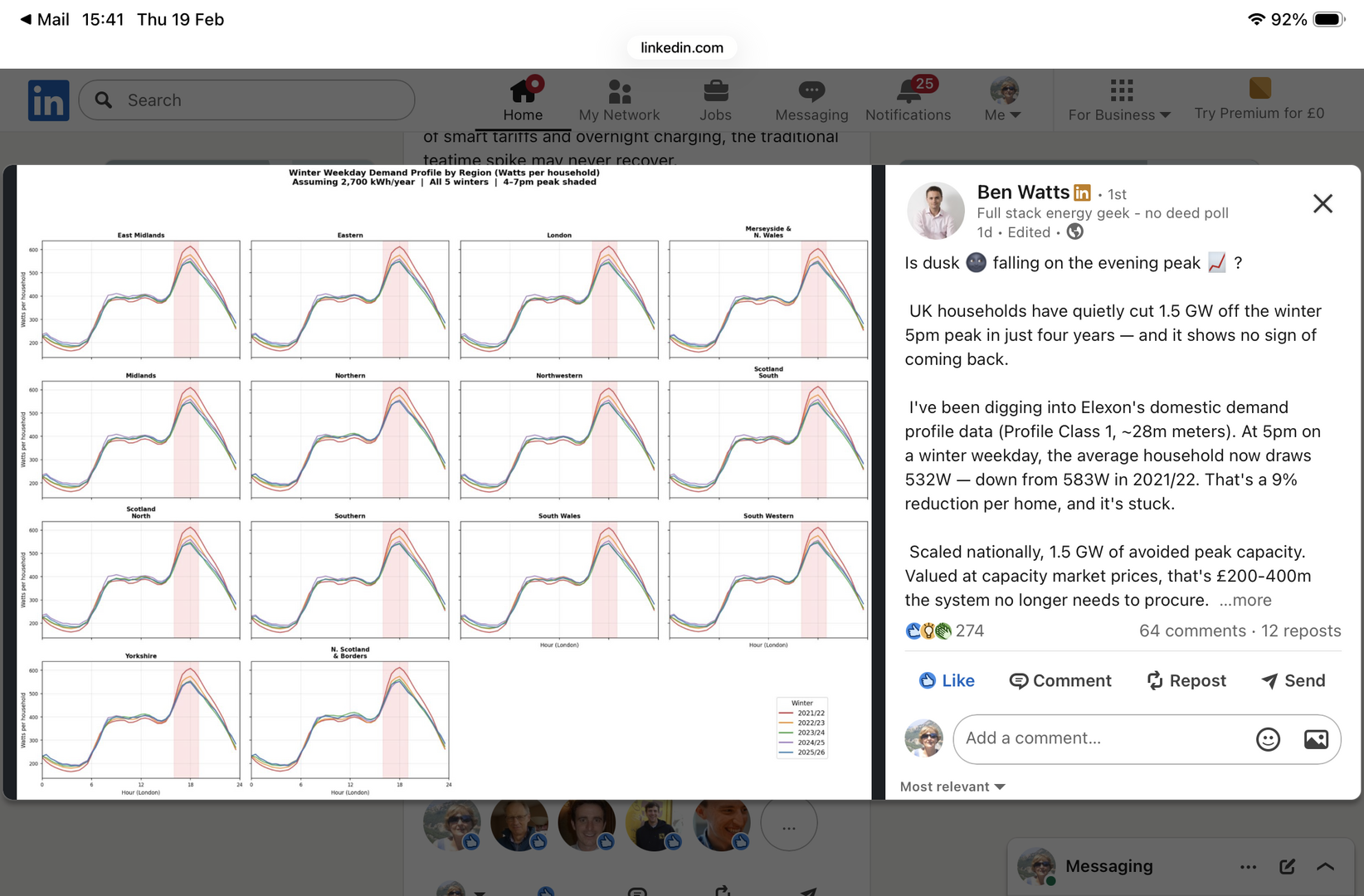
Ben Watts posted this analysis on LinkedIn showing the low overnight use is very much still prevalent, both over the last few years and in all regions.
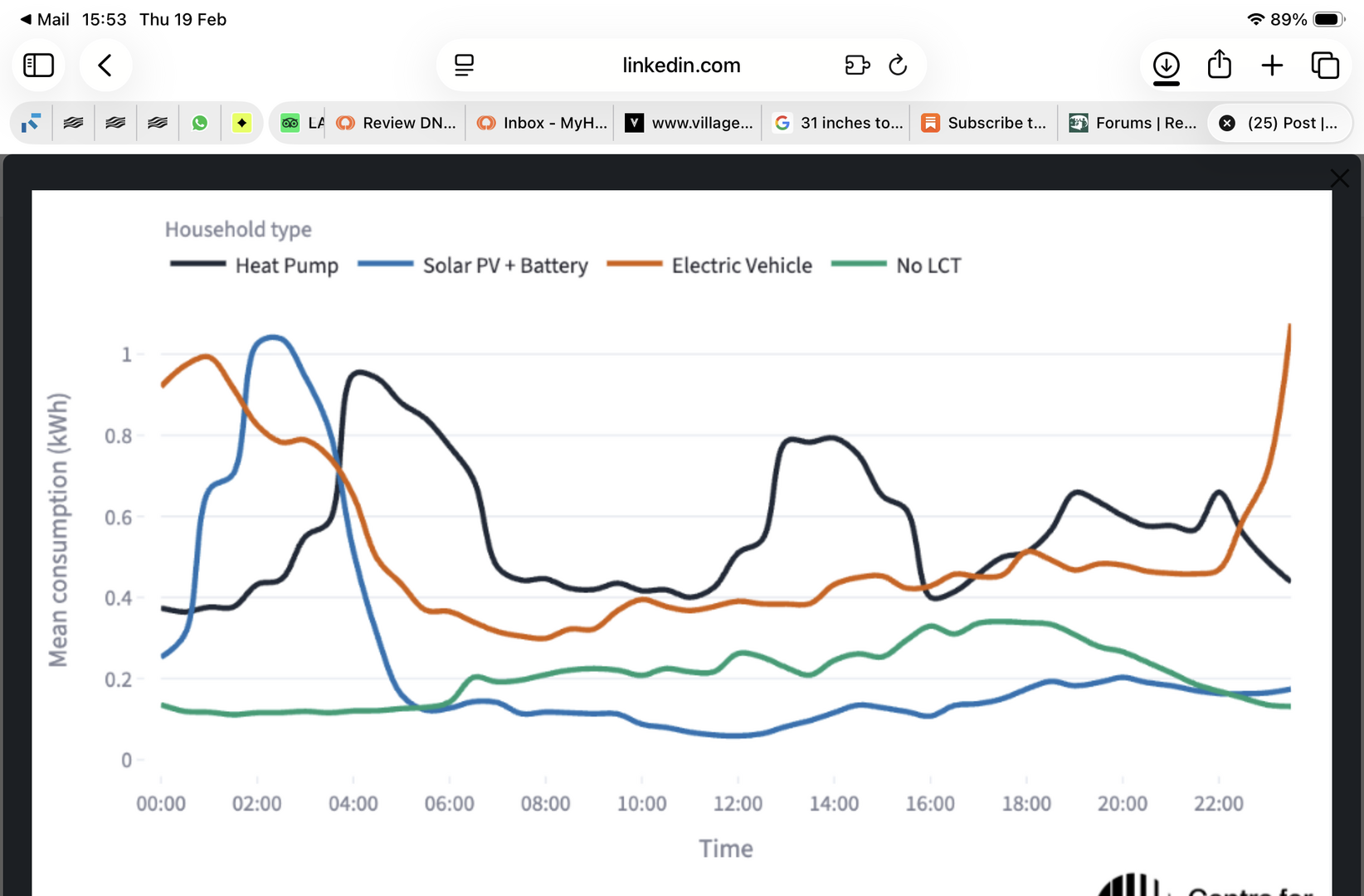
One of the replies was from an Octopus policy advisor showing how their flex EV and heat pump (Cosy) tariffs fit together to give usage in one of their models. Also some useful comments from a Regen director on their assumptions of flex use.
Most comments are on the original question posed about evening peak usage coming down in absolute terms, and potential causes.
This from Octopus’s centre for net zero shows their load predictions (I think!) LCT is load control tariff?
2kW + Growatt & 4kW +Sunnyboy PV on south-facing roof Solar thermal. 9.5kWh Givenergy battery with AC3. MVHR. Vaillant 7kW ASHP (very pleased with SCOP 4.7) open system operating on WC
19/02/2026 5:41 pm
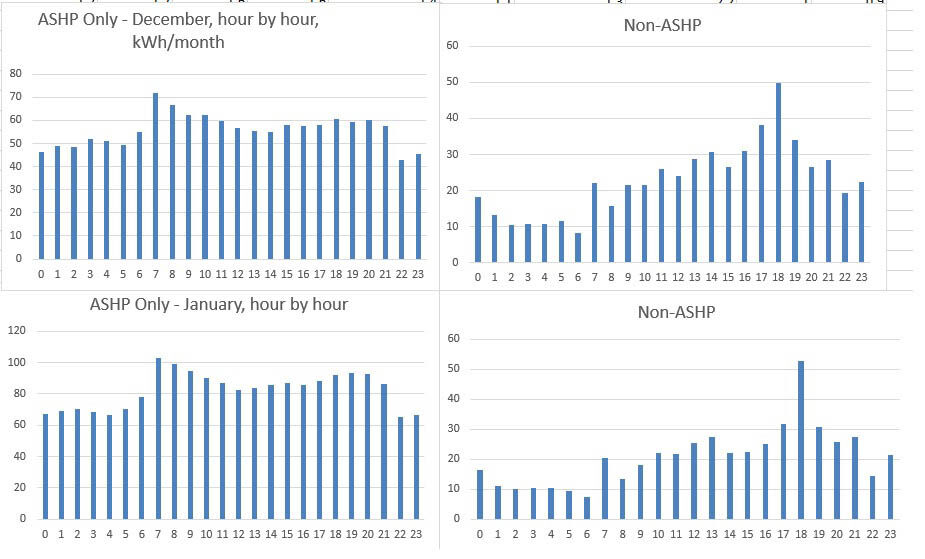
Attached are my usage figures hour by hour for all of December and January for the heat pump and for other domestic use. The heat pump usage is pretty much what I would expect but I don't understand why domestic use is so high - something for a closer look. The y-axis is kWh for the whole month so for daily figures divide by 31. As I've posted on here before, my house was practically designed to radiate heat and after a week in January of consistently sub-zero temperatures and relative humidity 85-90% I was pushing 5kW and 100 kWh / day 🙁 .

Latest Posts
-
RE: Humidity, or lack thereof... is my heat pump making rooms drier?
Actually, it’s better for wooden furniture – or at leas...
By Majordennisbloodnok , 6 hours ago
-
This is absolutely standard for any sealed pressurised ...
By JamesPa , 8 hours ago
-
RE: Oversized 10.5kW Grant Aerona Heat Pump on Microbore Pipes and Undersized Rads
@uknick TBH if I were taking the floor up ...
By JamesPa , 8 hours ago
-
RE: What determines the SOC of a battery?
@batpred Your BMS parameters will be the same as m...
By Bash , 9 hours ago
-
RE: Getting ready for export with a BESS
I would have not got it if it was that tight
By Batpred , 10 hours ago
-

RE: Setback savings - fact or fiction?
I also need to correct something I said by mistake earl...
By cathodeRay , 10 hours ago
-
RE: Electricity price predictions
@judith Thanks for sharing, and nice to see how the ...
By Batpred , 10 hours ago
-
RE: Testing new controls/monitoring for Midea Clone ASHP
@tasos the OAT is incorporated into the control logic. ...
By benson , 11 hours ago
-
RE: Need help maximising COP of 3.5kW Valiant Aerotherm heat pump
@judith thanks Judith. Confirmation appreciated. The ...
By DavidB , 13 hours ago
-
RE: Recommended home battery inverters + regulatory matters - help requested
That makes sense. I thought better to comment in this t...
By Batpred , 13 hours ago
-
Bosch CS5800i 7kW replacing Greenstar Junior 28i
My heat pump journey began a couple of years ago when I...
By Slartibartfast , 13 hours ago
-
RE: How to control DHW with Honeywell EvoHome on Trianco ActiveAir 5 kW ASHP
The last photo is defrost for sure (or cooling, but pre...
By JamesPa , 15 hours ago
-
RE: Plug and play solar. Thoughts?
Essentially, this just needed legislation. In Germany t...
By Batpred , 15 hours ago
-
RE: A Smarter Smart Controller from Homely?
@toodles Intentional opening of any warranty “can of wo...
By Papahuhu , 17 hours ago
-
RE: Safety update; RCBOs supplying inverters or storage batteries
Thanks @transparent Thankyou for your advic...
By Bash , 18 hours ago
-
RE: Air source heat pump roll call – what heat pump brand and model do you have?
Forum Handle: Odd_LionManufacturer: SamsungModel: Samsu...
By Odd_Lion , 18 hours ago
-
RE: Configuring third party dongle for Ecodan local control
Well, it was mentioned before in the early pos...
By F1p , 1 day ago
-
RE: DIY solar upgrade - Considering adding more panels
I know this is a bit old, but it made me wonder what co...
By Batpred , 1 day ago
-
RE: New Vaillant aroTherm Plus in black - When will it come to the UK?
@majordennisbloodnok Daikin, take note! (In fact, I hav...
By Toodles , 2 days ago
-
RE: Midea ASHP – how to set weather compensation
@mk4 — good work! First, I agree, no evidence of cycl...
By cathodeRay , 2 days ago
-

RE: Solis inverters S6-EH1P: pros and cons and battery options
I don't know about Solis inverters. It isn't a featur...
By Transparent , 2 days ago
-
Daikin Altherma 3 H HT - Freeze Prevention Threshold
Hi. We have an Altherma 3 HT (18kW I think) which, now ...
By RICHARDF5033 , 2 days ago
-
RE: Passiv Smart Thermostat - Help & Forum Support
@petch We are not yet compatible with the R290 from Gra...
By Will H , 2 days ago