

Notifications
Clear all
Joining the Renewable Heating Hub forums is completely free and only takes a minute. By registering you’ll be able to ask questions, join discussions, follow topics you’re interested in, bookmark useful threads and receive notifications when someone replies. Non-registered members also do not have access to our AI features. When choosing your username, please note that it cannot be changed later, so we recommend avoiding brand or product names. Before registering, please take a moment to read the Forum Rules & Terms of Use so we can keep the community helpful, respectful and informative for everyone. Thanks for joining!

04/10/2026 1:58 pm
Are the civil servants thinking of a domestic turbine within a suburban garden?...
... in which case the definition of "curtilage" needs specifying
Yes. The pd is for heat pumps on 'domestic premises'. The term curtilage is frequently used on planning law and, to the best of my knowledge, just means the property boundary.
This post was modified 3 weeks ago 2 times by JamesPa
4kW peak of solar PV since 2011; EV and a 1930s house which has been partially renovated to improve its efficiency. 7kW Vaillant heat pump.

04/10/2026 3:16 pm
So a farmhouse isn't "domestic premises"?
Is that being defined because there is or isnt a boundary wall between the house and the agricultural buildings?
Or because it may or may not have its own electricity supply?
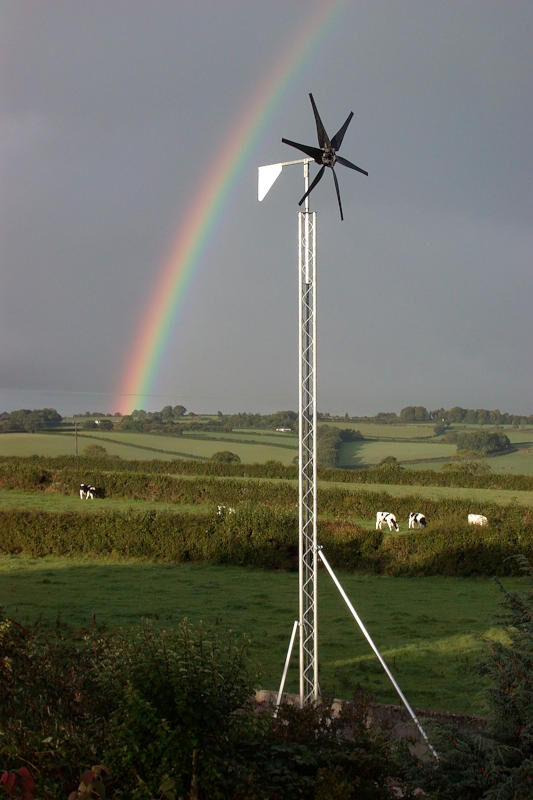
I do have a wind turbine within the curtilage of my own home. But the farm buildings are ¼mile away in the valley.
Save energy... recycle electrons!
04/10/2026 3:18 pm
So a farmhouse isn't "domestic premises"?
Without doing some research I can't immediately answer that question in planning law, but I would think it almost certain that the matter has been settled by one or more cases, albeit that case law continues to evolve.
The meaning of curtilage (also in practice a matter for case law) is discussed here
This post was modified 3 weeks ago 3 times by JamesPa
4kW peak of solar PV since 2011; EV and a 1930s house which has been partially renovated to improve its efficiency. 7kW Vaillant heat pump.
05/10/2026 7:53 am
Further to the above the actual text, describing what is permitted, reads
Permitted Development
G. The installation, alteration or replacement of a microgeneration air source heat pump—
(a)on a dwellinghouse or a block of flats; or
(b)within the curtilage of a dwellinghouse or a block of flats, including on a building within that curtilage.
Thus, although the title uses the word domestic, the actual text doesn't refer to 'domestic premises', it refers to 'dwelling houses' and 'flats'.
The interpretation section of the same order has something to say about the meaning of these terms and the Use Classes Order 1987 will also be relevant, possibly definitive.
A farmhouse, if principally designed for living in, would be a dwelling house in my reading. If it were designed for mixed use it may be questionable. The definition of curtilage therefore becomes relevant and I posted a link where there is discussion and links to some relevant case law. In essence it's context dependent. Hopefully this may give some indication whether a turbine 0.25 miles away on land in the same ownership would negate the installation of a heat pump or not under pd.
4kW peak of solar PV since 2011; EV and a 1930s house which has been partially renovated to improve its efficiency. 7kW Vaillant heat pump.
1


05/10/2026 8:09 am
I suppose it could be a noise argument?
Don't forget that permitted development means no opportunity for the lpa to review/intervene so tends to be conservative.
I'd be surprised if it wasn't a noise consideration. Neither wind turbines nor heat pumps are intrinsically noisy but both have come under attack in the past for the potential to be so in certain circumstances. In that light, it would be a pretty bold stance to allow two potentially noise-creating items to be installed close by one another without requiring some sort of sanity check that they won't compound each other's problem.
This is, of course, only permitted development. The fact remains that heat pumps and wind turbines can still be installed close to each other with planning permission.
All my own supposition, of course...
105 m2 bungalow in South East England
Mitsubishi Ecodan 8.5 kW air source heat pump
18 x 360W solar panels
1 x 6 kW GroWatt battery and SPH5000 inverter
1 x Myenergi Zappi
1 x VW ID3
Raised beds for home-grown veg and chickens for eggs
"Semper in excretia; sumus solum profundum variat"
2

05/10/2026 2:45 pm
Sound level calculation for air source heat pump permitted development noise compliance using MCS 020 a) against the fixed 37 dB(A) limit.
See this useful online calculator:
https://tradecalculator.co.uk/renewables/heat-pump-noise-calculator/
For example, my two Daikin A2A outdoor units (sited side-by-side) have a maximum sound power of 60dB each, they are on the ground with a wall behind them (Q4).
There are two assessment positions that need to be considered: (i) 1m perpendicular in front of the neighbour's back door, which is 9m away, and (ii) 1m perpendicular in front of the neighbour's nearest first floor window, which is 14m away. Position (i) is completely obscured by a solid fence (<18mm thick) and position (ii) is in full view. Due to the sound damping effect of the fence (-5dB) both positions need to be checked.
The calculated noise levels are (i) 34dB and (ii) 35.1dB, so both are within the 37dB limit.
Note, if the fence wasn't there, then the noise level would be 39dB at position (i) and would not be compliant. Having a single heat pump and no fence, the maximum noise level would be 35.9dB, which would again be compliant.
The calculator is useful for checking compliance in simple situations i.e. one or two heat pumps. If you scroll down on the webpage, it explains the assumptions of the model and the formula that MCS 020 a) uses.
In practice as a courtesy to my neighbours, and for maximum efficiency, I only ever run the heat pumps in eco mode which drops the maximum sound level substantially by reducing the maximum compressor and fan speeds. That does not however make any difference to the compliance calculation required.
This post was modified 3 weeks ago by Majordennisbloodnok

05/10/2026 6:03 pm
The idealist in me says pioneers in this space should be rewarded!
This post was modified 3 weeks ago by Majordennisbloodnok
8kW Solis S6-EH1P8K-L-PLUS hybrid inverter; G99: 8kW export; 16kWh Seplos Fogstar battery; Ohme Home Pro EV charger; Vaillant Arotherm Pro 7kW; 100Amp head, HA lab on mini PC
1
Page 2 / 2
Prev

SPONSORS
Degrees of Separation
Latest Posts
-

RE: New Build 3 Phase or 1Phase
Not so. 1: It's now the case that the Service Fuse wi...
By Transparent , 8 hours ago
-
RE: How will removing the standing charge on gas bills benefit heat pumps?
I think it has an enormous impact on air/air users. The...
By EtchedPixels , 16 hours ago
-
@editor Ouch, sorry to re start the tick. I had assume...
By DavidB , 1 day ago
-
RE: Say hello and introduce yourself
@e-a-west as the good Major said, welcome to the forums...
By Mars , 1 day ago
-
RE: How much of your renewable and home setup would still work if the internet went down?
Yes I actually have a copy of a tool that whenever a ce...
By EtchedPixels , 2 days ago
-
RE: Indevolt Batteries UK Support & Info Thread
@editor Hi, To resolve this, please tap on the A...
By Indevolt Tech , 2 days ago
-
RE: Double or Triple Glazed Windows?
Posted by: @singlespeed With 9 years repairing windo...
By Rob of York , 3 days ago
-
@transparent we’re still running a secure version of PH...
By Mars , 3 days ago
-
RE: How quickly would you want/expect heat recovery to take from setback?
Much longer than that here. The heating isn't even on. ...
By bobflux , 4 days ago
-
RE: Passiv Smart Thermostat - Help & Forum Support
Obviously the weather is changeable but there's a defin...
By Singlespeed , 4 days ago
-
RE: The Changing Jet Stream Could Challenge UK Air Source Heat Pumps
@rob-of-york I must admit that when we had a Daikin hea...
By Toodles , 4 days ago
-
RE: Forum updates, announcements & issues
Get the Renewable Heating Hub heads-up on WhatsApp. I...
By Mars , 4 days ago
-
RE: Safety study for plug in batteries out to tender - looks like Q3 2027 at best before legal
@editor I pointed out to the one of the Fuse execs that...
By dansus , 4 days ago
-
RE: 15kw pump for 225m2 1990's house - over kill?
@seaviews As well as loft insulation, there are othe...
By Rob of York , 4 days ago




SPONSORS