
Notifications
Clear all
Air Source Heat Pumps (ASHPs)
140
Posts
12
Users
23
Reactions
8,040
Views
Topic starter
13/12/2025 11:21 am
@robs — is there anything weird in your post or footer/signature? That's where the page layout breaks for me.
Midea 14kW (for now...) ASHP heating both building and DHW

13/12/2025 5:25 pm
Following this discussion with much interest.
We operate a set back, as much by necessity of having an over-sized heat pump, but also due to my Scrooge-like tendencies.
We cannot operate our 12kW heat pump continuously, even on minimum output, until the OAT falls below 5C, so by necessity we are inherently operating a set back much of the time. We have an indoor set temperature of 20C. We switch off at midnight, and typically go to bed around 1am which allows the house to cool a little before bed (to a more comfortable sleeping temp). We typically get up around 10am, at which point the inside temp may have fallen as low as 15C. Heating goes back on (still on a minimum LWT of 32-33C) and is able to recover to a more tolerable level (17C) relatively quickly. We still have our 'bed warmth' so this is not too bad. The house continues to warm during the day, maybe reaching 19C by late afternoon (depending on OAT) which is fine as we are busy/active during the day, and then recovers back to 20C for the evening to bed time when we are more sedentary and appreciate the extra heat. This works well for us and clearly saves 10h of running per day.
Some observations:
Switching off clearly saves us 10h of ~1kW/h minimum input (10kWh usage, minimum)
Circulation pumps can have an impact. An electrical draw of 100W (2 x 50W pumps) for 10h saves 1kW of usage during the 10h setback period. This saving is definitive even if the recovery energy is the same as the energy saved, and saves us 365kWh per year regardless. The smaller the heat pump, the greater the impact of constant wattage circulation pumps. 100W is 20% for a heat pump with an electrical input of 500W and 10% for my larger 12kW model.
We are off during the coldest periods and largely avoid costly defrost cycles which would occur mostly overnight for us, avoiding poor COPs. We are reheating during a warmer part of the day where the COP is potentially higher.
A constant 20C IAT would not be appropriate for us. Our average IAT is maybe 2C lower, which must use less energy than maintaining 20C or above as would result in continuous running, and I want 18C for sleeping, so I'd either have to close off the bedroom TRV (further exacerbating the fact the radiators cannot dissipate the heat being produced) or switch off as we do.
My scientific curiosity would love to perform some like for like experiments to demonstrate (at least to me) that our setback savings are real, but as is highlighted above there are far too many external variables outside of our control (solar gain, wind chill, temperature variations) to ever be able to identify two directly comparable days. The scale of any savings will of course also depend on weather patterns. The savings for us will be greater where the OAT swings in our favour (2C overnight during the setback and 10C during the day) versus days of constant 10C OATs.
This post was modified 3 weeks ago by Old_Scientist
Samsung 12kW gen6 ASHP with 50L volumiser and all new large radiators. 7.2kWp solar (south facing), Tesla PW3 (13.5kW)
Solar generation completely offsets ASHP usage annually. We no longer burn ~1600L of kerosene annually.

13/12/2025 7:21 pm
My scientific curiosity would love to perform some like for like experiments to demonstrate (at least to me) that our setback savings are real, but as is highlighted above there are far too many external variables outside of our control (solar gain, wind chill, temperature variations) to ever be able to identify two directly comparable days.
Two days will never be sufficient because the run up and the days after matter as well. Somewhere in the West Country (I think) there are two houses built in a temperature controlled warehouse, that is what is needed.
My feeling, which can be justified by qualitative argument based on the physics, is that there definitely are situations where setback is likely to save money. These include
- very high loss low thermal mass houses (which will therefore cool a lot but dont take too much to reheat - simply put they have the thermal characteristics of a tent)
- very low loss houses, particularly where multiple circulation pumps have been fitted which thus can form a significant proportion of the total consumption (effectively heating at a COP of 1 if you are lucky).
- Houses with oversized heat pumps that don't manage their own cycling well are also another likely candidate.
The challenge is the ones in the middle, tolerably but not super well insulated houses with high thermal mass that therefore dont cool much during any normal daily setback and which have been fitted with a heat pump that is either well sized or manages cycling well. In other words a typical 5-10kW 2-4bed 100-250sqm house that makes up much of our housing stock.
I also have some concern about an excessive focus on the energy balance in the fabric. What matters to the inhabitants is not that energy balance, but the IAT. Is it possible that while the IAT is OK, the house is still out of balance, and so in fact the conservation of energy (which I don't dispute) doesn't apply in the short term, but only in the (much) longer term? Yes, the house loses X amount of energy during the setback, and X ultimately needs to be put back in, but what about the short term. Maybe the fabric is forever playing catch up
Whilst I accept that what matters to the inhabitants is IAT not energy balance, if the house is 'forever playing catch up' then unless you exclude the days at the start of setback you are not measuring something that is sustainable, you are measuring, at least in part, the results of a transition. Hence the focus on returning to the same condition as the starting point. I grant that this may, in a scenario where setback is practiced for a very long time, be a different state to that where no setback is practiced for an equally long time.
I predict that, in the absence of properly controlled lab experiments, this discussion may go on forever!
@cathoderay did you ever repeat this comparison post your 'big bang'. I agree that this is one of the more convincing demonstrations that, in your case, setback appears to make a difference, but I am also conscious that this was (I think) when your system suffered from some limitations that may or may not be relevant
This post was modified 3 weeks ago by JamesPa
4kW peak of solar PV since 2011; EV and a 1930s house which has been partially renovated to improve its efficiency. 7kW Vaillant heat pump.
Topic starter
13/12/2025 8:01 pm
I predict that, in the absence of properly controlled lab experiments, this discussion may go on forever!
That is a valid prediction that can be tested, apart from the fact none of us will be around when the conclusions are drawn!
I think with your help I have answered the setback duration question, ie when does a long obvious saving setback become a less obvious saving setback and it is when you have an overall steady state (ie keep coming back to where you started) situation. Going away for two weeks and then coming back and putting the heating on is a transition sate. And I do get the energy balance thing, which my simple mind sees as being like a bath with a leak that you need to maintain at a depth of 20cm of water. During the day you do that by having a tap running in to match the flow out through the leak, but overnight you turn off the tap to reduce the risk of undetected flooding. In the morning you turn the tap on again, but the flow rate has to be a bit higher than normal, to bring the water level back up to 20cm, before going back to the normal slightly lower rate. In this case, the extra water that needs to be added in the morning will exactly equal that lost overnight when the tap was off.
Which leads me to wonder, given the empirical results, if something is somehow wrong with the steady state assumption(s), not the principle, but how we are applying it?
Midea 14kW (for now...) ASHP heating both building and DHW
Topic starter
13/12/2025 8:21 pm
That is a valid prediction that can be tested, apart from the fact none of us will be around when the conclusions are drawn!
I've just realised I was talking nonsense, if something goes on forever, it is infinite, and so cannot be tested!
Midea 14kW (for now...) ASHP heating both building and DHW
Topic starter
13/12/2025 8:24 pm
did you ever repeat this comparison post your 'big bang'. I agree that this is one of the more convincing demonstrations that, in your case, setback appears to make a difference, but I am also conscious that this was (I think) when your system suffered from some limitations that may or may not be relevant
No, I haven't yet, and I will need to wait until I have enough post 'big bang' data to do it. I will look at how much data I already have tomorrow.
Midea 14kW (for now...) ASHP heating both building and DHW

13/12/2025 8:29 pm
Which leads me to wonder, given the empirical results, if something is somehow wrong with the steady state assumption(s), not the principle, but how we are applying it?
Maybe this:
I grant that this may, in a scenario where setback is practiced for a very long time, be a different state to that where no setback is practiced for an equally long time.
or maybe that the effect you are seeing is not caused by setback (correlation does not equal causality)
or maybe it is but not due to the obvious thermodynamics - eg something to do with the PHE (particularly as I think the results were pre big bang?)
or maybe something else we haven't yet thought of
We really need 20 similar experiments in other houses!
I've just realised I was talking nonsense, if something goes on forever, it is infinite, and so cannot be tested!
Very true!
4kW peak of solar PV since 2011; EV and a 1930s house which has been partially renovated to improve its efficiency. 7kW Vaillant heat pump.

14/12/2025 5:53 pm
... what we are primarily looking at here is energy use, observed when it is known, and expected (predicted) when it is not known, eg what it would have been had I not had a setback.
The predicted values are based on assumptions and it is these assumptions that need testing IMHO.
"Also, you've assumed that once the IAT has recovered the house fabric has also returned to its pre-setback state, I'd suggest that this is not a safe assumption and the fabric will continue to re-absorb energy. As a result your calculated expected values include additional energy (thus inflated) as a result."
I am not sure about this. The IAT is what matters to the inhabitants. If the fabric is still re-absorbing energy despite a recovered IAT, and I agree it may be, the heat pump and it's control logic doesn't know this (it doesn't know what the IAT is, let alone the energy flux in the fabric), it only knows and only uses the OAT/AIT to set the set LWT and so in due course the energy in. Yes, it does also know the RWT, but, subject to being corrected, because this is a grey area that may be relevant, I don't think that is used in any way to set the LWT, which is merely derived from the WCC.
Your 9-10 April graph shows that prior to your setback your heat pump was supplying 2.5-3kW to your house at an OAT of around 13-14C. During the setback the OAT drops from about 12C to about 8C, your "energy out vs OAT graph" shows that the heat loss of your house is 3.5-5kW at those OATs. Taking the middle of that range, means to maintain the IAT you would have needed about 13 kWh of energy for the setback period.
During the reheat period for IAT (3 hours from 3-6) puts in about 23.5 kWh energy at an OAT of about 5C, your "energy out vs OAT graph" predicts the need for about 6.5 kW at 5C and thus about 19.5kWh to maintain the IAT. So there's 4 kWh of excess of energy delivered into your house compared to continuous running during these 3 hours. The next 3 hours (6-9) sees about 22 kWh put into your house with an average OAT of about 8C, your "energy out vs OAT graph" predicts a little over 5kW needed at that OAT giving about 16kWh needed for continuous running and so an additional 6kWh of energy was put into your house during this 3 hours. The following 3 hours (9-12) shows about the same energy put in as your "energy out vs OAT graph" would predict. From eye-balling your graphs (not hugely accurate I know!) 10 of the 13 kWh needed to maintain a constant IAT during the setback period can be accounted for, greater accuracy than eye-balling may account for (some or all of) the other 3 kWh.
The heat pump is following your logic... your WC curve has been setup to provide the desired IAT despite the re-absorption of energy by the fabric. You may not have consciously done this but to achieve your desired IAT you will have accounted for it, your auto adaption Python script could also have a role in this too.
Furthermore, I think your logic may be the wrong way round. If the house is in reality somehow sucking in more energy during the recovery period, then my predicted/expected should be too low (ie deflated, rather than inflated) as a result. But in fact they are neither: the predictions match the observations.
If you have taken the setback data and removed the setback period to predict the steady state data, then having excess energy delivered during the non-setback period will inflate the prediction. The values are inflated during the ~6 hours of actual recovery from the setback (see calcs above). Also your predictions are based on your WC curve not changing when running without setback, and your Python auto adaption script modifying your WC curve with the same frequency, which are unlikely.
I also have some concern about an excessive focus on the energy balance in the fabric. What matters to the inhabitants is not that energy balance, but the IAT. Is it possible that while the IAT is OK, the house is still out of balance, and so in fact the conservation of energy (which I don't dispute) doesn't apply in the short term, but only in the (much) longer term? Yes, the house loses X amount of energy during the setback, and X ultimately needs to be put back in, but what about the short term. Maybe the fabric is forever playing catch up, while the IAT is OK for the inhabitants? My earlier question about the duration of setback is relevant here: longer setbacks (days or weeks) do mean real savings. At what point, and why, do the savings start to become more questionable?
To answer the question of does a setback save you energy/money you can't exclude part of the return to the starting state, the energy needs to be returned to the fabric so that during the following day's setback the IAT doesn't plumet due to there not being enough energy stored in the fabric to help maintain the IAT.
Longer setbacks, of days or weeks, come with an acceptance of undesirable IATs for occupants - so an apples vs oranges comparison in many respects.
Topic starter
15/12/2025 11:10 am
@robs — thanks for comprehensive reply.
The predicted values are based on assumptions and it is these assumptions that need testing IMHO.
I agree, this is essential, as the predicted values determine the final result and so conclusion. There aren't many assumptions, and I think they are valid:
(1) there is a linear relationship between OAT and energy out (the whole basis of heat pump system design and weather compensation), and thereby to energy in, which is nonlinear (2nd order polynomial) because of the effect of falling COP at lower OATs
(2) a plot using only hours when the heating was on ie excluding setback hours of OAT against energy in will allow us to (a) visually assess whether there is a relationship and, if we are satisfied there is a relationship (personally, I am), (b) determine the equation that describes the relationship between OAT and energy in
(3) we can then use that equation to determine (predict) what the energy in would be at given OATS even when we don't have any energy out at that point in time (because there was a setback in operation), ie determine the expected value, had the heating been on
There is also the visual check provided by data points for where we do have the observed energy in data and at the same time plot the expected value (re-post for convenience (with a typo corrected), data points on the X axis are setback data, zero energy out):
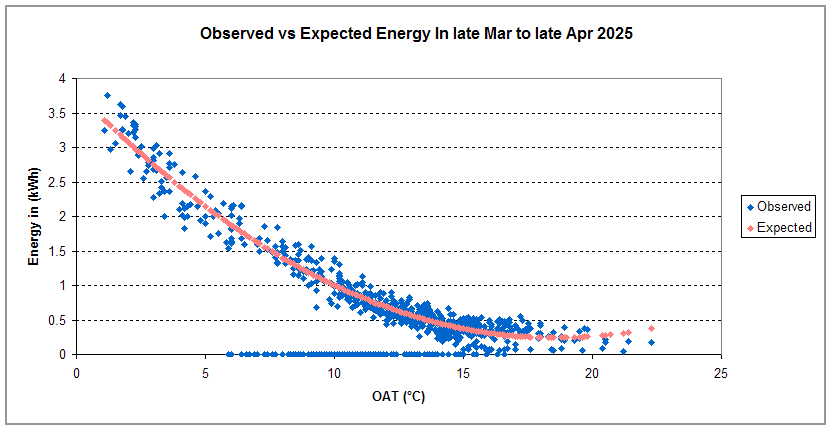
It looks to me like the predicted values fit very well with the observed values when we have both. This suggests to me the prediction equation is valid, and will accurately predict what the expected value would have been had the heating been on during a setback.
Your 9-10 April graph shows that prior to your setback your heat pump was supplying 2.5-3kW to your house at an OAT of around 13-14C. During the setback the OAT drops from about 12C to about 8C, your "energy out vs OAT graph" shows that the heat loss of your house is 3.5-5kW at those OATs. Taking the middle of that range, means to maintain the IAT you would have needed about 13 kWh of energy for the setback period.
This is in effect doing a back of the envelope eyeballed version of my predicted method. If we take the mid point 10 degrees OAT, the energy out is about 4.5kWh. Given a 6 hour setback, that is 6 x 4.5 = 27kWh of energy out, not 13kWh. I am not sure how you got to only 13kWh. But the real problem I have with this is approach (focusing on the energy out) is you then have to convert back to energy in (which is what we are actually interested in), and that is place where we have to make a lot of assumptions about things like COP. Why not do the simple thing and look at the energy in in the first place?
However, sticking with reverse engineering the energy out to get energy in:
During the reheat period for IAT (3 hours from 3-6) puts in about 23.5 kWh energy at an OAT of about 5C, your "energy out vs OAT graph" predicts the need for about 6.5 kW at 5C and thus about 19.5kWh to maintain the IAT. So there's 4 kWh of excess of energy delivered into your house compared to continuous running during these 3 hours.
We can do better than 'about', we have the data in the csv files: it is 23.64kWh in the first 3 hours, 0300 to 0600 (your Mark 1 eyeball works very well!) but hourly mean OATs are lower (3.6, 3.5, 2.4), lets say 3.2 degrees, for which the energy out chart suggests around 7.4kWh, or 3 x 7.4 = 22.2kWh for the three hour period. That suggests extra energy out (to the house), but only 1.44kWh, not 4kWh.
Doing the same thing for 0600 to 0900 and 0900 to 1200 comes out at
0600 to 0900: 22.00kWh at a mean OAT of 4.07 vs 6.6 x 3 = 19.8kWh from the energy out chart = excess of 2.2kWh supplied vs your 6kWh
1900 to 1200: 11.97kWh at a mean OAT of 10.3 vs 4.3 x 3 = 12.9kWh from the energy out chart = excess of 0.9kWh supplied vs your 'about the same'.
Thus the total extra energy put back over the 0300 to 1200 period appears to have been 1.44 +2.2 + 0.9 = 4.54kWh, not 10kWh.
How does this compare to what was lost during the setback? The mean OAT was about 10 degrees, and IAT dropped from 19.9 to 18.5 degrees during the setback. If we treat my house house a big radiator sitting in my garden warming my garden, how much heat has to be lost from the house to the garden to for the IAT to fall by 1.4 degrees? Now, I am not sure, but it seems to me we can use the energy out chart to get a handle on this by changing it to an inside outside delta t chart rather than an absolute OAT chart. In fact, we don't even need to chart it. If the mean OAT was 10 degrees, and the mean IAT was near enough 19 degrees, then the 10 degrees OAT point on the charts is also the 9 degree inside/outside delta t point, with the energy out at that point being 4.37kWh (from the equation):
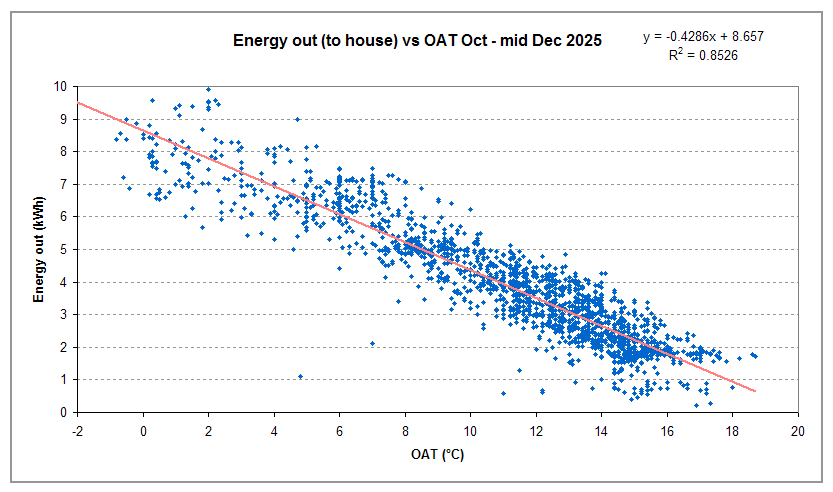
If we assume the inside/outside delta t to energy out relationship is linear, which we believe it is, and at 19 degrees IAT and OAT, the energy out/heat loss is zero, see chart, then that means for degree change in inside/outside delta t, the energy out changes by 4.37 / 9 = 0.49 kWh per degree change in inside/outside delta t. If we now flip that on its head, then I think we can say that for each degree decrease (because the IAT drops, getting closer to the OAT) in the inside/outside delta t, then the energy out and/or heat loss drops by 0.49 kWh. Now there is a lot of averaging out going one here, but if that drop goes on over six hours, then the loss over that six hours is 0.49 (drop per degree) x 1.4 (the drop) x 6 (number of hours) giving a total loss over the six hours of 4.12 kWh. Doing a sanity check, this doesn't seem entirely bonkers. It is the same as putting a 1kW conventional electric heater in the garden and leaving it on for four and a bit of the six hours. If anyone fancies doing the full heat capacity equation assessment of the energy lost during the setback, please do so (two storey building with storey hit a bit less than normal say 2m per storey, roughly 18 by 5 metres footprint, ~34cm solid stone walls, tile roof with standard ~300mm insulation, semi-detached on the short side).
Now, I am a retired doctor, not a retired heating engineer, and as a rule we doctors don't bother to calculate how much energy a feverish patient loses to the ward as their fever comes down, so I may have got this completely wrong. But, if I haven't, and the heat loss during the setback is around 4.12 kWh, and the extra heat put in during the full recovery period is 4.54 kWh, then, give or take, and allowing for measurement error, the building is to all intents and purposes in energy balance, the energy lost during the setback is replaced during the recovery, and thus no violations of the conservation of energy have taken place, but overall (from the previous calculations), I have saved some energy.
On the point about whether I have subconsciously baked in the necessary adjustments into my WCC to accommodate setbacks, possibly, possibly not. For long periods of time I have the same WCC (albeit with occasional auto-adapt tweaks), whether I am running setbacks or not. The last time I changed it was on 19th Feb this year, when I lowered the left hand flow temp by one degree. Since then I have had periods of setback running and non setback running. The energy in chart above uses data from a setback period, and 24 hour period under consideration is in that setback period, so I may have baked in some extra energy in in the recovery period. I can redo the analysis using energy in data from a non-setback period, and see if that makes any difference. The energy out chart above covers a non setback period.
One final point just for clarity: my auto-adapt script will have done very little if anything during the 24 hours under consideration. The IAT didn't drop below 18 degrees, which is when a boost is triggered. It may have briefly lowered output a fraction mid morning on the 10th, when the IAT went over 20 degrees.
I remain as ever fully open to debate on this matter. Any comments are very welcome.
Midea 14kW (for now...) ASHP heating both building and DHW
Topic starter
15/12/2025 1:10 pm
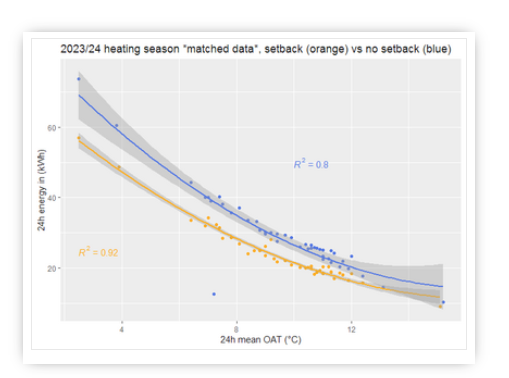
@jamespa (and anyone else interested) — I have now done the post big bang 'two populations' (setback and no setback) plots for 2025 (Feb to mid Dec), both for all data (left) and for matched data (right, only using pairs, where a setback data point is matched to a non-setback data point where the OAT is within 0.1 degrees, the idea being 'matched controls', but at a cost of a smaller data set and so wider confidence intervals):
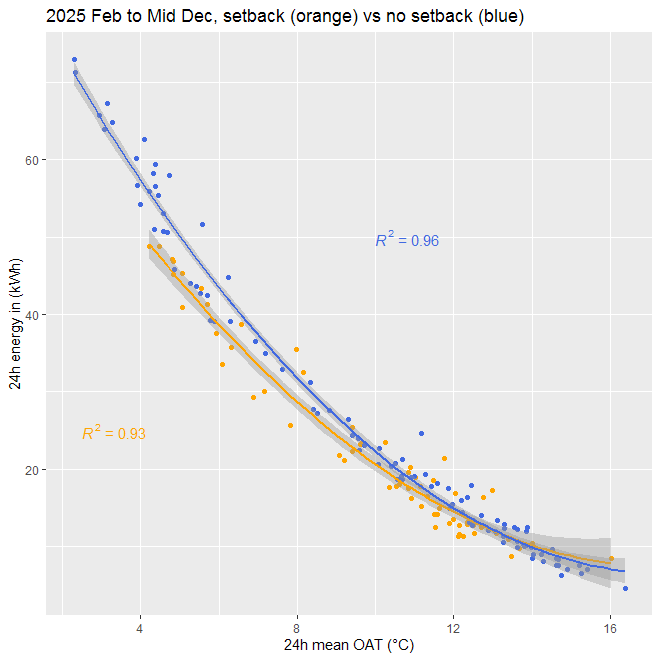
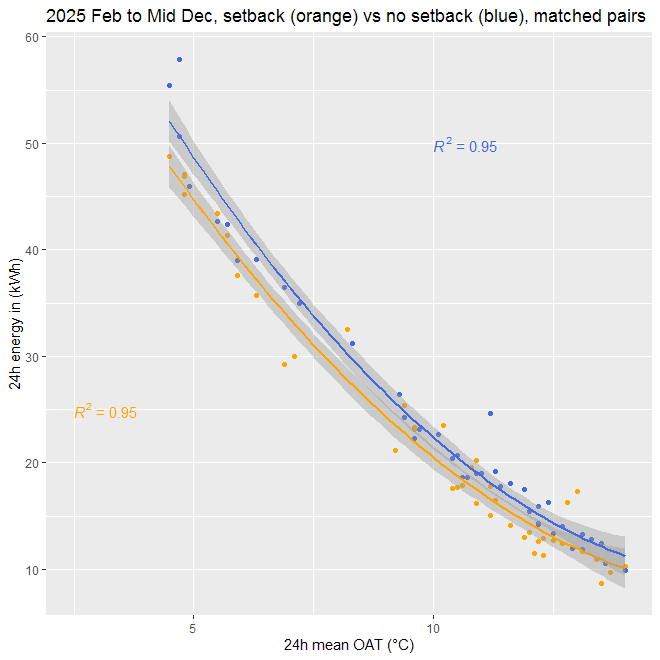
The lines are closer than in the previous plots, but at lower OATS they do appear to be separate (grey 95% confidence bands don't overlap), although they do at higher OATs. It is also worth mentioning that all the setback points come from last spring, while the non setbacks points are all from this autumn. It shouldn't make a difference, but maybe it has.
I'm not sure what this tells us. Something changes as the OAT goes down? Or just not enough data yet?
Midea 14kW (for now...) ASHP heating both building and DHW
15/12/2025 1:43 pm
I'm not sure what this tells us. Something changes as the OAT goes down? Or just not enough data yet?
Fascinating. If I was asked to guess before you presented the data, I would have guessed that there might be a separation at higher OATs (where water pump consumption matters) rather than at lower OATs.
The fact they are different to the previous results is significant though, it shows that somehow (we dont know how) the 'stuff in the middle' (between heat pump and emitters) probably matters!
Its also notable that this time some of the orange points spread above the blue line and some of the blue points reach the orange line. This may tell us something if there is another variable.
Autumn vs spring might make a difference. Last spring we had very bright weather, I think more so than this autumn. Even without that diurnal temperature profiles in Spring and Autumn can be quite different.
Im wondering if there is another dimension (beyond Average OAT) that we can/should consider. Temp swing could be important, as could sunshine hours.
4kW peak of solar PV since 2011; EV and a 1930s house which has been partially renovated to improve its efficiency. 7kW Vaillant heat pump.
Topic starter
15/12/2025 1:59 pm
@jamespa — thanks. I am going outside now have a much needed bonfire while I still can, as the wind is in the right direction. It will provide some thinking time, tending a bonfire is I find a very meditative activity. For what it is worth, before I did the plots, I expected the results to be broadly the same as the previous ones. The other main change between these plots and the earlier ones is of course 'big bang' in late January, opening up all the valves on my system, allowing more heat to flow into the building when needed at lower OATs. That may be relevant.
Midea 14kW (for now...) ASHP heating both building and DHW


Latest Posts
-
RE: Radiator sizing sanity check
No chance! Largely, hence my suggestion to do some...
By JamesPa , 5 hours ago
-
RE: Testing new controls/monitoring for Midea Clone ASHP
As it turns out this is correct! All I needed to do was...
By benson , 5 hours ago
-

Here is an update of the setback we operate on our syst...
By SUNandAIR , 8 hours ago
-
RE: Grant ASHP 17.5 kw. weather curve
@chinkoa Sorry there are two separate thoug...
By JamesPa , 8 hours ago
-
RE: Solar Power Output – Let’s Compare Generation Figures
@transparent As easy as putting sparklers in champag...
By Papahuhu , 9 hours ago
-
@f1p Looks good, and will likely be something I use whe...
By Sheriff Fatman , 11 hours ago
-
RE: Cascade 2x Grant Areona 10kw ASHP - Ongoing setup issues
Either complete Bow Locks or at best a marginal effect....
By JamesPa , 14 hours ago
-
Hi all I’m looking to get some insight on what others...
By Renewables345 , 14 hours ago
-

RE: The Great British Heat Pump Owner Persona Survey: Let's Build Our Archetype!
@mosibi, go on then, complete the survey. Let's get the...
By Mars , 15 hours ago
-
RE: Water Hammer After Heat Pump Install
@jaynieq I wish you luck with this one. I think the ma...
By JamesPa , 17 hours ago
-
RE: Optimum new build house design for Heat Pump
From first principles I would say: Definitel...
By JamesPa , 1 day ago
-
RE: Weather compensation- why you should use it
As good a place as any to drop this video:/p>
By Mars , 1 day ago
-
RE: Forum updates, announcements & issues
@transparent D'Oh - I did look before I posted but I mi...
By dr_dongle , 2 days ago
-
Compatibility with Samsung AE080RXYDEH
I am new to all this. We have a SamsungAE080RXYDEH that...
By John999 , 2 days ago
-
RE: New Fogstar 15.5kWh upright solution
@batpred Maybe you should buy your additional batter...
By Bash , 2 days ago
-

RE: Data Accuracy Problem: Daikin 8kW Heat Pump's Onecta App vs MMI Power Consumption
@nursethescreens Yes, comfort and happiness of the fami...
By Toodles , 2 days ago
-
RE: Connecting Growatt SPH5000 over wired ethernet rather than wireless
Thanks folks. I had tried googling an ethernet lab adap...
By z8lccda , 2 days ago
-
RE: Changing from 4-port buffer to volumizer
@toodles I'm not concerned that the behaviour is not no...
By Andy1618 , 2 days ago
-
-
RE: Setback savings - fact or fiction?
I agree, and I think there are two things in play here....
By cathodeRay , 2 days ago


