
Notifications
Clear all
Air Source Heat Pumps (ASHPs)
360
Posts
21
Users
48
Reactions
55.3 K
Views
15/02/2026 8:50 am
@mk4 — good to hear that you have made progress, and the comfortometer is where it should be.
It seems that the ASHP does not cycle when operating (I state this with an 80% confidence factor based on the 5min sampling rate of the PV inverter power consumption graph and the daily continuous compressor runtime shown in the midea wired controller - once on, it seems not to loose a minute, the counter resets every time the pump switches on).
It does seem to modulate a lot as exhibited by the ranging compressor speed, water flow speed and output power (viewed randomly in the wired controller screen). The highest water flow speeds (>2m3/h) understandably appear at the start up phase as the pump tries to heat up the water and chases also the ΔT.
On one level this isn't that important if the comfortometer is where it should be, and you have a COP of around 4.2, but at the same time it is always good to know what your heat pump is up to. I do wonder whether your later generation of Midea heat pump is fundamentally different to my older generation Midea heat pump. In moderate and above OATs, my heat pump always does slow cycling, and the flow rate is constant much of the time at just under 1.5m^3/h, and only drops to a lower level (not off) during the off part of cycles, and when it finds itself running in steady state. This recent but not typical (normally slow cycling is much more in evidence) 24 hour chart is useful because it includes the three running states my heat pump uses, slow cycling, steady state and defrosts. On the left we have normal slow cycling, which happens when the OAT is ~8°C and above, plus a DHW reheat at 1300. In the middle we have the relatively rare mostly steady running state, which happens when the OAT is in the upper single figures. On the right we have a couple of defrosts, which generally appear when the OAT falls below 5°C. Note that the flow rate (blue line, plotted as true flow rate x 10 to make it easier to see) never goes above 1.5m^3/h, and generally lies at one of three values.
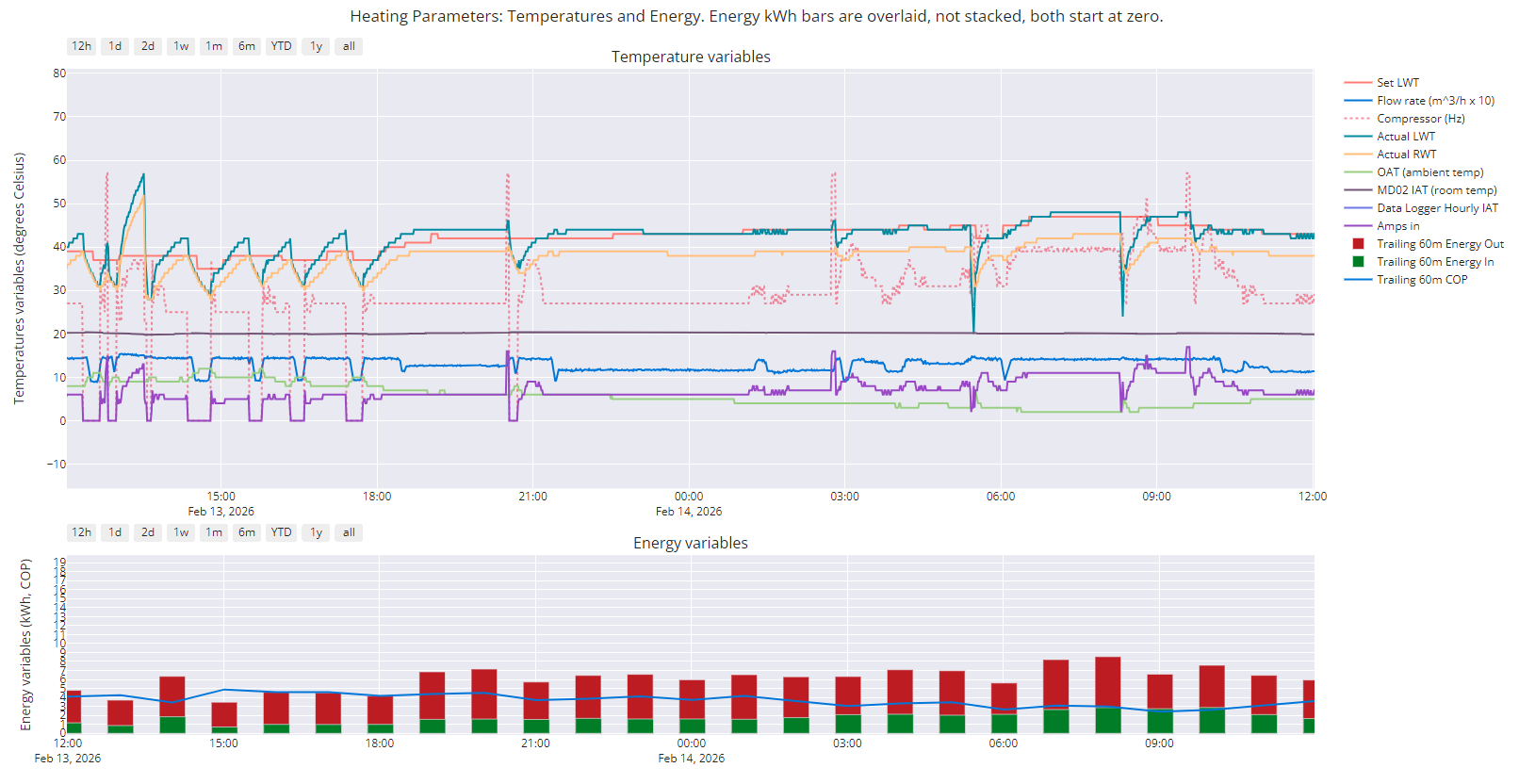
If I was in your shoes, which I am not, so feel free to take or leave this suggestion, I would get a pencil and some paper, and at a convenient time when the OAT is 10°C or above take minute readings of of the flow rate and the actual LWT (not the value on the screenshots above, which is the Set LWT, T1S), over a period of say 20-30 minutes, perhaps even longer if you can bear it. These readings, in particular the actual LWT, will then give you the best available indication of whether your heat pump cycles or not at moderate OATS.
Midea 14kW (for now...) ASHP heating both building and DHW

17/02/2026 6:03 pm
Curiosity got the better me and I mustered the stamina to do it. In fact I did it for two days and over a period of circa 2 hours per day (albeit with some time gaps and also less data types collected in day 1). Day 1 OAT range was 12 dropping to 11 and day 2 OAT 11 dropping to 9 degrees.
Despite the day 1 time gaps in the collected data I am pretty sure midea did not cycle. There are however some strange findings in the data, namely:
1. LWT is constantly below T1S (the wc target it is supposed to be chasing) by 2 to 3 degrees, despite the fact that pump is operating below max capacity)
2. Water circulator pump PWM percentage decreases as the flow rate increases (!!!). ChatGPT reckons that the indicated flow rate is a calculated and not an actually measured figure….
I need time to transfer the manual readings to a spreadsheet and then we can perhaps ponder on possible explanations. In any case, comfortometer remains high, power consumption is reasonable, so it’s an academic discussion really, not an actual problem.
17/02/2026 7:44 pm
@mk4 — thanks for the update.
There are however some strange findings in the data, namely:
1. LWT is constantly below T1S (the wc target it is supposed to be chasing) by 2 to 3 degrees, despite the fact that pump is operating below max capacity)
If you look at the chart I posted recently, you will see on the left hand side where it is doing normal cycling that the actual LWT spends a fair amount of time below the set LWT. It is only when it is in steady state running (middle section of the chart) that the actual LWT reaches the set LWT. I think we need to see the plot of you data to make more sense of it.
2. Water circulator pump PWM percentage decreases as the flow rate increases (!!!). ChatGPT reckons that the indicated flow rate is a calculated and not an actually measured figure….
It may depend on what the percentage is. As I understand it, with PWM off (ie 0%) the pump runs at full speed (100%). @jamespa can probably elaborate (and correct me if I am wrong).
I tend to avoid AI. Too many alarming/hilarious answers depending on how you look at them. Remember it just uses word associations with no human sense of what they actually mean to generate its answers.
In any case, comfortometer remains high, power consumption is reasonable, so it’s an academic discussion really, not an actual problem.
Good news about comfort and costs, but at the same time there is no harm at all in an academic discussion so long as you want to do it. And you never know, it might even serendipitously lead to something else!
Midea 14kW (for now...) ASHP heating both building and DHW

17/02/2026 7:54 pm
As I understand it, with PWM off (ie 0%) the pump runs at full speed (100%). @jamespa can probably elaborate (and correct me if I am wrong).
For most pumps yes, there are pumps that work the other way round so PWM off = 0%.
This means that for most pumps removing the PWM cable forces it to run at full speed.
4kW peak of solar PV since 2011; EV and a 1930s house which has been partially renovated to improve its efficiency. 7kW Vaillant heat pump.

18/02/2026 7:07 am
@mk4 — thanks for the update.
If you look at the chart I posted recently, you will see on the left hand side where it is doing normal cycling that the actual LWT spends a fair amount of time below the set LWT. It is only when it is in steady state running (middle section of the chart) that the actual LWT reaches the set LWT. I think we need to see the plot of you data to make more sense of it.
Hi all. I have also observed the strange behavior regarding LWT and T1s. By monitoring the relevant values I noticed, that if I calculate the T1s based on my weather curve, then LWT is close. This suggests, that maybe T1s is not depicted correctly. This may be not true, but could you check?
I also attach a file that could be useful, namely Midea'a service manual for R290 units. In this are explained the control strategies in some detail and also the various modes of operation, are more clearly described.
Edit: I just had a look at the parameter t_T4_Fresh_H, which is "The refresh time of climate-related curves in heating mode". This is defined in increments of 0.5 hours, default 0.5. This actually means, sampling of the weather curve every 30 mins. Does this mean change of T1s every 30 mins. ? Could this explain the erratic behavior ?
This post was modified 2 days ago by Tasos
Midea MHCV10WD2N7 R290, 5.8kWp energy community solar power.
18/02/2026 9:39 am
Edit: I just had a look at the parameter t_T4_Fresh_H, which is "The refresh time of climate-related curves in heating mode". This is defined in increments of 0.5 hours, default 0.5. This actually means, sampling of the weather curve every 30 mins. Does this mean change of T1s every 30 mins. ? Could this explain the erratic behavior ?
Ah, yes, thanks for reminding us where this interval is set (and posting the R290 manual). The wording in my R32 manual is "t_T4_FRESH_H sets the refresh time of heating model climate temperature curve" which certainly is not the clearest of English expressions, but could be taken to mean refresh the Set LWT, and on my wired controller it is set to 0.5 hours (30 minutes). But if you look at the chart I posted above, the Set LWT appears to change at random intervals, but at the same time some of the intervals do look as though they might be 30 minute intervals. But I am not sure how this can explain the erratic behaviour. The Set LWT is just that, a set value for the LWT.
Midea 14kW (for now...) ASHP heating both building and DHW
18/02/2026 10:04 am
Ah, yes, thanks for reminding us where this interval is set (and posting the R290 manual). The wording in my R32 manual is "t_T4_FRESH_H sets the refresh time of heating model climate temperature curve" which certainly is not the clearest of English expressions, but could be taken to mean refresh the Set LWT, and on my wired controller it is set to 0.5 hours (30 minutes). But if you look at the chart I posted above, the Set LWT appears to change at random intervals, but at the same time some of the intervals do look as though they might be 30 minute intervals. But I am not sure how this can explain the erratic behaviour. The Set LWT is just that, a set value for the LWT.
Well, because there is a considerable delay in sensor information. This could have a serious effect on the performance of the closed loop system, such as the LWT one.
One more thought, after looking again on my graphs. Could it be that at low LWT, the system cannot keep up with Δτ = 5 C rule ?
For example, in the most recent readings, I see: set LWT 35, actual LWT 43 and actual RWT 38 (so that Δτ = 5). And freq = 35, which means it can go lower, but it doesn't.
Midea MHCV10WD2N7 R290, 5.8kWp energy community solar power.
18/02/2026 1:21 pm
In my (very) limited set of data the Set LWT (T1S.C1_CLI in my wired controller) changed (with a delay that is possibly explained by the t_T4_Fresh_H parameter) when the OAT (T4) changed. And its (rounded) value was in accordance to what is expected based on our custom wc curve.
Could it be that you experience more erratic Set LWT behavior because you auto adapt the wc curve? Do you apply steep or mild modifications?
18/02/2026 1:22 pm
As I understand it, with PWM off (ie 0%) the pump runs at full speed (100%). @jamespa can probably elaborate (and correct me if I am wrong).
For most pumps yes, there are pumps that work the other way round so PWM off = 0%.
This means that for most pumps removing the PWM cable forces it to run at full speed.
Thanks, this makes perfect sense when trying to decipher the limited data I gathered!
18/02/2026 1:31 pm
Could it be that you experience more erratic Set LWT behavior because you auto adapt the wc curve? Do you apply steep or mild modifications?
I don't think so. They are only mild changes, usually one degree at a time, up to a maximum of three degrees in very extreme circumstances which are very rare, and the auto adapt script only runs once an hour. It also only changes the WCC end points, so there isn't an immediate change in the Set LWT, that will only happen when the heat pump resets the set LWT against the WCC.
Midea 14kW (for now...) ASHP heating both building and DHW
18/02/2026 2:23 pm
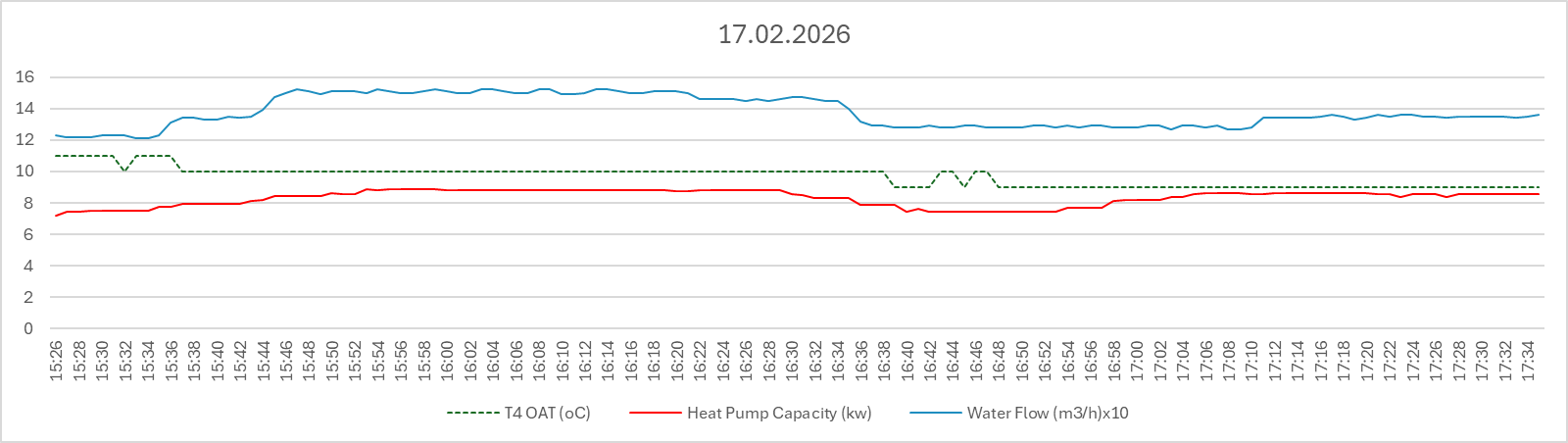
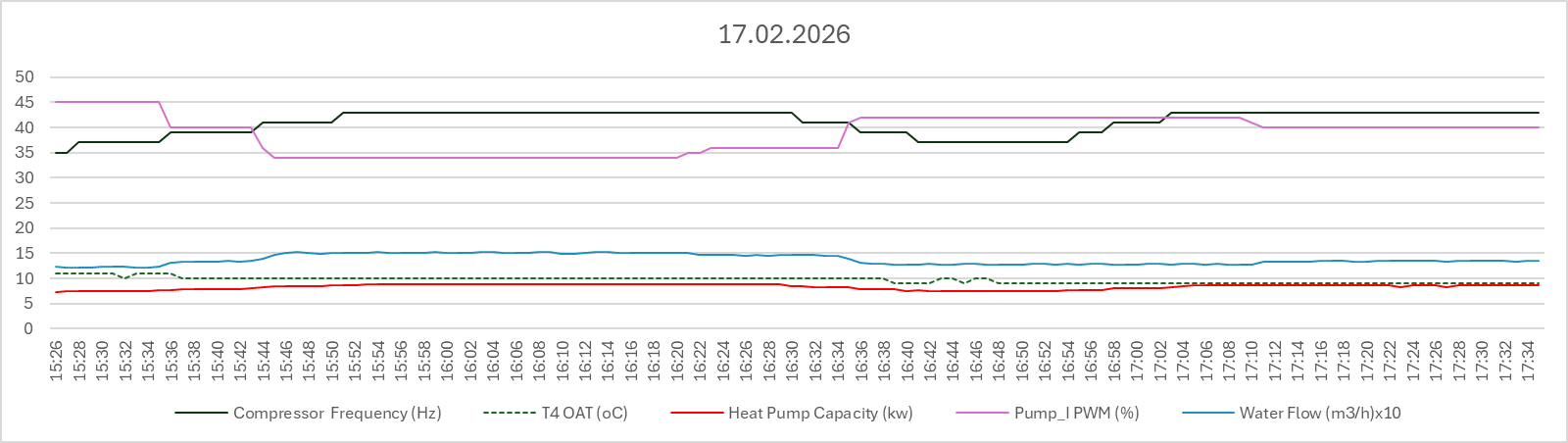
So, here is what I was able to manually sample. Circa two hours during two consecutive days.
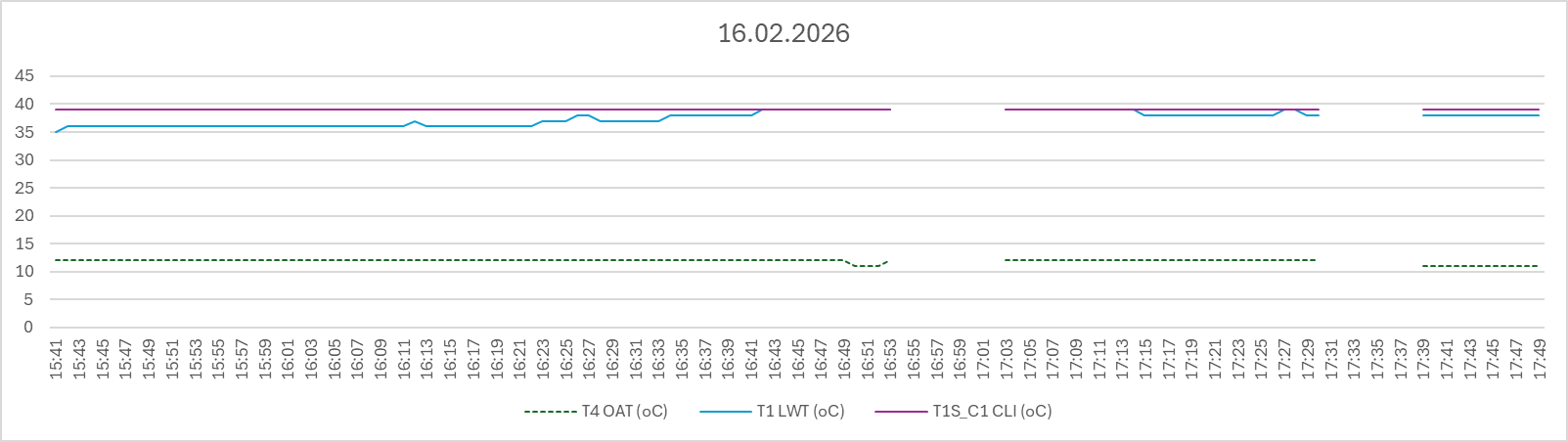
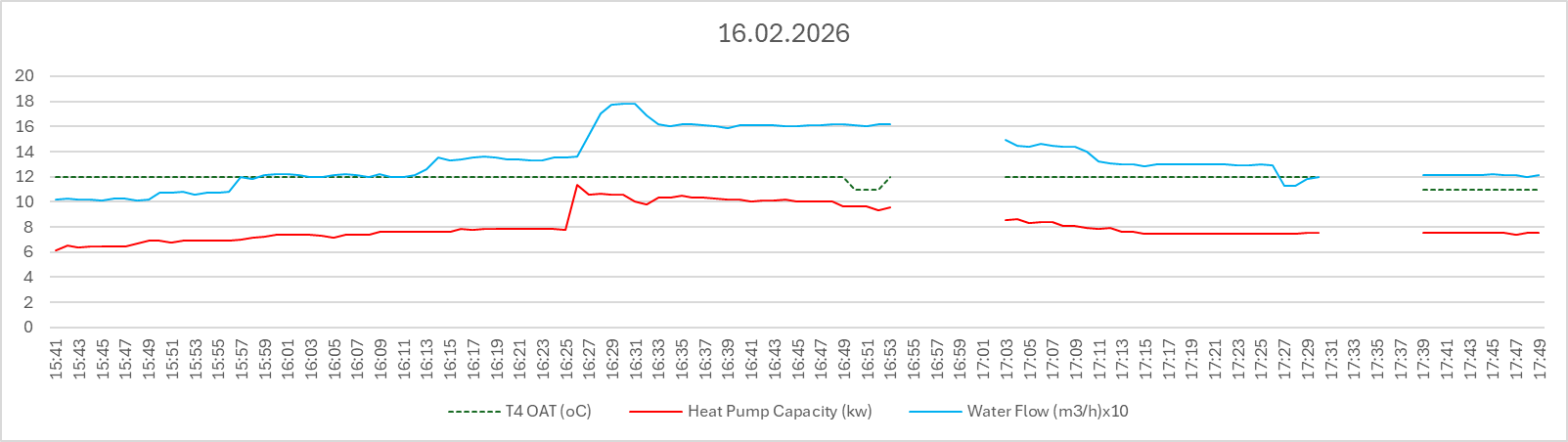
The data gathered on 16.02.2026 has two 10min gaps due to force majeure! Despite the gaps, based on the rest of the data, I believe midea did not cycle during the sampling time.
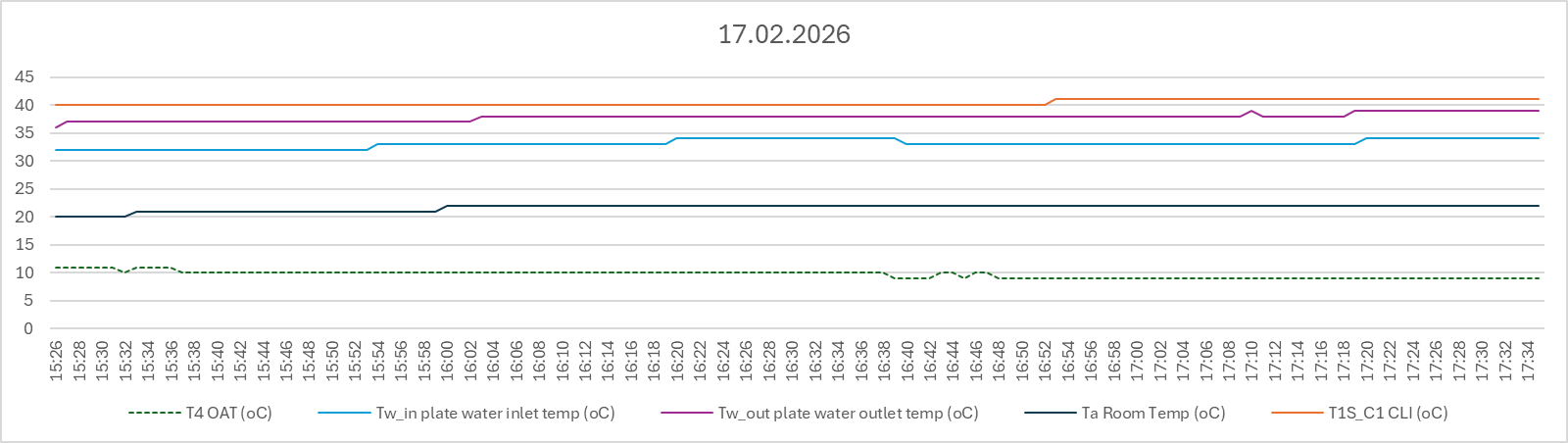
The 1st day I wrote down T4 OAT, T1 LWT and T1S_C1 CLI. (aka the Set T1). The 2nd day I recorded also Ta IAT, Tw_in plate water inlet temp and Tw_out plate water outlet temp (the latter was always the same as T1 LWT).
You may see in the 17.02.2026 diagram that T1S rises from 40 to 41 when T4 OAT drops from 10 to 9 degrees. Whereas on 16.02.2026, T1S was 39 degrees while OAT was 12 to 11 degrees.
I stand corrected regarding my previous statement about T1 LWT never reaching Set T1. This was a behavior I noticed during the 2nd day. ΔT performance however seems stellar.
In fact on the 2nd day, half an hour after I stopped recording data, midea switched off apparently because IAT had surpassed the Room Set temp Ta (21.5 degrees). Two hours later we had to fiddle with the schedule and the set IAT to make it switch on again.
Having said that, one observation I take away from this exercise is that the room temperature sensor in the wired controller is not to be taken seriously. During the two hours of data sampling, it went from 20 degrees to 22 degrees, whereas our good, old Siemens thermostat merely moved from 19.2 to 19.6 degrees. And I think I would know if IAT had indeed risen to 22 degrees..... May be the midea sensor was affected by my body heat (:-)), more likely it is a very crudely calibrated sensor.
Which of course makes me think that even the rest of the midea temp sensors are not that accurate and we should just notice the overall comparative deltas and trends as opposed to the actual values.
The 3rd chart shows heat output capacity and water flow (x10 for chart scaling purposes) seemingly responding to OAT drop (or so I want to believe for my beautiful new toy...). The 4th chart adds also compressor frequency and PWM percentage.
The last chart is again heat output capacity and water flow (x10) from 16.02.2026, for the benefit of @cathoderay , depicting a large variation of water flow values.
18/02/2026 4:43 pm
@mk4 — good work!
First, I agree, no evidence of cycling at OATs where a R32 Midea unit might be expected to cycle during the sampling period.
In fact on the 2nd day, half an hour after I stopped recording data, midea switched off apparently because IAT had surpassed the Room Set temp Ta (21.5 degrees). Two hours later we had to fiddle with the schedule and the set IAT to make it switch on again.
Having said that, one observation I take away from this exercise is that the room temperature sensor in the wired controller is not to be taken seriously. During the two hours of data sampling, it went from 20 degrees to 22 degrees, whereas our good, old Siemens thermostat merely moved from 19.2 to 19.6 degrees. And I think I would know if IAT had indeed risen to 22 degrees..... May be the midea sensor was affected by my body heat (:-)), more likely it is a very crudely calibrated sensor.
Which of course makes me think that even the rest of the midea temp sensors are not that accurate and we should just notice the overall comparative deltas and trends as opposed to the actual values.
I'm still not convinced the wired controller does anything with Ta (which is the actual Room temperature as recorded by the wired controller, not the target room temp, the set room temp is TS, which is on the home/main page on my controller) when in WC mode. Mine is always reported as 25°C. I agree your Ta does change. But I agree with the general idea that it doesn't appear to mean or do anything. My TS is shown as 40°C, a triumph of hope over experience. In practice, if it is used at all (which I still don't it is in WC mode on my R32 unit), it is always on ie always calling for heat.
The other sensors eg LWT RWT we can do crude sanity checks on using an IR thermometer. It's a while since I did it, but I seem to recall the results were 'good enough', or put another way, I could trust the Midea sensors.
The last chart is again heat output capacity and water flow (x10) from 16.02.2026, for the benefit of @cathoderay , depicting a large variation of water flow values.
I agree, there are large variations which I never see. I also have no record of a PUMP_I PWM (%) variable, either in the OPERATION PARAMETERS or the modbus registers or the R32 service manual. I think we can conclude that your R290 unit does make more use of pump modulation than my R32 unit does. I still haven't worked out how my unit does make the limited flow rate adjustments that it does make.
Midea 14kW (for now...) ASHP heating both building and DHW
Page 30 / 30
Prev

Latest Posts
-

RE: Humidity, or lack thereof... is my heat pump making rooms drier?
Actually, it’s better for wooden furniture – or at leas...
By Majordennisbloodnok , 4 hours ago
-
This is absolutely standard for any sealed pressurised ...
By JamesPa , 6 hours ago
-
RE: Oversized 10.5kW Grant Aerona Heat Pump on Microbore Pipes and Undersized Rads
@uknick TBH if I were taking the floor up ...
By JamesPa , 6 hours ago
-
RE: What determines the SOC of a battery?
@batpred Your BMS parameters will be the same as m...
By Bash , 7 hours ago
-

RE: Getting ready for export with a BESS
I would have not got it if it was that tight
By Batpred , 8 hours ago
-
RE: Setback savings - fact or fiction?
I also need to correct something I said by mistake earl...
By cathodeRay , 8 hours ago
-
RE: Electricity price predictions
@judith Thanks for sharing, and nice to see how the ...
By Batpred , 9 hours ago
-
RE: Testing new controls/monitoring for Midea Clone ASHP
@tasos the OAT is incorporated into the control logic. ...
By benson , 10 hours ago
-
RE: Need help maximising COP of 3.5kW Valiant Aerotherm heat pump
@judith thanks Judith. Confirmation appreciated. The ...
By DavidB , 11 hours ago
-
RE: Recommended home battery inverters + regulatory matters - help requested
That makes sense. I thought better to comment in this t...
By Batpred , 12 hours ago
-
Bosch CS5800i 7kW replacing Greenstar Junior 28i
My heat pump journey began a couple of years ago when I...
By Slartibartfast , 12 hours ago
-
RE: How to control DHW with Honeywell EvoHome on Trianco ActiveAir 5 kW ASHP
The last photo is defrost for sure (or cooling, but pre...
By JamesPa , 13 hours ago
-
RE: Plug and play solar. Thoughts?
Essentially, this just needed legislation. In Germany t...
By Batpred , 14 hours ago
-
RE: A Smarter Smart Controller from Homely?
@toodles Intentional opening of any warranty “can of wo...
By Papahuhu , 15 hours ago
-
RE: Safety update; RCBOs supplying inverters or storage batteries
Thanks @transparent Thankyou for your advic...
By Bash , 16 hours ago
-
RE: Air source heat pump roll call – what heat pump brand and model do you have?
Forum Handle: Odd_LionManufacturer: SamsungModel: Samsu...
By Odd_Lion , 17 hours ago
-
RE: Configuring third party dongle for Ecodan local control
Well, it was mentioned before in the early pos...
By F1p , 1 day ago
-
RE: DIY solar upgrade - Considering adding more panels
I know this is a bit old, but it made me wonder what co...
By Batpred , 1 day ago
-

RE: New Vaillant aroTherm Plus in black - When will it come to the UK?
@majordennisbloodnok Daikin, take note! (In fact, I hav...
By Toodles , 1 day ago
-
RE: Midea ASHP – how to set weather compensation
@mk4 — good work! First, I agree, no evidence of cycl...
By cathodeRay , 1 day ago
-

RE: Solis inverters S6-EH1P: pros and cons and battery options
I don't know about Solis inverters. It isn't a featur...
By Transparent , 1 day ago
-
Daikin Altherma 3 H HT - Freeze Prevention Threshold
Hi. We have an Altherma 3 HT (18kW I think) which, now ...
By RICHARDF5033 , 2 days ago
-
RE: Passiv Smart Thermostat - Help & Forum Support
@petch We are not yet compatible with the R290 from Gra...
By Will H , 2 days ago


