

Notifications
Clear all
Joining the Renewable Heating Hub forums is completely free and only takes a minute. By registering you’ll be able to ask questions, join discussions, follow topics you’re interested in, bookmark useful threads and receive notifications when someone replies. Non-registered members also do not have access to our AI features. When choosing your username, please note that it cannot be changed later, so we recommend avoiding brand or product names. Before registering, please take a moment to read the Forum Rules & Terms of Use so we can keep the community helpful, respectful and informative for everyone. Thanks for joining!

16/11/2026 9:53 am
@cathoderay I haven’t considered the ‘cost savings’ claimed in my equation; fitting the Homely controller is a component in the control of my heat pump. Some may wish to wrestle with a Python or whatever but, if one requires a ‘no faff’ setup that ‘just works’ and works well at that, then the use of such a controller does the job; with my inability to write codes onto a screen, Homely is the winner for me! Rewards, Toodles.
Toodles, heats his home with cold draughts and cooks food with magnets.

16/11/2026 9:57 am
Some certainly do eg Ecodans but as you say the set up is not always intuitive and accessible, which is a pity because adding that extra layer of control can make a useful difference. I don't know, but my hunch is that most mainstream heat pumps as fitted in the UK don't have such additional layers of control
Vaillant, which accounts for a fair proportion of the total (pretty much all the Heat Geek ones and many others), certainly does, as you say Mitsubishi does, Daikin does. Octopus is probably the biggest (in terms of numbers) that doesn't, or maybe it does, who knows exactly what the algorithm is (its presented as 'thermostat controlled' but we don't so far as I am aware, actually know what it does 'under the hood').
The ones that definitely dont have some form of adaptive control are the cheaper brands eg Midea, Clivet and clones. I dont know about the likes of Ideal, Samsung's
later generations (earlier ones didn't). Panasonic has so many options I would be surprised if this is not one of them.
Because I dont have the figures I dont know whether the ones that do account for the majority or not but I would say with some certainty that, if they dont, its a substantial majority.
The issue (if it is one) is really a feature of weather compensation, not the heat source, so applies equally to boilers with WC which, in some European countries has been mandatory for many years in order to ensure that they actually condense.
At the same time, for most heat pumps ie not high temperature ones any corrections will tend to be slow, because a standard heat pump is not geared up to deliver sharp pulses of high energy. It is just the nature of the beast.
R290 is pretty much the norm now so I would question that statement for newly installed heat pumps. In terms of the currently installed base then you are probably right.
I do wonder if we are over-thinking this however. Most people dont care too much about an upward excursion of a half to one degree and, for sure, a boiler set up in the way they are normally set up, stability is likely to be worse. Its all an interesting debate but does it matter to your average Joe (which, I think, Is the Octopus philosophy!). As I have already commented upthread I doubt that anything short of an internet connected (for weather forecasting) AI enabled system which has been given the opportunity to experiment with your house is capable of achieving 'perfect' control (whatever that means) for the wide variety of housing stock that it must deal with. I can think of several good reasons why the manufacturers of boilers and heat pumps might include that as an option, but some equally good reasons why I would not want to rely on it! Sometime simple is good enough and best.
4kW peak of solar PV since 2011; EV and a 1930s house which has been partially renovated to improve its efficiency. 7kW Vaillant heat pump.

16/11/2026 10:03 am
@andrewj @cathoderay To be honest what has been discussed in this thread so far has backed up my belief that the current weather compensation control system is, putting it bluntly, pants.
I could never understand why the point of control of the flow temperature was in your garden and your whole comfort experience is controlled by what the outside temperature does.
In my opinion a heating system has the primary purpose of keeping your environment at a comfortable level irrespective of what the weather conditions are outside, which means the point of control should be in the house. This would solve a multitude of problems as the control system would make adjustments to maintain the internal environment at the required level.
If the weather outside suddenly went from mild to cold, the house would start loosing temperature, so the control system would adjust the flow temperature up or if the weather changed from cold to mild, the house temperature would start to rise, hence the control system would start reducing the flow temperature.
In my case I have a scenario, it can be 2C outside and a bright sunny day which provides a lot of solar gain, however the heat pump does not see this and continues to pump large amounts of energy into the house, the result being, the house temperature rises shutting down the heating. By monitoring the internal temperature, a control system would keep lowering the flow temperature to maintain the desired environment, offsetting the effects of the solar input and to a certain extent avoid shutting the heating off because it has exceeded the upper limit of the thermostat.
I have been thinking of my next project (after I have stabilised my battery communications) to see if I can turn my HP into a dumb unit and control it using a modbus add on and start using the internal environment as the point of control. After this discussion, it has inspired me to crack on with it.
5 Bedroom House in Cambridgeshire, double glazing, 300mm loft insulation and cavity wall insulation
Design temperature 21C @ OAT -2C = 10.2Kw heat loss, deltaT = 8 degrees
Bivalent system containing:
12Kw Samsung High Temperature Quiet (Gen 6) heat pump
26Kw Grant Blue Flame Oil Boiler
4.1Kw Solar Panel Array
34Kwh GivEnergy Stackable Battery System

16/11/2026 10:06 am
Interim reply, I will then reply to the other points.
None of my radiators are undersized. Even the radiator that nominally was undersized on the radiator schedule is more than capable of maintaining heat in its room. The living area can easily get above 23c if I increase the WC curve. I don’t actually believe my house heat loss is 8.5kWh or even 7.5kWh.
Whatiffery (spreadsheet based) heat loss calculations often over-estimate heat loss. It all depends on the assumptions (what ifs) built into the spreadsheet. With a heat pump, you can measure the actual heat loss. Provided the building is in steady state (steady IAT), then the energy delivered to the building (ie energy out) is the heat loss. By measuring and plotting this for various OATs, you get plot that gives you your actual heat loss. For further details, and more sophisticated analysis, see this excellent thread started by @rob-of-york.
It’s worth mentioning here that Octopus set up their Cosy systems to run thermostatically and their control loop is controlled by a thermostat. I really don’t like it because it does force the whole house heating to be based on an area of the room which holds the thermostat, exactly like my gas boiler.
Exactly. It rather goes against the basic principles of using weather compensation, which as we keep on saying uses (only) the OAT to match the flow temp to the current heat loss at the current OAT.
It is possible to bump the target temp up beyond what it can reach but what I have noticed is that it still doesn’t run continuously. It may report that it is providing heat but house power usage (and visual inspection) indicates the unit isn’t running and is in some pause state.
This may well be that it is using slow on/off cycling as a way of modulating output. This is certainly normal behaviour for Midea units like mine at moderate OATs (> about 8°C OAT), and I suspect a lot of other heat pumps do it as well. Here is an image of my heat pump's recent behaviour over 24 hours, showing it's three operating modes, slow cycling on the left when the OAT is above around 8°C, steady state running between about 8 and 5°C OAT, and defrost cycling below 5°C OAT (the big spike on the left is a DHW cycle):
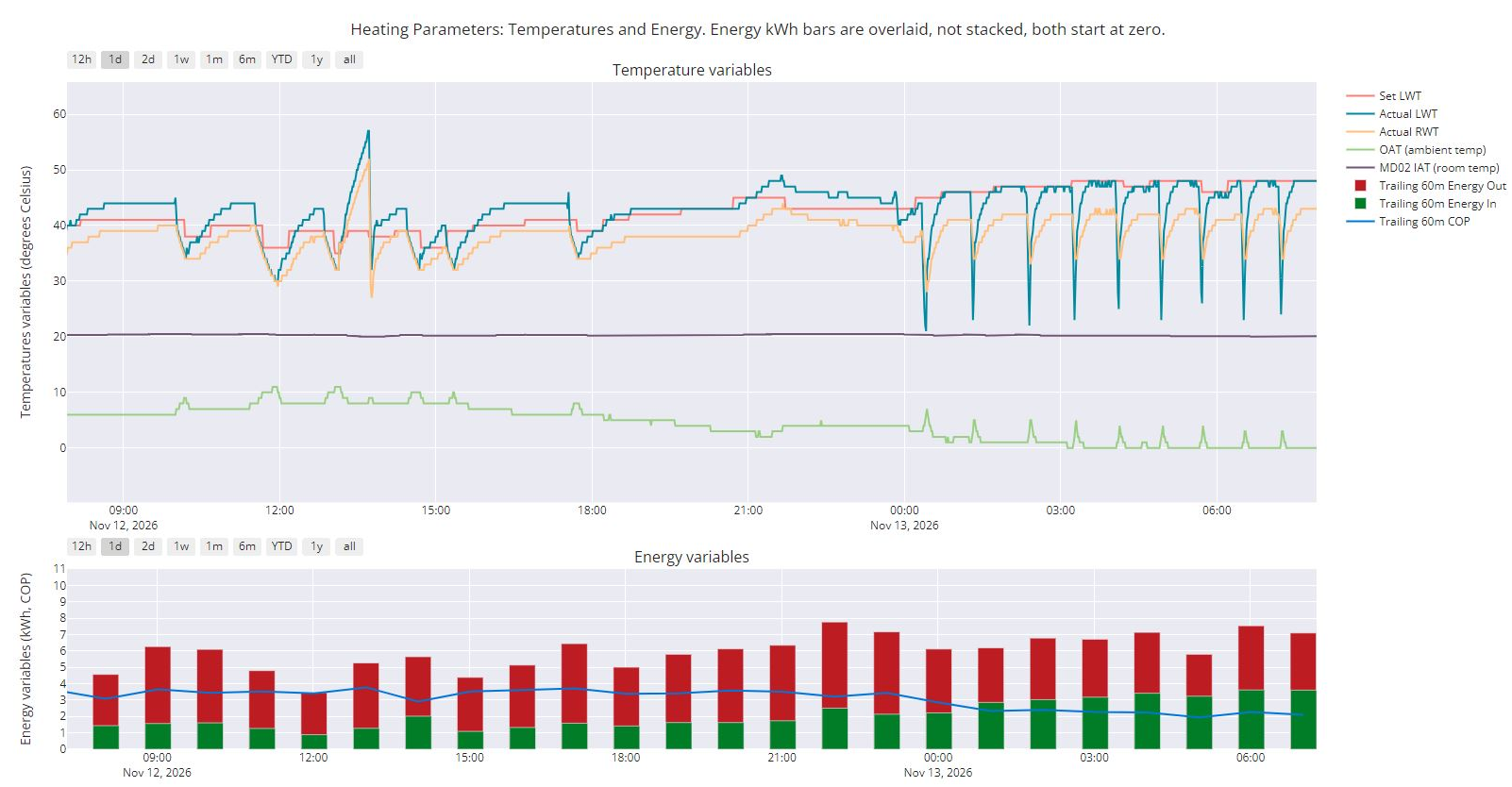
Also note the steady IAT, and how the energy use and COP change in the lower chart.
Midea 14kW (for now...) ASHP heating both building and DHW

16/11/2026 10:08 am
@andrewj @cathoderay To be honest what has been discussed in this thread so far has backed up my belief that the current weather compensation control system is, putting it bluntly, pants.
With a house that has a very low thermal mass that may well be true that Thermostatic control based solely on indoor temperature is as good or even better. With a house that has a thermal mass typical of the average house, its not true, because of the effect of the delayed response which, with pure thermostatic control (and particularly if you are operating at fixed, high flow temperature), almost inevitably results in larger instability.
I could never understand why the point of control of the flow temperature was in your garden and your whole comfort experience is controlled by what the outside temperature does.
There are some very good reasons:
Because the temperature in your garden determines, to first order, how much energy you need to put in to make up for the energy lost and, because its a leading indicator not a lagging indicator, is likely to result in a more stable internal temperature (housues are all different, manufacturers have to design something which works well enough for all; not perfectly for one).
Furthermore, by adjusting you attempt to match the energy emitter by the radiators to the energy the house needs, thus reducing cycling which makes for greater comfort.
Further still, both for heat pumps and boilers, running at the lowest flow temperature possible results in greater efficiency.
Weather compensation is not new, and its not specifically for heat pumps. Many boilers have had it for many years and in several EU countries its mandatory for boilers and has ben for years for the reason of efficiency. Its not perfect but it is simple and better than the other simple alternative, namely thermostatic control based purely on indoor temperature.
I have been thinking of my next project (after I have stabilised my battery communications) to see if I can turn my HP into a dumb unit and control it using a modbus add on and start using the internal environment as the point of control. After this discussion, it has inspired me to crack on with it.
There is no doubt that a control system tailored to each individual house is, in principle, and often in practice, capable of achieving a better result than a generic one. The problem is that manufacturers of boilers and heat pumps cant do this, instead they have to design something robust that works well enough. They add a fair number of options so the control can, in fact, be tailored, which we then complain about because it makes it complicated! Hence my comments about AI above.
Obviously if you design something specifically tailored to your house it has the potential to work better. You may want to read a bit about control theory first, as there are some gotchas with anything involving a delay between stimulus and respoinse.
This post was modified 3 hours ago 8 times by JamesPa
4kW peak of solar PV since 2011; EV and a 1930s house which has been partially renovated to improve its efficiency. 7kW Vaillant heat pump.
16/11/2026 10:28 am
if one requires a ‘no faff’ setup that ‘just works’ and works well at that, then the use of such a controller does the job; with my inability to write codes onto a screen, Homely is the winner for me!
Absolutely, and I have said as much. I just wanted to add a cautionary note that Homely in the real world is probably more about better 'no faff' control than cost savings. ("But not everyone wants to spend the time and effort setting up such a system. They then have the option of using something like Homely, which may provide better control, though the claimed cost savings are almost certainly very optimistic to say the least.").
Because I dont have the figures I dont know whether the ones that do [have additional controls] account for the majority or not but I would say with some certainty that, if they dont, its a substantial majority.
R290 is pretty much the norm now so I would question that statement for newly installed heat pumps. In terms of the currently installed base then you are probably right.
All good points. Worth noting that the currently installed base is perhaps less likely to have additional controls, and less likely to use R290, but that will change over time.
I do wonder if we are over-thinking this however.
I think at some point most or all of us have wondered why @andrewj is worrying about tenths of a degree, but his explanation is that it is a way into understanding what his heat pump is doing, rather than an actual obsession with tenths of a degree, which is fair enough. I and I know some others quite happily tolerate IAT variations of greater than one degree, so long as it is above a basic minimum, which is 18°C for me.
As I have already commented upthread I doubt that anything short of an internet connected (for weather forecasting) AI enabled system which has been given the opportunity to experiment with your house is capable of achieving 'perfect' control (whatever that means) for the wide variety of housing stock that it must deal with. I can think of several good reasons why the manufacturers of boilers and heat pumps might include that as an option, but some equally good reasons why I would not want to rely on it! Sometime simple is good enough and best.
All agreed. That is why starting with locally based weather compensation makes sense, and then only adding extra controls of increasing sophistication as and when wanted or in some cases needed.
I could never understand why the point of control of the flow temperature was in your garden
It's because the OAT, which is in your garden, is the main variable determinant of your heat loss — as covered, along with various other points, very well by @jamespa.
Weather compensation is far from perfect, but it is a very useful simple starting point.
I have been thinking of my next project (after I have stabilised my battery communications) to see if I can turn my HP into a dumb unit and control it using a modbus add on and start using the internal environment as the point of control. After this discussion, it has inspired me to crack on with it.
This is what I did (scripted control over modbus), though it augments weather compensation, rather than replaces it. If you already have the necessary skills, and it sounds as though you do, it is not at all difficult, and will provide you with endless hours of harmless fun over the winter months.
Midea 14kW (for now...) ASHP heating both building and DHW

1
16/11/2026 10:43 am
I could never understand why the point of control of the flow temperature was in your garden
It's because the OAT, which is in your garden, is the main variable determinant of your heat loss — as covered, along with various other points, very well by @jamespa.
Weather compensation is far from perfect, but it is a very useful simple starting point.
I think its worth reflecting on what the priorities of a heating system are. One is certainly that it is to be robust. This means that the controls must be self contained and work, at least in some sort of fallback mode, without access to the internet. It also means that the design of the controller needs to be deterministic, not based on something, like 'AI' that we cant interrogate.
If we superimpose this on practical design cycles and a requirement that parts be available for many years (we will be complaining when our heat pump controller fails in its 10th year and the parts are discontinued!), plus the fact that much of the technology we have today was not around even 12 months ago, and of course the requirement for cost containment whilst being suitable for a very wide range of houses, its easy to see why manufacturers opt for something that is simple but good enough.
They all build in options so you can tailor it to your house (which we then criticise as making it complex) and, so far as I am aware, there is not a heat pump or boiler on the planet that could not be operated with a thermostat and fixed flow temperature if that is what you want to do!
For my money the balance that heat pump/boiler manufacturers have struck is about right. If you want something more sophisticated still and (in some modes) internet dependent, there is Havenwise, Homely, Passiv, Adia. If you want to build your own and have hours of harmless fun thats also possible!
This post was modified 3 hours ago 5 times by JamesPa
4kW peak of solar PV since 2011; EV and a 1930s house which has been partially renovated to improve its efficiency. 7kW Vaillant heat pump.
16/11/2026 10:52 am
For what it is worth, here is my setup not quite coping over the last 48 hours, including that wet and windy spell of weather:
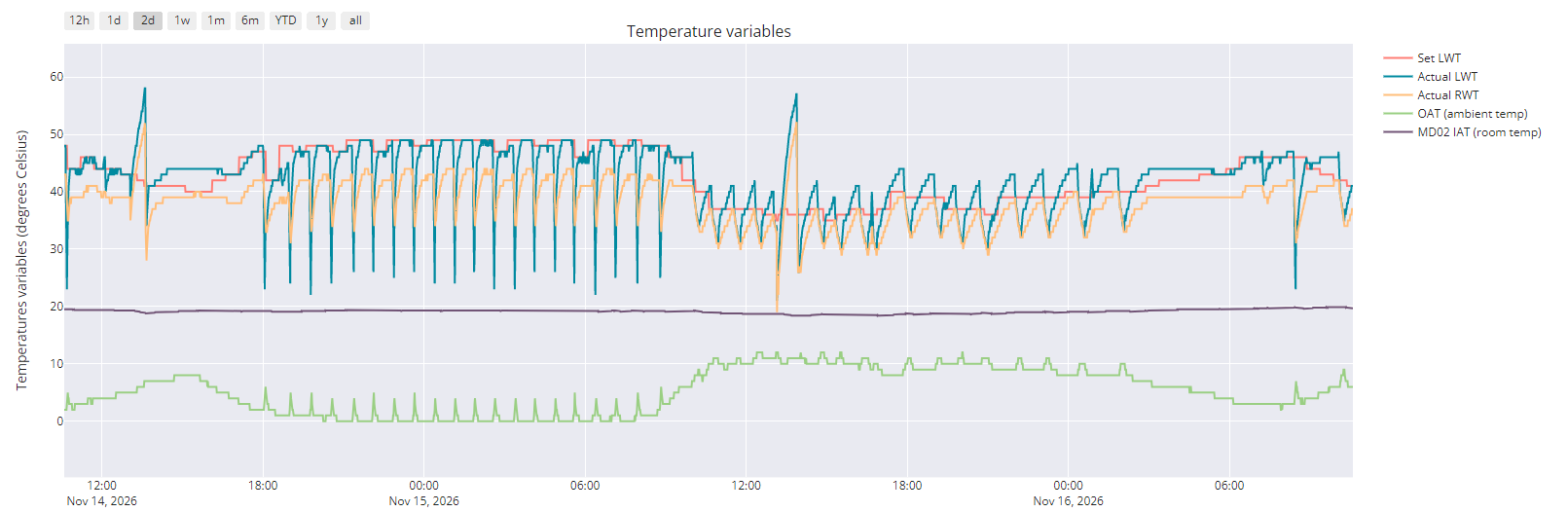
As you can see, the IAT fell a bit, despite the warmer IAT, for much of yesterday. But the lowest it got to was 18.4°C (happened during the DHW heating cycle at 1300-1400 yesterday), which is not low enough to trigger my auto-adapt response, which only kicks in when the IAT is more than one degree away from my desired IAT of 19°C. To all intents and practical purposes, this is a steady IAT.
@jamespa — agreed, simple, good enough and local is best.
Midea 14kW (for now...) ASHP heating both building and DHW

16/11/2026 11:46 am
I have been thinking of my next project (after I have stabilised my battery communications) to see if I can turn my HP into a dumb unit and control it using a modbus add on and start using the internal environment as the point of control. After this discussion, it has inspired me to crack on with it.
It maybe that you can fairly easily set up hybrid control that combines both a programmable timer thermostat and weather compensation. This is how my gas boiler is controlled. It is on a weather compensation curve that determines the flow temperature. The curve selected means that the radiator output is a little higher than needed for pure weather compensation control, but not that far off. The thermostat in the living room then turns the heating off when the programmable set point for the current time period is reached. The result is very stable indoor temperatures. The weather compensation avoids the overshoot that occurs with too hot radiators. The thermostatic control avoids issues with extra heat energy from solar gain, cooking etc. Since the house has good insulation and fairly substantial thermal mass, it only changes temperature slowly so any cycling happens over a long period. It's not a perfect set up, but for my house at least, it seems to work better than either weather compensation alone or thermostatic control alone.
The only thing it doesn't deal with well is recovery from a cold house. If we have been away for a while and the house is cold, we turn the weather compensation dial on the boiler up (higher flow temperatures) so the house can heat back up quickly, and then reset it to our default.
This post was modified 2 hours ago by Rob of York
16/11/2026 11:59 am
It maybe that you can fairly easily set up hybrid control that combines both a programmable timer thermostat and weather compensation.
Most heat pump controllers for which I have studied the manuals (about 10) natively support this, often in various flavours, out of the box. Those that don't (and indeed those that do) all support a demand for heat signal from an external thermostat, which can be combined with the native weather compensation, to achieve this.
If that's what someone wants its easily achievable and probably how many are already set up. From what people say here its exactly how Octopus set up their heat pumps, although its difficult to tell whats happening under the hood!
I use this arrangement in my house (Vaillant 'expanded' mode) at the extreme ends of the season only, when solar gain tends to dominate loss. For most of the season pure WC works better in my house. I think the lesson here is that it is probably worth playing with the options if the heating is unsatisfactory!
The only thing it doesn't deal with well is recovery from a cold house. If we have been away for a while and the house is cold, we turn the weather compensation dial on the boiler up (higher flow temperatures) so the house can heat back up quickly, and then reset it to our default.
And most, if not all, support 'holiday mode' where you can tell it in advance when to switch back on. Nothing to stop you specifying that it should come on a day before you get home!
4kW peak of solar PV since 2011; EV and a 1930s house which has been partially renovated to improve its efficiency. 7kW Vaillant heat pump.

Topic starter
16/11/2026 12:51 pm
And most, if not all, support 'holiday mode' where you can tell it in advance when to switch back on. Nothing to stop you specifying that it should come on a day before you get home!
Man, I would kill for a holiday mode on the Octopus app. As it is, all has to be done manually. Hot water is easy to turn off/on remotely, but with heating you have to go into the schedule and set the holiday target temp for each slot (at least you can copy it to other days of the week). If you want a staged return to normal temp you need to do that manually. We often go away for a week and I just don’t bother because the faff is too much. Plus the danger of forgetting!
It’s an interesting discussion. As I’ve mentioned I’m trying to understand how my Cosy unit is working and how the WC curve is impacting how the house heats and is maintained. I do know if I bump the WC warm weather temp to 36c the living area in the house will warm to around 22.5c, and other rooms to over 23c (which my wife loves). That does require the thermostat to be placed in the downstairs loo with a target temp of 21c (or 20c or 19c it doesn’t matter actually.) My target is to be able to keep the Cosy running without interruption from the thermostat, providing heat constantly but not overheat or consume a large amount of power. Difficult without a controlled outdoor environment, annoying the wife by getting it wrong and it being too cold (the difference between “warm enough” and “absolutely arctic” is surprisingly narrow and there’s no such thing as being “too warm”) and ultimately it may not be possible to provide a constant balanced flow of heat of course.
I can easily envisage someone creating a heat pump weather station so it can look at temperature, light levels, wind speed, Etc and tweak the WC curve accordingly! I’m joking of course…

16/11/2026 12:57 pm
This is exactly what my auto-adapt script does. It is a series of 'if the desired vs actual difference is this, then change the WCC by this amount' statements. But not everyone wants to spend the time and effort setting up such a system. They then have the option of using something like Homely, which may provide better control, though the claimed cost savings are almost certainly very optimistic to say the least.
From the installation manuals / technical guidance docs for some HP models I've read through, they typically use the error between IAT and IAT set-point, apply a user-configurable multiplier/gain to the error, then apply that to the adjust the flow-temp determined by the WCC and OAT.
I do wonder if we are over-thinking this however. Most people dont care too much about an upward excursion of a half to one degree and, for sure, a boiler set up in the way they are normally set up, stability is likely to be worse. Its all an interesting debate but does it matter to your average Joe (which, I think, Is the Octopus philosophy!)
I'd argue the problem is less about minor errors, +- 0.5 to 1 deg C, during steady-state operation but rather the much more serious issue of very slow response time when responding to disturbances / dynamic conditions - for example, when the house is very cold for some reason and the heat-pump, faithfully following the WCC tuned for steady-state operation, runs with a flow temperature which results in it operating at a fraction of it's actual power rating, taking a day or more to reach the required IAT, all while the house is uncomfortably cold.
That will be a problem, a lot of people won't want a heating system which cannot restore the house to a reasonable temperature in a reasonable time (i.e. several hours, not days or multiple days). And it's entirely unnecessary, when the heat-pump has capacity available to get the house up to temperature more quickly, but it's unused because of a poorly designed control algorithm.
Closed loop control using the IAT and IAT set-point is one option, but an even simpler option would be for heat-pumps to come with two modes - eco, so follow the WCC and maximise efficiency, and a boost mode, to push the flow-temp up to restore the IAT back to the set-point before dropping back into eco once IAT is up to set-point. Although I'd argue closed-loop is probably the superior of the two.
This post was modified 34 minutes ago by Temperature_Gradient

SPONSORS

Degrees of Separation

Latest Posts
-

RE: How quickly would you want/expect heat recovery to take from setback?
I think the resolution to this (in the absence of some ...
By JamesPa , 31 minutes ago
-
-
RE: Got two or three heat pump quotes that don’t agree? Post them here.
100% agree about this particularly as many manufacturer...
By JamesPa , 3 hours ago
-
Tell us about your heating system
We’ve added a few new fields to member profiles so that...
By Mars , 3 hours ago
-
RE: Grant Aerona3 13kw - Buffer Tank - Heating Journey
@toodles Thank you 🙂 I think I'm quiet lucky as the...
By HeyMikey , 5 hours ago
-
RE: Buffer tank on a 2 x 14kw Ecodan system
@fosterl2 I'm sure it's over simplified as there'...
By Singlespeed , 5 hours ago
-
RE: Why don't people choose heat pumps?
By the same measure we should be insisting that all gas...
By Batpred , 17 hours ago
-
RE: Load Shift and Lifestyle Shift Complete - our journey has ended, for now
I do not disagree with the concept of wanting to live a...
By Batpred , 17 hours ago
-
RE: Grant Aerona - Weather Compensation and Schedules
@taffonthetaff Yes, I have now gotten to the bottom of ...
By bontwoody , 20 hours ago
-
RE: Grant R290 DHW Cycle Interuption
Occasionally our Grant R290 activates all three circuit...
By TaffontheTaff , 20 hours ago
-
RE: Peak Energy Products V therm 16kW unit heat pump not reaching flow temperature
@davec 47kwh for 3 days is very low, compared to what I...
By johnd , 22 hours ago
-
RE: Our 10 year old Grant heat pump failed
As I understand it it was working then stopped. More l...
By JamesPa , 1 day ago
-
@pipcart, Wattson is back... please go to the homepage ...
By Mars , 1 day ago


SPONSORS

