
Notifications
Clear all
Air Source Heat Pumps (ASHPs)
35
Posts
12
Users
10
Reactions
1,704
Views

Topic starter
12/11/2025 5:56 pm
So I've watched the latest video on youtube, and there was a lot of talk about flow rates, a pretty confusing episode and i've watched it twice now. My Daikin unit literally makes every effort in the world to crash my flow rate down to 7ltr pm, it can happily run much much higher when it first runs, circa 25ltr's pm but will actively look to dive that down low. Also at those high flow rates it drinks juice.
So we have nice fat pipework, big rads etc. They all seemed to suggest that a system had some kind of mythical flow rate that sounded high, hence more pumps as a lazy solution. Daikin seem to have designed their heat pumps to crash flow rates. I've seen loads of Daikin Altherma users who see this behaviour. So has Daikin literally built really bad heat pumps that are incapable of peak efficiency?
We run a system that is on all day every day and we see low power draw so it seems to be efficient. The Dainkin energy reporting suggests we are comfortably seeing a COP of 3.9 With a DT target of 4
Any more thoughts on what i'm clearly not getting.
This topic was modified 3 months ago 2 times by Mars
1


12/11/2025 9:40 pm
I’ll defer to @pirate-rich and @nigel-d and @ian-e on this one…
Get a copy of The Ultimate Guide to Heat Pumps
Subscribe and follow our YouTube channel!

13/11/2025 12:37 am
@editor another great episode, but same as @phil-bell I am now going to have a good look at my flow rate, my lowest flow rate I can get out of my Grant Aerona3 is 28l/min but I think this may not be enough, my system is constantly cycling (which is kind of making it more economical lol!!). So the next few days are going to be spent adjusting the flow rate (I am going to stick on medium so 30-32l/min) and see where that gets me. The big spikes are DHW cycle but the unit is putting 20 mins of heat into the house and then turning off. That said the house is warm and my COP is good. These things are marvellous mystery machines!

Kind Regards
Si
——————————————————————————
Grant Aerona3 13kW
13 x 435w + 13x 480w Solar Panels
Sigenergy 10kW Inverter
16kW Sigenstor battery

13/11/2025 8:38 am
Don't mistake designed flow rates (which fixed speed pumps need to be set to to obtain maximum input when required) with variable flow rates that heat pumps with PWM pumps targeting DT (or sometimes theoretical flow rate) use.
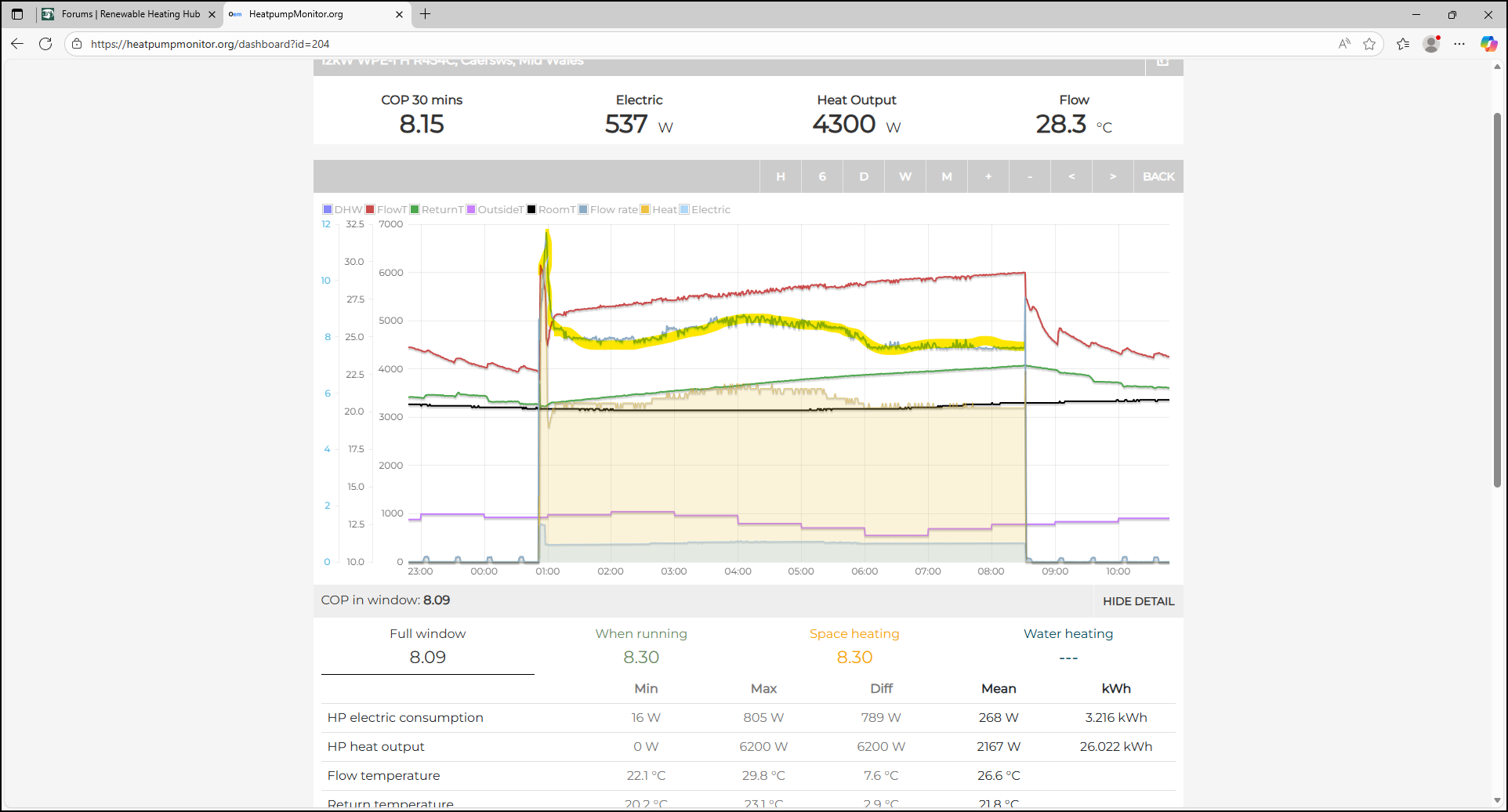
If you look at the flow rate (highlighted in yellow) on my Stiebel Eltron, it varies. This is because my heat pump targets DT6, so to do this has to adjust its flow rate to meet the load. As you can see on the graph, my load was very small, so it could run between 7-9 litres per minute and still give the correct amount of heating for my home.
If it required the full 12 kW heat input, the flow rate would increase to 28.6 litres/min at DT6. When you have 3 kW going in it only needs to be 7.2 litres/min (as my image shows).
Richard, Rich, Dick, Captain or Pirate... I answer to them all in any sequence! 🏴☠️☠️👍
See my heat pump running live here... 👉 HeatPumpMonitor.org 👈
Buying from 🏴☠️ PirateHeatingSupplies.com 🏴☠️ means you support my family owned, independant business! 🙏❤️👍
1
13/11/2025 9:19 am
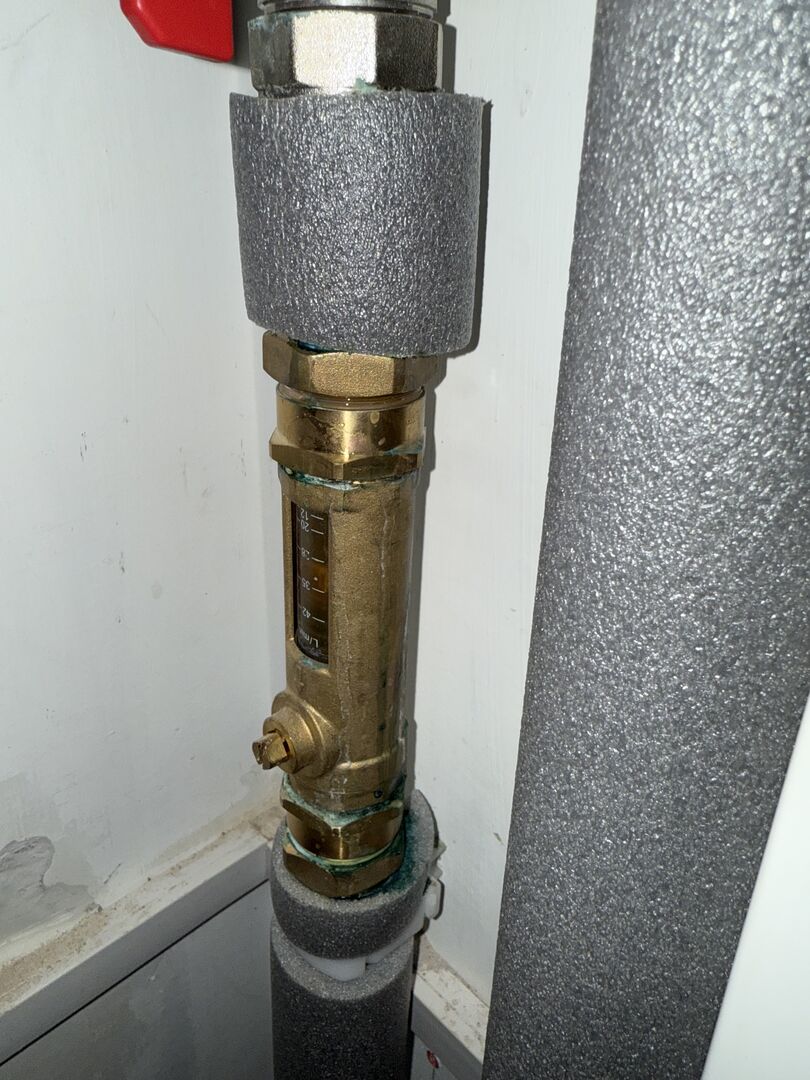
Look at you with your fancy schmancy variable PWM pump lol! I am now very envious! The Grant has three settings and a manual flow restricter. Mine looks like it was installed in the 70’s despite being less than a year old. I am starting to get a love hate relationship with my ASHP, I am going to start calling it Schroedinger! I know it is cleaner and more efficient than my old Trianco oil boiler but “the beast” just worked!
Kind Regards
Si
——————————————————————————
Grant Aerona3 13kW
13 x 435w + 13x 480w Solar Panels
Sigenergy 10kW Inverter
16kW Sigenstor battery
1
13/11/2025 9:21 am
I'm no heating engineer, but I feel like there was something missing in the discussion. Flow Rate, dT, Heat Pump Power Output, and Emitter Output are all inextricably linked together. When designing the emitters, you aim for a specific output, with a specific dT and flow rate. You can't change any one of those without changing the others because it's a simple formula:
output = Flow * 4200 * dT
Likewise, the heat pump needs to be able to move the heat it's producing away in order to function properly, and uses the same equation
If you have an unbuffered, unmixed system, Flow and dT across the heat pump have to be the same as the flow and dT across the emitters, which means the heat pump's output must match the emitter output. If you add a buffer, you can decouple the flow rate, but the heat pump and emitter output will still end up equal. All that will happen is that the dT of the heat pump's flow/return will change so that the rate of heat transfer can match (this is distortion).
Or, in the form of an example:
You have a heat pump rated to 5kW. Your emitters are sized to 5kW at a dT of 7K. If you have an unbuffered system, you therefore must have a flow rate of 5000/(4200*7) = 0.17l/s (or 10.2 l/min) in order to move that heat from the heat pump's exchanger into the radiators. If you can't achieve that flow rate (your pumps aren't powerful enough, or the system resistance is too high) then the maths turns around.
Say you can only manage a flow of 0.12l/s (or 7.2l/m). Well, now your dT is going to grow to 9.9K. Lets say before you were targeting an average flow of 40C (so a flow of 43.5C and a return of 36.5C), well now your average flow temperature would be 38.5C (flow 43.5C, return 33.6C) and your emitters will be less able to shed heat into your rooms. If the room temperature is 21C, and the emitters were sized to 5kW at an average temperature of 40C, now they can only shed about 4.6kW (and actually the dT on the emitters will shrink to 9.2K, with this repeating until we reach a steady state)
In order to get that emitter ability back up to 5kW, the heat pump will have to boost its flow temperature enough to get the average emitter temperature to that design 40C. This results in a flow temperature of 44.6C, which means you see a hit in the efficiency of its running.
However!
What I think was missing was a mention of how this all works when we're operating at part-load.
If the outdoor temperature is 10C rather than -3C, the emitters don't need (nor do we want them to) provide that continuous 5kW. In a buffered open-loop system the flow through them would remain the same, but the supply temperature would be dropped. Dropping the supply temperature will drop both the average emitter temperature and the dT.
Or, to do the maths again:
Say we're at a 2kW part load with the same emitters as before. If we're constrained to the flow from before, we get dT = 2000/(0.17*4200) = 2.8K. The average emitter temperature will also be 28.6C (with a flow of 30C and a return of 27.2C).
Alternatively, if the system is not buffered, it's likely the heat pump will have a target dT across its own flow and return. Let's say that's 4.5K. In this case, the unit has a fixed power output of 2kW, and a fixed dT of 4.5K, so we can work out the flow: Flow = 2000/(4200*4.5) = ~0.106l/s (or 6.35l/m).
The emitters will then be stuck at that 4.5dT and 0.106l/s flow. This will mean the flow temperature for the system will have to be 30.9C, with a return of 26.4C. Again, resulting in possible reduction in maximum efficiency.
I should also note that while the unbuffered system gets experiences some reduction in efficiency due to this flow rate modulation, the buffered system will experience similar reductions because the heat pump will still modulate its flow to the buffer. This will then result in unbalanced flows through the buffer (the heating will be at 0.17l/s while the heat pump will be at 0.106l/s), and you'll get mixing and distortion. The heating will end up pulling 0.064l/s from its own return, which would mean the flow from the heat pump would need to be 31.1C to get back to a flow to the emitters of 30C, so overall slightly worse than the unbuffered system.
The way I see it, heat pumps under part load can only really do two things:
- Reduce their dT to maintain flow rate.
- Reduce their flow rate to maintain their dT.
As I'm not a heating engineer, I don't know if the control strategy varies between manufacturers, but our Bosch system has a specific dT it is seeking to maintain. Thus, it moderates its flow rate to achieve a steady-state relationship between the heat source and the emitters. It seems plausible to me that another system could employ both control strategies. It could allow the dT to drop to a point, then once it hits its limit, continue to tail off power transmission by reducing the flow rate. Then, once a minimum flow rate is hit, the unit would have no choice but to over-supply heat for a while, then begin cycling.
Based on my impressions, though, I think most systems purely modulate their flow rate, and try to keep their dT constant. When the flow rate hits a minimum value, it then can't maintain both its heat output and its dT, so the heat output rises above the heat requirement, and cycling begins.
For this reason, I feel like a discussion on minimum flow rates that doesn't touch on modulation strategies is likely to cause a lot of undue worry.
But as I said before, I'm no heating engineer, so it's possible I'm completely off the mark on this.
EDIT: I see @pirate-rich has already explained this while I was getting my thoughts in line.
This post was modified 3 months ago by Steelbadger
2

13/11/2025 9:23 am
I was thinking something similar to the OP half way through the episode still worth a watch of course.
Emitter type, delta-T & WDC steepness are just some of the parameters that influence the flow rate I've seen on my 4KW Daikin. I have adjusted each to slow and smooth out the surges. The biggest one for me was switching to "pure" weather comp but that may not suit everyone of course. I subsequently had to enable a limit on the circulation pump when sampling because the switch from 0 to 25 ltr/s periodically was very obvious. There's also quiet mode that can be scheduled but you must make sure you have enough headroom on the very coldest days as you will loose ~20% heat output. Also reduces or caps though cold start spikes.

13/11/2025 12:37 pm
The way I see it, heat pumps under part load can only really do two things:
- Reduce their dT to maintain flow rate.
- Reduce their flow rate to maintain their dT.
Heat pumps cant do the first directly because its not something they directly control. DT is determined by the loss from the emitters (which is in turn determined by the flow temperature, the flow rate and the physics of convection.) The heat pump can directly control only flow temperature and pump speed.
The heat pump doesn't actually have to do either (1) or (2) actively. The way the control loop(s) work is (generally) this:
The heat pumps primary control loop adjusts the compressor modulation (and thus energy dumped into the water) to maintain a desired flow temperature, as specified by the WC curve (or a fixed flow temperature if that has been selected). The equilibrium point for this control loop is when the energy output from the compressor exactly equals the energy lost from system (ie from the emitters and any other energy losses in the system).
- If the energy lost from the system is less than the minimum output of the heat pump, equilibrium will not be reached and the flow temperature will rise above the desired value. Eventually the heat pump will shut off and then cycle so that the average energy over time equals the energy lost from the system. This situation will occur at moderate OATs (say above 10-12C) in almost all heat pump installations, because the typical modulation range of heat pumps is insufficient to cover the variation in OAT (and hence loss) we experience.
- If the energy lost from the system is more than the maximum output of the heat pump, equilibrium will not be reached and the flow temperature will fall below the desired value. This will cause the energy lost from the emitters (and thus the room temperature) to reduce until eventually equilibrium is reached at the heat pump max output and reduced room temperature. This situation should only occur if the heat pump is undersized or the OAT is less than the design OAT
- The output from the emitters (and thus the principal contribution to the system loss) is determined by their average emitter temperature relative to the room. This in turn is primarily determined by the flow temperature, although there is a secondary contribution from dT. The dT across the emitters is determined by this and the flow rate. In the absence of any change in the flow rate imposed by the heat pump, if the output from the emitters falls, the dT will fall and vice versa.
Some but not all heat pumps have a secondary control loop which adjusts the flow rate dynamically to target a specific fixed dT. This second control loop isn't necessary, but presumably the designers of those heat pumps that have it decided it offers them some advantage.
I hope that helps the thought processes.
This post was modified 3 months ago 6 times by JamesPa
4kW peak of solar PV since 2011; EV and a 1930s house which has been partially renovated to improve its efficiency. 7kW Vaillant heat pump.
13/11/2025 1:40 pm
Heat pumps cant do the first directly because its not something they directly control. DT is determined by the loss from the emitters (which is in turn determined by the flow temperature, the flow rate and the physics of convection.) The heat pump can directly control only flow temperature and pump speed.
The heat pump doesn't actually have to do either (1) or (2) actively. The way the control loop(s) work is (generally) this:
The heat pumps primary control loop adjusts the compressor modulation (and thus energy dumped into the water) to maintain a desired flow temperature, as specified by the WC curve (or a fixed flow temperature if that has been selected). The equilibrium point for this control loop is when the energy output from the compressor exactly equals the energy lost from system (ie from the emitters and any other energy losses in the system).
...
Some but not all heat pumps have a secondary control loop which adjusts the flow rate dynamically to target a specific fixed dT. This second control loop isn't necessary, but presumably the designers of those heat pumps that have it decided it offers them some advantage.
I hope that helps the thought processes.
I see what you're saying, and I perhaps attributed a bit too much agency to the process of 'finding' the equilibrium point, but I think the gist of my post still stands.
A heat pump without a secondary control loop, as I understand your description, does not control anything except its own compressor, with the flow temperature being the primary controlling input. That's fine, and it's technically accurate to say that it isn't controlling dT or flow rate, but the reality is that it kinda is 'controlling' dT indirectly, right?
Let's say the heat pump is producing 5000W at a 0.17l/s flow rate, 45C target flow temperature, with a design dT of 7K across the emitters. The weather gets warmer and the target flow temperature drops to 35C. The pump modulates down gradually in a stepped way until it's close to that temperature. The emitters output reduces from 5000W to 2675W as it varies linearly with the decline in temperature difference between the room and the emitter. Assuming the dT remains 7K
But the flow has remained the same, so the dT between flow and return on the emitters necessarily must change. We go from 5000/(0.17*4200) = 7K to 2675/(0.17*4200) = 3.75K. There's a bit of a feedback loop here as the lower dT means a higher average emitter surface temperature which needs to be accounted for, but we can repeat the maths a few times to see that the stable temperatures will be an emitter output of 3000W with a 35C flow temperature, a 30.8C return temperature, and a dT over the emitters of 4.2K.
It's maybe not controlling it directly, but by changing its target flow temperature lower, it is always going to reduce its dT, right? It isn't setting a target dT, but the targets it does set influence the dT to change up or down.
Unless, that is, it has the secondary controller which corrects for this dT change by modulating the pump.
1
13/11/2025 1:58 pm
That's fine, and it's technically accurate to say that it isn't controlling dT or flow rate, but the reality is that it kinda is 'controlling' dT indirectly, right?
Only to the same extent that outside temperature, or room temperature 'controls' dT. Its certainly true to say that dT may vary as a result of changing flow temperature or several other variables, but thats not 'control' in the sense that we tend to talk about it when thinking about how heating works.
It's maybe not controlling it directly, but by changing its target flow temperature lower, it is always going to reduce its dT, right? It isn't setting a target dT, but the targets it does set influence the dT to change up or down.
If nothing else changes then yes, but likewise if the room temperature changes but nothing else changes then dT will change and if the OAT changes then dT will change. So influence yet, control, no, unless as you say ....
Unless, that is, it has the secondary controller which corrects for this dT change by modulating the pump.
I do agree its a fine distinction, but its an important one IMHO otherwise we can get into causal mechanisms that dont exist and draw the wrong conclusions. I have seen it argued that, if a heat pump doesn't modulate flow rate, it cant control the energy output (because energy = dT*flow rate) and so is more likely to cycle than one that does modulate flow rate. The first part of this (and likely the second part) is simply is not true.
I think we agree on everything except terminology, and we arent far apart on that!
This post was modified 3 months ago 3 times by JamesPa
4kW peak of solar PV since 2011; EV and a 1930s house which has been partially renovated to improve its efficiency. 7kW Vaillant heat pump.
1

13/11/2025 2:01 pm
I am now going to have a good look at my flow rate, my lowest flow rate I can get out of my Grant Aerona3 is 28l/min but I think this may not be enough, my system is constantly cycling (which is kind of making it more economical lol!!).
Your system is constantly cycling, but fortunately the frequency of cycling is not very high. Have you tried lowering the weather compensation curve to try to reduce the cycling?
Grant Aerona 290 15.5kW, Grant Smart Controller, 2 x 200l cylinders, hot water plate heat exchanger, Single zone open loop system with TRVs for bedrooms & one sunny living room, Weather compensation with set back by room thermostat based load compensation
13/11/2025 2:20 pm
I am now going to have a good look at my flow rate, my lowest flow rate I can get out of my Grant Aerona3 is 28l/min but I think this may not be enough, my system is constantly cycling (which is kind of making it more economical lol!!).
Your system is constantly cycling, but fortunately the frequency of cycling is not very high. Have you tried lowering the weather compensation curve to try to reduce the cycling?
Cycling will always occur if the demand from the house (essentially the heat loss at the current OAT) is less than the minimum steady state output of the heat pump. In this case it cycles so that the average output is equal to the demand. Boilers do the same
Currently temperatures are pretty mild over much of the UK even at night, I doubt that there are many heat pumps that aren't cycling. You can reasonably many heat pumps in England to cycle at OATs above 10-12. An oversized heat pump or one with a restricted modulation range will cycle at lower OATs, there are a few that play tricks to get a higher modulation range that the typical ~3:1 (some good tricks, some not so good tricks) where the onset of cycling will be at a higher OAT.
A heat pump (or boiler) will also cycle if controlled by a thermostat as opposed to pure weather compensation, in this case because of the hysterisis of the thermostat.
Cycling doesnt save money unfortunately, it costs extra, but possibly not much extra. The amount of energy it needs to deliver to match the house loss is not changed by the fact its cycling, but it does so less efficiently because of (a) start up 'losses' and (b) if it could deliver the same energy by operating continuously at a lower flow temperature COP would be better.
Your system is constantly cycling, but fortunately the frequency of cycling is not very high. Have you tried lowering the weather compensation curve to try to reduce the cycling?
It should if the heat pump is cycling on the thermostat, probably wont (in fact it may even make cycling worse) if its cycling because its hit min output. Some people advocate forcing a min flow temperature as a measure to reduce cycling and (presumably) allow the house temperature to drift up slightly.
I cant quite decide whether the latter is sensible. Perhaps if you have a large concrete slab and UFH it is on balance because the slab will smooth out the differences and, with typical diurnal variation, you are 'overcharging' during the day (when its typically warmer outside and thus the heat pump is more efficient) and compensating during the night (when its colder outside and the heat pump is less efficient). That said if you have a ToU tarrif with cheap night rate this argument falls apart on cost grounds.
These things are marvellous mystery machines!
Indeed!
This post was modified 3 months ago by JamesPa
4kW peak of solar PV since 2011; EV and a 1930s house which has been partially renovated to improve its efficiency. 7kW Vaillant heat pump.
Page 1 / 3
Next

Latest Posts
-

RE: Solis inverters S6-EH1P: pros and cons and battery options
Just to wrap this up here for future readers: The S...
By Batpred , 25 minutes ago
-
RE: Electricity price predictions
I get the scientific argument however I would ask what ...
By JamesPa , 30 minutes ago
-
RE: Struggling to get CoP above 3 with 6 kw Ecodan ASHP
Welcome to the forums.I assume that you're getting the ...
By Sheriff Fatman , 32 minutes ago
-
RE: What determines the SOC of a battery?
I agree. Fogstar confirmed that the Seplos BMS does ...
By Batpred , 51 minutes ago
-
RE: Humidity, or lack thereof... is my heat pump making rooms drier?
I've found that generally the humidity in the house is ...
By IRMartini , 1 hour ago
-
RE: Say hello and introduce yourself
@editor @kev1964-irl This discussion might be best had ...
By GC61 , 2 hours ago
-
RE: Testing new controls/monitoring for Midea Clone ASHP
@benson — as @tasos suggests, plotting multiple variabl...
By cathodeRay , 4 hours ago
-
@painter26 — as @jamespa says, it's for filling and re-...
By cathodeRay , 6 hours ago
-
RE: Oversized 10.5kW Grant Aerona Heat Pump on Microbore Pipes and Undersized Rads
@uknick TBH if I were taking the floor up ...
By JamesPa , 17 hours ago
-
RE: Getting ready for export with a BESS
I would have not got it if it was that tight
By Batpred , 18 hours ago
-
RE: Setback savings - fact or fiction?
I also need to correct something I said by mistake earl...
By cathodeRay , 18 hours ago
-
RE: Need help maximising COP of 3.5kW Valiant Aerotherm heat pump
@judith thanks Judith. Confirmation appreciated. The ...
By DavidB , 21 hours ago
-
RE: Recommended home battery inverters + regulatory matters - help requested
That makes sense. I thought better to comment in this t...
By Batpred , 22 hours ago
-
Bosch CS5800i 7kW replacing Greenstar Junior 28i
My heat pump journey began a couple of years ago when I...
By Slartibartfast , 22 hours ago
-
RE: How to control DHW with Honeywell EvoHome on Trianco ActiveAir 5 kW ASHP
The last photo is defrost for sure (or cooling, but pre...
By JamesPa , 24 hours ago
-
RE: Plug and play solar. Thoughts?
Essentially, this just needed legislation. In Germany t...
By Batpred , 1 day ago
-
RE: A Smarter Smart Controller from Homely?
@toodles Intentional opening of any warranty “can of wo...
By Papahuhu , 1 day ago
-
RE: Safety update; RCBOs supplying inverters or storage batteries
Thanks @transparent Thankyou for your advic...
By Bash , 1 day ago
-
RE: Air source heat pump roll call – what heat pump brand and model do you have?
Forum Handle: Odd_LionManufacturer: SamsungModel: Samsu...
By Odd_Lion , 1 day ago
-
RE: Configuring third party dongle for Ecodan local control
Well, it was mentioned before in the early pos...
By F1p , 2 days ago
-
RE: DIY solar upgrade - Considering adding more panels
I know this is a bit old, but it made me wonder what co...
By Batpred , 2 days ago
-

RE: New Vaillant aroTherm Plus in black - When will it come to the UK?
@majordennisbloodnok Daikin, take note! (In fact, I hav...
By Toodles , 2 days ago
-
RE: Midea ASHP – how to set weather compensation
@mk4 — good work! First, I agree, no evidence of cycl...
By cathodeRay , 2 days ago


