
Notifications
Clear all

18/02/2026 5:41 pm
What would be really helpful is to understand flow rates and temps
OK here goes (you did ask!)
Radiator output is dependent on the area of the radiator and the temp difference (lets call it DeltaT) between the average rad temp and the room. Most rads are quoted for DeltaT=50C, eg 75C in, 65C out and 20C room temp.
A typical heat pump system runs at lower temperatures than this, for example 45 in, 40 out (average temp 42.5). With a room at 20 this means DeltaT is 22.5 not the 50 at which rads are usually quoted.
The output of most rads is proportional to DeltaT^1.3. Thus if the rad above has a quoted output (at DeltaT50) of 1kW then at DeltaT 22.5 it will output (22.5/50)^1kW = 360W.
We also speak of deltaT between flow and return or across the radiator, so in the example above where water comes in at 45 and goes out at 40 the deltaT is 5. We will come back to this.
Note that, although Im using small d for one and capital D for the other this is not a convention. Furthermore there are lots of DeltaTs in heating, so whenever anyone speaks of deltaT you need to know which particular one they are speaking about!
Flow rates are mostly about heat transport, ie getting energy from heat pump to rads. The rate of heat transfer is simply rate of rate of mass transfer * specific heat capacity of water * deltaT. So if the flow rate is 1200l/hr = 0.33l/s and the deltaT is 5C the rate of heat transfer is 0.33*4200*5 = 6390W.
There is some circularity here, but mother nature sorts it out for us to ensure everything is in balance.
The reason want low radiator temperatures (and thus need large radiators) is to keep flow temperature as low as possible.
The reason we want high flow rates is to keep deltaT low for any given output. Low deltaT means that the average rad temperature for the output needed occurs at a (input) lower flow temp. The downside is faster speeds of water in the pipes = more noise and more energy to the heat pump. We conventionally design for a deltaT of 5C which is a reasonable compromise.
Finally some, but not all, heat pumps modulate their water pump (and thus flow rate) to keep deltaT constant. There is, as yet, no explanation which is universally agreed for this design decision.
Hope that helps. Its not particularly easy to get ones mind around, but once you have it explains a lot. In the end heating is about generating heat (the heat pump), transporting it (the pipework), and then releasing it to the thing one wants to heat (the emitters). The house then dissipates the heat to the outside world. ALL of these have to be in balance otherwise something g will either heat up or cool down until; they are!
This post was modified 1 day ago by JamesPa
4kW peak of solar PV since 2011; EV and a 1930s house which has been partially renovated to improve its efficiency. 7kW Vaillant heat pump.

19/02/2026 1:11 am
Following on from @jamespa excellent answer(s), it really all starts with the heat loss figure. If you know the heat loss for the property (and even better for each individual room), then you know how much heat each radiator needs to supply and you can work out what flow temperature will be required to provide that amount of heat output for any given radiator.
Once you know how much heat output each individual radiator needs to supply, you can also sketch out a branch diagram from heat pump to emitters, noting the size of each section of pipe and how much heat needs to transfer down that branch of the pipe to get to the emitters (radiators). This will allow you to correctly size your pipework, and determine if those existing 10mm microbore tails are large enough, or not.
For the figures you've given us so far, 28mm primary pipework from heat pump (outside) to the cylinder / 3-way valve can cope with your 10kW heat pump (just), probably dropping to 22mm for primary heating branches, especially if it immediately splits into two for upstairs/downstairs or different ends of the house, finally branching off to 15mm into the radiators, all in copper would probably be a safe assumption. If you prefer plastic, refer to the chart given above for sizing that will allow for equivalent heat transfer.
To give you an example, in my own house I have a design heat loss of 7.4kW (you can estimate yours from the amount of heat generated on your coldest day divided by 24h). My heating is split into the two ends of the house, so the primary pipework immediately branches into 22mm copper serving each end of the property, with the chart above telling us that each branch can theoretically transfer 6.03kW of heat (so around 12kW in total for the whole property). If we assume a similar number of radiators on each branch, I need to be able to transfer around 3.7kW of heat (lets call it 4kW to be safe) to each end of the house, so 22mm copper gives me capacity to spare, but 15mm copper would be too small. I then branch down to 15mm copper into each individual radiator, and as long as no single radiator is more than 2.73kW output at my design flow temperature, I should be good with my pipe sizing (assuming I can get sufficient flow rate).
This post was modified 1 day ago 2 times by Old_Scientist
Samsung 12kW gen6 ASHP with 50L volumiser and all new large radiators. 7.2kWp solar (south facing), Tesla PW3 (13.5kW)
Solar generation completely offsets ASHP usage annually. We no longer burn ~1600L of kerosene annually.

Topic starter
19/02/2026 7:06 am
Thanks for all the incredible advice and suggestions given - clearly this is a steep learning curve for me but I will study your comments and formulate a plan/strategy.
my current thinking is that I wait until the weather improves enough to not need the heating and then turn off and drain the system this will allow me to work on new rads and pipework and as mentioned as part of the renovation look at the possibility of installing underfloor heating in the downstairs… I plan to do as much of the work myself to keep costs down.
One thing I still will need to decide at some point is whether to keep the 10.5kW Grant condenser or swap for a smaller Grant - probably 6kW or indeed a different system such as a Vaillant 3.5kW with better controls and monitoring??
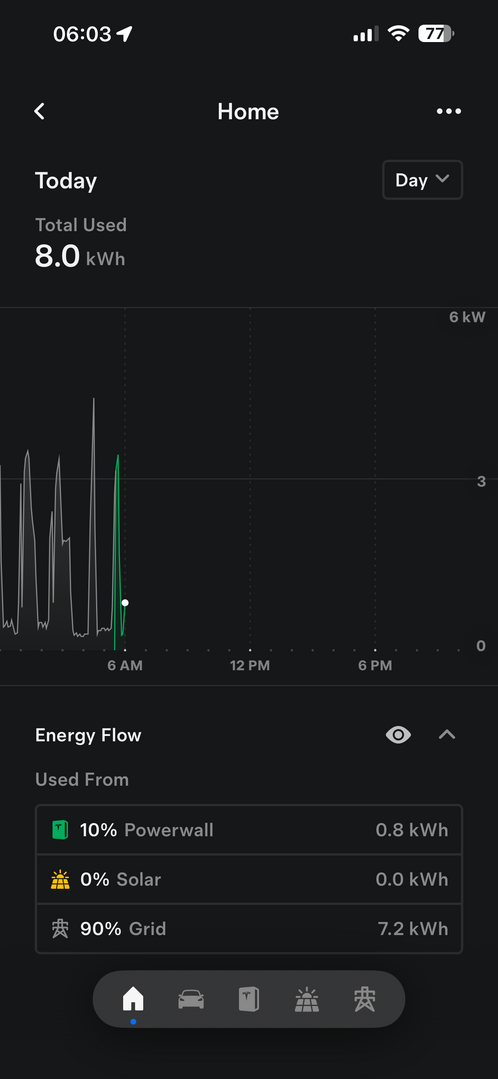
One question I still have is how detrimental it is to run an oversized condenser. I think I picked up from one of the Hub’s round table podcasts - is the importance of how low a specific heat pump can modulate down in terms of kW or power?? As a test, I monitored my heat pump overnight with stat set at 18 degrees - the total electrical usage for the house was 8kWh with background load of between 1.5-2kWh so rounding up, I’d say my heat pump used c6kWh so an average of 1kWh/hour. I will post a picture slowing the modulation which shows it came on about once an hour and ran at a peak of 3.3kW so at an estimated COP of 3 that would be 10kW which is pretty much 100%. So can I assume that at reference temp of 3 degrees (overnight outside temp) my unit might use over a full 24 hours c24kWh of electricity so at COP of 3 that would be 75kW of heat??
If for example I had a 3.5kW unit it would in theory at same temps with same rads, pipes and insulation be running at close to 100% over 24 hours and so a smaller heat pump condenser on its own wouldn’t in theory save much if any power and would maybe be working harder?
So my conclusion is that to reduce power usage and gain better efficiency (which is my main driver) I need to improve COP (assuming heat loss constant) and to improve COP I need to work on all the points discussed above emitters, flow temps/rates etc….
Whether I can get to optimum on my 10kW Grant will I guess depend on how low it can modulate down to? Chat GPT says it is c20%. My guess is that it’s never going to be as efficient as a smaller unit as at 20% it will be outputting c2kW of heat and for much of the time my house will need less than that. However, in theory at c20% it should operate at around 600w which isn’t too bad. Anyway lots to think about and consider. Any further comments on condenser sizing welcome.
19/02/2026 8:08 am
my current thinking is that I wait until the weather improves enough to not need the heating and then turn off and drain the system this will allow me to work on new rads and pipework and as mentioned as part of the renovation look at the possibility of installing underfloor heating in the downstairs… I plan to do as much of the work myself to keep costs down.
Very sensible. @old_scientist has very well described the design process starting with heat loss. You seem to know your whole house loss is ~3.5kW, one thing I would do now is to measure DeltaT across the radiators when its cold outside. This will give you invaluable information to help sense check the design. Also if you can find the info in the menus check the flow rate. Do both of these when the heat pump is actually producing heat!
I would probably also try to optimise the current WC curve so you have a sound baseline from which to start
One thing I still will need to decide at some point is whether to keep the 10.5kW Grant condenser or swap for a smaller Grant - probably 6kW or indeed a different system such as a Vaillant 3.5kW with better controls and monitoring??
The Vaillant 3.5kW is actually the 5kW downrated, but will still be a much better match. The down rqating affects the top end, but the moin output of the 3.5kW model is the same as the min output of the 5kW model. There are actually very few heat pumps with a capacity of <5kW (a few more have a sticker capacity <5 but are downrated higher capacity models). At this end of the capacity market you do need to be a bit smart to (a) check its not a downrated model and (b) have enough capacit to reheat DHW sufficiently quickly.
One question I still have is how detrimental it is to run an oversized condenser.
This is somewhat variable from model to model unfortunately, some cope well with oversizing, some less well. If your house retains heat for a good while and particularly with UFH in a slab you can mitigate somewhat by 'batch heating' The limit case of this is UFH is a concrete slab where you can treat the concrete slab like a storage heater.
So can I assume that at reference temp of 3 degrees (overnight outside temp) my unit might use over a full 24 hours c24kWh of electricity so at COP of 3 that would be 75kW of heat??
75kWh over 24hrs is 3.1kW average. A house that is 3.5kWh at -2 would be about 2.6kW at +3. Your COP at 3C may be a bit less than 3 so I think its all roughly consistent. That modulation graph doesnt look too bad, its a fairly long on cycle, so the efficiency loss is probably not too bad either.
If for example I had a 3.5kW unit it would in theory at same temps with same rads, pipes and insulation be running at close to 100% over 24 hours and so a smaller heat pump condenser on its own wouldn’t in theory save much if any power and would maybe be working harder?
Exactly that to first order, but working harder doesn't necessarily mean working less efficiently.
There are two main factors at play in efficiency. The efficiency vs modulation curve of a typical condenser typically peaks around 40-50% of its max capacity, so that is the most efficient operating point purely as far as the condenser is concerned. Heat pump manufacturers play games with this curve to squeeze out performance. The second factor is start up losses. Each time the condenser starts up there is lost energy, sometimes it seems quite a lot (its also not great for the condenser). In bad cases of cycling the cycles occur at 10 min intervals so the heat pump barely gets going and this can cause a dramatic penalty, perhaps as much as 30% (boilers suffer the same BTW). Hence the argument for right-sizing.
I suggest that, when it warms up, at say around 7C and 12C, you collect some more data on the cycling. We can then assess how bad it is and whether swapping the unit is likely to improve things a lot or a little.
Whether I can get to optimum on my 10kW Grant will I guess depend on how low it can modulate down to? Chat GPT says it is c20%.
Heat pumps can typically modulate to 20-25% of their output under any given conditions of OAT and FT. However thats only part of the story. What is more interesting in most cases is the ratio of max output at Design FT and Design OAT, to the min output at a much higher OAT and correspondingly lower FT. This is generally around 3:1.
Assuming (a) that you are working on weather compensation mode and (b) that there isnt a hidden low loss header I dont think there is much doubt that your biggest bang for the buck would be upzizing your rads so you can drop the FT by 10C or maybe even 15. This should reduce your consumption by 30%+. Upsizing rads will also increase system volume which will help with cycling. Everything else is likely to have a lesser return both in terms of bang for buck and bang for inconvenience. That is not an argument to avoid, just a heads up where to concentrate funds/effort.
Hope that helps.
4kW peak of solar PV since 2011; EV and a 1930s house which has been partially renovated to improve its efficiency. 7kW Vaillant heat pump.
19/02/2026 12:06 pm
My heat pump is maybe 3 times oversized on paper being a 12kW unit and my heat loss to date has been around 4kW, although we do not heat the house to 21C 24h a day. Having an oversized heat pump does not always translate into bad performance. We commonly turn off overnight for anything between 4-8h depending on weather, and in milder weather run in cycles. The heat pump is very rarely doing anything more than ticking over other than on initial startup. We still achieve a SCOP of 4. I have no doubt that you can achieve good performance with your existing unit when combined with a well designed system.
If I were buying/installing a new heat pump right now, I think my starting point would be the new Grant R290 units. They look very nice and can modulate their output down well in milder weather.
Have a look at this self install of a Grant R290 unit by Glyn Hudson:
Generally though, heat pumps are not new technology, and they all contain the same basic components so should all perform in the same ballpark. The real life differences come from system design. Keep it really simple and pay attention to the details that matter, keep the flow temperatures as low as possible by using large emitters (UFH and/or large K2 radiators) and choose a tariff giving an import price as low as possible and you will have a comfortable heating system that is cheap to run.
Samsung 12kW gen6 ASHP with 50L volumiser and all new large radiators. 7.2kWp solar (south facing), Tesla PW3 (13.5kW)
Solar generation completely offsets ASHP usage annually. We no longer burn ~1600L of kerosene annually.
1
19/02/2026 12:22 pm
Out of interest, I've just had a look back at my radiators spreadsheet, and at a flow temp of 35C (which is as high as we are ever going to run), my largest radiator outputs 730W so checking the table on page one of this thread shows 10mm copper would have been fine, and 10mm plastic microbore would also have been fine on all but my very largest of radiators on the very coldest of days.
In fact, one radiator (a towel rail in a bathroom) retained it's original microbore connections as it would have been too disruptive to have changed it due to bathroom tiling, and as expected that radiator has no issues getting warm and drying towels. I think the internal diameter of that plastic microbore was 6mm as measured on the other piping we ripped out.
Samsung 12kW gen6 ASHP with 50L volumiser and all new large radiators. 7.2kWp solar (south facing), Tesla PW3 (13.5kW)
Solar generation completely offsets ASHP usage annually. We no longer burn ~1600L of kerosene annually.
1
19/02/2026 1:57 pm
@uknick Some very useful real world data from @old_scientist very relevant to your case. If your loss is really 3.5kW I think its less than 50% probability you need to re-pipe. Many installers re-pipe at the slightest provocation and I have recently been accused on this forum of 'having a thing against re-piping'. I stand guilty as charged, but whats the point of taking up floorboards and removing perfectly good copper (or plastic) if you don't need to. Its massively disruptive and, unless there is an identifiable problem, unlikely to deliver any material benefit.
4kW peak of solar PV since 2011; EV and a 1930s house which has been partially renovated to improve its efficiency. 7kW Vaillant heat pump.
Topic starter
19/02/2026 5:02 pm
@jamespa Hi James ass always an incredible reply and so much great advice. I am trying to get my head around all the advice from comments and I've already learnt a lot. It sounds from your reply and others like I might not need to change the hear pump for something smaller - I guess if I could get to a COP of around 4 by increasing rads and possibly upgrading pipework then job done!! You did mention UFH above and I wonder what your thoughts are on this? I got a quote today from Wunda for a kit to do UFH in may downstairs which seems pretty reasonable at 1500 - would having UFH alter some of the rules around open loop etc? Thanks again for the advice...
Topic starter
19/02/2026 5:14 pm
@jamespa Phew - that's a lot to absorb! I am getting there and do understand the principle - I guess in the past with relatively cheap gas and high heating temps few cared much about flow rates, delta t's rad temps etc - but as electric costs more per kWh and those who embrace the electric revolution tend to be more geeky then inevitably all this becomes a thing and also important to avoid sky high electric bills. I am lucky in that I am an EV driver and so get low cost overnight tariff and my battery is a buffer which can last all day making performance less critical than it might be without a cheap tariff and battery. However, as I mentioned in my initial post I am designing for the next 10 or 20 years and need to keep costs as low as possible across all areas of life. Thanks again for your help with this.

19/02/2026 5:21 pm
@uknick One thing to consider is that the flow temperature for UFH is lower than for radiators so you may end up heating the water for the radiators and then have to blend it down in temperature for the floor which will negate some of the advantages of having UFH
House-2 bed partial stone bungalow, 5kW Samsung Gen 6 ASHP (Self install)
6.9 kWp of PV
5kWh DC coupled battery
Blog: https://thegreeningofrosecottage.weebly.com/
Heatpump Stats: http://heatpumpmonitor.org/system/view?id=60
Topic starter
19/02/2026 5:23 pm
@old_scientist Thanks for the messages - yes I have watched Glyns install video (more then once actually 🙂 and have also followed his adventures over the years with his family in his mini electric camper - great guy and very knowledgeable.... I also liked the look of the R290 Grant - still not quite sure what advantage R290 has over R32 but like you if I was starting again I'd consider the R290 units. How do you monitor performance of your system - do you have Open Energy Monitoring installed?
it's good to hear your experience and the fact that you get a very good SCOP with an oversized heat pump and that your rads would in theory be sufficient even on micropore. I guess I need to be careful not to over engineer and/or waste time and money unnecessarily....
1
Topic starter
19/02/2026 5:29 pm
Thanks to everyone for your amazing lengthy and detailed comments I really do appreciate how knowledgeable folk are on this forum - I have read them all and will revisit as I progress with the project.

Latest Posts
-

RE: Humidity, or lack thereof... is my heat pump making rooms drier?
Actually, it’s better for wooden furniture – or at leas...
By Majordennisbloodnok , 6 hours ago
-
This is absolutely standard for any sealed pressurised ...
By JamesPa , 8 hours ago
-
RE: Oversized 10.5kW Grant Aerona Heat Pump on Microbore Pipes and Undersized Rads
@uknick TBH if I were taking the floor up ...
By JamesPa , 8 hours ago
-
RE: What determines the SOC of a battery?
@batpred Your BMS parameters will be the same as m...
By Bash , 9 hours ago
-

RE: Getting ready for export with a BESS
I would have not got it if it was that tight
By Batpred , 10 hours ago
-
RE: Setback savings - fact or fiction?
I also need to correct something I said by mistake earl...
By cathodeRay , 10 hours ago
-
RE: Electricity price predictions
@judith Thanks for sharing, and nice to see how the ...
By Batpred , 10 hours ago
-
RE: Testing new controls/monitoring for Midea Clone ASHP
@tasos the OAT is incorporated into the control logic. ...
By benson , 11 hours ago
-
RE: Need help maximising COP of 3.5kW Valiant Aerotherm heat pump
@judith thanks Judith. Confirmation appreciated. The ...
By DavidB , 13 hours ago
-
RE: Recommended home battery inverters + regulatory matters - help requested
That makes sense. I thought better to comment in this t...
By Batpred , 13 hours ago
-
Bosch CS5800i 7kW replacing Greenstar Junior 28i
My heat pump journey began a couple of years ago when I...
By Slartibartfast , 13 hours ago
-
RE: How to control DHW with Honeywell EvoHome on Trianco ActiveAir 5 kW ASHP
The last photo is defrost for sure (or cooling, but pre...
By JamesPa , 15 hours ago
-
RE: Plug and play solar. Thoughts?
Essentially, this just needed legislation. In Germany t...
By Batpred , 15 hours ago
-
RE: A Smarter Smart Controller from Homely?
@toodles Intentional opening of any warranty “can of wo...
By Papahuhu , 17 hours ago
-
RE: Safety update; RCBOs supplying inverters or storage batteries
Thanks @transparent Thankyou for your advic...
By Bash , 18 hours ago
-
RE: Air source heat pump roll call – what heat pump brand and model do you have?
Forum Handle: Odd_LionManufacturer: SamsungModel: Samsu...
By Odd_Lion , 18 hours ago
-
RE: Configuring third party dongle for Ecodan local control
Well, it was mentioned before in the early pos...
By F1p , 1 day ago
-
RE: DIY solar upgrade - Considering adding more panels
I know this is a bit old, but it made me wonder what co...
By Batpred , 1 day ago
-

RE: New Vaillant aroTherm Plus in black - When will it come to the UK?
@majordennisbloodnok Daikin, take note! (In fact, I hav...
By Toodles , 2 days ago
-
RE: Midea ASHP – how to set weather compensation
@mk4 — good work! First, I agree, no evidence of cycl...
By cathodeRay , 2 days ago
-

RE: Solis inverters S6-EH1P: pros and cons and battery options
I don't know about Solis inverters. It isn't a featur...
By Transparent , 2 days ago
-
Daikin Altherma 3 H HT - Freeze Prevention Threshold
Hi. We have an Altherma 3 HT (18kW I think) which, now ...
By RICHARDF5033 , 2 days ago
-
RE: Passiv Smart Thermostat - Help & Forum Support
@petch We are not yet compatible with the R290 from Gra...
By Will H , 2 days ago


