
Notifications
Clear all

Topic starter
06/02/2026 4:10 pm
I have a concurrent thread running re improving COP. This is a spin off question which I hope is more appropriate as a new topic.
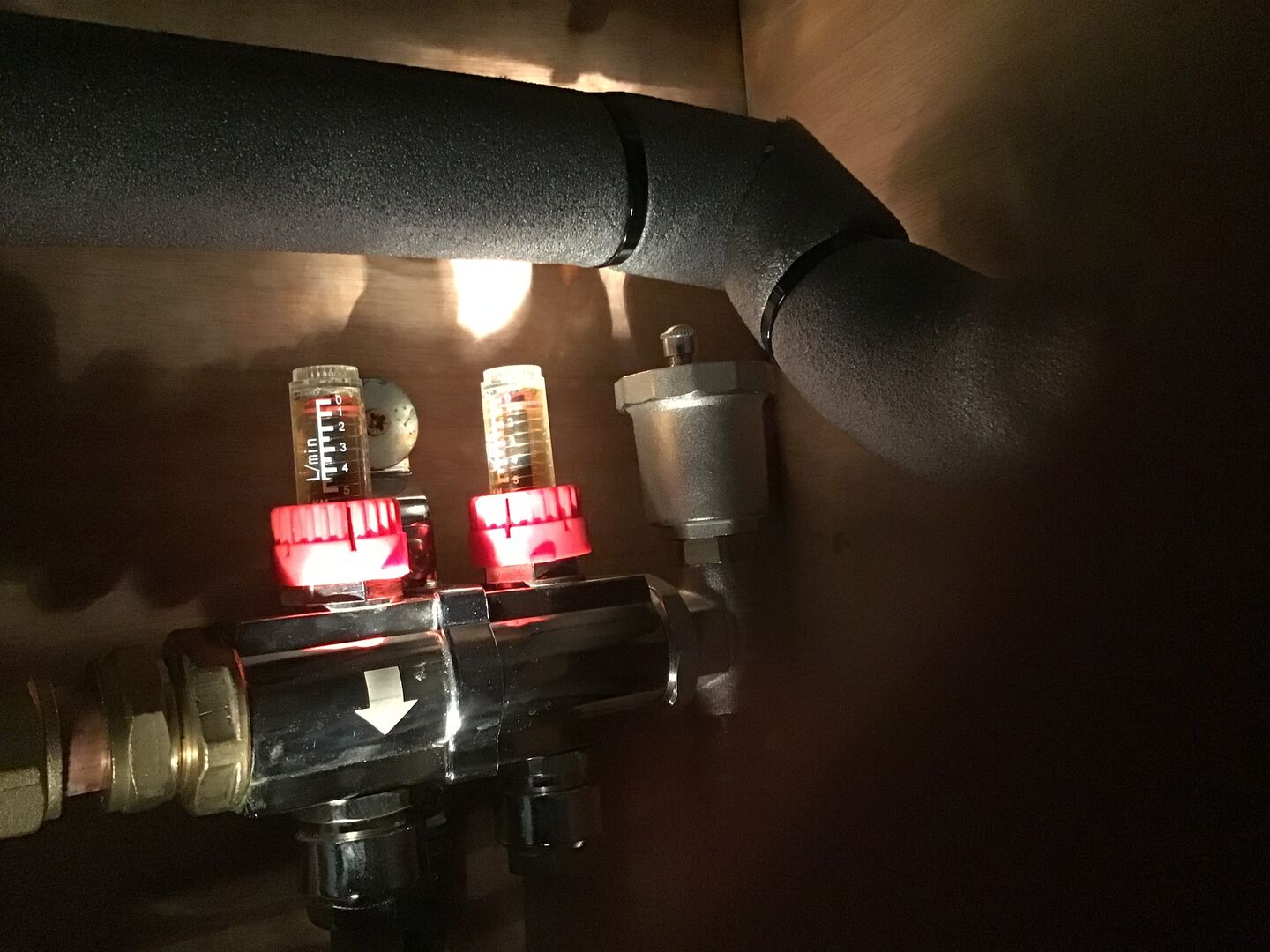
i am slowly getting to know my system, installed Sept. last year. During a call to Vaillant today, the tech support indicated that something odd appears to be happening in that the flow and return DT is mostly <5C. My hand on the UFH flow and return suggest the flow is as expected but the return is ambient - cold to touch. The circuit has its own pump, which has a green light so seems to be running. The pic below shows the flow meters - with which I am unfamiliar. My first impression was that the flow is actually zero - which would explain the cold return. Have I interpreted the picture correctly?? Apologies for the poor lighting and hope it is enough. Both meters have the red disk in the same upper position. Any advice would be appreciated.
This topic was modified 11 hours ago by Mars
1


06/02/2026 4:19 pm
Yeah, absolutely, those look closed or open very, very little. You can see it says 0 at the top and 5 at the bottom, which are litres per minute. I'd open it to 1 litre per minute to see what happens.
If you have rads connected to the same heating circuit it might affect them, which is why I suggest opening to 1 litre per minute for now.
This post was modified 11 hours ago by Mars
Get a copy of The Ultimate Guide to Heat Pumps
Subscribe and follow our YouTube channel!
06/02/2026 4:27 pm
Yes, your interpretation is correct, and those flow meters are indicating a zero or close to zero flow.
Assuming you have a buffer or low-loss header, this would mean that your heat pump will essentially just be circulating water through the buffer and back to itself, with a minimal heat loss (and so a low dT).
If you don't have a buffer or low-loss header, you may instead have a bypass valve, or some other component which is able to act as a kind of short-circuit for the heating fluid (this includes another manifold, or radiators etc).
You may be seeing zero flow here because the flow-regulating valves are closed right off, because the circulation pump feeding the manifold is not pumping (for whatever reason), or because the zone-control thermostats (if you have them) have closed those circuits.
From checking your other post, it seems as if you're running open loop, so there shouldn't be any thermostat-controller actuators on the heating circuits. Then again, you also didn't flag any concerns with your heating not actually working, so I'm a bit suspicious.
Was this photo taken while the heat pump was on, and actively heating?
This post was modified 10 hours ago by Steelbadger
1
06/02/2026 4:30 pm
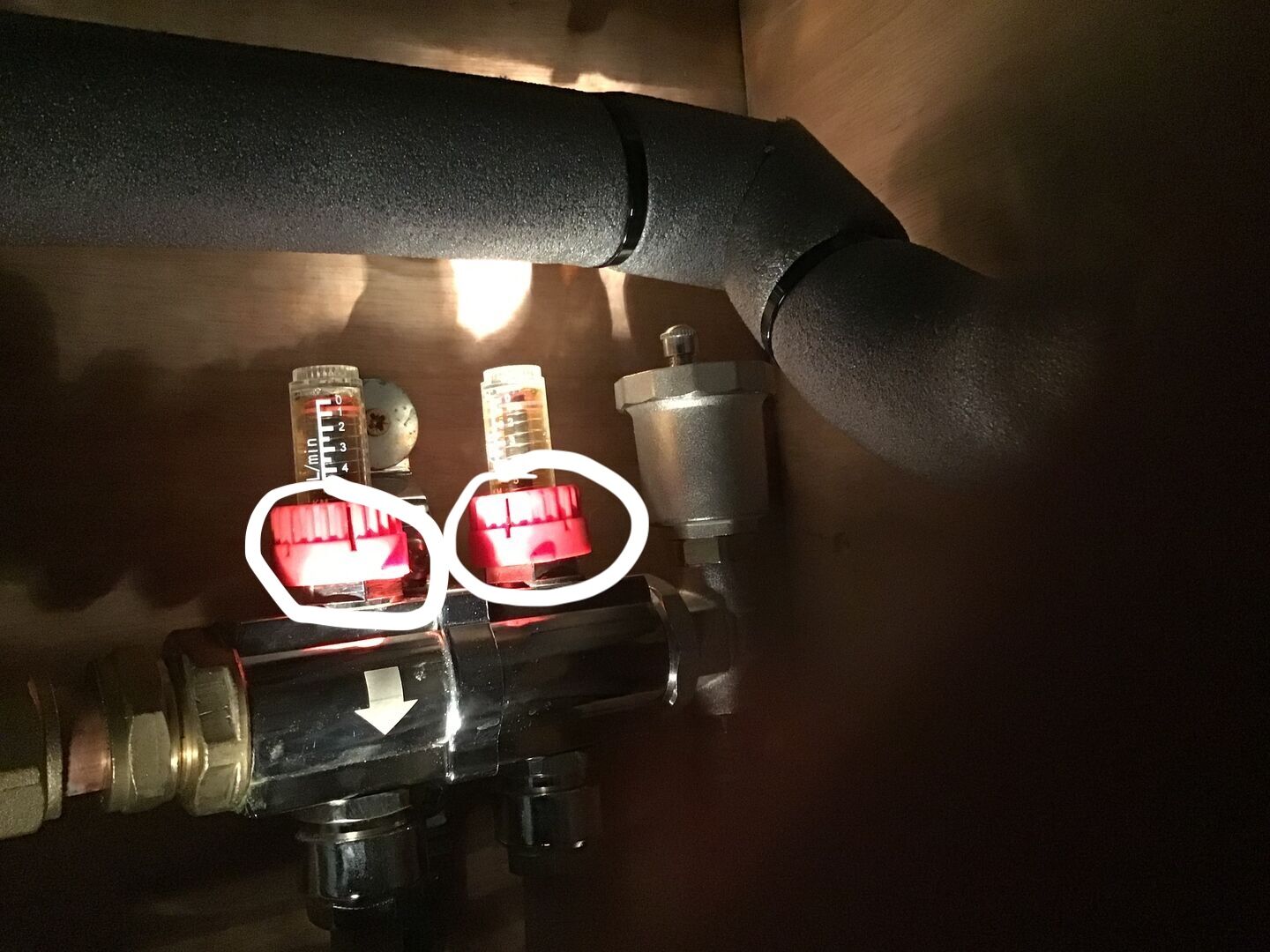
@davidb, turn the red bit (see photo) anti-clockwise. 2-3 finger turns should drop it to around 1l/min.
Get a copy of The Ultimate Guide to Heat Pumps
Subscribe and follow our YouTube channel!
Topic starter
06/02/2026 5:00 pm
@editor so simple, thanks. Reevaluating what I was seeing, the valve was only just cracked open. It meant the flow pipe was warm a meter away from the manifold. I have set both to your suggested 1l/m but curious to know why that figure. Is that a simple industry rule of thumb?
06/02/2026 5:18 pm
@davidb there isn’t really a universal 'rule of thumb' number for UFH flow rates, which is why I was careful not to present 1 l/min as the answer. In your case it was more of a safe, visible starting point than anything else.
UFH flow rates are ultimately a function of heat output, pipe spacing, loop length and design temperature difference, so in a perfect world you’d calculate them loop by loop. But when you’re troubleshooting a system that’s clearly doing almost nothing, the immediate goal isn’t optimisation, it’s simply to get meaningful circulation and see how the system reacts. Going from effectively zero flow to 1 l/min is a big enough step that you’ll feel it quickly in pipe temperatures and see it reflected in system behaviour, without suddenly dumping a load of flow into the circuit and destabilising everything else.
As you’ve already seen, with the valves barely cracked open the flow pipe warming a short distance from the manifold makes total sense... there just wasn’t enough movement to carry heat back. At 1 l/min you’re now firmly into 'this should actually do something' territory, which gives you useful feedback.
There’s also a practical reason for not jumping straight to higher numbers. If your UFH is on the same primary circuit as radiators, or shares a buffer/LLH, opening the manifold too far can absolutely throw balancing out elsewhere. UFH likes low and slow by nature, so sneaking up on the flow rather than swinging it wide open is usually the least disruptive way to go.
On @steelbadger’s point, he’s right to flag the bigger picture. Near-zero flow at the manifold will lead to low system dT because the heat pump is effectively circulating against itself via whatever path offers the least resistance, whether that’s a buffer, bypass or another open circuit. That doesn’t automatically mean anything exotic is broken, but it does mean the UFH loop wasn’t participating in heat delivery at all.
Given you’re running open loop, no actuators closing things down and the pump appears to be running, the simplest explanation was also the right one here: the flow limiters were basically shut. The key now is to see how the system behaves with some actual circulation... how the UFH responds, whether the return starts to lift and what happens to overall dT and COP once the heat has somewhere useful to go.
I’d live with 1 l/min for a bit, observe, then adjust incrementally.
Get a copy of The Ultimate Guide to Heat Pumps
Subscribe and follow our YouTube channel!
Topic starter
06/02/2026 5:18 pm
@steelbadger yes, HP running “normally” and, if you have seen some of my other thread, I have no stove burning. I have the system in active mode - so control via WC curve only. With only a trickle through the UFH pipes, I am not surprised I haven’t been reaching set temperature.
Topic starter
06/02/2026 7:16 pm
Update - I have been checking the UFH return manifold, waiting on a rise in temperature. Response was fairly slow so I figured the heat was being absorbed by the slab. However I then realised the flow had returned to nearly closed. Strange, I had it set clearly at just over 1. I readjusted the flow control only to find it wasn’t operating, regardless of how much I rotate the adjuster. It looks like I have a hardware failure. I have no idea what that will take to fix as I am on a Scottish island and my installer on the mainland. Add to that we have had no ferry service for 2 days due to an easterly gale! If there are any tricks I can perform to get the flow going, please take to your keyboard. Thanks to all for their comments. BW.
06/02/2026 8:38 pm
@davidb, if the flow has drifted back to near-closed and the adjuster now isn’t doing anything (bearing in mind that I'm not a plumber or heating engineer) that, for me, points to a failed or stuck flow regulator on the manifold rather than anything the heat pump or controls are doing. With UFH, a trickle like that will happily fool you into thinking things are running normally, while in reality the slab is being starved of energy. Under those conditions, not hitting set temperature is exactly what you’d expect.
I think that the slow return temperature rise you saw also fits. Some absorption into the slab is normal on start-up, but if the flow control is intermittently or permanently closed, you’ll never get sustained heat transfer... you’re effectively trying to heat a concrete mass with a dribble of water.
Before you resign yourself to waiting for ferries and installers, there are a couple of low-tech things worth trying. Gently tapping the flow meter body and valve stem can sometimes free a stuck regulator.
Fully winding the adjuster open and closed a few times can also help if it’s jammed with debris or scale. That solved a similar issue for us a couple of years ago.
Get a copy of The Ultimate Guide to Heat Pumps
Subscribe and follow our YouTube channel!
Topic starter
06/02/2026 9:03 pm
@editor thanks for the tips which I will try before calling my installer on Monday. Again much appreciated.
1

Latest Posts
-
RE: If a heat pump can only heat DHW to 50C then what? Issue with 18KW Heliotherm heat pump
Hi, Nothing yet. I've asked customer to measure flow...
By errmm , 3 hours ago
-

RE: High Temp Heat Pumps for fast warm-up of house
I don't know exactly how long it takes to heat up (and ...
By JamesPa , 4 hours ago
-
RE: Need help maximising COP of 3.5kW Valiant Aerotherm heat pump
OK. What Im seeing looks fairly normal TBH: 1 start ...
By JamesPa , 4 hours ago
-
RE: Vaillant Tech Support Flagged Low DT: UFH Return Cold, Suspected Zero Flow
@editor thanks for the tips which I will try before cal...
By DavidB , 6 hours ago
-
RE: Daikin 6kw setup with Dixell controller
@jamespa Many thanks for your reply, a very detailed an...
By CraigH , 6 hours ago
-
RE: Exploring the role of alternative clean heating solutions - Government Consultation
Despite reservations, I found some time to respond to t...
By Rusty , 6 hours ago
-

RE: New Vaillant aroTherm Plus in black - When will it come to the UK?
@crankplus, nope, still not, and I've followed up with ...
By Mars , 6 hours ago
-
RE: Octopus Cosy Heat Pump Owners & Discussion Thread
@agentgeorge Probably, but temperature change at -10 ha...
By AndrewJ , 7 hours ago
-

RE: External wall insulation - your experience
To be clear, my experience was very positive. The journ...
By Batpred , 9 hours ago
-

@foxesfan Re: ‘Servicing’ as @editor has covered in his...
By Toodles , 9 hours ago
-
RE: A Smarter Smart Controller from Homely?
@benson No idea why mine doesn’t work, all I see on ...
By Papahuhu , 10 hours ago
-
RE: Battery sizing - How low can you go!
It seems I am seeing something similar to what you do, ...
By Batpred , 11 hours ago
-
RE: Gaslighting in the heat pump industry – has anyone else experienced this?
Don’t know if this is relevant to this thread, but my A...
By Gruff2001 , 12 hours ago
-
RE: Bosch CS5800i 5kW - Experience So Far
@majordennisbloodnok While getting Home Assistant runni...
By Steelbadger , 1 day ago
-
RE: MCS - BS EN 12831-1:2017 – Heat Loss Survey
Since May 2025 it no longer a requirement in England to...
By JamesPa , 1 day ago
-
RE: Air source heat pump roll call – what heat pump brand and model do you have?
Forum Handel @jancold Manufacturer: Daikin Model: E...
By Jancold , 1 day ago
-
RE: Octopus Cosy 12 Heat Pump Regret: Incredibly Loud, Poor Heating & Constant Hum - Help!
@harriworld it was roughly 3am for an hour as that’s ...
By L2jad , 1 day ago
-
RE: Hoped for improvements not being realised on my Mitsubishi heat pump
I have been wondering that myself. The fact is that, ...
By JamesPa , 1 day ago
-

RE: Filtering Tap Water – Share Your Setup for Cleaner, Better-Tasting Water
I remember when I was in my early 20s I was introduced ...
By Majordennisbloodnok , 1 day ago
-
RE: Setback savings - fact or fiction?
But if it is recorded an an integer, which it seems it ...
By cathodeRay , 2 days ago