Notifications
Clear all
Joining the Renewable Heating Hub forums is completely free and only takes a minute. By registering you’ll be able to ask questions, join discussions, follow topics you’re interested in, bookmark useful threads and receive notifications when someone replies. Non-registered members also do not have access to our AI features. When choosing your username, please note that it cannot be changed later, so we recommend avoiding brand or product names. Before registering, please take a moment to read the Forum Rules & Terms of Use so we can keep the community helpful, respectful and informative for everyone. Thanks for joining!
Your Home
1
Posts
1
Users
1
Reactions
19
Views

Topic starter
15/11/2026 1:12 pm
This topic picks up the UK Government's Be Ready Campaign.
It starts with the following observations by @etchedpixels over here on the topic Why People don't choose Heat Pumps:
As to resilience. Most UK home installations are not capable of operating with grid down. Many people were never told about that, many people were pushed fancy brand products and then told that it was another grand for a "gateway" to do the stuff built into plenty of low end kit, or two grand by the time they've come back and installed it. Plug in solar/battery is also of limited use in this situation because you can't isolate the house via a plug socket. Even if you have batteries you'll probably have no internet after a few hours, no mobile internet after a few days and meshcore isn't going to save you - sorry.
Longer term I suspect battery does become an answer because despite Trumps demand creation battery prices keep dropping and it's now at the point 16kWh of top end batteries is under 2 grand and still falling. Indeed we are at the point where "normal" batteries (as opposed to the expensive ones pushed by many MCS installers) are pretty much not worth sizing under 16kWh because of the fixed costs around them. Indeed even the "plug in ready" (and the ASA really needs to slap someone for that name) kit is now shifting from 2 to about 5kWh because the fixed costs of the unit in inverters, casing, compliance, shipping etc mean that there's not much price difference below that.
It is interesting to look how other countries do things, especially ones with dodgier grids and/or regular extreme weather events.
Florida has lots of people with non grid tie battery, an automatic (or manual) transfer switch and a generator input. Many of them still consider the generator the essential bit. The batteries make it nicer, save money and the like all year but when push comes to shove and you get no power for a week after a hurricane then it's the generator that will save your backside.
There's also a lot of self install stuff where you get an electrician to fit a smart panel and then you just stack house powering but non grid tied batteries and whatever yourself, basically a smarter transfer switch. Ditto there's things like window unit aircon anyone can install cheaply and increasingly these come with options for direct solar (to the end user it's just a window unit with some more connectors, but it's of course some battery and MPPTs and probably on the DC side of the heatpump for efficiency).
South Africa has had lots of fun with rolling blackouts aka load shedding and a lot of people have inverters that do full house backup and which has built in generator ports too. It's where Sunsynk really made their name and the kit reflects that - 32A or higher backup circuit, ultra fast switchover and an auxiliary input that turns on/off according to configurable rules and is wired to the "geyser" (what they call the immersion heater).
I agree the UK really isn't ready for what is potentially coming, and it's not going to be helped by the modern British entitlement culture where everyone thinks it's not their problem and that government is going to ride in and save them (ironically the same government they don't believe can keep the grid running).
@transparent - there's another issue with interconnectors. When they mostly move power one way the people at the generating end see their bills go up. This has already become a massive political issue in Norway and it's undoubtedly going to get worse as the French for example start asking quite why they are not charging high rates for connectors and using the money to drive down local bills. Same conversation for Scotland around independence.
Let me pick up the last point first. I'm deliberately explaining basic principles for the benefit of readers who don't already know about these concepts.
The National Energy Systems Operator (NESO) routinely uses transfers of electricity across the Marine Interconnectors to mainland Europe. Here's a map from Ofgem's report into Extreme Weather Events during summer'26:
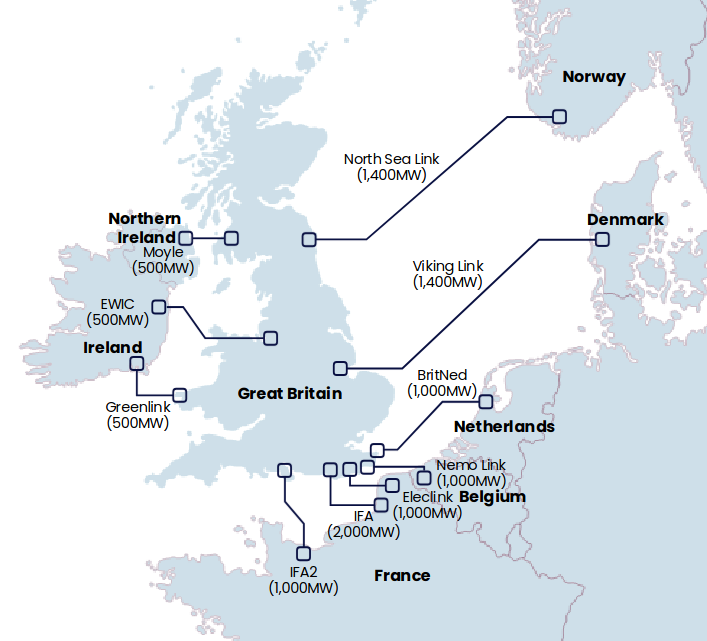
NESO use these interconnectors to stabilise the frequency at 50.0Hz which is defined in Sect.27 of the Electricity Safety, Quality and Continuity regulations (2002).
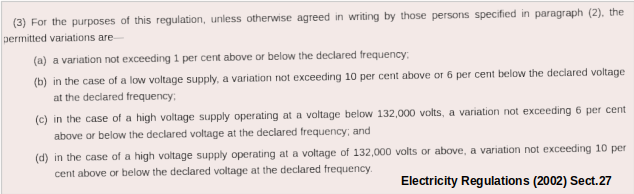
Although the Statute states that the frequency must be within 1% of 50Hz (49.5 - 50.5Hz) NESO's normal operational range is restricted to 49.8 - 50.2Hz.
If Britain has too little electricity being generated, the frequency falls. When there's excess generation, grid voltage and frequency rises.
NESO measures the Rate of Change of Frequency (RoCoF) which gives them a warning of the need to take action.
There was a Parliamentary Emergency Debate on 15th July concerning grid instability in the week beginning Monday 22nd June'26.
This paragraph is taken from Ofgem's Preliminary Factual Report on the events of that week, which was published 19th Oct.
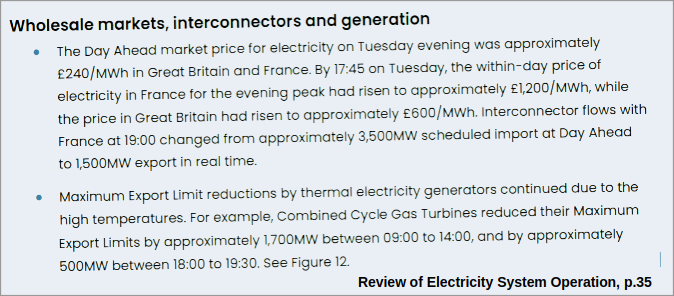
That para describes sudden and unanticipated changes in electricity flows on the Marine Interconnectors.
Although @etchedpixels comments on the costs, when there are shortfalls of such magnitude, the cost is of lesser significance. Neither NESO nor the French System Operator (SO) is prepared to allow their frequency to fall. If it were to move outside the statutory envelope then it becomes impossible for generation sites being held on StandBy to connect to the grid. The inevitable result is a grid collapse, such as occurred in Spain and Portugal on 28th April 2025. On that day, the French SO opened the contactors, ceasing electricity flows to Spain and isolating the Iberian Peninsula from the rest of Europe.
It took the Spanish operator less than an hour to restore power, but outages continued in some areas throughout the rest of the day and eleven people died.
Now let me move abruptly across to the other comments about in-home storage batteries.
Unlike commercial Battery Energy Storage Systems (BESS) which is connected to the grid, in-home batteries can be chosen which will provide power to the household appliances when there is a power outage. That's the type we're discussing here because if offers resilience to the home.
Two Distribution Network Operators have already decided to deliver small-capacity portable battery storage to customers on their Priority Services Register (PSR) who have medical needs. SSE is giving out 1kWh EcoFlow Delta 3 units. Those aren't cheap, and it's unlikely that 1kWh would be sufficient to operate medical equipment for the 3 days, which is the level of emergency the government says we should prepare for.
@etchedpixels and I favour 16kWh batteries. Those are static units, weighing about 130kg.
Such a battery unit is now ridiculously cheap and can be bought directly from Chinese manufacturers who have stocks already in Europe for fast delivery:
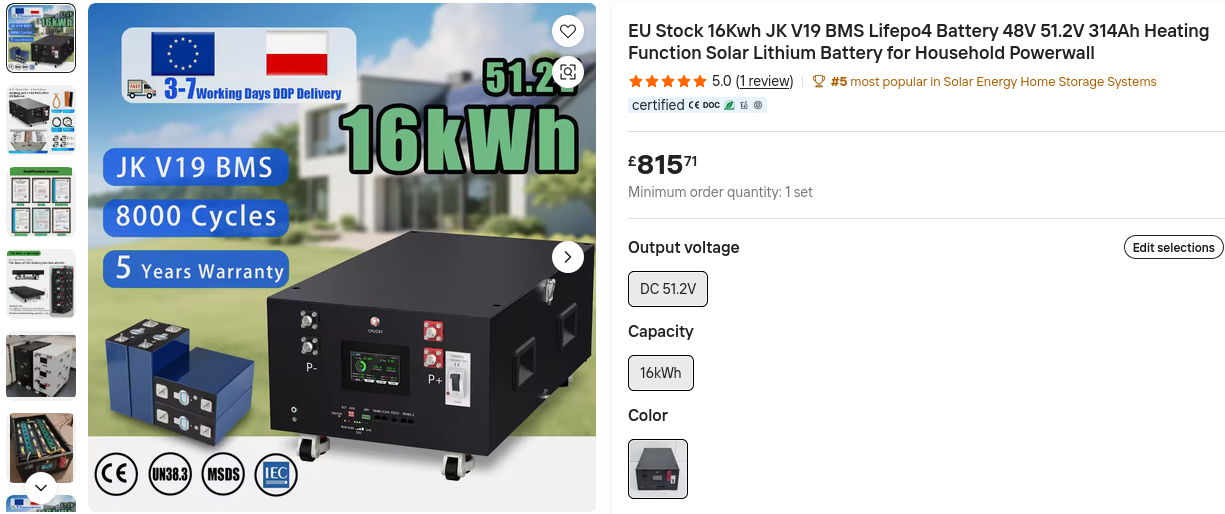
That £815 price excludes VAT and delivery. The reference DDP means Delivery Duty Paid. The seller's final price will include all delivery charges, import tax and VAT.
You will also need an Off-Grid Inverter to provide 240v AC to the home, and to allow the battery to be recharged from the grid when prices are low.
When householders install such storage batteries, the overall effect on the grid is positive.
The use of mass distributed storage lowers national peak-demand and means NESO doesn't have to buy so much electricity across the Interconnectors.
Thus home storage batteries not only bring you resilience against outages, but also contribute stability to the grid.
Save energy... recycle electrons!

1

SPONSORS

Degrees of Separation
Latest Posts
-

RE: How quickly would you want/expect heat recovery to take from setback?
I think you are right, 30c is just at the limit and the...
By AndrewJ , 4 minutes ago
-
RE: Why don't people choose heat pumps?
This topic is straying into useful observations about t...
By Transparent , 35 minutes ago
-
This topic picks up the UK Government's Be Ready Campai...
By Transparent , 39 minutes ago
-
RE: Load Shift and Lifestyle Shift Complete - our journey has ended, for now
This opening sentence stopped my reading right at the s...
By QdsdHxJX9PFLfi7 , 2 hours ago
-
-
RE: Our 10 year old Grant heat pump failed
As I understand it it was working then stopped. More l...
By JamesPa , 2 hours ago
-
@pipcart, Wattson is back... please go to the homepage ...
By Mars , 2 hours ago
-
Do heat pump defrost cycles impair heat pump efficiency (COP values)?
The short answer is no, as far as I can see from data f...
By cathodeRay , 3 hours ago
-
RE: Peak Energy Products V therm 16kW unit heat pump not reaching flow temperature
@davec how are getting on with the grant unit in the co...
By johnd , 5 hours ago
-
RE: Are We Sleepwalking Into Another Race to the Bottom?
That is a good approach and an excellent result. For co...
By Judith , 21 hours ago
-
RE: Say hello and introduce yourself
Good to see you here, @claytonbrowne, and welcome to th...
By Mars , 1 day ago
-
RE: Issues with Samsung heat pump – high running costs and house dropping to 11C overnight
It looks very much like a radiator balancing i...
By hml1827 , 2 days ago
-
I have, @transparent, but chose to pose the question he...
By Majordennisbloodnok , 2 days ago


SPONSORS