
Notifications
Clear all


Topic starter
26/11/2025 11:10 am
I recently completed the Heat Geek Mastery course, partly out of personal interest, partly out of necessity. Running Renewable Heating Hub, speaking to manufacturers, interviewing engineers and engaging with thousands of homeowners on the forums puts me in daily contact with the complexities and disputes of the heat pump world.
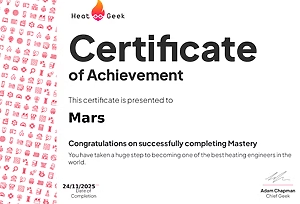
I wanted to deepen my understanding so I could engage meaningfully with engineers, challenge poor practice, interpret the jargon and ultimately give homeowners more accurate guidance. From that perspective, the course did exactly what I hoped it would. I now understand the theory of heating systems and heat pumps at a level I didn’t expect, including maths that at times felt designed to expose my limits.
I can read a radiator schedule. I can understand pump curves, delta T, emitter output tables, frictional resistance, DT5 versus DT10 design assumptions and the implications of flow temperature on efficiency. I can look at a system and roughly understand why something is performing well or why it’s not. But after all of that, there’s one glaring truth that needs to be said plainly: even after completing one of the most theoretical and structured courses available, I still have absolutely no idea how to actually install a heat pump.
What the course gave me is knowledge. What it could never give me is competence.
The installation of a heat pump is not just a theoretical exercise, nor is it a single skillset. It is the convergence of multiple trades, each of which has its own depth, its own technical culture and its own ways of going disastrously wrong. Even if a person mastered the Heat Geek content, plus the basic Level 3 heat pump qualification, plus a wiring course, plus the usual plumbing prerequisites, they still wouldn’t necessarily be capable of installing a heat pump to a high standard. Because the reality is this: heat pump installation demands an unusual combination of theoretical discipline, practical skill, experience, judgement, patience and, frankly, humility. And almost no one has all of those things at once.
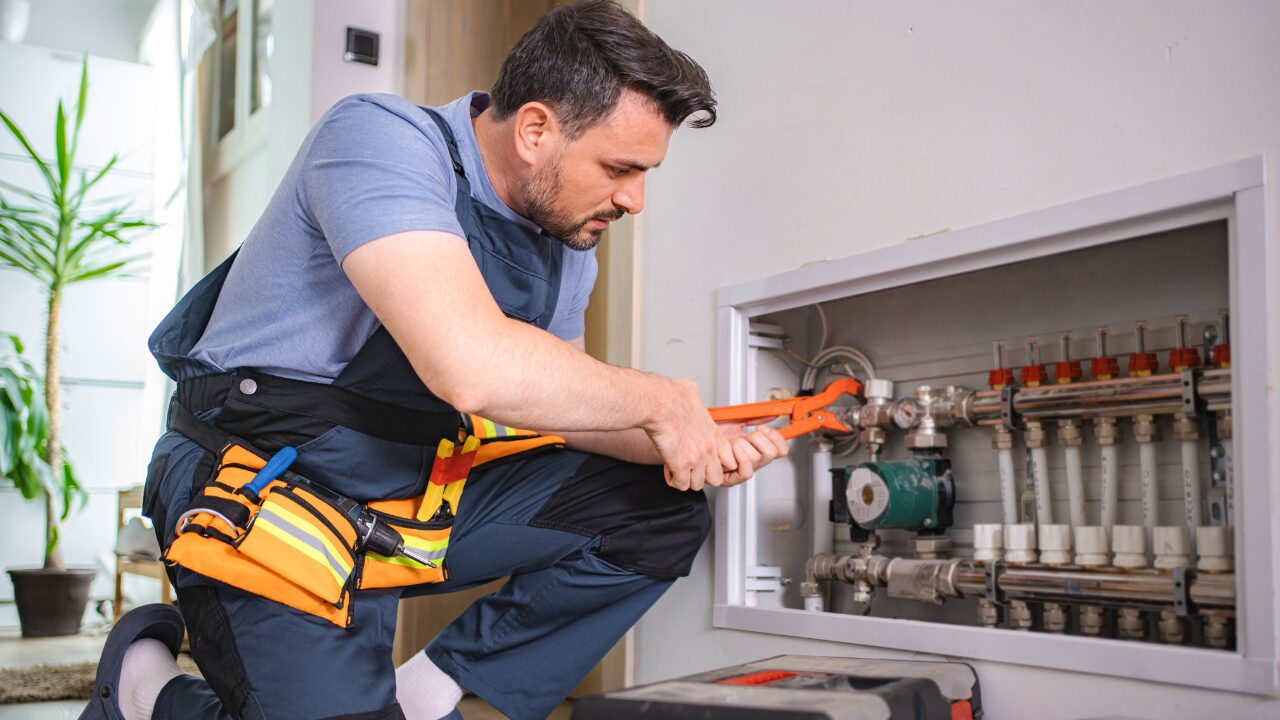
The plumbing element alone requires years of experience to do well. Achieving clean, tidy pipework that is both functional and aesthetically respectable is a craft in itself. Poor pipe routing can restrict flow, create noise or starve emitters within a system. Lift the lid on the majority of failing systems and somewhere in the bowels of the installation you’ll find a poor plumbing decision: a lazy connection, a kinked pipe, a badly sized pump, an unnecessary buffer or low-loss header that destroys the system’s efficiency. The pipework is literally the bloodstream of a system. You can know all the theory in the world, but if you can’t physically execute it, you cannot produce a good installation.
Then there’s electrics. Controls wiring on a heat pump installation is not glamorous, but it’s absolutely critical. If you mis-wire a sensor, misinterpret a terminal or fail to integrate correctly with a cylinder stat, mixing valve or third-party controller, the system can behave unpredictably, short cycle, refuse to defrost correctly or, in some cases, not function at all. We've witnessed this firsthand on our system. This requires proper electrical knowledge, not just the ability to follow a schematic, but the ability to interpret a manufacturer’s quirks, understand relay logic, fault-find under pressure and correct mistakes without making more of them.
And then we get to the theory. This is the part that most people outside the industry underestimate, and the part that many inside the industry like to quietly ignore. A good heat pump installation is fundamentally a design exercise. It requires accurate heat loss calculations, appropriate emitter sizing, correct pump and pipe sizing, a flow temperature target that is realistic and a design margin that allows the system to function in real, messy life, not just in neat spreadsheets.
The Heat Geek course makes the theory accessible. But knowing the formula for emitter output at different delta Ts and actually applying it in a Victorian terrace with unknown insulation, mislabelled pipework, unbalanced radiators and rooms that behave completely differently than the design suggests, these are two very different worlds.
I now understand why good installers are constantly balancing theory with reality. They aren’t “forgetting the maths,” nor are they blindly obeying it. They are interpreting it, through experience, judgement and, sometimes, creative compromise. The best installers have a feel for a building, a sense of how it will behave in extreme weather, an intuition for where the pinch points are, which parts of the design matter most, and where you can safely flex. That only comes from doing it. It does not come from any online course, no matter how good the teaching. These are the installers that we are trying to find on a daily basis so that they can be added to our recommended installer list.
At the opposite end of the spectrum, theory without discipline becomes dangerous. We lived this ourselves recently. We had an installer who waved away theory as if it were optional, who believed you could “figure it out on site,” who relied on guesswork and gut feeling and did not respect what the numbers (or our house) were trying to tell him. That approach didn’t result in a quirky fix for our heat pump; it resulted in a broken system. He didn’t just get the design wrong, he physically damaged the heat pump, disrupted the hydraulic integrity of the system and turned a functional home into a project of diagnosis and repair. That experience is not rare. The forums are filled with variations of the same story.
And this is why choosing an installer is a minefield. Because you are not just choosing a tradesperson; you are selecting a rare hybrid of engineer, plumber, electrician, designer, counsellor and sometimes detective. And you are trusting them with something that has hundreds of potential failure points, any one of which can compromise performance, efficiency and comfort.
This is why we created the Recommended Installer Network. Not because we claim to have a perfect list (such a thing will never exist) but because we’re trying to identify the installers who consistently blend theory with real-world application, who design properly, install carefully, commission meticulously and, perhaps most importantly, take responsibility when things go wrong. Because things do go wrong. A heat pump install has a million places where something can go sideways. What matters is how an installer responds when it does.
The majority of the installers we bring into the network are the ones who show a pattern of thinking, not a pattern of perfection. They study. They improve. They ask questions. They turn up to fix their mistakes. They don’t disappear when a system throws an error code that the manufacturer’s manual hasn’t documented. They don’t dodge phone calls, deny problems or blame homeowners. They behave like professionals. And it is astounding how rare that combination really is.
So completing the Heat Geek Mastery course was valuable. It has transformed the way I think about heating systems, question assumptions and support homeowners. It has also given me an appreciation for the sheer complexity of doing this work properly. It has made me more sympathetic towards the good installers, more wary of the careless ones and more convinced that homeowners need help navigating this industry. Because the gap between theory and practice is a chasm, and falling through it can cost a homeowner thousands of pounds, years of frustration and a deep mistrust of a technology that can work brilliantly when done right.
So am I now a certified heat pump installer? Of course not. But I am better equipped to spot good practice, call out poor practice, ask the right questions and help guide homeowners towards the people who can deliver systems that actually work. And in an industry where the smallest mistake can undermine the biggest investment, that feels worth the effort.
This topic was modified 1 month ago 2 times by Mars
Get a copy of The Ultimate Guide to Heat Pumps
Subscribe and follow our YouTube channel!
3

26/11/2025 1:55 pm
Thank you for doing that, @editor, and for writing this article.
It struck me when I was reading the post that I've seen this before several times. In particular, it was a hot topic a couple of decades ago in the IT industry with certification "boot camps" being a frequently chosen path for people starting out in IT to progress their careers quickly. The problem they faced was that few companies would invest in people without qualifications so the job market for newbies was dire. The hiring companies reaped what they sowed, of course, finding a plethora of candidates who had certificates coming out of their ears but zero practical experience and therefore little value to the company.
As you rightly point out, certificates don't guarantee competence. They are a useful nugget of data to include in your overall judgement of whether someone can do the job, but that nugget still needs to be paired up with other bits of gathered information; in the heating world, things like "can I see work they've done before", "are they listening to me", "do their answers to my questions stand up to scrutiny", "how well does their proposed design match the wide range of best practice guides available online" and so on.
Looking at it from the other side - the installer's - having the knowledge that Heat Geek course provides doesn't ensure someone does a good job but it does remove an obstacle from that path. Eventually it's another confirmation of that old adage that "you can teach skills, you can't teach the right attitude".
105 m2 bungalow in South East England
Mitsubishi Ecodan 8.5 kW air source heat pump
18 x 360W solar panels
1 x 6 kW GroWatt battery and SPH5000 inverter
1 x Myenergi Zappi
1 x VW ID3
Raised beds for home-grown veg and chickens for eggs
"Semper in excretia; sumus solum profundum variat"
2

29/11/2025 4:57 pm
Congratulations on passing the course.
The observations as regards wisdom, experience, competence etc reminds me of when we used to try and employ young(ish) automotive engineers.
One key skill, that I always maintain cannot be taught, is knowing when you don't know enough. In simple terms, when to stop and ask for guidance, advice, mentoring whatever.
It's a real talent to have that correct "stop point" and the personality to use it.
Much rather have that than someone that crashes ahead regardless of the (obvious?) red flags.
2


30/11/2025 9:32 pm
I recently completed the Heat Geek Mastery course, partly out of personal interest, partly out of necessity. Running Renewable Heating Hub, speaking to manufacturers, interviewing engineers and engaging with thousands of homeowners on the forums puts me in daily contact with the complexities and disputes of the heat pump world.
WOW! Congratulations - that's impressive. It's a very 'anthropological' approach towards your work - immersion.
I happen to think it's a great way to do things which is why I've been battering my poor little brain learning about Grid Balancing Mechanisms with Alexon. Ouch! Neso Grids! Ouch! 🫢
But I think it helps to see the things that aren't always obvious and to understand the 'culture' of what you are working with. Personally speaking, it helps me to stand back and look at the gaps between what people say and what they do.
Are any more 'kitchen table' productions in the offing? How about one on training? With Urban Plumber? 😁
2
Topic starter
30/11/2025 10:56 pm
@lucia, fair play to you for diving into grid balancing and Neso grids… that stuff makes Heat Geek maths look like a colouring book.
As for more “kitchen table” productions… nothing specifically planned in that format, but there are some new video concepts coming very soon. Different style, more structured and rooted in real-world experience.
Get a copy of The Ultimate Guide to Heat Pumps
Subscribe and follow our YouTube channel!
1

01/12/2025 8:50 am
@lucia have you discovered https://matched.energy/clean-power-index?r=true&c=true for how green each of our energy suppliers are? It doesn’t include nuclear yet so many are greener than this figure. His talk on the Oxford Energy Forum is good too. Can I take it that you meant Elexon not Alexon? Automatic spelling correction is a pain!
I looked at the control challenge of balancing power, voltage and phase over time, blinked hard at some of the literature and decided to not go there, so well done for giving it a go! The main issue I see is the gaming of the system and profiteering as power generators use every loophole to maximise their profits at the expense of the customer and grid stability. They seem to be always one step ahead of NESO/Ofgem/ DESNZ. Games playing with our money.
@editor I followed a lot of the Heatgeek design stuff, but never did the very hard work of qualifying so congratulations! So I had lots of criteria for our install, not only do they agree with my heat loss calculations (I did it 3 different ways until I got to our gas bill, nerd(!)) but also how much of our pipe work needed changing. But tbh despite being fairly adept at physical visualisation I could not see how to redo the 3D jigsaw which was our plumbing system. So you correctly identify skill and experience as essential too.
2kW + Growatt & 4kW +Sunnyboy PV on south-facing roof Solar thermal. 9.5kWh Givenergy battery with AC3. MVHR. Vaillant 7kW ASHP (very pleased with it) open system operating on WC
2
01/12/2025 8:31 pm
I looked at the control challenge of balancing power, voltage and phase over time, blinked hard at some of the literature and decided to not go there, so well done for giving it a go
Yes, I meant Elexon. [🤦🏻♀️]
"Giving it a go" is doing all the heavy lifting here [🙈]
Thank you. I figured I can't do this project if I can't speak the language and luckily for me, so far, all these high-flying engineers and number crunchers are being very accessible and kind. And to be honest, my little brain creaks at times but it is really fascinating.
Elexon is literally midway to moving the entire system over to half-hourly settlement so it was an incredibly interesting time to be alongside. The team was running on adrenaline and late nights but very obviously excited about their project.
(Not looking at the consumer impact yet but plenty of time to dig into that as the UK is so far behind with metering)
Thanks loads for that link - it's really useful. I'll make a hot button for it on my phone. I have a fab Europe wide app that does it by country too but not by company.
The main issue I see is the gaming of the system and profiteering as power generators use every loophole to maximise their profits at the expense of the customer and grid stability.
Absolutely! I agree. That's why my project is European and comparative - I think that is one aspect - regulation - that needs to be researched and then shared.
I've also been meeting the TSOs and I'm managing huge amounts of data but it's riveting. [🤓]
2

Latest Posts
-

RE: Recommended home battery inverters + regulatory matters - help requested
1: The EREC G standards apply to devices which can expo...
By Transparent , 7 minutes ago
-
RE: Octopus Cosy Heat Pump Owners & Discussion Thread
@jamespa thanks James. That’s an interesting figure: j...
By AndrewJ , 28 minutes ago
-
RE: Advice for a novice on Mitsubishi Ecodan 6kW
+1 from me on @jamespa's advice. From what it seems t...
By Majordennisbloodnok , 56 minutes ago
-

@majordennisbloodnok This is some really good stuff. I ...
By Steelbadger , 12 hours ago
-
RE: Gen 6 Samsung ASHP losing 20C of DHW in 60 min directly after generation
Shouldn’t your temp sensor be in the middle or lowest s...
By EcoBaker , 13 hours ago
-
RE: New Fogstar 15.5kWh upright solution
@batpred In all fairness you haven't provided any he...
By Bash , 13 hours ago
-
RE: Insulating a pitched roof with kingspan, has anyone done it?
Thank you everyone for all of the information, it looks...
By TRBob , 14 hours ago
-
RE: Solar Power Output – Let’s Compare Generation Figures
@transparent Yep, they didn’t even mention it. When ...
By Papahuhu , 14 hours ago
-
Air source heat pump circuit not operational
Hi - need some advice about one circuit on my heating s...
By Plummersknowe , 15 hours ago
-
RE: Setback savings - fact or fiction?
They are lovely, and I feel lucky to live in one, but t...
By cathodeRay , 16 hours ago
-
RE: Who's your electricity provider and what's your tariff?
Worth adding that, for this tariff, the Octopus app has...
By Batpred , 16 hours ago
-
RE: APP for remote Daikin ASHP Operation
Thanks, @newhouse87. Understood. I was only asking on...
By Majordennisbloodnok , 17 hours ago
-
@mike-patrick A propos, I think my heat pump generates ...
By dr_dongle , 17 hours ago
-

RE: Mitsu Zubadan flow temperature issue
Update: The flow temperature has now stabilized at 60C ...
By bontwoody , 18 hours ago
-
Balancing UFH flow rates, pump speeds etc
I have an old building with modern extension & ashp...
By Tim441 , 18 hours ago
-
RE: Advice on Vaillant Sensocomfort
I may have answered my own question. Telling the Senso ...
By dr_dongle , 19 hours ago
-
RE: Heat pump not reaching flow temperature
@johnd, I'd hesitate before saying that's definitely wr...
By Majordennisbloodnok , 19 hours ago
-
RE: Installer Fitted 9kW Instead of 11kW Heat Pump and Changed MCS Paperwork - What do I do?
@mairia Firstly its good to heat that cancelling setbac...
By JamesPa , 19 hours ago
-
RE: Say hello and introduce yourself
Thanks @jamespa. Much appreciated. I've read that Intro...
By Green_Fox , 21 hours ago