You won't be able to daisy chain (for comms) your Fogstar battery though unless you get one of these packs you mention with a Seplos V3 BMS (which almost certainly won't be the case).
You'd be wise to stick with a Seplos Fogstar unit, probably ready built seeing as you had issues building your own one.
You won't be able to daisy chain (for comms) your Fogstar battery though unless you get one of these packs you mention with a Seplos V3 BMS (which almost certainly won't be the case).
According to earlier posts, Fogstar is now using another BMS.
8kW Solis S6-EH1P8K-L-PLUS hybrid inverter; G99: 8kw export; 16kWh Seplos Fogstar battery; Ohme Home Pro EV charger; 100Amp head, HA lab on mini PC
They all use a standard or derivative communication and you can convert between without much issue, I have an esp doing that on my setup because I also take the data into HA. It's a super simple protocol.
In any case as already mentioned most inverters can do it just from the battery voltage alone with no BMS comms.
My goal is for the inverter to charge and discharge the various batteries to serve the loads of the house (with a low energy bill).
My Solis inverter has a single set of power ports for batteries (same as any inverter for domestic use). Still I assume that the inverter needs to communicate independently with the various batteries, to be able to report and act on soc (which is reported by the BMS of each battery), etc?
From the above, it seems the BMS to inverter communication uses a very simple protocol.
Is the protocol used to allow an inverter to communicate soc, etc with various batteries (with daisy chaining from master to slave) not based on modbus?
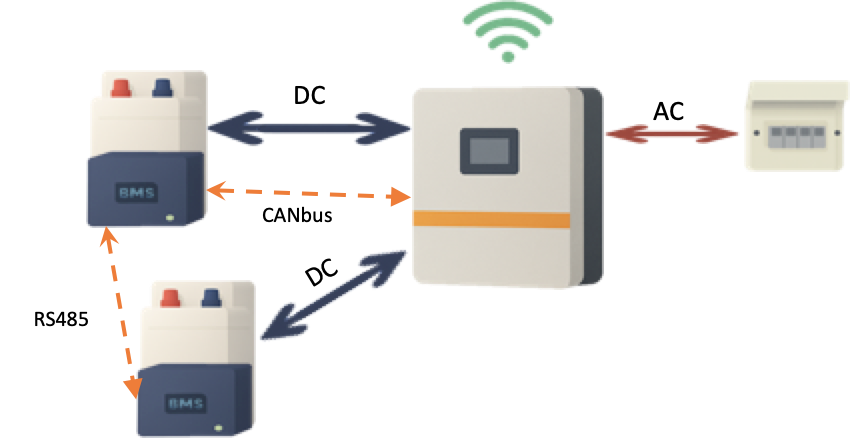
In the diagram below, I describe my understanding of the comms connections @bash described, which assumes that the BMSs on each battery can be made to work together (a basic way being that they are all the same SEPLOS model, with the same firmware installed).
My question is of course, why would the daisy chaining of BMS comms not work with other BMS models?
Is it not enough to ensure all the BMS "extend" the RS485 bus from master to slave? So if I would add another battery pack, the master port of the bottom battery pack in the above diagram would just need connecting to the slave of the third one?
8kW Solis S6-EH1P8K-L-PLUS hybrid inverter; G99: 8kw export; 16kWh Seplos Fogstar battery; Ohme Home Pro EV charger; 100Amp head, HA lab on mini PC
- the support that they provided meant that I had to contact the BMS manufacturer, etc. I am not happy with the support that they provided.
- fully ready batteries are available for less than half Fogstar´s
Whoever bought Fogstar was forced to learn these things... Why would they not buy their next pack "from source" at half price? Unless they are buying for someone else..
8kW Solis S6-EH1P8K-L-PLUS hybrid inverter; G99: 8kw export; 16kWh Seplos Fogstar battery; Ohme Home Pro EV charger; 100Amp head, HA lab on mini PC
@batpred the protocol can be a little different between various batteries BMS, the physical connection is the easy bit.
It's possible to do, but you need to take care that they don't fight each other. Often more effort than it's worth.
It's typically modbus or rs485.
Seplos have particular quirks when parallelled too, for instance you can't change any config with it in a diary chain, you have to split them apart to do so.
Seplos have particular quirks when parallelled too, for instance you can't change any config with it in a diary chain, you have to split them apart to do so.
This is very true and a slight annoyance that I have found, although removing one of the data cables resolves this issue temporarily.
Once I had "tinkered" enough with the settings I now leave them alone. I haven't upgraded to the latest 1.5 firmware also.
I'd absolutely use Fogstar again, their service for me was exemplary.
I did the numbers and there is very little in it financially to try and get your cells cheaper, especially as they guarantee the authenticity of the cells by buying them direct from the manufacturers.
the protocol can be a little different between various batteries BMS, the physical connection is the easy bit.
It's possible to do, but you need to take care that they don't fight each other. Often more effort than it's worth.
It's typically modbus or rs485.
Erm... not quite.
Modbus describes the language used for the commands to be sent and received. There is a universal standard for this, but BMS units and inverters commonly use variations of it.
Modbus can be used across a number of different physical connection standards.
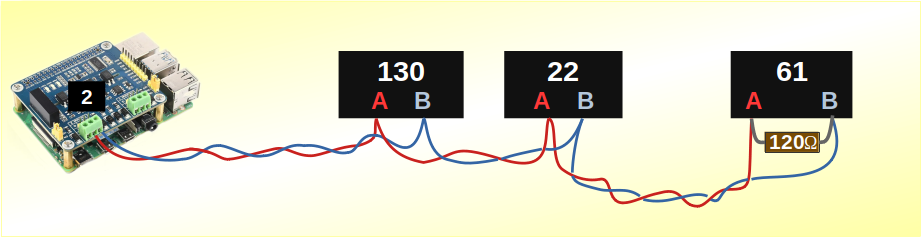
RS485 is the physical topology most commonly used for storage battery connections. It uses a twisted pair of wires, marked A and B, possibly with an earth wire too. Each device on the RS485 bus must have its own unique ID number.
Modbus can also be used across ethernet wiring (TCP/IP), or USB.
RS485 doesn't stipulate any particular connector. Just because an inverter has an RJ45 socket marked "RS485" doesn't imply it's being used across TCP/IP. You have to read the manual.
There's a wide range of sensors, meters and micro-controllers which can happily co-exist on the RS485 topology, provided each is first configured with its own ID.
In the diagram below, I describe my understanding of the comms connections @bash described, which assumes that the BMSs on each battery can be made to work together (a basic way being that they are all the same SEPLOS model, with the same firmware installed).
My question is of course, why would the daisy chaining of BMS comms not work with other BMS models?
You've mixed software and hardware concepts within the same question, making it unanswerable.
Yes, you can have multiple BMS units connected to the same RS485 bus, with the Inverter acting as the Master.
Either the inverter must be able to support different Modbus variants simultaneously, or else the BMS units would all need to be of the same type (eg from the same manufacturer).
You can't just make all the physical connections and then expect the inverter to sort it out for you!