Given the frenzy over the safety of lithium batteries in general, does anyone have any sound evidence that shows a LiFePO4 lithium battery in particular directly causing a fire/explosion, rather than just being present when something else caught fire/exploded? I am not after general evidence about any lithium battery, but rather specific evidence about LiFePO4 batteries.
Midea 14kW (for now...) ASHP heating both building and DHW
My present hypothesis is that LiFePO₄ is inherently safe. You can mechanically damage them by drilling into them, and it will produce sparks and gas emissions, but there isn't a fire which then keeps burning.
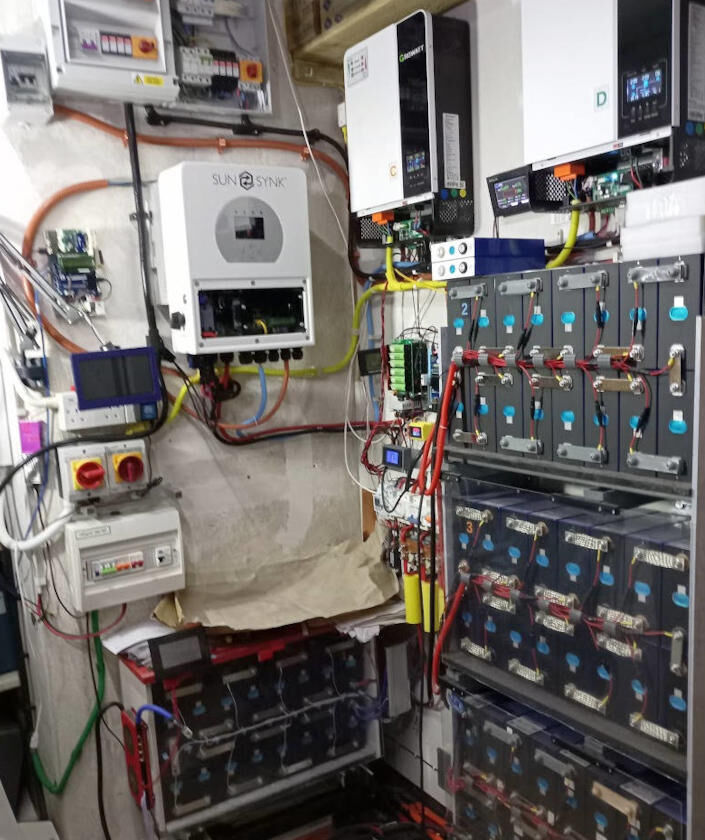
I do have quite a lot of them on open shelving in the plant room, and I do have several CO₂ fire extinguishers, including one in that room,
... but if there were to be a fire, then it's more likely to be failure of the electronics in the inverters rather than the batteries.
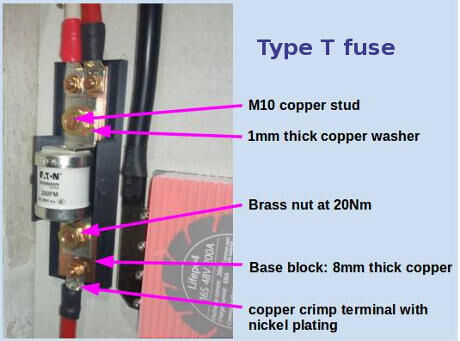
Between the four LiFePO₄ batteries and the inverters there are fast-acting Type-T fuses, and DC-class 125A MCBs which are slower, but will trip due to either thermal or mechanical over-current sensing.
Together they would cut off any high-current from the batteries, which might otherwise be adding energy to an inverter fire.
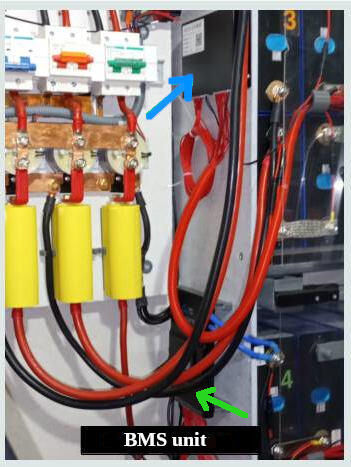
There are also BMS units which have sense-wires to each cell. That's normal practice, and a 'duff' cell would result in the BMS isolating that entire battery until the cell was replaced.
It's not mandatory but it does provide reasonable guidance for the installation of home storage batteries.
However, it suffers from putting all Lithium cell types in the same category. That's clearly wrong, and results in all Li-ion chemistries being treated as if they are Li-MNC and likely to cause a fire.
It's all too easy to read reports of lithium battery fires and incorrectly assume that the battery was the cause.
That might not be true.
For example, there was a house roof that caught fire in Devon, which had solar panels covering the south-facing side. The press reported it as if the PV panels were to blame.
But the attic was the location of the solar inverter and a (small) storage battery. The damage was sufficiently severe that the seat of the fire couldn't be established. It might have been due to a fault in the inverter, or possibly the MC4 connectors which couple the panels together,
Commercial batteries are often reported as having caught fire, and there are plenty of reports online.
But Battery Energy System Storage (BESS) is gradually evolving, and newer containers often include fire-suppressant spray systems in the roof.
If the BESS cell chemistry were still Li-MNC, then I doubt that would be effective. Li-MNC generates heat when it burns (an exothermic reaction), and hence suffers from Thermal Runaway.
But combustion from the other five main types of Li-ion cells can be quenched by removing oxygen. LiFePO₄ is now the dominant chemistry in commercial BESS installations.
Once again, it's too easy to assume that a commercial battery fire was caused by the batteries themselves. It's just as likely that there was another fault, such as the charger continuing to supply current after the battery was full.
This post was modified 3 weeks ago 2 times by Transparent
@batpred — but that's the thing, the BBC report you linked to is a typical media scare story tacked onto a fire and rescue service generic 'stay safe' warning.
"Mr Davies of SWFRS [South Wales Fire and Rescue Service] said people should do their research and buy devices, batteries and chargers from reputable retailers.
Otherwise there is a risk they can "overheat, catch fire and almost lead to a firework-like explosion", he said."
The article and SWFRS (who should know better) only talk about lithium ion batteries, which is a generic term for a number of different lithium battery chemistries. There's no doubt some of them can do a lot more than 'almost lead to a firework-like explosion', but LiFePo4 (lithium iron phosphate) batteries (which are a type (subset) of lithium ion batteries) have a much better track record. What I am after is evidence they (LiFePO4s) can cause fires or, as the SWFRS puts it, 'almost lead to a firework like explosion'.
I see @transparent has just posted a detailed reply, but I am going to post this to underline again the fact that not all lithium batteries are created equal. I have yet to see a single bit of sound evidence that LiFePO4 (lithium iron phosphate) batteries can cause fires. Sure they can be present at a fire caused by something else, but that not the same as being the cause of the fire.
... but if there were to be a fire, then it's more likely to be failure of the electronics in the inverters rather than the batteries.
Between the four LiFePO₄ batteries and the inverters there are fast-acting Type-T fuses, and DC-class 125A MCBs which are slower, but will trip due to either thermal or mechanical over-current sensing.
It still seems that the layout shown in this photo (I presume the photo is not recent) is generally not recommended for LiFePo4 batteries (one exception being if SOC is always low).
As for the fuses, they do not harm, but without reading the full paper and confirming it is fully peer-reviewed, etc, it is not clear whether they would be recommended only for NCA or for other Lithium based batteries, namely LFP.
16kWh Seplos Fogstar battery; 8kW Solis S6-EH1P8K-L-PLUS hybrid inverter; Ohme Home Pro EV charger; 100Amp head, HA lab on mini PC
Yes, I agree, and all these battery lifepo4 (LFP) kits come with fuses that cut off any short circuiting, short circuits being the main risk.
Not all do, the 'reputable' ones should have protection, called the BMS, or Battery Management system, that as well as controlling charging, is supposed to provide various protections against for example over (and under) temperature and over-current discharge, but more of a circuit breaker than a fuse, and the latter often have a trip delay measured in seconds rather than milliseconds. You really need to have proper external fuses as well.
With the cheaper unknown name Chinese batteries you cannot be sure what you are getting. For all you know, the BMS may be a bit of twisted foil from inside a fag packet. There's a chap called Will Prowse who makes it his business to do lithium battery 'tear downs' on youtube and elsewhere, well worth taking a look if you are in the lithium battery market.
The paper you link to covers only small (3Ah capacity) pouch type LiFePO4 batteries, and I would be reluctant to extrapolate any findings to other larger capacity LiFePO with prismatic cell construction. Furthermore, as you found, the paper is behind a paywall, which renders it useless (you can't make sense of or critique a paper you can't read).
You are right about the regulatory risk. The BBC article you linked to mentions the government is already getting all hot under the collar about lithium batteries as a generic class. The other 'rules and regulations' menace is ignorant insurers, who add sometimes ludicrous lithium exclusion or restriction clauses to their policies.
Me? I'm still waiting for the evidence that LiFePO4 lithium batteries that have been properly installed pose any risk.
Midea 14kW (for now...) ASHP heating both building and DHW
Fuses (external) are not optional add-ons that do no harm, they are essential, and must be adequately rated eg T type to handle the sort of current a lithium battery including LiFePO4s can deliver. They are your last line of defence if the BMS protection fails for whatever reason.
The initial sections of the paper available to those of us outside of academia seem to be referring to 'confined' LiMNC chemistry and small (3Ah) LFP pouch cells.
The photo you referenced shows 280Ah prismatic LFP cells. It is prismatic cells which we normally encounter in domestic storage batteries, commercial BESS, and in the marine transport sector.
The Type-T fuses you referred to are not commonly used in the domestic storage sector. They are expensive, and it is difficult to obtain matching fuse-holders.
However, they were chosen for their speed of circuit interruption, which is 10x faster than other comparable fuses found in LFP battery systems.
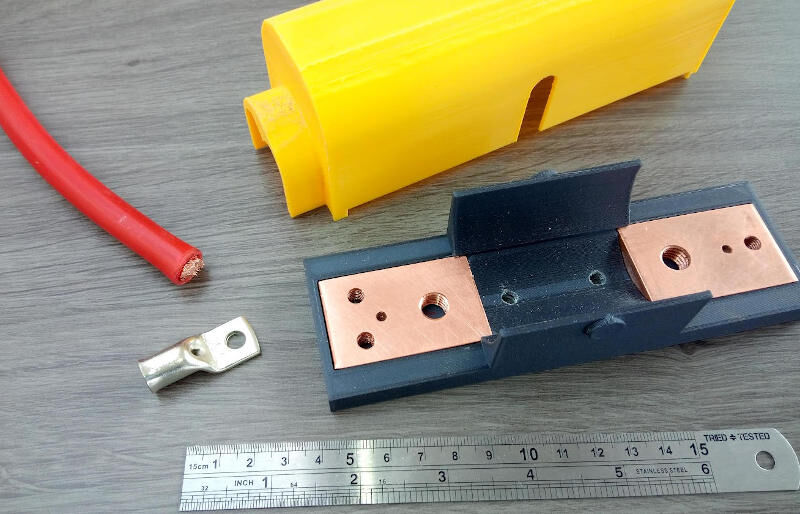
I made the fuse-holders myself, using a 3D printer and some very chunky pieces of copper!
The yellow covers on my fuse-holders are lined with intumescent sheet, which will expand rapidly if it gets hot (in a fire).
In the event of a hot fuse/connection, or the ceramic case rupturing, intumescent fibre would fill the voids in the fuse-holder, thereby excluding oxygen.
No, I've never heard of anyone else doing this. But this plant room is a test-site, and the safety precautions are greater than you'd normally expect for domestic storage batteries.
Will Prowse has now been mentioned above. He runs the DIY Solar Power Forum in the USA.
@transparent the eFiXX team posted s youtube video earlier this year on this subject.
"We set out to do what no one should: try to destroy a lithium solar storage battery.in this video, The E Team subjects a lithium-based home energy battery to a series of escalating tests - from high-current discharges and mechanical disconnects to blowtorches and full short-circuit attempts"
@iaack — thanks, a useful video. They do make it clear that the battery undergoing the tests is a LiFePO4 (LFP) battery, and it is clear that that battery can take a LOT of abuse and remain intact without catching fire or exploding. My only comment is they might have put even more emphasis on the fact that it was LiFePO4 battery, because that's the whole point, reputable LiFePO4 lithium batteries are remarkably resilient. Imagine doing those tests on a lead acid battery! It does make one wonder why there is so much hand wringing and bed wetting in the regulatory, emergency service and insurance sectors about all lithium batteries. They need to sharpen up their act and focus on the real risks from particular types of lithium batteries, rather than on imaginary risks across the board.
Midea 14kW (for now...) ASHP heating both building and DHW