
Notifications
Clear all

Topic starter
28/10/2025 3:44 pm
I recently bought a 8k hybrid inverter.
The vendor confirmed that in order to connect it to the consumer unit, cables and protection devices needed to be rated x1.25 the maximum current that the inverter would receive or send. These are typically MCBs (preferably use RCBOs that also enable RCD function).
The following diagram shows what is involved.
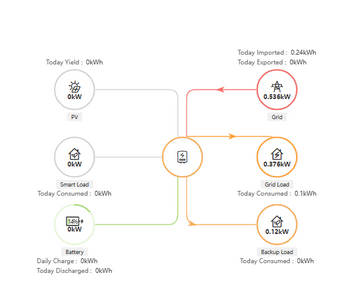
In my case, two cables were planned to be buried in a wall and so they would need RCD protection (which is preferably achieved using RCBOs):
- one is used to supply power to backup loads
- the second is used to provide grid power to the inverter. It is also used to provide power to the house and/or grid, when there is production on site. So this requires devices that are not damaged when subjected to bi-directional flows.
In SE England, the shops that you can go and buy them include these that are open extended hours:
- screwfix.com
- toolstation.com
- tlc-direct.com
Additionally there are specialised shops like CEF, that are only open during working hours, so you may prefer delivery in 2/3 days.
The manufacturer advises for 100ma RCDs to be used. But in case your local electricity grid is not rock-steady (like in my case), the inverter cleans the power before using it. This often results in frequent triggering of the RCD. The manufacturer may recommend 300ma or higher RCDs. If PV is produced, this can also result in the need to use less sensitive (higher ma) devices.
In my case, the amp rating of devices required was 62.5 Amp for the grid and 45.5 for the backup. But given these inverters are available in 10Kw+ sizes, higher capacity may be needed.
Finding suitable devices proved time consuming as you find the protection level originally expected needs to be adjusted. Additionally, in some cases, RCBOs of the required rating were not available and so RCDs would have to be combined with MCBs.
Over to @transparent and others to add to my summary description and identify suitable options and example shops.
8kW Solis S6-EH1P8K-L-PLUS hybrid inverter; G99: 8kw export; 16kWh Seplos Fogstar battery; Ohme Home Pro EV charger; 100Amp head, HA lab on mini PC

28/10/2025 5:27 pm
There won't be many RCBOs with a 100mA trip rating because that's stipulated for fire protection, rather than human safety.
However, Proteus do manufacture a 63A rated Type-A RCBO here in the UK.
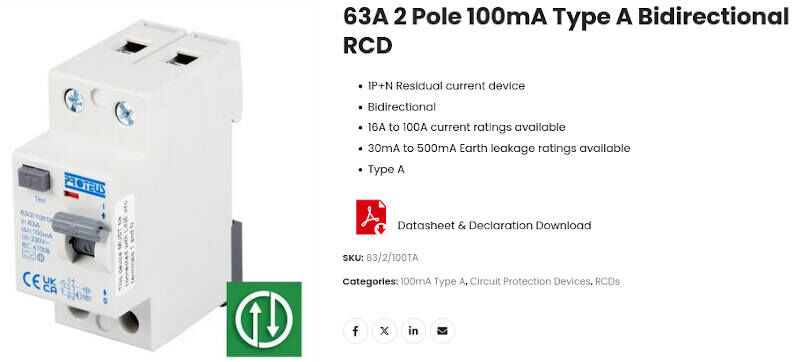
CEF are the usual suppliers for Proteus trips, but other professional electrical outlets may order them if you ask specifically.
This isn't the sort of item you'd expect to source through a retail chain such as Toolstation (Travis Perkins Group), Screwfix and B&Q (Kingfisher Group).
Depending on the required cable length and the method of burial in the wall, I would expect the required mains cable size to be 10mm² or 16mm²
For current capacity above 63A you'd need to use a separate RCD (Type-A) and an MCB selected according to your cable size.
The RCD would need to be able to carry at least the same current as the MCB, and 125A would be fine.
The RCD and MCB will be 3-phase of course.
An inverter requiring that much current wouldn't be permitted by the DNO on a single-phase supply.
The other major manufacturer of such high-current RCDs and RCBOs is Chint.
They manufacture in China.
Their products are available here in UK,
or at reduced price by ordering direct from the Chint Electrical store on the AliExpress platform.
Delivery from China is typically 8-10 days at the moment.
This post was modified 4 months ago by Transparent
Save energy... recycle electrons!
Topic starter
29/10/2025 7:17 pm
Exactly @transparent , this type of RCBOs are not easily available. We are only considering a 8k inverter and it is only available from a couple of shops. And I did not find many brands.
There are other ways to meet regulations. For example, to make sure all the cables are surface mounted and inside ducting. An electrician can advise on what may work in each case. Essentially that would enable use of double or triple pole MCBs that are very cheap (and commonly available for much higher Amps).
My 8kw inverter is single phase and is only expected to export 5kw. The rest of the capacity may be for consumption.
And before advising anyone to move a circuit from single phase to triple phase, I would need to understand the costs involved. If they are lucky to find anyone willing to put a ceiling on all the costs, that is great.
Otherwise, they need to be ready for the whole journey. @transparent may be able to expand on what this would typically involves.
8kW Solis S6-EH1P8K-L-PLUS hybrid inverter; G99: 8kw export; 16kWh Seplos Fogstar battery; Ohme Home Pro EV charger; 100Amp head, HA lab on mini PC
31/10/2025 10:41 am
Exactly @transparent , this type of RCBOs are not easily available.
It's the requirement to have 100mA earth-leakage tripping which makes your request more difficult to satisfy.
There are plenty of bi-directional Type-A RCBOs at 40A+ if the usual 30mA trip was acceptable.
I stopped looking once I'd find two products from reputable manufacturers with whom I've actually been in direct contact.
I wasn't anticipating that you'd use my recommendations as being indicative of the state of the market.
There are other ways to meet regulations. For example, to make sure all the cables are surface mounted and inside ducting.
Surface-mounted cables will have a higher current rating than those within ducting due to their ability to release heat into the surrounding air.
There are several online cable-size calculators which allow the input of such parameters, such as this one by TLC-Direct.
... Essentially that would enable use of double or triple pole MCBs that are very cheap (and commonly available for much higher Amps).
Sorry, I don't follow that argument.
Double-pole MCBs are available for DIN-rail mounting in a consumer unit up to 125A,
But you'd still need a separate RCD to obtain any earth-leakage protection.
3-pole MCBs are for 3-phase supplies of course.
And before advising anyone to move a circuit from single phase to triple phase, I would need to understand the costs involved.
I've just commented about that here on a topic about a Storage Battery problem.
Save energy... recycle electrons!
Topic starter
31/10/2025 5:28 pm
Exactly @transparent , this type of RCBOs are not easily available.
It's the requirement to have 100mA earth-leakage tripping which makes your request more difficult to satisfy.
There are plenty of bi-directional Type-A RCBOs at 40A+ if the usual 30mA trip was acceptable.I stopped looking once I'd find two products from reputable manufacturers with whom I've actually been in direct contact.
I wasn't anticipating that you'd use my recommendations as being indicative of the state of the market.
I do not understand the reason for the confusion.
I did not see more than a couple of 100ma bi directional RCBOs in the UK market, and of low amps. And as I mentioned, the grid power is very dirty in my area. So the Solis requires the ma to be higher than 100ma.
In essence, they are not easily available.
My advice is for anyone to consider alternatives that can meet the regulations. Another that electricians mentioned is to use armoured cable. This is more expensive than normal cable but it may provide predictability for the project. This may be of significant value to many.
And before advising anyone to move a circuit from single phase to triple phase, I would need to understand the costs involved.
I've just commented about that here on a topic about a Storage Battery problem.
You seem to have included the wrong link, I could not find any figures. Hopefully your estimate is not close to what I was given - £3200 to install the battery and inverter?
When I said "costs", I mean what the customer has to pay.
8kW Solis S6-EH1P8K-L-PLUS hybrid inverter; G99: 8kw export; 16kWh Seplos Fogstar battery; Ohme Home Pro EV charger; 100Amp head, HA lab on mini PC
31/10/2025 6:53 pm
It's the correct link @batpred and here's the relevant text:
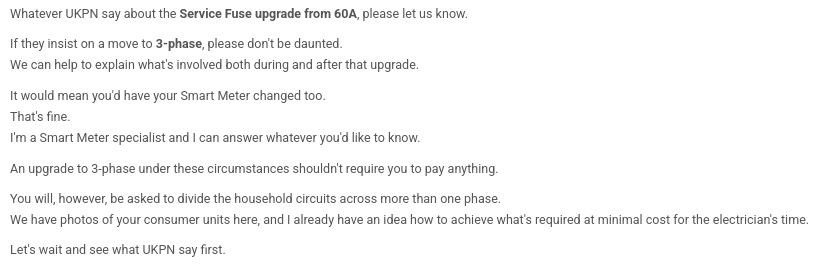
The only costs involved with the DNO upgrading a dwelling to 3-phase are those charged by your own electrician to divide the household circuits across the phases.
It's impossible to estimate that unless the present arrangement of consumer unit(s) and circuits is known.
Your estimate of £3200 for an electrician to install a battery and inverter depends on what is required to run cabling back to the consumer unit.
That's specific to the dwelling and can't be assessed here on an open forum without detailed knowledge of the property.
And as I mentioned, the grid power is very dirty in my area. So the Solis requires the ma to be higher than 100ma.
I don't follow that logic, but I can make two useful observations:
a: there shouldn't be any correlation between higher-frequency components being present on the 50Hz mains supply and whatever filters are incorporated into an inverter.
Those inbuilt filters may well result in a small amount of current leakage to ground, but the leakage current is the same irrespective of the quality of the mains sinusoidal waveform.
b: It is usually the case that higher-frequency noise is imposed onto the 50Hz mains supply by AC/DC switching electronics, such as found in the inverter.
In other words, the inverter is more likely to be the culprit, not the device being adversely affected.
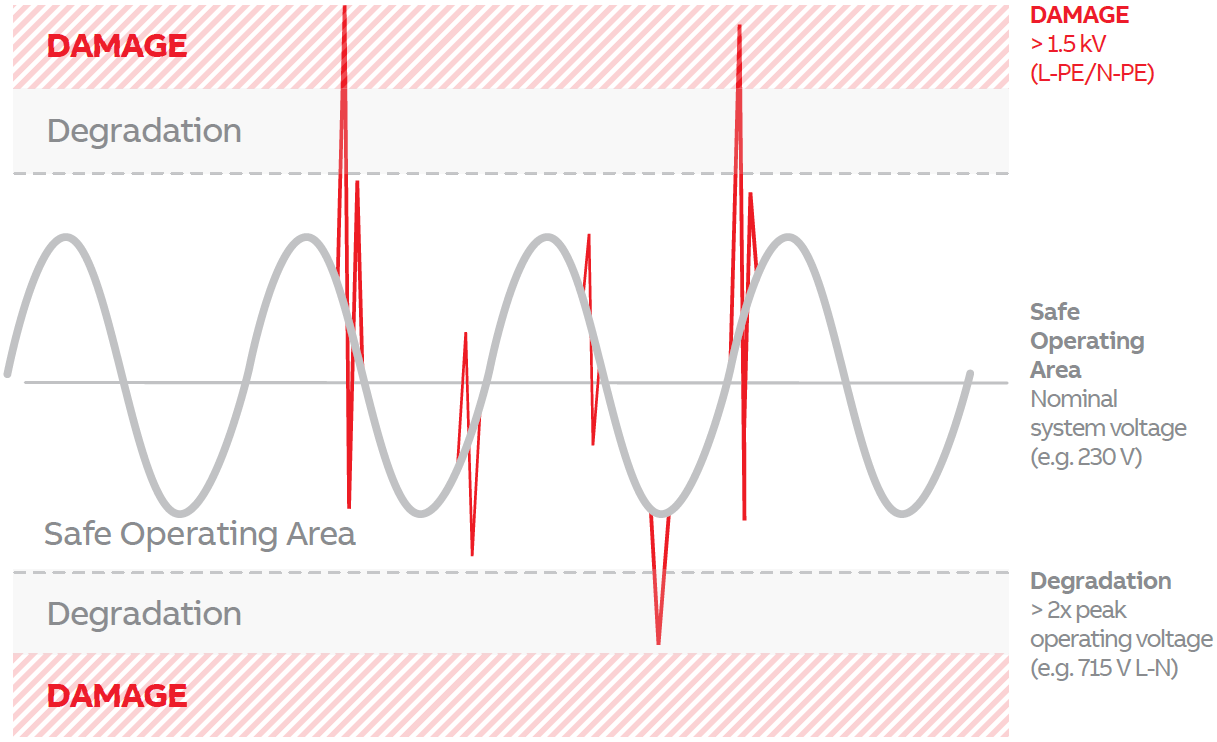
In rare instances transient spikes are sufficiently large that they can cause degradation of insulation within a device,
or arcing within electronics.
There are transient suppressors which can remove such high frequency spikes and harmonics.
They are very often found in medical apparatus, for obvious reasons!
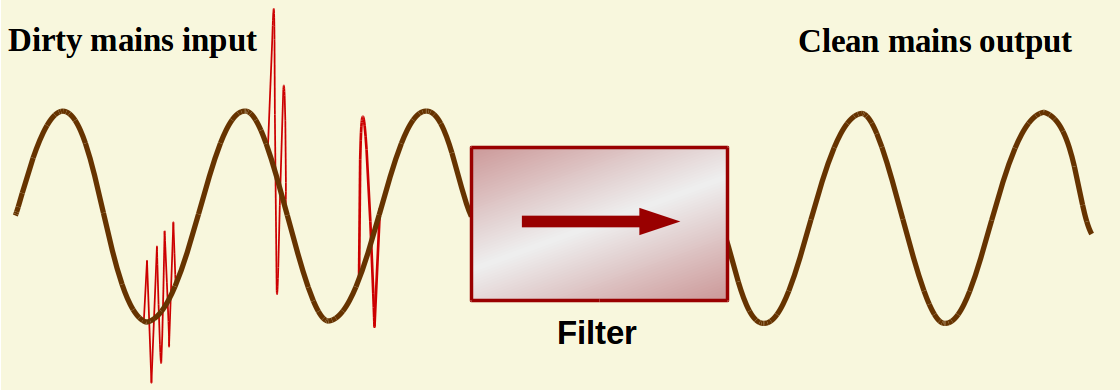
Since I have a number of (different types of) inverters, I've installed transient suppressor filters in reverse on their mains supplies.
That means I'm removing spikes which might be created within the inverter electronics, to prevent them propagating through the consumer unit to other household circuits.
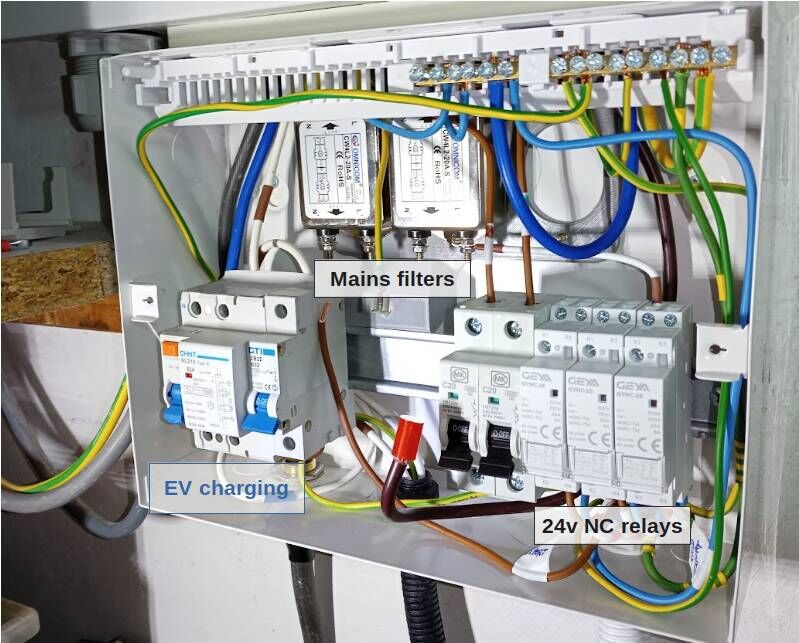
The above photo was taken whilst that particular Consumer Unit was still being assembled.
The M4 terminals on those filters were fitted with tamper-resistant insulated caps before the remainder of the trips were installed onto the DIN rail.
Save energy... recycle electrons!
31/10/2025 7:08 pm
I did not see more than a couple of 100ma bi directional RCBOs in the UK market, and of low amps.
Quite possibly...
... and I've identified two more above, and provided the URLs so you can check their specifications.
Let me add yet another couple of brands to this growing list of RCBOs with 100mA leakage-current rating:
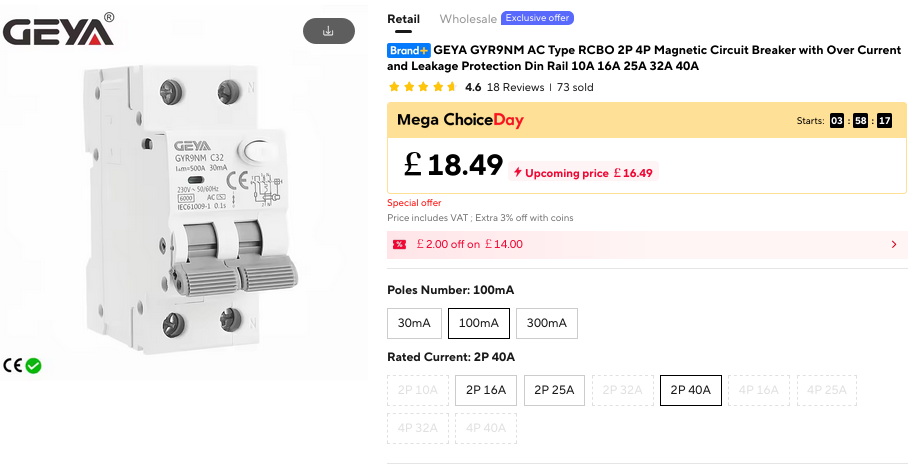
Geya is another Chinese-based manufacturer, and also well known to me.
The above listing can be found here on AliExpress, and you can choose from three alternatives for the earth-leakage trip current.
Geya also make DC MCBs, which can be used between a battery and an inverter, for example.
They are technically competent, and provide good customer service.
They don't advertise their complete range on AliExpress.
If you can't find what you want, click the button to send a Message to Seller and ask them (in English).
Next, there's this particularly cheap RCBO badged 'Live'' and available from the UK-based online reseller Electrical 4 Less.
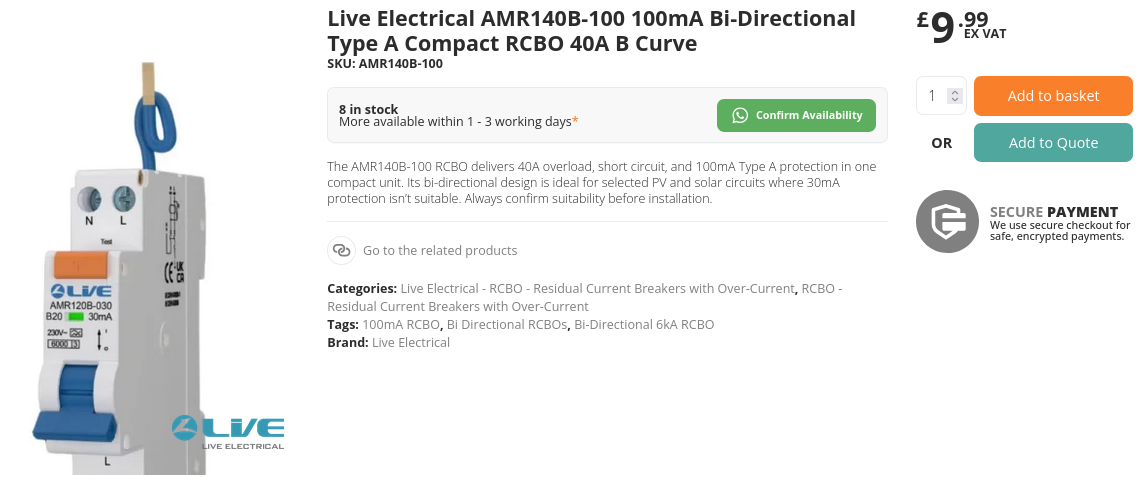
I'm not finding it particularly difficult to identify where these RCBOs are available from.
But they're not 'consumer devices', and you'd normally expect your electrician to get them for you through his trade outlets.
This post was modified 4 months ago 2 times by Transparent
Save energy... recycle electrons!
Topic starter
01/11/2025 1:45 am
It's the correct link @batpred ...
The only costs involved with the DNO upgrading a dwelling to 3-phase are those charged by your own electrician to divide the household circuits across the phases.
Ok, but it would be helpful to get a figure. Perhaps assuming a standard arrangement of consumer unit(s) and circuits that a terraced house has?
Also I assume the dno is not responsible for making the areas where the new cable goes good.. so the cost to the consumer is more?
I am curious though about how electricity prices compare between 3 phase and single . Perhaps a new topic?
And as I mentioned, the grid power is very dirty in my area. So the Solis requires the ma to be higher than 100ma.
I don't follow that logic, ...
My dno's feed has a dirty neutral. Based on what Solis support said, when the inverter discharges that to earth, it causes triggering of rcbos.
When my installation finishes and I confirm the power in the g99, I will notify these issues to the dno. Hopefully they will fix it.
8kW Solis S6-EH1P8K-L-PLUS hybrid inverter; G99: 8kw export; 16kWh Seplos Fogstar battery; Ohme Home Pro EV charger; 100Amp head, HA lab on mini PC
01/11/2025 10:52 am
I assume the dno is not responsible for making the areas where the new cable goes good
The following diagram is taken from the Meter Operator's Code of Practice guidance (MOCoPA)
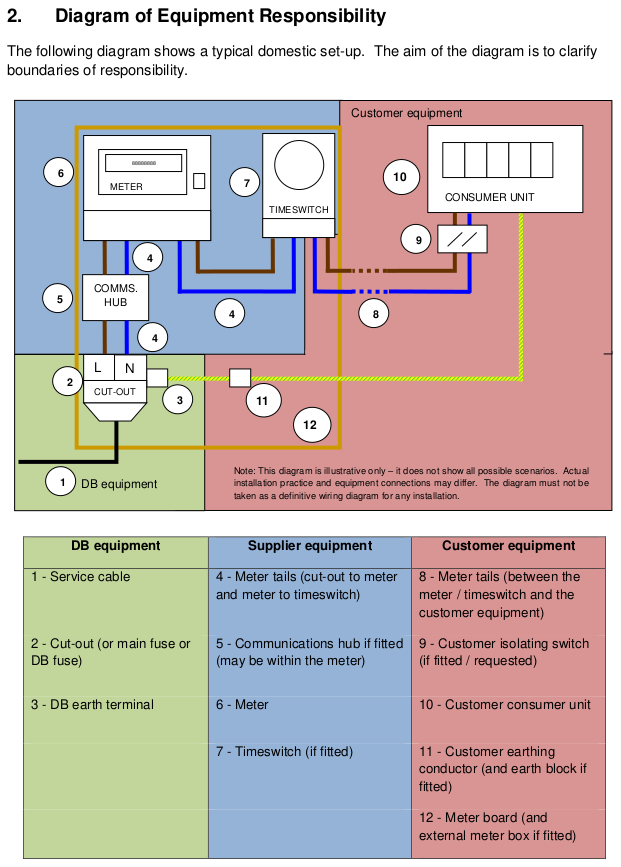
When a dwelling is upgraded to 3-phase, your Energy Supplier coordinates with your DNO.
The devices on the blue and green sections of the diagram are changed together.
It has been the case in the past that some Energy Suppliers make a charge to install a 3ph Smart Meter.
However, if the work is being done based on a technical requirement from your DNO, then it's a safety issue, for which you shouldn't pay of course!
If your Supplier still tries to levy a charge under these circumstances, then telephone a rival supplier.
Tell them you'll move your account to them if they provide a 3ph meter.
That's a persuasive argument,
which you can then take back to your existing Supplier and tell them they're about to lose a customer!
I am curious though about how electricity prices compare between 3 phase and single
The cost per kWh remains the same.
There isn't a different Tariff for householders with 3-phase domestic supplies.
3-phase Electricity Smart Meters operate under Vector Sum.
If your house is exporting to the grid on one phase, and importing on the other two, you are only charged for the difference between the phases.
Save energy... recycle electrons!
2
Topic starter
26/01/2026 7:21 pm
In your case @jamespa the Changeover Switch in a separate enclosure would also provide that functionality via a Centre-Off position.
That would make sense; the 2 off mcbs would need to go in the same enclosure so the challenge might be to find the right kit of parts! A quick search didn't turn up any din mounted 4 pole 100A changeover switches with centre off other than an unbranded Chinese one. Hopefully one exists!
I appreciate the challenge @jamespa ...
This thread includes various suggestions. Geya have them, but I believe do not supply CUs. One option that at some point I considered was to use an ATS (of the type used in conjunction with a generator and an inverter) - just aiming to use the manual override. I think that, additionally to chinese brands, I found Schneider and Hager. But using an ATS could add questions so I managed to keep it as plan B.
This post was modified 1 month ago by Batpred
8kW Solis S6-EH1P8K-L-PLUS hybrid inverter; G99: 8kw export; 16kWh Seplos Fogstar battery; Ohme Home Pro EV charger; 100Amp head, HA lab on mini PC
1
27/01/2026 5:12 pm
There will no problem in @jamespa getting a generic steel enclosure with an integral DIN rail
and putting whatever Transfer Switches and MCBs he needs into them
The enclosure doesn't have to sold as a "Consumer Unit",
nor is there any need to put <brand name> trips into <brand name> enclosures.
A quick search didn't turn up any din mounted 4 pole 100A changeover switches with centre off other than an unbranded Chinese one.
The Transfer switch doesn't need to have 100A capacity.
If the total of all loads on the main house CU is (say) 45A, then using a MTS (Manual Transfer Switch) rated at 63A is perfectly adequate.
Just supply its 'grid input' connection from a 63A MCB in the CU between the MTS and the meter.
If you were to fit an MTS rated at 100A, then the cabling would also have to be capable of carrying 100A, and would probably be 25mm².
That's expensive stuff!
Limit the current to 63A, and your electrician might be able to use 16mm² cable, depending on distance, proximity to other cables, and how it's routed.
There's a free cable-size calculator on the TLC Direct site.
A 'centre off' MTS may not literally have a centre-off position for a lever.
It could have two interlocked levers, only one of which can be up (on) at a time.
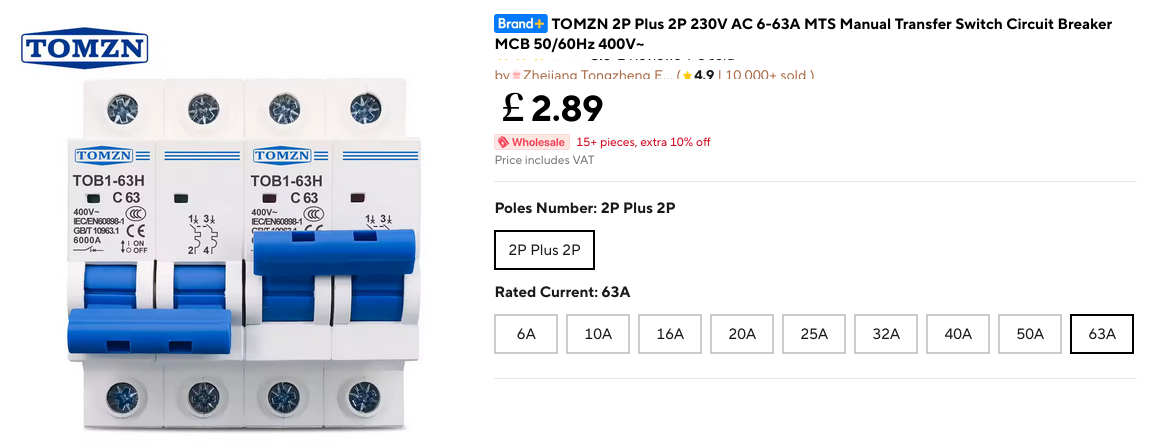
or perhaps a rotary switch like this:
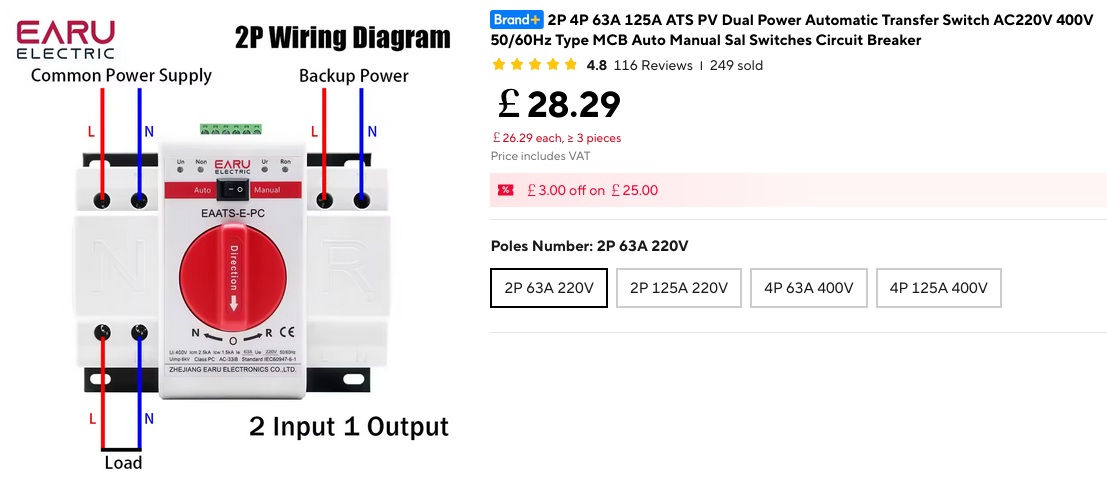
I'm happy to help if you want guidance on which Chinese manufacturers are more reputable, or to
interpret specifications written in Chinglish.
This post was modified 1 month ago by Transparent
Save energy... recycle electrons!
27/01/2026 6:01 pm
@transparent thanks
The Transfer switch doesn't need to have 100A capacity.
The main fuse is 80A, I was told to upgrade from 60A before getting an ashp. In retrospect I don't know why. However, given that this is rhe case it seems to me the transfer switch has to be rated at at least 80A as does everything else downstream until MCBs are reached. Of course I could put in 63A MCB immediately prior, but its getting a bit silly tge number of components.
4kW peak of solar PV since 2011; EV and a 1930s house which has been partially renovated to improve its efficiency. 7kW Vaillant heat pump.
Page 1 / 2
Next

Latest Posts
-

RE: Daikin Altherma 3 LT compressor longevity question
This mess is intriguing: I wonder if this represent...
By bobflux , 21 minutes ago
-
RE: Say hello and introduce yourself
Hi. I'm Mike. Thank you for letting me join. My partn...
By Fretless6 , 2 hours ago
-
RE: Connecting Growatt SPH5000 over wired ethernet rather than wireless
The simplest wired option is usually the Growatt Ethern...
By Jonatan , 5 hours ago
-
RE: Peak Energy Products V therm 16kW unit heat pump not reaching flow temperature
ASHPs do have a minimum compressor speed. The minimum h...
By bobflux , 12 hours ago
-
RE: Electricity price predictions
@jamespa And it seems some of the nasty public cloud...
By Batpred , 12 hours ago
-
RE: Tell us about your Solar (PV) setup
Location: near Lyon, France 12kWp on the roof, 2x Sol...
By bobflux , 12 hours ago
-
RE: Jokes and fun posts about heat pumps and renewables
Technology is rapidly advancing. BBC News reported th...
By Transparent , 15 hours ago
-
What matters for flow and pressure drop is internal dia...
By bobflux , 16 hours ago
-

RE: Do Fridges and Freezers have COP ratings?
@editor Thank you all for your replies and submitted in...
By Toodles , 18 hours ago
-
I know and yes. The secondary deltaT wont necessaril...
By JamesPa , 22 hours ago
-
RE: Designing heating system with air to water heat pump in France, near Lyon
Just love the way you put it! 🤣
By Batpred , 2 days ago
-
RE: Safety update; RCBOs supplying inverters or storage batteries
Thank you for sharing. So it seems that your Schneid...
By Batpred , 2 days ago
-

RE: Forum updates, announcements & issues
@upnorthandpersonal thanks for the thoughtful, consider...
By Mars , 2 days ago
-
RE: Solar Power Output – Let’s Compare Generation Figures
@mk4 All 21 panels have their own Enphase IQ7a microinv...
By Toodles , 2 days ago
-
RE: Setback savings - fact or fiction?
Great, so you have proven that MELCloud is consistently...
By RobS , 3 days ago
-
RE: Mitsu PUHZ120Y 'Outdoor Temp 'error?
Thanks David & James It almos...
By DavidAlgarve , 3 days ago
-
RE: Surge protection devices SPDs
@trebor12345 - your original Topic about the right type...
By Transparent , 3 days ago
-
RE: Help needed with Samsung AE120RXYDEG
@tomf I’ve been sent this from a service engineer at Sa...
By Mars , 3 days ago
-
RE: Buying large amp bidirectional RCD and RCBO
Yes... I went through this particular headache and ende...
By bobflux , 4 days ago
-
O-oh! Let's take this as an opportunity to 'pass the ...
By Transparent , 4 days ago
-
RE: Homely setup on daikin heat pump
@craigh I refer to our somewhat elevated temperature of...
By Toodles , 4 days ago
-
RE: Air source heat pump roll call – what heat pump brand and model do you have?
My turn, this describes the future installation, only t...
By bobflux , 4 days ago