
Notifications
Clear all

02/12/2025 3:24 pm
It begs the question if you don't mind, do you have some suggested specific options that could be followed to help the fuel poor in any of those specific areas you mentioned?
Before I dive into the issue of a strategy which helps the fuel poor,
can I just take a step back and point out there are already 'alternatives' for future energy strategy.
I'll put Energy Strategy into three broad categories.
Please say if you'd like me to expand any of these abbreviations:
1: The existing status quo.
Policy direction is led by DESNZ, and they also implement specific actions derived from that policy such as
- the BUS to encourage HP installation, incl grants based on MCS criteria
- SSES, which will soon announce the Consumer-Led Flexibility scheme to switch-off domestic appliances during times of high demand
- EV and charger subsidies
Planning implementation for NSIPs (above 50MW) are assessed by HMIP, and signed off by SoS for ESNZ.
These usually incorporate some compulsory purchase and/or statutory elements.
Ofgem meets with representatives of the energy sector who operate under licences issued by them.
DNOs produce their RIIO documents, and ask Ofgem to allow the costs they require to implement the targets in those Agreements.
Energy Suppliers discuss with Ofgem the obligations they must meet, incl
- levies for ECO projects
- retrofitting housing stock
- smart meter roll-out
- Use of Service contracts with DNOs and Transmission companies
- tariff structures
Consumers have no direct input to any of the above, apart from electing the government.
Lobbying happens.
Reports get written.
2: The imminent future energy strategy, as being implemented and proposed by NESO, under specific direction from Ofgem.
Ie this scenario is based on the Energy Act (Nov'23)
NESO is the grid operator (electricity, gas and heat networks).
They have been given a mandate to
- decarbonise the electricity grid by 2030
- attain Net Zero by 2050
- electrify transportation by whatever time-frame gets set by government.
Ofgem has also awarded NESO the task to set up Regional Energy Strategic Plan organisations.
They are to implement the national objectives defined by NESO, within their geographical areas, which havediffering constraints and resources.
GB is divided into 14 RESP regions, each of which is to have a Strategic Board of 16 members, chaired by a NESO representative.
Six Members on each Strategic Board will be drawn from Local Authorities. They can be elected Councillors or council officers, but not both.
There is no funding available for salaries or training.
Most 'training in the ways of NESO' has already occurred via webinars.
The initial Transitory RESPs will create the RIIO-ED3 Agreements for the DNOs.
The fully-fledged RESP Strategic Boards won't emerge until 2027, and will produce a Regional Energy Plan document every three years.
Any RESP Board which doesn't produce a Plan that meets the targets/requirements, will have an Energy Plan implemented onto their region by Ofgem.
Much less opportunity for lobbying and reports (unless NESO asks)
3: Other alternative energy strategies, which may include aspects of:
- greater implementation of Community Energy projects
- innovation, incl energy technology which doesn't yet exist
- unaffordability of either of the first two categories
- consumers help themselves to energy solutions, incl possible answers to Fuel Poverty
- Local Government programmes emerge
- different tariff mechanisms
etc
In other words, there is already going to be an alternative energy strategy implemented, and it's presently out for Consultation by NESO.
Unless consumers have been part of the RESP Forums and webinars to date, it's unlikely they will be able to participate due to the complexity.
But I'm happy to help if you get stuck on the Consultation Document or online forms (by Qualtrics).
I haven't (yet) posted any of the slides/graphics which explain/expand Category-2, as I've tried to keep this brief.
@jamespa is watching and I don't want him remarking on my verbosity!
Let's remember that this Topic is on Electricity Pricing.
If responses here go into other subject-matter, then let's take this post of mine into a new Topic...
This post was modified 1 month ago 2 times by Transparent
Save energy... recycle electrons!

03/12/2025 8:47 am
I assume a lot of people have already seen this. I havent looked at it for some time. There may be better sites and it may already be on the forum.
https://www.energydashboard.co.uk/map
I thought it was interesting seeing the geography of generation as this is a big driver on costs and hence our bills.
The split was interesting although I don't know about the limitations of the data, perhaps @transparent and @lucia have a view
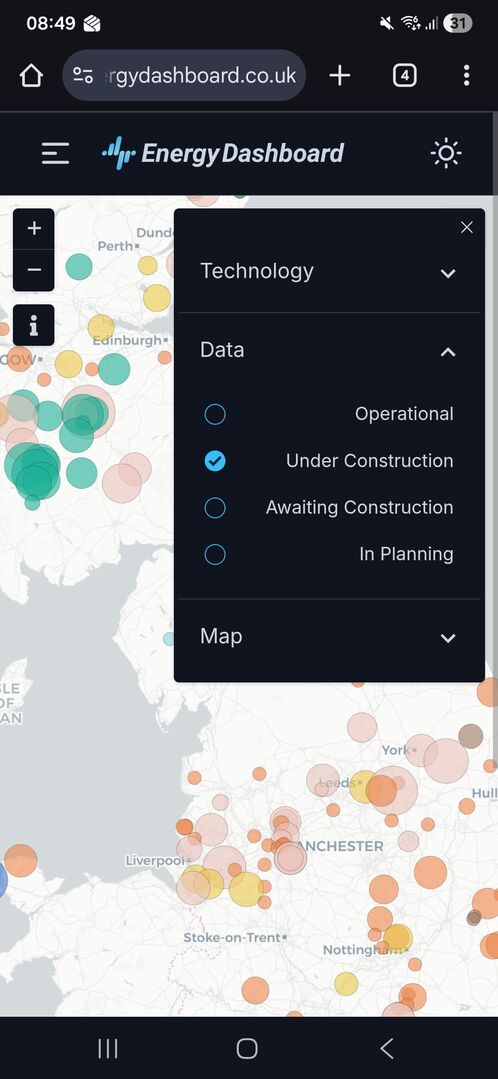
It will be fascinating to watch what it looks like as the net zero transition progresses.
It may be better posted elsewhere but I don't know the forum well
This post was modified 1 month ago 2 times by Jeff
04/12/2025 7:43 am
Grid investment and impact on bills
This post was modified 1 month ago 2 times by Jeff


04/12/2025 7:54 am
@jeff I hope some of that huge gas investment is to pay Centrica to store gas in Rough, otherwise the UK is at risk of running out of gas, say if a Russian ship drags it's anchor over the Norwegian pipeline.
It's crazy to run both gas and electric networks, we should start a strategic phase out of gas in my humble opinion.

04/12/2025 8:42 am
It's crazy to run both gas and electric networks, we should start a strategic phase out of gas in my humble opinion.
I think that plan is called net zero! I suppose we will need some investment in gas in the interim to keep aging networks going. It would help a lot if the country would unite around a strategic direction. But of course that doesn't suit some of the politicians!
This post was modified 1 month ago 2 times by JamesPa
4kW peak of solar PV since 2011; EV and a 1930s house which has been partially renovated to improve its efficiency. 7kW Vaillant heat pump.

04/12/2025 8:57 am
The underground gas pipes near us are all being replaced, with our street around the time we removed it from our house altogether!
I think the gas network is working on the assumption that their buried pipe network has some future value, and won’t just be a stranded asset with unhappy shareholders.
A more joined up approach would be to somehow decommission gas in areas where the network would have been upgraded, offering heating replacement schemes (don’t ask me how it would work). It seems to me that replacing old pipes now is doubling down on the wrong tech.
1
04/12/2025 9:28 am
It is what it is. Just some observations not a personal view on whether it is right or wrong.
There still hasn't been a decision on blending hydrogen or hydrogen heating, whatever the merits.
The previous ban on stopping new gas boilers in existing homes was scrapped. Over a million a year currently.
The majority of power when the wind doesn't blow is expected from gas turbines for a long time.
The huge shift in gas transmission as LNG replaces uk gas from the North Sea. This requires investment West to East.
Replacement of old pipes.
Etc.
We are decades off relying on gas, it's a marathon not a sprint.
All potentially up ended at the next general election with tweaks in the current strategy. I expect a huge investment in North Sea gas and reactors after the next election.
Will be interesting to see how things evolve for those still around in 2050, won't be me.
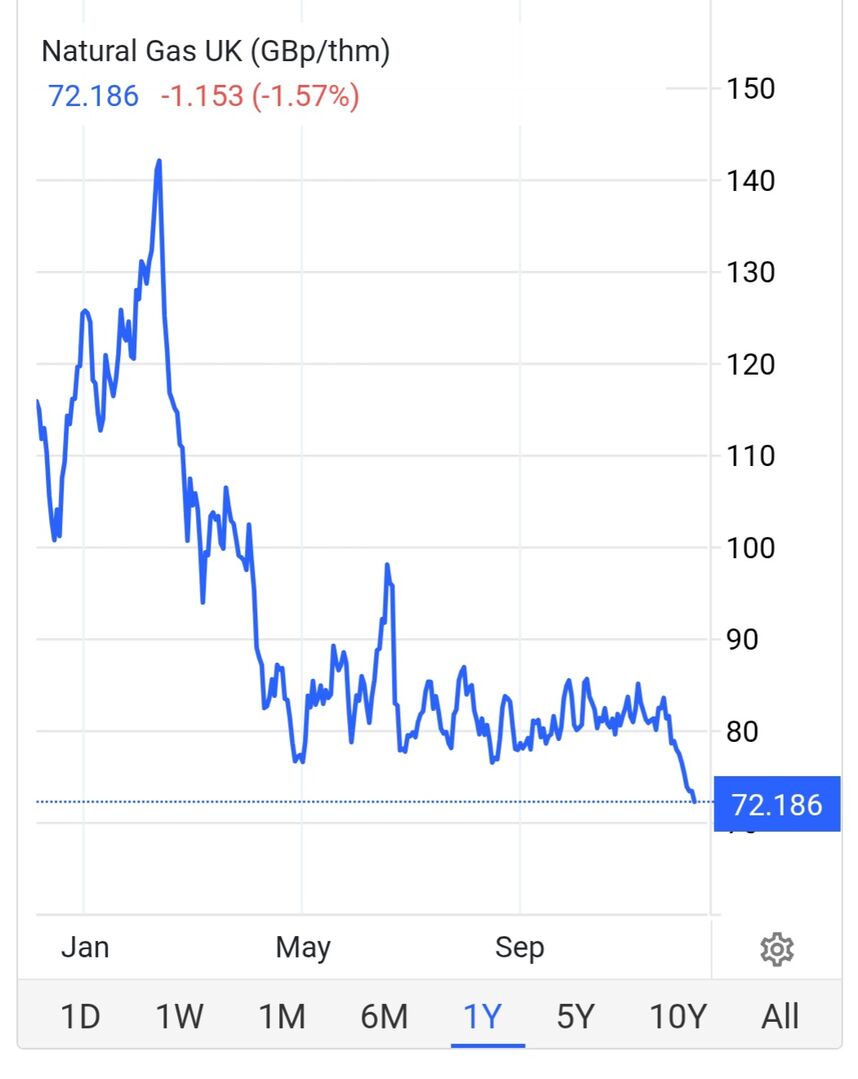
Further short term falls in gas price will help keep gas and electricity down at the next price cap. If we had decent storage we could capture this to reduce the price of electricity. Instead we are exporting it to Europe.
This post was modified 1 month ago 4 times by Jeff
04/12/2025 9:43 am
The huge shift in gas transmission as LNG replaces uk gas from the North Sea. This requires investment West to East.
Replacement of old pipes.
Etc.
We are decades off relying on gas, it's a marathon not a sprint.
Noted, as you say the 'dash for gas ' will take a while to work through. I dont object to necessary maintenance or infrastructure upgrades, I just hope these are being kept to the minimum possible given the policy to move away from gas (notwithstanding what may happen after the next election, which is still 3.5 years away).
Will be interesting to see how things evolve for those still around in 2050, won't be me.
Scarily I could just possibly be around then. If so I will probably have dementia so possibly wont care!
This post was modified 1 month ago by JamesPa
4kW peak of solar PV since 2011; EV and a 1930s house which has been partially renovated to improve its efficiency. 7kW Vaillant heat pump.
1

04/12/2025 11:55 am
Noted, as you say the 'dash for gas ' will take a while to work through. I dont object to necessary maintenance or infrastructure upgrades, I just hope these are being kept to the minimum possible given the policy to move away from gas (notwithstanding what may happen after the next election, which is still 3.5 years away).
The fossil fuel industry has been trying to push hydrogen, probably a good way to drain resources that are best used in electrification. This is despite a pilot showing that it would introduce risks (both infra and boilers are not ready).
16kWh Seplos Fogstar battery; 8kW Solis S6-EH1P8K-L-PLUS hybrid inverter; Ohme Home Pro EV charger; 100Amp head, HA lab on mini PC

04/12/2025 12:02 pm
The fossil fuel industry has been trying to push hydrogen, probably a good way to drain resources that are best used in electrification. This is despite a pilot showing that it would introduce risks (both infra and boilers are not ready).
Indeed. From the pov of the fossil industry it doesn't matter one iota whether hydrogen is practical or not, the whole point is to delay. 'Hydrogen ready' boilers are on sale!
4kW peak of solar PV since 2011; EV and a 1930s house which has been partially renovated to improve its efficiency. 7kW Vaillant heat pump.
1
04/12/2025 12:28 pm
Noted, as you say the 'dash for gas ' will take a while to work through. I dont object to necessary maintenance or infrastructure upgrades, I just hope these are being kept to the minimum possible given the policy to move away from gas (notwithstanding what may happen after the next election, which is still 3.5 years away).
The fossil fuel industry has been trying to push hydrogen, probably a good way to drain resources that are best used in electrification. This is despite a pilot showing that it would introduce risks (both infra and boilers are not ready).
Information on H100 for anyone interested. Is this the pilot you mean?
https://www.h100fife.co.uk/pioneering-h100-fife-project-passes-major-milestones/
It says the infra and boilers are ready in the pilot. The infra has been built and homes are being connected after Xmas. Safety reviews have been passed. The pilot includes offshore wind producing hydrogen.
Be interesting to hear the feedback from homeowners in 2026 if all goes ahead.
Not an area I know much about other than reading about the pilot over the years.
The government were going to makes a decision in 2026 on hydrogen but I wonder if it may get pushed back. Hydrogen infrastructure was mentioned in the ofgem network upgrades document as a possible additional cost coming onto our bills.
A bit about hydrogen in general on business, including the hydrogen boiler going into Kimberly Clark
https://www.gov.uk/government/news/jobs-unlocked-as-first-wave-of-hydrogen-projects-sign-contracts
Is this a subject you know well? Any information you can give us?
This post was modified 1 month ago 2 times by Jeff
04/12/2025 12:33 pm
I'll put Energy Strategy into three broad categories.
...1: The existing status quo.
Policy direction is led by DESNZ, and they also implement specific actions derived from that policy such as
...
Lobbying happens.
Reports get written.
I suppose non carbon based generation has been taking market share, but fixed costs have been rising..
2: The imminent future energy strategy, as being implemented and proposed by NESO, under specific direction from Ofgem.
Ie this scenario is based on the Energy Act (Nov'23)
...
Much less opportunity for lobbying and reports (unless NESO asks)
Interesting, who would advocate for small consumers in this scenario? Appointees from local authorities?
3: Other alternative energy strategies, which may include aspects of:
- greater implementation of Community Energy projects
- innovation, incl energy technology which doesn't yet exist
- unaffordability of either of the first two categories
- consumers help themselves to energy solutions, incl possible answers to Fuel Poverty
- Local Government programmes emerge
- different tariff mechanisms
...
In other words, there is already going to be an alternative energy strategy implemented, and it's presently out for Consultation by NESO.
If these local approaches allow local pylons to be put on the ground, great!
But inherently, trying to provide certainty of supply based on wind, pv and hydro, at local level would require very large scale storage. Many areas could be stuck with very expensive solutions. And not clear why....
Putting faith (and funding) on non-existent technologies and innovation is great if there's cash to spare. 😉
16kWh Seplos Fogstar battery; 8kW Solis S6-EH1P8K-L-PLUS hybrid inverter; Ohme Home Pro EV charger; 100Amp head, HA lab on mini PC

Latest Posts
-
MLCP (Multi-Layer Composite Pipe) for ASHP
@editor nope. The info you reported was sufficient for ...
By iotum , 39 minutes ago
-
RE: Advice for a novice on Mitsubishi Ecodan 6kW
@robs Quick response while I'm in stationary traffic le...
By Sheriff Fatman , 51 minutes ago
-
RE: Setback savings - fact or fiction?
Maths looks right to me, my only question about this ca...
By JamesPa , 1 hour ago
-
RE: Ideal HP290 14kW ASHP - how to optimise
@jamespa I wasn’t offended at all. You are very knowled...
By Davesoa , 2 hours ago
-
RE: Experience - New Build / Complete New Heating System
@vincro I would be surprised if it is much above 5 to 6...
By ASHP-BOBBA , 2 hours ago
-
RE: Recommended home battery inverters + regulatory matters - help requested
Yes, certainly not enough could have been tested in any...
By Batpred , 2 hours ago
-
RE: Post-Traumatic Heat Pump Stress Disorder
Yes bang on and maybe I can illustrate that by way of e...
By iotum , 4 hours ago
-
-

RE: Replacing my 18 month old Hitachi Yutaki ASHP
A big thank you to @jamespa for all his efforts online ...
By trebor12345 , 7 hours ago
-

RE: GSHP WOES! Midland based engineer recommendations?
@editor It is indeed for servicing. My current service ...
By Morgan , 8 hours ago
-
RE: Sunsynk Whole House Backup Issue
Hi @lostandconfused , I agree that topic/thread is the ...
By Batpred , 8 hours ago
-
RE: Speedcomfort radiator fans
In case it helps Andrew Kuhne on openenergy monitor has...
By JamesPa , 9 hours ago
-

Things have gone quiet with you @drei. Any updates?
By Mars , 12 hours ago
-
RE: Passiv Smart Thermostat - Help & Forum Support
Thanks @tim441. Interesting timing, as Passiv are a cur...
By Mars , 14 hours ago
-
Hi everyone, I have a two year old Marlec Solar iBoos...
By Tallmarc , 16 hours ago
-
RE: Please help with the settings ecodan
Are you trying to address any particular performance is...
By Sheriff Fatman , 22 hours ago
-
RE: Solis inverters S6-EH1P: pros and cons and battery options
🤣 Well, I never managed to get the HA solis "...
By Batpred , 23 hours ago
-
RE: Vaillant aroTherm not heating with many faults
@editor hmmm, our engineers Rae, Craig, Naz, Rob and Ry...
By ASHP-BOBBA , 1 day ago