
Notifications
Clear all

06/06/2025 12:18 pm
@iaack of course, you're right, but that's not the market the OEM of 'Heat Saviour' is targeting, They are targeting retrofit ASHP heat pump market, so it clearly says in their marketing literature. I can't see this product offers any advantages to that market, save purely the convenience of the retrofit installer. The home-owner or occupier is the party disadvantaged, with a built-in thermodynamic inefficiency and additional running cost of a second circulator pump that in many smaller homes would not be needed.
Sadly we don't really do district heating in the UK to any great extent. Shame, as larger air, ground or water source heat pumps serving multiple dwellings offer efficiency advantages. Most houses have their own CH and DHW fired combustion combi boiler. If the UK is committed to replacing those in pursuit of Net Zero 2050 and to decarbonise domestic heating, then replacement products should compliment best practise and best efficiency. 'Heat Saviour' doesn't, it lowers the SCOP potential of the ASHP by adding a 2nd PHX in the design in addition to the one in the heat pump. It increases running costs, by requiring a second circulator, and by raising the design LWT temperature on the primary circuit side to achieve the required flow temperature on the secondary side.
3

06/06/2025 4:27 pm
@allyfish As you say, all the ‘plus points’ and ‘advantages’ are very much for the benefit of the installers - the costs to the end user would appear to be irrelevant! It really is a shame that the advertising / sales fraternity have such finely tuned aims (that rarely if ever extend to providing any advantage to the end user!).☹️ Toodles.
Toodles, heats his home with cold draughts and cooks food with magnets.
2

26/01/2026 2:18 pm
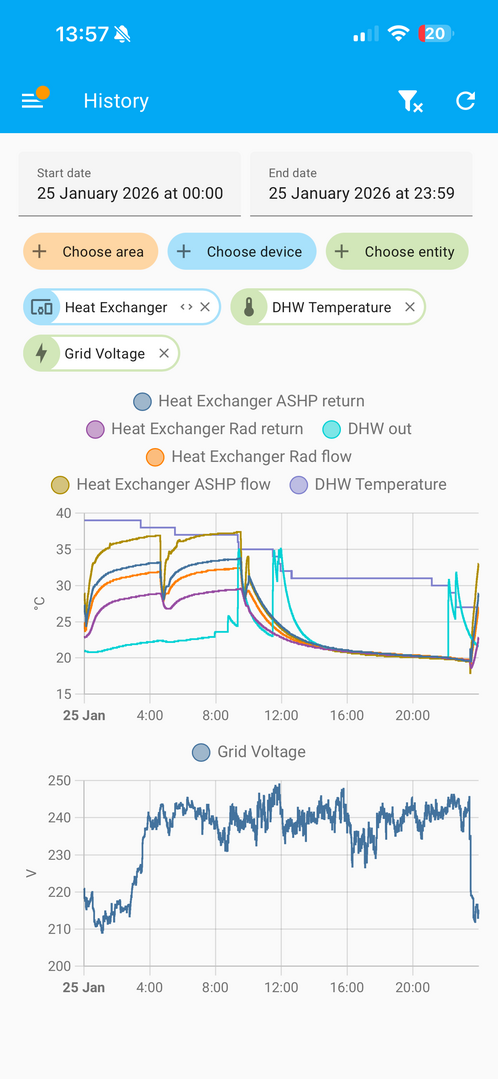
26/01/2026 2:21 pm
I happen to have a Heat Saviour (HS)in my system!
After nearly 4 years I have quite a lot of daily data on both electric usage and outside temperature.
Observations on discussion so far:
- claims that plates are thermodynamic ally inefficient whereas web suggests that they are highly efficient
- claims that they are for the benefit of the installer only.
This interesting explanation
https://savree.com/en/encyclopedia/plate-heat-exchanger-phe
says they are highly efficient generally but work best in a contraflow configuration and adherence to the principle that hotter water rises and therefore the hotter fluid (either flow or return) should be at the top. As best I can tell the HS runs the plates horizontal. I do not know if it has a chevron plate design. The aim is create turbulence to make effective use of the full area of each plate.
Regarding efficiency there are two issues:
- heat lost through the external surface, which is actually quite small
- does it allow the ASHP to achieve a delta of 5C and likewise the rads
My observations of my system are
- that ASHP side is 4C and the Rads 3C measured continuously close to the HS
- Hewers installed it with parallel flow and have not changed this or justified their way being right. I can’t but help feel the delta would be improved but the HS design seems inherently to be wrong if indeed the plates are horizontal.
In use I have dropped the ASHP flow to 35c and built and installed a housing below every rad to force air driven by a fan in the housing through the rads rather than relying on convection. It has been a noticeable improvement. So far in January I have only used 530kWh. At -6C I used 41 kWh (24h average-1.6C). More recently about 10-17kWh. All this for a very large 300m2 property with EPC of C. On Intelligent GO it is cheap to run given I have battery and solar.

Topic starter
27/01/2026 8:28 am
@filipe Im not absolutely sure from your post whether you are pleased on not with your installation but get the impression you are in which case thats good to hear.
Plate heat exchangers in contraflow configuration are indeed pretty efficient. Nevertheless there must always be a temperature drop across them (between primary and secondary) which be compensated for by increasing the flow temperature from the heat pump, thus reducing its COP.
The key question with this piece of kit is no, does the system work with it, its would it work without it? Put another way, what problem is it solving for the householder that justifies the expense of the kit and extra water pump, the cost of installation and the probable reduction in efficiency due to the temperature drop?
In almost all cases the answer is that it isn't solving a problem or at most isn't solving a problem that couldn't be better solved another way. Just like a buffer tank its almost certainly unnecessary, certainly costs money, and very probably compromises performance. The way its sold targets it at social housing, the occupants of which presumably don't have money to throw away, and the floor area of which is unlikely to be anywhere near that where plumbing arrangements more complex than simply connecting the heat pumps to the emitters might be necessary.
Hence the criticism. However if you have it and you are happy that's great, but of course it doesn't prove you wouldn't be equally happy without.
4kW peak of solar PV since 2011; EV and a 1930s house which has been partially renovated to improve its efficiency. 7kW Vaillant heat pump.
1
28/01/2026 8:53 pm
I should have mentioned my flow temperature is fixed at 35C which you can see in the photo. I quite agree about contraflow but have failed to get the installer to do anything. The secondary pump uses about 20W compared to the ASHP’s 1.5kW in heating mode. It ran continuously for more than 6 hours today. On the day in the photo it cost me £1 to heat the house - about 15kWh for 300m2 floor area and 6 large bedrooms etc. So it does alright.
- So how can I get the installer to take action under MCS?
- I’m hoping the contraflow gives a better delta T and that I can run the ASHP harder unless I need more plate
Thanks Phil
1
Topic starter
29/01/2026 9:04 am
So how can I get the installer to take action under MCS?
You probably cant, MCS is, at least from the reputation it has here,essentially useless as a consumer protection organisation
- I’m hoping the contraflow gives a better delta T and that I can run the ASHP harder unless I need more plate
Contraflow should reduce the difference between the flow temp from the heat pump and flow temp to emitters, which means you can reduce the former improving COP. It wont make the heat pump work harder nor is there a reason to do so.
There is nothing wrong with your current DT of 3/4 so dont worry about this!
Overall I get the impression your system is working pretty satisfactorily so perhaps dont change anything! Is there an actual problem you are trying to solve?
This post was modified 3 weeks ago by JamesPa
4kW peak of solar PV since 2011; EV and a 1930s house which has been partially renovated to improve its efficiency. 7kW Vaillant heat pump.
Page 2 / 2
Prev

Latest Posts
-

RE: Humidity, or lack thereof... is my heat pump making rooms drier?
That’s my pleasure, @andrewj. The only challenge now is...
By Majordennisbloodnok , 6 minutes ago
-
RE: Electricity price predictions
@toodles @skd Then there is not going to be much from t...
By ChandyKris , 51 minutes ago
-
RE: Solis inverters S6-EH1P: pros and cons and battery options
@batpred I reckon Andy might know a thing or 2 about...
By Bash , 1 hour ago
-
RE: What determines the SOC of a battery?
@batpred Ironically you didn't have anything good to...
By Bash , 2 hours ago
-
RE: Testing new controls/monitoring for Midea Clone ASHP
Here’s a current graph showing a bit more info. The set...
By benson , 3 hours ago
-
RE: Setback savings - fact or fiction?
True there is a variation but importantly it's understa...
By RobS , 3 hours ago
-

Below is a better quality image. Does that contain all ...
By trebor12345 , 3 hours ago
-
Sorry to bounce your thread. To put to bed some concern...
By L8Again , 3 hours ago
-
@painter26 — they (the analogue gauges) are subtly diff...
By cathodeRay , 4 hours ago
-
Our Experience installing a heat pump into a Grade 2 Listed stone house
First want to thank everybody who has contributed to th...
By Travellingwave , 7 hours ago
-
RE: Struggling to get CoP above 3 with 6 kw Ecodan ASHP
Welcome to the forums.I assume that you're getting the ...
By Sheriff Fatman , 10 hours ago
-
RE: Say hello and introduce yourself
@editor @kev1964-irl This discussion might be best had ...
By GC61 , 12 hours ago
-
RE: Oversized 10.5kW Grant Aerona Heat Pump on Microbore Pipes and Undersized Rads
@uknick TBH if I were taking the floor up ...
By JamesPa , 1 day ago
-

RE: Getting ready for export with a BESS
I would have not got it if it was that tight
By Batpred , 1 day ago
-
RE: Need help maximising COP of 3.5kW Valiant Aerotherm heat pump
@judith thanks Judith. Confirmation appreciated. The ...
By DavidB , 1 day ago
-
RE: Recommended home battery inverters + regulatory matters - help requested
That makes sense. I thought better to comment in this t...
By Batpred , 1 day ago
-
Bosch CS5800i 7kW replacing Greenstar Junior 28i
My heat pump journey began a couple of years ago when I...
By Slartibartfast , 1 day ago
-
RE: How to control DHW with Honeywell EvoHome on Trianco ActiveAir 5 kW ASHP
The last photo is defrost for sure (or cooling, but pre...
By JamesPa , 1 day ago
-
RE: Plug and play solar. Thoughts?
Essentially, this just needed legislation. In Germany t...
By Batpred , 1 day ago
-
RE: A Smarter Smart Controller from Homely?
@toodles Intentional opening of any warranty “can of wo...
By Papahuhu , 1 day ago
-
RE: Safety update; RCBOs supplying inverters or storage batteries
Thanks @transparent Thankyou for your advic...
By Bash , 2 days ago
-
RE: Air source heat pump roll call – what heat pump brand and model do you have?
Forum Handle: Odd_LionManufacturer: SamsungModel: Samsu...
By Odd_Lion , 2 days ago
-
RE: Configuring third party dongle for Ecodan local control
Well, it was mentioned before in the early pos...
By F1p , 2 days ago