
Notifications
Clear all

12/01/2026 9:55 pm
@jamespaamespa, thank you both @iaack so far I haven’t calculated this latent heat of fusion. Just the raising of the 180L of water temperature from 25C to 40C. It doesn’t seem insignificant. But please let me know if my maths is wrong.
Maths looks right to me, my only question about this calculation is whether its reasonable to assume that the whole 180l is reduced in temperature to 25C. The heat pump measures the temperature at the heat pump, ie just after its been cooled, I would guess that much of the water in the system might be warmer, possibly quite a lot warmer. A bit of maths on pump speed etc might help give an angle on this question but it might also be necessary to observe flow temp and state of defrost (or feel the radiators!). The min flow temp may not correspond with the end of defrost in which case the amount of water at a higher temp than the min could be even more than a calaculation based on pump speed might indicate.
My point above is, however, that the latent heat of fusion is already contained within the amount needed to reheat the water, because thats where the energy corresponding to the latent heat of fusion has come from. So to add it in would be double counting this amount. Its interesting to calculate it nevertheless to compare with the reheat energy, if only to allow us to ask the question - where does the rest go? This will also serve as a sense check and conservation of energy tends to do.
Depending on exactly what you are trying to work out so might adding in "the electrical energy to replace the 12 minutes when the HP is not adding heat energy to the system during the defrost."
I think it might be easier (or perhaps a complementary sense check) to do an integration on power consumption during the defrost 'spike' which occurs immediately after defrost. I posted this diagram from mine (7kW Vaillant) earlier
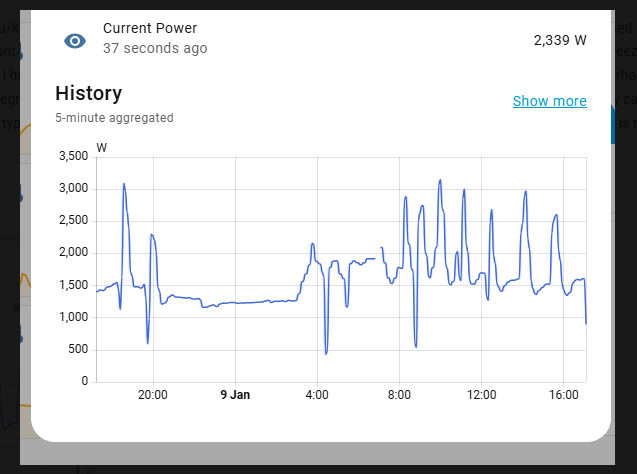
An 'eyeball integration' of the spike (ignoring the dip) suggests about 0.25kWh. This will be largely the reheat energy I imagine. However that doesn't account for the fact that the consumption in the period after the spike may be higher than it would have been in the absence of defrost, but of course that is partially replacing the energy that was not put in during the dip in the cases where there is one. If you complete your calculation perhaps we can compare two ways of getting at the same question which may give us a view of the uncertainty!
Thats probably served to confuse rather than clarify in which case I apologise.
This post was modified 2 hours ago 4 times by JamesPa
4kW peak of solar PV since 2011; EV and a 1930s house which has been partially renovated to improve its efficiency. 7kW Vaillant heat pump.
1
Page 16 / 16
Prev

Latest Posts
-
MLCP (Multi-Layer Composite Pipe) for ASHP
@editor nope. The info you reported was sufficient for ...
By iotum , 1 hour ago
-
RE: Advice for a novice on Mitsubishi Ecodan 6kW
@robs Quick response while I'm in stationary traffic le...
By Sheriff Fatman , 2 hours ago
-
RE: Setback savings - fact or fiction?
Maths looks right to me, my only question about this ca...
By JamesPa , 2 hours ago
-
RE: Ideal HP290 14kW ASHP - how to optimise
@jamespa I wasn’t offended at all. You are very knowled...
By Davesoa , 2 hours ago
-
RE: Experience - New Build / Complete New Heating System
@vincro I would be surprised if it is much above 5 to 6...
By ASHP-BOBBA , 2 hours ago
-
RE: Recommended home battery inverters + regulatory matters - help requested
Yes, certainly not enough could have been tested in any...
By Batpred , 3 hours ago
-
RE: Post-Traumatic Heat Pump Stress Disorder
Yes bang on and maybe I can illustrate that by way of e...
By iotum , 5 hours ago
-
-

RE: Replacing my 18 month old Hitachi Yutaki ASHP
A big thank you to @jamespa for all his efforts online ...
By trebor12345 , 8 hours ago
-

RE: GSHP WOES! Midland based engineer recommendations?
@editor It is indeed for servicing. My current service ...
By Morgan , 9 hours ago
-
RE: Sunsynk Whole House Backup Issue
Hi @lostandconfused , I agree that topic/thread is the ...
By Batpred , 9 hours ago
-
RE: Speedcomfort radiator fans
In case it helps Andrew Kuhne on openenergy monitor has...
By JamesPa , 10 hours ago
-

Things have gone quiet with you @drei. Any updates?
By Mars , 13 hours ago
-
RE: Passiv Smart Thermostat - Help & Forum Support
Thanks @tim441. Interesting timing, as Passiv are a cur...
By Mars , 14 hours ago
-
Hi everyone, I have a two year old Marlec Solar iBoos...
By Tallmarc , 17 hours ago
-
RE: Please help with the settings ecodan
Are you trying to address any particular performance is...
By Sheriff Fatman , 23 hours ago
-
RE: Solis inverters S6-EH1P: pros and cons and battery options
🤣 Well, I never managed to get the HA solis "...
By Batpred , 24 hours ago
-
RE: Vaillant aroTherm not heating with many faults
@editor hmmm, our engineers Rae, Craig, Naz, Rob and Ry...
By ASHP-BOBBA , 1 day ago


