
Notifications
Clear all

Topic starter
17/11/2025 4:19 pm
Some tweaks of WC may indeed be necessary, if its too hot both downstairs and up (and its not solar gain) then you definitely need to turn the WC down!
Hot upstairs seems to be a problem with modern houses. With open plan and good insulation, there is literally nowhere for the heat from downstairs to go other than the bedrooms. People on buildhub are now doing newbuilds without upstairs heating other than in the bathroom. This is all a bit iterative, it might take you the whole season to get it spot on. There is also an element of adjusting to constant temperature!
Indeed. I've been out most of the day but monitoring. The downstairs living area was 22.4c at 7am but rose to 23.3 by mid-morning. At 14:30 it dropped by 0.1c and now, at 16:00 it is 23c (and whilst writing this has gone up to 23.1c at 16:18!!) Having turned down the radiators upstairs, temps are reading 23.7c - 24.9c and I've got little room for manoeuvre here as these rads are only open 0.25 turns. So my plan is to leave it overnight to see how it copes as the temp is forecasted to drop to 0c overnight. If I maintain temps then I think I can drop the WC curve; if it doesn't maintain temps (by which I mean the living area sticks around 23c) then I might have to tweak open the downstairs radiators. I have to be careful here though as some of the radiators share a 15mm loop and there would be a risk of starving Peter to feed Paul! I have a feeling that with a couple of upstairs rooms I will need to use the TRVs to limit their temperature but hopefully not.
Anyway, I feel I'm making progress because temps are closer and the daily COP is 4.11

17/11/2025 4:39 pm
@andrewj Sounds promising; and those LSV’s can be tricky devils, if you have a quarter turn open valves, a tweak might only be a few degrees clockwise to effect a noticeable reduction. (Well worth trying though before resorting to using the TRV’s which are brute force by comparison). Regards, Toodles.
Toodles, heats his home with cold draughts and cooks food with magnets.
17/11/2025 4:45 pm
And I might add that the constancy provided by the LSV is much better for the system than the variable effect of a changeable TRV. Using the TRV as an overly-warm limiting device and nothing more is a good starting point when there are other variables like the WC possibly being higher than you may require. Regards, Toodles.
Toodles, heats his home with cold draughts and cooks food with magnets.
Topic starter
17/11/2025 4:57 pm
@andrewj Sounds promising; and those LSV’s can be tricky devils, if you have a quarter turn open valves, a tweak might only be a few degrees clockwise to effect a noticeable reduction. (Well worth trying though before resorting to using the TRV’s which are brute force by comparison). Regards, Toodles.
That's good to know, thanks. I'll definitely be using TRVs as last resort.

17/11/2025 6:28 pm
That's good to know, thanks. I'll definitely be using TRVs as last resort.
If LSVs prove troublesome (which they definitely can) take the heads off the TRVs and fit decorators caps. That gives you a much more linear and fine adjustment of flow.
4kW peak of solar PV since 2011; EV and a 1930s house which has been partially renovated to improve its efficiency. 7kW Vaillant heat pump.
Topic starter
17/11/2025 7:22 pm
If LSVs prove troublesome (which they definitely can) take the heads off the TRVs and fit decorators caps. That gives you a much more linear and fine adjustment of flow.
Can you clarify a bit please. I thought decorators caps CLOSED the valve off so there was no risk of them opening? I would have thought just removing the TRV would leave them completely open. I think there's an underlying assumption I'm not getting here!!
17/11/2025 7:29 pm
If LSVs prove troublesome (which they definitely can) take the heads off the TRVs and fit decorators caps. That gives you a much more linear and fine adjustment of flow.
Can you clarify a bit please. I thought decorators caps CLOSED the valve off so there was no risk of them opening? I would have thought just removing the TRV would leave them completely open. I think there's an underlying assumption I'm not getting here!!
A decorators cap will close the trv completely if you screw it down completely. If you don't it will partially close the trv, more controllably than many lsvs. Some actually have +/- indicators moulded into them.
4kW peak of solar PV since 2011; EV and a 1930s house which has been partially renovated to improve its efficiency. 7kW Vaillant heat pump.
Topic starter
17/11/2025 7:51 pm
A decorators cap will close the trv completely if you screw it down completely. If you don't it will partially close the trv, more controllably than many lsvs. Some actually have +/- indicators moulded into them.
Ah, that makes sense.
Topic starter
18/11/2025 10:58 am
A bit more information. I monitor the room temps at various times during the day and record them, along with some other pertinent information. Unfortunately, I don't have access to detailed information, only what is provided through the Octopus App which isn't very fine grained. Recorded temps are on devices with an accuracy of +-0.3c but measured to be same as, or within 0.2c of the Primary Pod reading. I have 3 pods: Primary is in the Living Area, one pod is in the Study and one in the Cloakroom.
Attached are the results from the 16th to around 10:30am this morning - hopefully readable but I could provide the Excel spreadsheet which has many more days on it. On the 16th, the Cosy was running on a 24/7 schedule at 22c; at midnight on 17th I changed this to be 24/7 at 25c and at around 7pm changed it again to be 24/7 30c (Living area was getting too close to 25c.) You can see the flow temps I have set: note that I adjusted it at 21:40 on the 17th and reduced the cold weather temp again at around 4am (I woke hot and bothered!!) "Time last run" means the hour period for which the Cosy produced heat - this is the minimum granularity and I can't see if that was for 5mins or 60mins; "running" means it was producing heat when I took the readings. It's probably worth mentioning that 2 of us sleep in Bedroom 1 and that the en-suite temp will rise because of use sometime around 8:30 to 09:00. The Entry Hall will get a fair bit of solar gain in the morning as there is a large window, east facing.
What I notice about the data is that during the night, even with the temps dropping low, the room temps were for the most part maintained. I'm a bit stuck on where to go with this now as the WC curve for the Cold temp can't be adjusted warmer (<50c; max value is 57c) and the radiators are really turned down, particularly upstairs. Any suggestions? I was thinking: open windows in the house to let some of the heat out until rooms reach around 22.0-22.5c and see if these temps are maintained by the current settings? If not, then I could adjust the WC curve up at the cold weather end maybe? Problem is I'm not really sure what the data is telling me, apart from the house is way too hot. Alternatively, I could go back to the scheduled 24/7 22c and let the Cosy cycle around that temp to see if the WC adjustments have made any difference?
The design heat loss for the house came out at around 8.4kWh by Octopus; Heat Geek calculated 8.2kWh. Could have been the other way around but within 200wh of each other. I'm beginning to think my house has anywhere near that amount of loss and thus perhaps the Cosy 9 is oversized? For example, with my wife and I in the living area of an evening the temperature reading will rise 0.2c. During the summer months, heating off, internal house temps can easily get to the upper 20s; on very warm days upstairs can get into the low 30s (yes, it's not nice!)
I do have some other data points: gas usage for heating during the year Feb 2024 to Jan 2025 was 8937kW but that was with the living area set to 21c, non-open plan downstairs (which it is now) and typically 22c - 24c upstairs (by dint of physics and bang-em-in-boiler installer!) - both Octopus and Heat Geek had access to this month-by-month breakdown at design time. COPs for the 16th, 17th and 18th to now are: 4.36, 3.85 and 3.18.

EDIT: if I had to take a guess right now, as the weather is heating up, the living area is slowly cooling down even with the Cosy running - at 11:07 it is reading 23.4c (other rooms seem to be maintaining their last recorded temp)
This post was modified 3 months ago by AndrewJ
18/11/2025 1:47 pm
Sorry Im confused. What is the actual problem you are now trying to fix? I thought it was lack of balance between upstairs and downstairs but it it now:
apart from the house is way too hot.
in which case turn the low OAT end of the WC curve down until it isnt, slowly, one degree every 24hrs (you could probably change by 2 degrees initially). Dont expect things to change rapidly! Opening windows, unless you do so for hours, wont speed things up much because the fabric still retains heat and takes a long time to lose it. Make sure all TRVs are fully open and thermostats set to max when you do this so that its the WC that is dominating not any on/off controls.
In simple terms for the simplest 'pure WC' setup:
- You use balancing' to change the relative temperatures of rooms
- You use the WC curve to change the overall temperature
- You use thermostats and TRVs as limiters only, not controllers, ie they should be set above the desired temperature*
I think you may be changing things a bit too quickly. Houses typically take 24hrs plus to adjust, no point in making 2-3 changes within 24hrs you wont be able to work out whats happening!
Does that make sense?
I'm beginning to think my house has anywhere near that amount of loss and thus perhaps the Cosy 9 is oversized? For example, with my wife and I in the living area of an evening the temperature reading will rise 0.2c.
Oversizing wont affect internal temperature which depends on the flow temperature (ie the WC curve adjustment) not the capacity of the heat pump (assuming its not undersized of course). However if your house loss was overestimated (which is quite likely) then your radiators may be bigger than is needed for the flow temperature it was designed to work at, so the house will overheat if run at that flow temperature. Not a problem, simply drop the flow temperature (WC curve) to fix that, which will also improve efficiency. That said, if your heat pump is well oversized then it may operate less efficiently than if it is right-sized even once you adjust the flow temperature to give the desired indoor temperature.
Re 'with my wife and I in the living area of an evening the temperature reading will rise 0.2c.' - together you are adding 200W to the energy input to the room, so not too surprising.
* with some heat pumps there is a link between the internal temperature sensor and the WC curve in which case you may to apply a slightly different methodology to achieve the same outcome. Not sure if that applies to Octopus, manual isn't clear, nobody here seens to know so its a case of suck it and see, Easiest way to experiment is to see if turning up the target room temperature changes the flow temperature. If it doesnt then they arent linked in this way. The evidence would suggest not if
apart from the house is way too hot.
is correct
This post was modified 3 months ago 13 times by JamesPa
4kW peak of solar PV since 2011; EV and a 1930s house which has been partially renovated to improve its efficiency. 7kW Vaillant heat pump.
Topic starter
18/11/2025 2:41 pm
Sprry Im confused. What is the actual problem you are now trying to fix? I thought it was lack of balance between upstairs and downstairs but it it now:
apart from the house is way too hot.
in which case turn the low OAT end of the WC curve down until it isnt, slowly, one degree every 24hrs. Make sure all TRVs are fully open and thermostats set to max when you do this so that its the WC dominating not any on/off controls.
Sorry if it wasn't clear. I have set all TRVs open, the set temp is 30c which is max (at around 7pm last night from 25c) and turned down the low OAT end to its minimum value of 50c (if you mean the cold weather flow temp.) I didn't do the latter 24 hours ago, only at 4am this morning - and prior at around 21:40 yesterday to 53c from 55c, but as I mentioned the temps upstairs and downstairs have remained quite stable. Even if it wasn't 24 hours I would have expected some heat loss to reduce temps upstairs and downstairs but the temps remain pretty stable even now so the Cosy seems to be keeping pace if that makes sense. Maybe I'm being too impatient and the rate of change is likely to be slow - it's not expected to be as cold tonight, down to 5c and cooling off from there tomorrow mid-afternoon to -2 early Thursday morning.
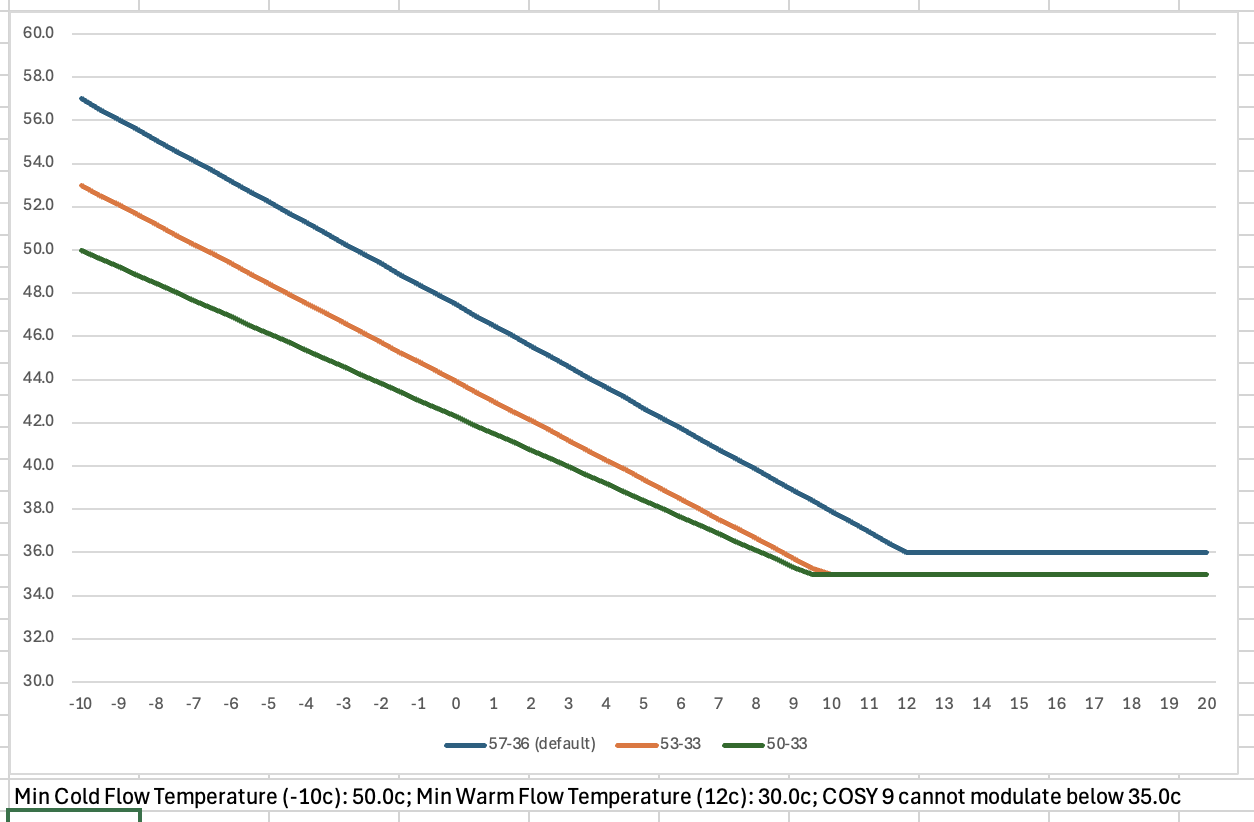
It is 7.5c outside right now so more impacted I suspect by the high OAT end of the curve which I turned down to 33c, from 36c, at around 21:30 yesterday. Cosy 9 isn't running at the moment (fan is stopped) so I guess it's hit its lowest flow temp (35c) and can't go lower?? Could be I need to turn this end up from 33c.
EDIT: There is no link between the internal sensor (Primary Pod) and flow temp. The Pod is used as a simple on/off thermostat. I had a go at plotting the WC curve for the Cosy based on my understanding that it is a linear curve between -10c and +12c.
This post was modified 3 months ago 3 times by AndrewJ
18/11/2025 3:02 pm
I have set all TRVs open, the set temp is 30c which is max (at around 7pm last night from 25c)
great, that establishes the right conditions to set up WC and indeed balance your rads
There is no link between the internal sensor (Primary Pod) and flow temp. The Pod is used as a simple on/off thermostat.
Good to know
Maybe I'm being too impatient and the rate of change is likely to be slow - it's not expected to be as cold tonight, down to 5c and cooling off from there tomorrow mid-afternoon to -2 early Thursday morning.
You have to be very patient! Because I set quiet mode overnight my flow temp last night was 6C lower overnight than the 'equilibrium' flow temp, an effect which I see only when its near or below zero. The house cooled by only a degree in 8 hours. Houses have a lot of thermal mass.
and turned down the low OAT end to its minimum value of 50c (if you mean the cold weather flow temp.)
Is 50C really the minimum low OAT flow temp, if so thats crazy crazy crazy and wont work at all with UFH so sounds wrong.
Are you sure that there is not an installer setting for min permissible flow temp, which can be adjusted down. Alternatively can you make the -10 figure even colder, which would have the same effect.
Just a reminder, in simple terms for the simplest 'pure WC' setup:
- You use balancing' to change the relative temperatures of rooms
- You use the WC curve to change the overall temperature
- You use thermostats and TRVs as limiters only, not controllers, ie they should be set above the desired temperature
Its just a case of tweaking until you are happy. Easiest done when its cold, so the next few days is a good time, but you do have to be patient!
4kW peak of solar PV since 2011; EV and a 1930s house which has been partially renovated to improve its efficiency. 7kW Vaillant heat pump.

Latest Posts
-
RE: Electricity price predictions
@skd I think your guess might well be right - unfortuna...
By Toodles , 4 minutes ago
-
RE: Humidity, or lack thereof... is my heat pump making rooms drier?
@majordennisbloodnok I’m glad I posted this. There see...
By AndrewJ , 15 minutes ago
-
RE: What determines the SOC of a battery?
@batpred I didn't write the Seplos BMS software, I a...
By Bash , 2 hours ago
-
RE: Testing new controls/monitoring for Midea Clone ASHP
@tasos and @cathoderay thanks. I have some history grap...
By benson , 2 hours ago
-

I am having my existing heat pump changed to a Vaillant...
By trebor12345 , 3 hours ago
-
Our Experience installing a heat pump into a Grade 2 Listed stone house
First want to thank everybody who has contributed to th...
By Travellingwave , 3 hours ago
-
RE: Setback savings - fact or fiction?
@cathoderay The input power is largely determined by...
By RobS , 4 hours ago
-

RE: Solis inverters S6-EH1P: pros and cons and battery options
Just to wrap this up here for future readers: The S...
By Batpred , 6 hours ago
-
RE: Struggling to get CoP above 3 with 6 kw Ecodan ASHP
Welcome to the forums.I assume that you're getting the ...
By Sheriff Fatman , 6 hours ago
-
RE: Say hello and introduce yourself
@editor @kev1964-irl This discussion might be best had ...
By GC61 , 7 hours ago
-
@painter26 — as @jamespa says, it's for filling and re-...
By cathodeRay , 11 hours ago
-
RE: Oversized 10.5kW Grant Aerona Heat Pump on Microbore Pipes and Undersized Rads
@uknick TBH if I were taking the floor up ...
By JamesPa , 22 hours ago
-
RE: Getting ready for export with a BESS
I would have not got it if it was that tight
By Batpred , 24 hours ago
-
RE: Need help maximising COP of 3.5kW Valiant Aerotherm heat pump
@judith thanks Judith. Confirmation appreciated. The ...
By DavidB , 1 day ago
-
RE: Recommended home battery inverters + regulatory matters - help requested
That makes sense. I thought better to comment in this t...
By Batpred , 1 day ago
-
Bosch CS5800i 7kW replacing Greenstar Junior 28i
My heat pump journey began a couple of years ago when I...
By Slartibartfast , 1 day ago
-
RE: How to control DHW with Honeywell EvoHome on Trianco ActiveAir 5 kW ASHP
The last photo is defrost for sure (or cooling, but pre...
By JamesPa , 1 day ago
-
RE: Plug and play solar. Thoughts?
Essentially, this just needed legislation. In Germany t...
By Batpred , 1 day ago
-
RE: A Smarter Smart Controller from Homely?
@toodles Intentional opening of any warranty “can of wo...
By Papahuhu , 1 day ago
-
RE: Safety update; RCBOs supplying inverters or storage batteries
Thanks @transparent Thankyou for your advic...
By Bash , 1 day ago
-
RE: Air source heat pump roll call – what heat pump brand and model do you have?
Forum Handle: Odd_LionManufacturer: SamsungModel: Samsu...
By Odd_Lion , 1 day ago
-
RE: Configuring third party dongle for Ecodan local control
Well, it was mentioned before in the early pos...
By F1p , 2 days ago
-
RE: DIY solar upgrade - Considering adding more panels
I know this is a bit old, but it made me wonder what co...
By Batpred , 2 days ago