

Notifications
Clear all
Joining the Renewable Heating Hub forums is completely free and only takes a minute. By registering you’ll be able to ask questions, join discussions, follow topics you’re interested in, bookmark useful threads and receive notifications when someone replies. Non-registered members also do not have access to our AI features. When choosing your username, please note that it cannot be changed later, so we recommend avoiding brand or product names. Before registering, please take a moment to read the Forum Rules & Terms of Use so we can keep the community helpful, respectful and informative for everyone. Thanks for joining!
Energy Storage
233
Posts
20
Users
170
Reactions
122.8 K
Views

Topic starter
20/07/2022 10:10 am
@chickenbig my cells should be balanced. But I'll check them before I do anything when connecting. As to torque, I'll probably just buy a digital torque wrench

20/07/2022 3:06 pm
these are 400A Zeeman ANMH fuses; they have an interrupt rating of 2,000A@80V DC. Has anyone performed testing around what interrupt capacity is actually required for LiFePO4 batteries
We need to think of this from the alternative viewpoint.
If a short-circuit were to occur, a 16S (48v) LiFePO4 battery would supply about 20kA. It is unlikely to experience serious damage from doing so, because that's the consequence of its chemistry. The cells survive.
However, the downstream device which caused the short-circuit will not emerge unscathed. If it's the charger/inverter, then the energy conversion to heat could easily cause a fire. 3.6MJ in 1mS is available if the electronics tries to 'take it'.
A Type-T fuse is preferable because it's designed to operate very fast at such currents. The charger/inverter will still be damaged, but the house doesn't burn down.
If I was an Insurer, or a Loss Adjuster working on their behalf, that's the level of protection I'd expect to see.
The UK doesn't (yet) have any regulatory controls or guidance for connection of off-grid ELV battery storage. If it did, then I suspect that house insurers would refer to that document in order to assess their level of risk.
In the meantime, it's down to Forums like this to promote common-sense safe practice, based on experience and the laws of physics. I've done basic research into Type-T fuses, which is why I made that recommendation, whereas I have little knowledge of the Zeeman ANMH fuses as yet.
Equally, I reserve the right to change my mind as we share information and find our way forward together! 😎
Save energy... recycle electrons!
2

20/07/2022 3:44 pm
Out of curiosity why not use a cheaper manual torque wrench with a calibration certificate and meeting the ISO standard +-3% accuracy?
Is it that you trust your digital wrench more? Do you often get it recalibrated?
I am no expert, just curious.
20/07/2022 4:09 pm
Again out of curiosity. Did you inform your building and contents insurance company you were installing solar panels and batteries in your home? Did they have any questions or requirements? Is there any mention of solar panels or storage batteries in your policies?
Does having solar panels and batteries increase the cost of insurance due to their value?
2

20/07/2022 9:35 pm
why not use a cheaper manual torque wrench with a calibration certificate
Is that question for me @jeff ?
When researching the range of torques I was likely to require for installing LiFePO4 batteries it was clear that I needed one that would operate below the usual ranges. Wera is well known to me as a high quality manufacturer of screwdrivers, and I found a supplier of their A6 torque wrench which was then at a substantial discount.
When fitting busbars to EVE cells I usually torque first to 6Nm and then re-visit each nut to torque again at 8Nm, which is the level specified by the manufacturer.
Is it that you trust your digital wrench more?
I don't have a digital wrench.
Did you inform your building and contents insurance company you were installing solar panels and batteries in your home?
No. I have had off-grid PV panels for 15+ years and changed insurers several times. When they did ask questions, they were only interested in panels connected to the grid via an inverter. That may not seem logical to me because such panels will have been installed by an accredited professional, but who am I to argue?!
I've now had grid-connected PV panels and a grid-connected storage battery for about 18-months. When I switched to my current insurer, there were no questions about renewable-energy installations at the home.
Save energy... recycle electrons!
21/07/2022 7:34 am
why not use a cheaper manual torque wrench with a calibration certificate
Is that question for me @jeff ?
When researching the range of torques I was likely to require for installing LiFePO4 batteries it was clear that I needed one that would operate below the usual ranges. Wera is well known to me as a high quality manufacturer of screwdrivers, and I found a supplier of their A6 torque wrench which was then at a substantial discount.
When fitting busbars to EVE cells I usually torque first to 6Nm and then re-visit each nut to torque again at 8Nm, which is the level specified by the manufacturer.
Is it that you trust your digital wrench more?
I don't have a digital wrench.
Did you inform your building and contents insurance company you were installing solar panels and batteries in your home?
No. I have had off-grid PV panels for 15+ years and changed insurers several times. When they did ask questions, they were only interested in panels connected to the grid via an inverter. That may not seem logical to me because such panels will have been installed by an accredited professional, but who am I to argue?!
I've now had grid-connected PV panels and a grid-connected storage battery for about 18-months. When I switched to my current insurer, there were no questions about renewable-energy installations at the home.
No the questions deliberately were not just directed at you @Transparent.
I was curious about a variety of view points and experience to be honest. Your knowledge is always very useful.
I appreciate some of my questions are not well formed as i am no expert. For example a torque and a wrench, manual and digital torque ranges etc.
Thanks for the responses, useful to know.
I am sometimes wary about asking anything in case i come across as an idiot as with the whole torque and fuse stuff as examples. So thanks for your patience.
21/07/2022 8:30 am
Am curious about fuses.
Do we have examples of what installers are fitting for battery storage, not because i think they may good or bad necessarily, just out of curiosity about what sort of solution they are putting in?
Do those with batteries on this forum know what they have?

Topic starter
21/07/2022 2:03 pm
@jeff this is the Torque wrench I am considering - https://www.amazon.co.uk/ACDelco-ARM601-3-Digital-Torque-Wrench/dp/B08YK8ZH47
5-50Nm
21/07/2022 3:06 pm
what size fuse do you think is present in the box?
In which box? ... the Mason enclosure manufactured by Seplos?
And do I assume we're discussing the 'size' in Amps, as opposed to millimeters? 🤔
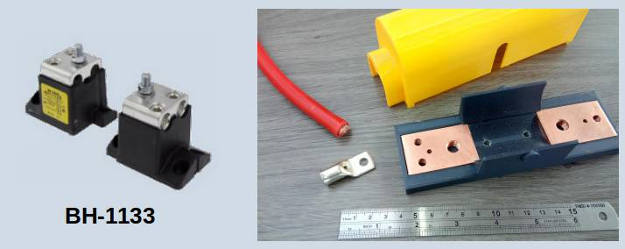
I'm suggesting that the Breaking Capacity is every bit as important as the rated value. The Bussman type-T which I'm currently using is rated 250A, with a breaking capacity of 200kA.
I wouldn't expect the 250-FM fuse to 'blow' because my inverters have taken slightly more than 250A through it. I've got DC circuit-breakers for that level of current protection. The fuse is there to provide fire/explosion protection in case of a short-circuit.
At the moment I'm building my own fuse-holders with an outer cover. I can't find a supplier with stock of the Bussmann BH-1133 modular fuse-blocks.
Save energy... recycle electrons!
Topic starter
21/07/2022 3:25 pm
@transparent Yes the amp rating. ChickenBig said "I confirmed with a Seplos tech-support person that these are 400A Zeeman ANMH fuses; they have an interrupt rating of 2,000A@80V DC"
22/07/2022 11:15 am
Zeeman is a Chinese manufacturer. Their website provides scant detail of their ANMH fuse range.
It isn't even clear if the 'ANMH' name refers to the fuse characteristics, or merely the case style!
Similar looking 'ANH' and 'ANS' fuses from other manufacturers are commonly used in electric vehicles.
It's a 'slow blow' fuse, and similar to the Type-T in that respect. It will tolerate surges when motors start up, for example.
I'm wary of three points:
- Zeeman quote an Interrupting Rating of 2000A. That's not the same as a Breaking Capacity, and is much lower than the instantaneous current which would flow from a 48v LiFePO4 battery if the attached inverter went short-circuit.
- The ceramic casing may well 'contain' the arc as the fuse ribbon melts, but it doesn't look physically large enough to contain any silica-based quenching agent.
- The blow-time of 0.1 to 1 second at 2kA of current seems too long. To prevent a 'flash fire' in the electronics of an inverter, I'd want to see a fuse operating much faster than that - say, within 1mS.
I'd want to know more detail before I'm confident that the Zeeman ANMH really would prevent fire from an accidental short circuit.
Remember, you don't have to stick with the internal fuse which Seplos supply in the Mason box. You can always add a second fuse in series. If it's physically too large to go inside the box, then add it externally.
The whole point is that both you and a house insurer would feel confident that you've taken reasonable steps to minimise risk. (That's what Loss Adjusters want to see.)
Save energy... recycle electrons!
SPONSORS
Degrees of Separation

Latest Posts
-

RE: Missing flow temperature in Heat Geek proposal
Not sure I agree entirely with that, @singlespeed. Fr...
By Majordennisbloodnok , 4 minutes ago
-
RE: Replacing Storage Heaters with a Heat Pump in a Stone Cottage
I fully sympathise with any wish not to have to sign up...
By cathodeRay , 37 minutes ago
-
Vaillant ecoTEC Plus - Flow Temp and Set Up
Still setting up and testing my new Vaillant. Firstly...
By trebor12345 , 51 minutes ago
-
RE: Indevolt Batteries UK Support & Info Thread
The main issue is that the items you want to power are ...
By JamesPa , 2 hours ago
-
RE: battery storage without solar
Also don't forget that in you may not be able to use th...
By JamesPa , 4 hours ago
-
RE: Tesla Powerwall (2) Calibration Cycles
One practical safeguard is to separate the calibration ...
By EnergyStorageTech , 5 hours ago
-
RE: Nook batteries from Octopus
Until Octopus publishes the electrical limits, the key ...
By EnergyStorageTech , 9 hours ago
-
RE: tepeo ZEB UK Support & Info Thread
There is at least one large scale system in this catego...
By Toodles , 17 hours ago
-
RE: Getting closer to a finished Haier system
Apart from sealing the external Primary Pro joints and ...
By Singlespeed , 22 hours ago
-
RE: Are We Sleepwalking Into Another Race to the Bottom?
@jamespa Hope someone tries it! As a consumer, I woul...
By Batpred , 2 days ago
-
RE: Air-to-Air Heat Pumps & Air Conditioning: UK Heating and Cooling Q&A
Our latest Homeowners’ Q&A episode has just dropped...
By Mars , 2 days ago
-
RE: Vaillant ecoTEC Plus with sensoCOMFORT and weather compensation
Yes, its described in the sensocomfort manual. Its als...
By JamesPa , 2 days ago
-
RE: Heat Geek installations: share your experiences
My summary, highlighting the oddities.
By Batpred , 2 days ago
-
RE: Renewable Heating Hub Homeowners' Q&A Podcast
What a day yesterday! Two podcasts recorded, brilliant ...
By Mars , 3 days ago
-
RE: Adding additional Solar Panels to a DC coupled battery system
I too use AI when researching online. It's able to co...
By Transparent , 3 days ago






SPONSORS