
Notifications
Clear all

30/11/2025 8:04 pm
That's the approach Britain took with HS2.
The number and depth of academic reports was substantial.The costs were given less emphasis because they were substantiated on the future boost to the economy, brought about by benefits which HS2 would bring to the Midlands and the North of England.
I'm not sure at what stage in the project you are referring to but HS2 was proposed and designed by civil engineers not 'academics'.
Not that this bears any relationship to what I said about the expertise in Devon re both climate change and renewable infrastructure which, once again has working engineers on the payroll because the SW is the home of technical consultancies. Some of these people have global expertise - boots on the ground. Including oil and gas btw.
Plymouth, likewise.... Never mind the MOD. Which has major renewables plans in Devon.
In other words you can't randomly cast aspersions on 'academics' as a generic category.
"That list is confidential, but does not include the 2700-acre Beacon Solar Farm being proposed for the area just north of Pyworthy Bulk Supply Point (see location on map below)."
The list is not confidential. This is perhaps outdated information. As I have said, I'm communicating directly with NESO and was in a technical conference with them recently and I will be again.
Again, not that it's relevant to what I said.
What I said was the view of policy formation you outlined is very far from the truth of how policy-making actually happens.
You are talking about it as if this is all down to 'air head' politicians who make decisions without knowing what they're talking about.They don't have anything much to do with it actually. That's not how it works.
And you can put them all right by copying our forum posts and sharing them in media briefings to local Reform/Tory/? MPs - and help them to block planning applications.
I'm not arguing the rights and wrongs of individual applications but I do object to climate change deniers and the Reform anti-renewables lobby.
I have no skin in the game btw.... None! I'm not an activist. I'm not allied to any political party. Nada... That's how and why I can do my work.
As I keep pointing out - climate change is a fact - how we achieve decarbonisation is an open question imo.
30/11/2025 8:52 pm
Now let's look at the 'boosting the local economy'aspect.
NESO have helpfully published the same map, but showing areas which suffer most from energy poverty.
The divisions are Local Government boundaries.Fuel Poverty is measured using the Low Income Low Energy Efficiency (LILEE) indicator.
Under this indicator, a household is considered to be fuel poor if they are living in a property
with fuel poverty energy efficiency rating of band D or below and when they spend the required
amount to heat their home, they are left with a residual income below the official poverty line.
[HMG Fuel Poverty Statistics]
What's this got to do with boosting the economy? I am the person who raised energy poverty as an issue in this forum a while back.
Fuel poverty is a horrible problem I know rather a lot about but what has it got to do with my point about the money coming into the region to build a renewables tech economy?
Why are you quoting poverty figures from the past as if they somehow "prove" that renewables are not going to boost the local economy in the future? They do nothing of the sort...
We know the SW has a huge division between the well-off (mostly retired) and low income groups. We know it has suffered from under investment. So if renewables (in the broadest sense - not just pylons and panels) offers a chance to improve that why block them?
If renewables offer a route towards energy security and enable us to be less at the mercy of global fossil fuel markets why block them?
What's your view on climate change?
In the deep SW green tech including marine, agritech, biotech, clean energy and environmental science had a £24.1bn turnover in 2024. It's had more injections of funding and new start ups since then. And no it's not on electricity bills.
Once again, I have not offered my opinion on how this functions but it is happening. Skills training funding has only just been started. The number of start-ups and enduring start-ups has grown a lot. Electricity distribution networks are also changing quite dramatically in some areas in the future but I'll leave it at that.
Really, this is all looks like a 'dead cat' strategy - whether intentional or not.
Lots of pretty charts and maps and random information that does a good job of distracting but doesn't REALLY answer the questions. They always seem to impress some people I guess.
But they distract from what was raised - Reform lobbying, and blocking renewables planning applications. All while sounding very reasonable.
I'm actually very interested in people who feel they have no stake in decarbonisation but when I see climate change deniers whipping that up for their own political purposes, I find it quite disconcerting. I guess that's because I have literally followed the money in the past and seen the huge gap between the 'leaders' and what they say versus what they do and the 'followers'.
I certainly don't want my forum posts and my work being used to prop that up. Sadly, it limits what I feel I can say here going forward.


30/11/2025 9:14 pm
@batpred, the figures on the graph you show suggest a difference of more in the region of 7-8p.
..
As for your Octopus question, yes the price differential between the incoming and outgoing Agile tariffs has historically been along those lines quite often.
However, the period available to discharge the battery at the highest export rate has typically only been one or two half hour slots. Even if you were able to exploit that every day of the year at the maximum throughput, your 8kW inverter would earn you a princely sum of £87.60 and leave your battery in the winter with 8kWh less to avoid your heat pump from importing from the grid at a higher price than necessary. In practice, unless you enjoy the thrill of the chase, the gaming of the agile rates to make money is a lot of effort for very little real return.
😀
Thanks, today seems a particularly good day.
At the moment we have no heatpump and Solis AI has some algo looking to maximise "benefit" (have to be careful with the terminology as Reeves may want me to keep some accounts...). So when I get the SEG export finished and start being able to export, I could change from the self-use algo to the "profit" one....
But good point: £87... even if that is 8.7% of the cost of an additional 16kwh battery...?
16kWh Seplos Fogstar battery; 8kW Solis S6-EH1P8K-L-PLUS hybrid inverter; Ohme Home Pro EV charger; 100Amp head, HA lab on mini PC
30/11/2025 10:44 pm
The UK has no 'official' definition of fuel poverty. We also have no concrete energy poverty policies whereas the EU has made it a designated area for decarbonisation policies. For instance, a percentage of the national carbon taxes in each country has to be spent on energy poverty alleviation. This is happening in numerous ways from bill support to offering refits for housing and renewable heating. Refits, as far as I remember, are policy too.
We've discussed it in these forums before if you search. There's also some good discussions on energy pricing too . Britain is an outlier because we privatised so heavily and extensively in the 90s.
One example I suggested previously is Spain where energy consumption is banded in tiers and charged at different rates depending on consumption - with exemptions for disability, health or old age.
Spain also has special tariffs for low income. But above all they have mostly disassociated gas prices from renewables and because they have massively increased their national renewable energy generation capacity their consumer electricity is now one of the cheapest in Europe.
Britain just dumps non-payment onto consumer energy bills which is somewhat tautological because it raises the bills of the energy poor too.
Because there's no definition of energy poverty in those numbers above they are not truly indicative - they count non-payment mainly but then randomly switch to other metrics.
However, for many people energy poverty is often dealt with by cutting energy use - lots of very energy poor people just stop consuming energy but they pay their bills. So they get missed in these woolly stats.
1
30/11/2025 11:24 pm
I'm actually very interested in people who feel they have no stake in decarbonisation but when I see climate change deniers whipping that up for their own political purposes, I find it quite disconcerting. I guess that's because I have literally followed the money in the past and seen the huge gap between the 'leaders' and what they say versus what they do and the 'followers'.
I certainly don't want my forum posts and my work being used to prop that up. Sadly, it limits what I feel I can say here going forward.
If anyone is looking to quote any opinion written here, it is the same as saying "I spoke to that Labour MP and she said x and y. They have no clue". Basically unless there is a name and the MP backs it, anyone drawing any conclusions from it is doing so at his/her own risk.
So in a similar way, if content of the forum is used for political scoring, this would be risky, They can easily be asked ti get confirmation from the author in writing.. I would not worry, in fact I would love if someone makes this mistake and info gets from reform councillor to their MPs!
16kWh Seplos Fogstar battery; 8kW Solis S6-EH1P8K-L-PLUS hybrid inverter; Ohme Home Pro EV charger; 100Amp head, HA lab on mini PC

01/12/2025 6:29 am
The UK has no 'official' definition of fuel poverty. We also have no concrete energy poverty policies whereas the EU has made it a designated area for decarbonisation policies. For instance, a percentage of the national carbon taxes in each country has to be spent on energy poverty alleviation. This is happening in numerous ways from bill support to offering refits for housing and renewable heating. Refits, as far as I remember, are policy too.
We've discussed it in these forums before if you search. There's also some good discussions on energy pricing too . Britain is an outlier because we privatised so heavily and extensively in the 90s.
One example I suggested previously is Spain where energy consumption is banded in tiers and charged at different rates depending on consumption - with exemptions for disability, health or old age.
Spain also has special tariffs for low income. But above all they have mostly disassociated gas prices from renewables and because they have massively increased their national renewable energy generation capacity their consumer electricity is now one of the cheapest in Europe.
Britain just dumps non-payment onto consumer energy bills which is somewhat tautological because it raises the bills of the energy poor too.
Because there's no definition of energy poverty in those numbers above they are not truly indicative - they count non-payment mainly but then randomly switch to other metrics.
However, for many people energy poverty is often dealt with by cutting energy use - lots of very energy poor people just stop consuming energy but they pay their bills. So they get missed in these woolly stats.
Are you an academic?
01/12/2025 9:32 am
@majordennisbloodnok Roulette anyone? 😉
🙂
Well, octopus does have some games on their API, giving some freebies..
16kWh Seplos Fogstar battery; 8kW Solis S6-EH1P8K-L-PLUS hybrid inverter; Ohme Home Pro EV charger; 100Amp head, HA lab on mini PC
01/12/2025 9:39 am
Just curious
Is that OK?
Are you an academic?
I am looking to become one again, Jeff, topic being what's behind the promotion of "alternative views" on decarbonisation 🙂
In the meantime, I am a gambler!
16kWh Seplos Fogstar battery; 8kW Solis S6-EH1P8K-L-PLUS hybrid inverter; Ohme Home Pro EV charger; 100Amp head, HA lab on mini PC

01/12/2025 10:04 am
Because there's a superb range of expert opinion in the S. West, for example. The University of Exeter has a world-renown climate and energy policy department. Never mind Plymouth and elsewhere. Perhaps it would be better to point your councillors and MPs at experts.
That's the approach Britain took with HS2.
The number and depth of academic reports was substantial.The costs were given less emphasis because they were substantiated on the future boost to the economy, brought about by benefits which HS2 would bring to the Midlands and the North of England.
I'm not sure at what stage in the project you are referring to but HS2 was proposed and designed by civil engineers not 'academics'.
My apologies.
I should've written "The number and depth of expert reports was substantial".
It was your post that linked expert opinion to universities in SW England.
I shouldn't have followed in that direction.
My communications with Councillors and MPs aren't constrained to SW England.
There is no restriction on the location of a Councillor who asks me for advice or a meeting.
Briefings which I wrote over a year ago are being sent between Members of Local Planning Authorities, and can end up anywhere.
The Universities of Exeter and Plymouth are not the local centres of Net Zero expertise for the majority of the energy plans I'm looking into.
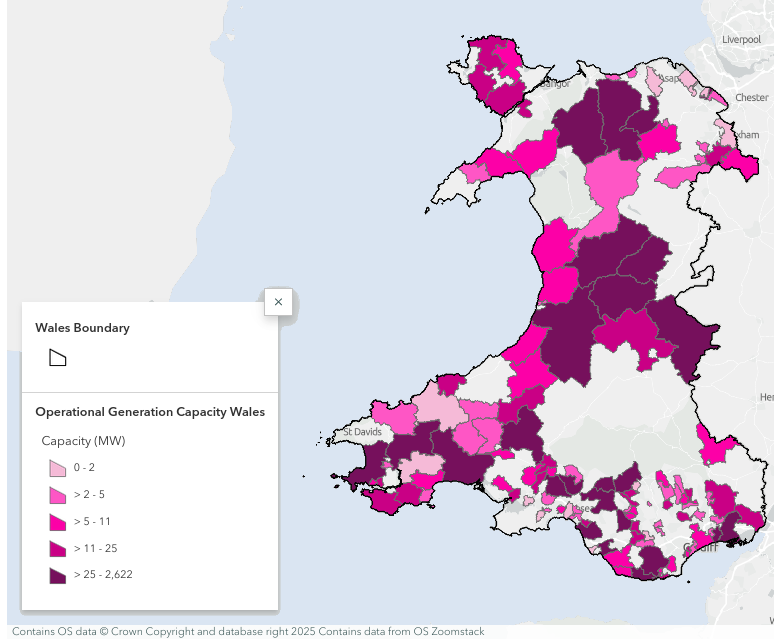
Within this Topic, I selected the example of grid capacity constraints for generation in Devon and Cornwall because I already had the three maps which demonstrated the point I made.
I do also have relevant maps (NESO and National Grid) for other areas of GB, but these would still need editing to allow the same overlays.
Here, for example is the Operational Generation Capacity for Wales:
The UK has no 'official' definition of fuel poverty.
Quite possibly.
But I deliberately used the map derived from the statistics which NESO has used in the RESP's Nations and Regions Context document.
That document is proposed as one of the five sources from which tRESPs will create future energy strategy.
As such it includes the definition of Fuel Poverty and the source reference which I took care to quote:
Fuel Poverty is measured using the Low Income Low Energy Efficiency (LILEE) indicator.
Under this indicator, a household is considered to be fuel poor if they are living in a property
with fuel poverty energy efficiency rating of band D or below and when they spend the required
amount to heat their home, they are left with a residual income below the official poverty line.
[HMG Fuel Poverty Statistics]
Since the Nations and Regions Contexts documents form part of the current RESP Consultation process, anyone here can
respond and raise objections to the Fuel Poverty classification and mapping detail.
The Consultation allows for alternative proposals to be made by respondents, including comparisons with Spain if you wish.
Because there's no definition of energy poverty in those numbers above they are not truly indicative - they count non-payment mainly but then randomly switch to other metrics.
Sorry, I don't understand that.
What numbers? The statistics being used by NESO, from which I quoted?
Or was it an earlier reference from someone else, which has incorporated non-payment as a source?
Lots of pretty charts and maps and random information that does a good job of distracting but doesn't REALLY answer the questions. They always seem to impress some people I guess.
NESO would be disappointed to learn that.
But they ought to hear that opinion.
They are creating the regulatory mechanism by which Britain's strategic energy planning will be decided for the future... until at least 2050.
If there are problems/distractions with the maps and information included in their five Reference Foundations, then how will the REAL answers arise?
The information and references I'm giving here are derived from NESO's RESP process.
These Foundations are the basis on which the Strategic Board for each RESP must make their decisions...
... initially on the next RIIO-ED3 Agreements between DNO's and Ofgem,
... and then on the Regional Energy Strategic Plans themselves.
Those decisions affect future energy pricing.... the subject of this Topic.
Where the Regional Energy Plans indicate that increased investment is required in infrastructure, then Ofgem will use that to approve increases in bills.
Save energy... recycle electrons!
1
01/12/2025 9:14 pm
Are you an academic?
No...
I have postgrad-level research experience though. Does that count?
I'm working on a Europe-wide research project on grids, generation and decarbonisation. As the person writing these pretty posts already knows.
And is easy to discover if you explored this forum a little before asking. I have a professional background in analytics - defence, UK government depts, banks etc. - amongst other things.
And you are so easily distracted by pretty pictures and waffle that you don't ask yourself why anyone would go to so much effort and yet carefully avoid not answering the points originally raised.
Fascinating...
2

Latest Posts
-
RE: Octopus Cosy 12 Heat Pump Regret: Incredibly Loud, Poor Heating & Constant Hum - Help!
So, after much anguish, and even visiting the neighbour...
By razz , 18 minutes ago
-
MLCP (Multi-Layer Composite Pipe) for ASHP
@editor nope. The info you reported was sufficient for ...
By iotum , 2 hours ago
-
RE: Advice for a novice on Mitsubishi Ecodan 6kW
@robs Quick response while I'm in stationary traffic le...
By Sheriff Fatman , 3 hours ago
-
RE: Setback savings - fact or fiction?
Maths looks right to me, my only question about this ca...
By JamesPa , 3 hours ago
-
RE: Ideal HP290 14kW ASHP - how to optimise
@jamespa I wasn’t offended at all. You are very knowled...
By Davesoa , 3 hours ago
-
RE: Experience - New Build / Complete New Heating System
@vincro I would be surprised if it is much above 5 to 6...
By ASHP-BOBBA , 4 hours ago
-
RE: Recommended home battery inverters + regulatory matters - help requested
Yes, certainly not enough could have been tested in any...
By Batpred , 4 hours ago
-
RE: Post-Traumatic Heat Pump Stress Disorder
Yes bang on and maybe I can illustrate that by way of e...
By iotum , 6 hours ago
-
-

RE: Replacing my 18 month old Hitachi Yutaki ASHP
A big thank you to @jamespa for all his efforts online ...
By trebor12345 , 9 hours ago
-

RE: GSHP WOES! Midland based engineer recommendations?
@editor It is indeed for servicing. My current service ...
By Morgan , 10 hours ago
-
RE: Sunsynk Whole House Backup Issue
Hi @lostandconfused , I agree that topic/thread is the ...
By Batpred , 10 hours ago
-
RE: Speedcomfort radiator fans
In case it helps Andrew Kuhne on openenergy monitor has...
By JamesPa , 11 hours ago
-

Things have gone quiet with you @drei. Any updates?
By Mars , 14 hours ago
-
RE: Passiv Smart Thermostat - Help & Forum Support
Thanks @tim441. Interesting timing, as Passiv are a cur...
By Mars , 15 hours ago
-
Hi everyone, I have a two year old Marlec Solar iBoos...
By Tallmarc , 18 hours ago
-
RE: Please help with the settings ecodan
Are you trying to address any particular performance is...
By Sheriff Fatman , 24 hours ago
-
RE: Solis inverters S6-EH1P: pros and cons and battery options
🤣 Well, I never managed to get the HA solis "...
By Batpred , 1 day ago