On 7th Nov NESO issued their usual weekly Newsletter.
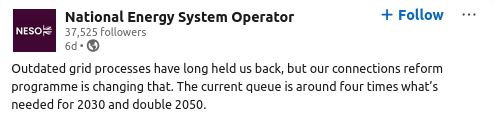
One item linked to their LinkedIn page. The opening paragraph and the statistics in the video-clip on that page are relevant to this topic on pricing.
The information being presented will have been derived from NESO's Connections Reform Process, which started in May'25.
We can assume that the 800GW figure in the video is the total of the "offers to connect" which NESO were presented with.
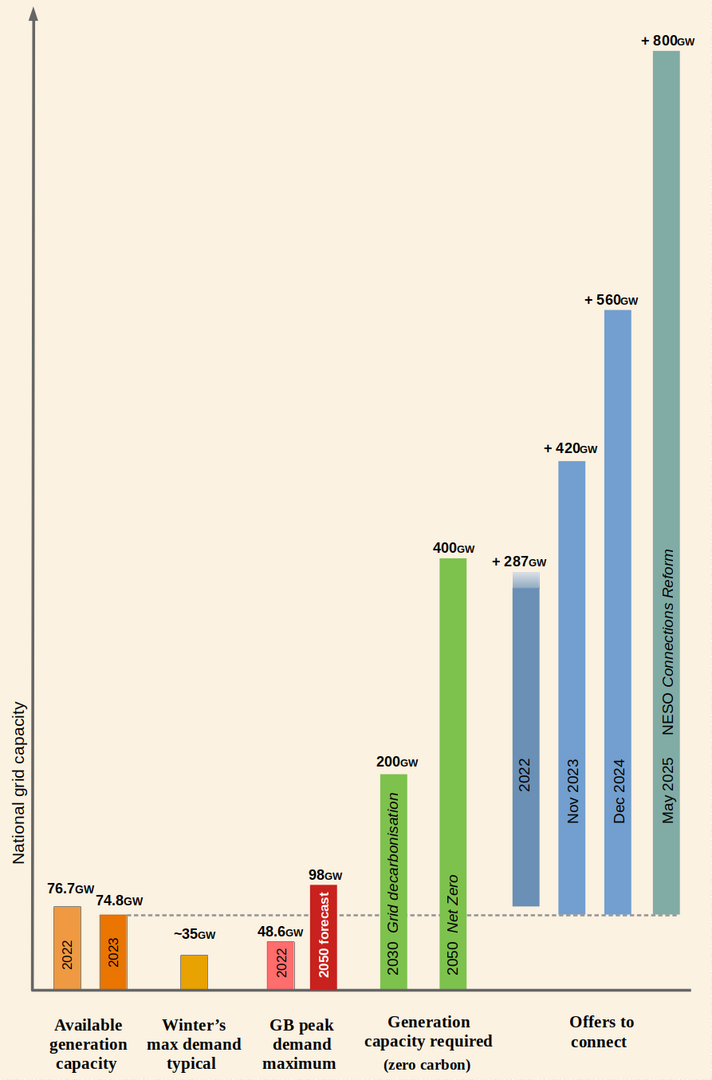
I have therefore added three columns to the Grid Capacity histogram which I've posted to this forum over the years:
Start at the rightmost columns in blue.
The first three blue columns are taken from National Grid sources. They're public announcements, but must have reasonable accuracy in order to comply with Stock Market regulations.
The rightmost column is that Offers to Connect queue which NESO calculated through the Connections Reform program.
Note that offers to connect are in addition to the existing base of available generation. So those columns don't start at zero.
meeting Net Zero for all GB energy processes by 2050
I've started those columns at zero because that's the implication from NESO's wording, but I may be wrong. In any case a large proportion of existing generation will have been decommissioned by then.
The other columns on the histogram can be substantiated from DUKES, chapter-5, which is published annually in July.
As we consider and discuss these statistics, let's remember why NESO assess the need for 200GW of generation (and storage) capacity to decarbonise the grid by 2030.
Unlike my earlier orange columns, NESO's figure takes into account that all of that generation will be derived from renewable sources.
Thus their first green column isn't necessarily in conflict with my orange column for 2023. They're basically telling us that to guarantee 70GW-ish of actual electricity, we need to start with 200GW of potential generation.
This post was modified 1 month ago 5 times by Transparent
They're basically telling us that to guarantee 70GW-ish of actual electricity, we need to start with 200GW of potential generation.
I guess that isnt too much of a surprise that there is a fairly large ratio if its largely renewables, given that renewables are rather variable in output. How much nuclear is there in the mix and tidal for that matter both of which are more reliable.
Does it suggest that there will be some cheap electricity to be had and also some very expensive electricity, so those who can manage their loads or have batteries will be still be able to play games, much like now!
4kW peak of solar PV since 2011; EV and a 1930s house which has been partially renovated to improve its efficiency. 7kW Vaillant heat pump.
On 7th Nov NESO issued their usual weekly Newsletter.
One item linked to their LinkedIn page. The opening paragraph and the statistics in the video-clip on that page are relevant to this topic on pricing.
The information being presented will have been derived from NESO's Connections Reform Process, which started in May'25.
We can assume that the 800GW figure in the video is the total of the "offers to connect" which NESO were presented with.
I have therefore added three columns to the Grid Capacity histogram which I've posted to this forum over the years:
Start at the rightmost columns in blue.
The first three blue columns are taken from National Grid sources. They're public announcements, but must have reasonable accuracy in order to comply with Stock Market regulations.
The rightmost column is that Offers to Connect queue which NESO calculated through the Connections Reform program.
Note that offers to connect are in addition to the existing base of available generation. So those columns don't start at zero.
meeting Net Zero for all GB energy processes by 2050
I've started those columns at zero because that's the implication from NESO's wording, but I may be wrong. In any case a large proportion of existing generation will have been decommissioned by then.
The other columns on the histogram can be substantiated from DUKES, chapter-5, which is published annually in July.
As we consider and discuss these statistics, let's remember why NESO assess the need for 200GW of generation (and storage) capacity to decarbonise the grid by 2030.
Unlike my earlier orange columns, NESO's figure takes into account that all of that generation will be derived from renewable sources.
Thus their first green column isn't necessarily in conflict with my orange column for 2023. They're basically telling us that to guarantee 70GW-ish of actual electricity, we need to start with 200GW of potential generation.
Will we will get 70GW of electricity from 200GW of generation and storage?
The overall load factor for installed generation varies by site and technology, but the average in 2024 was 28%. Solar was 10%.
I wouldn't be surprised if we are to cope with peaks and troughs in demand/supply that we need a bit more capacity, even allowing for storage/load shedding/load shifting etc.
How much nuclear is there in the mix and tidal for that matter both of which are more reliable.
By 2030 both turbines at Hinkley-C will be running, which comes to 3.26GW
Hydro is the highest level of renewable generation because it can be controlled. But the bulk of it is in Scotland.
EGL1 (Eastern Green Link 1), EGL2 and EGL3 will all be functional. Each is a DC submarine cable at around 2GW.
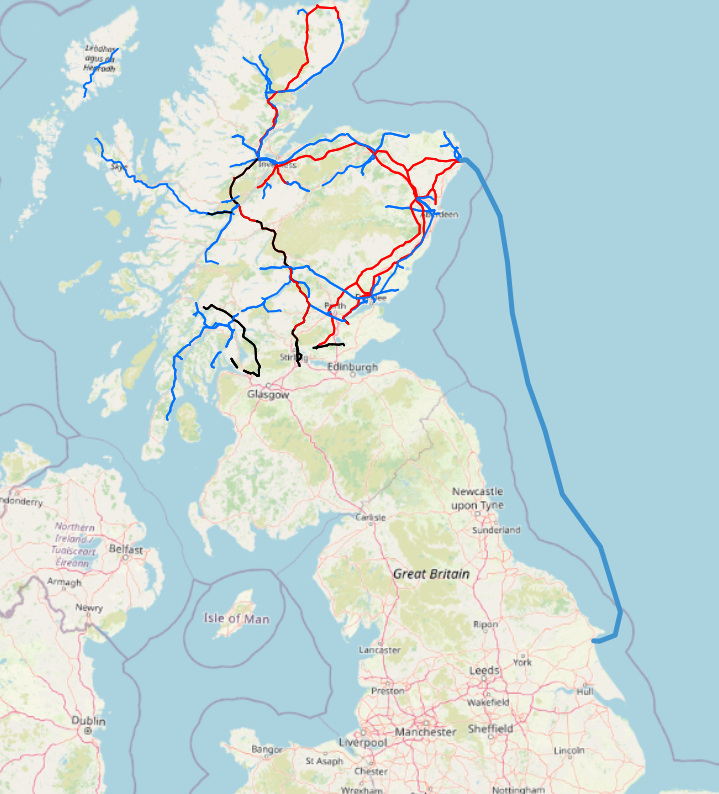
This map shows the route for EGL2
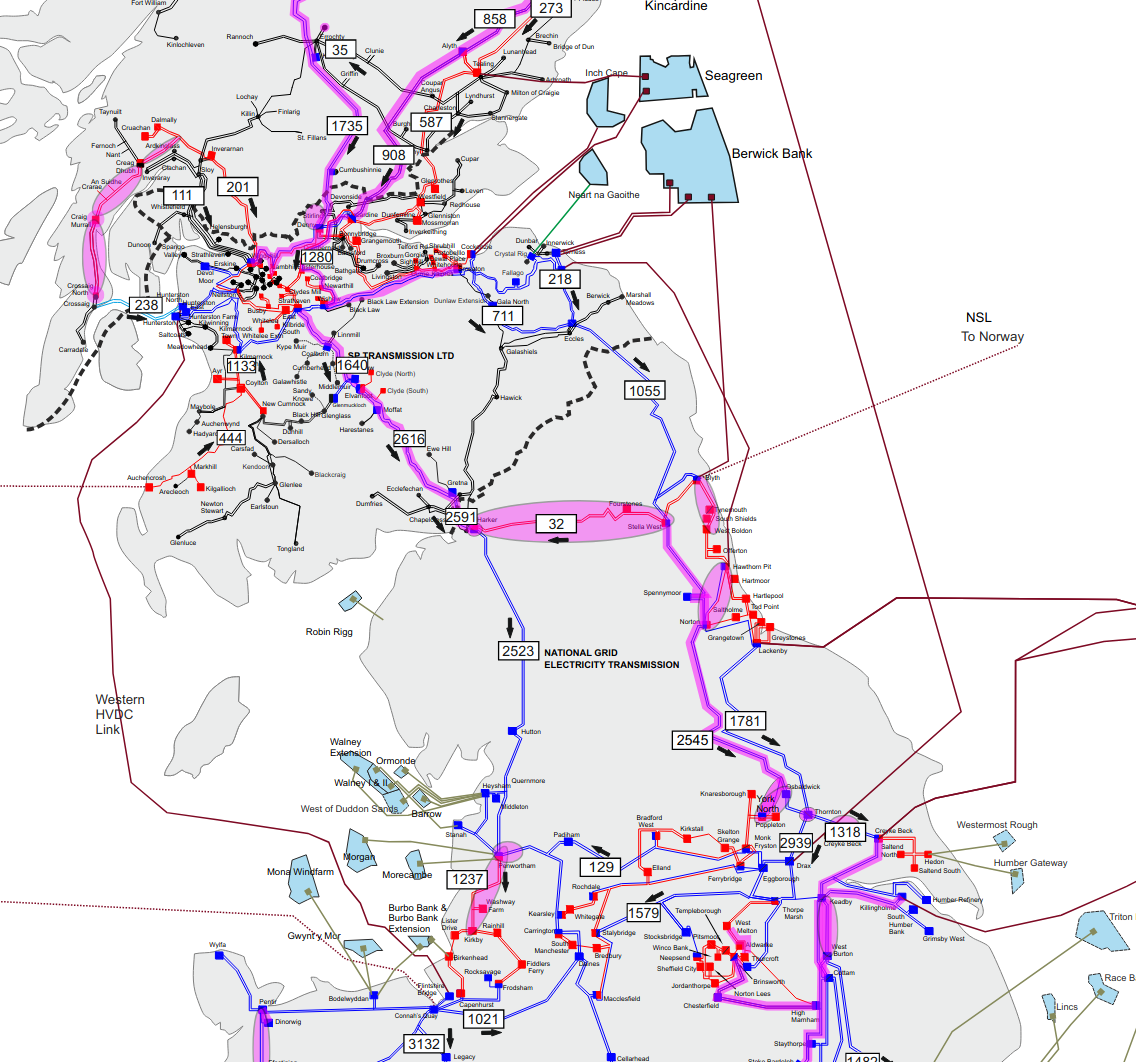
The EGL projects are to bring large amounts of Scottish hydro-electricity southwards, avoiding the need to upgrade the weak Transmission Grid from Edinburgh/Glasgow across the English border to Lancashire/Yorkshire.
The figures in those rectangles are MW.
If you want to look deeper into this, have a look at the ETYS (Electricity Ten Year Statement) documents, now here on NESO's website.
This post was modified 1 month ago 4 times by Transparent
In their submission to the Commons Select Committee, National Grid had argued that the then-existing definition of Long Duration was too short, and needed to be used for storage lasting 200hrs and above.
The Lords obviously agreed with that, because they used that figure in their own deliberations.
The problem with Britain having LDES, is that it must be continuously funded to remain on standby. The site's owners have no revenue-stream to retain that stored energy.
For that reason it's very difficult for LDES projects to attract financial investors, especially for the development of new LDES technology.
The quantities of storage being contemplated are also far too low. There's little point in having LDES sites with export capability of a few hundred megawatts, because it isn't capable of keeping the grid 'live'.
One way of incentivising longer term storage would be to stop giving grid connections to any more short-term battery storage applications.
The great majority of the battery storage sites in GB are based on a 2-hour model. This is financially lucrative, but the owners of those Short Duration BESS assets aren't contracted to provide electricity for the benefit of GB.
Instead they sell it all over Europe, whilst leaving NESO to pay for CCGT plants to be kept running during periods of high demand. See Watt Logic 13th Jan'25.
The problem with Britain having LDES, is that it must be continuously funded to remain on standby. The site's owners have no revenue-stream to retain that stored energy.
For that reason it's very difficult for LDES projects to attract financial investors, especially for the development of new LDES technology.
The quantities of storage being contemplated are also far too low. There's little point in having LDES sites with export capability of a few hundred megawatts, because it isn't capable of keeping the grid 'live'.
Not to mention the planning issues involved, assuming we are talking pumped hydro (or are they considering very large battery banks - at least as big a planning issue probably bigger..
Just to get an idea, roughly how much LTS is needed to make a material contribution, and at what charge/discharge rate?
4kW peak of solar PV since 2011; EV and a 1930s house which has been partially renovated to improve its efficiency. 7kW Vaillant heat pump.
Erm... obtaining planning consent is rarely a problem for applications which are energy-based.
Existing Planning Regulations are inadequate to address the issues raised by energy applications. LPAs are still required to make decisions to consent or reject applications where they
a) are speculative, or with little evidence that they can be delivered
b) fail to state the parties involved in the project
c) show no evidence of communication with the Grid Operator
d) omit which category of EREC G99 certification applies to the site
e) incur infrastructure upgrade requirements which are disproportionate in form or cost
f) are sited in an area which already exhibits substantial over-generation
g) are sited such that they reduce grid resilience or threaten security of supply
h) fail to mention additional/related/future energy projects which will follow
i) conflict with other generation/storage projects in the same area
j) are an attempt to acquire available grid-connection capacity also sought by other applicants
k) are seeking planning consent to be used as a company asset which gets sold on
l) omit detail of what is to be installed; its capacity or battery-chemistry for example
m) can be controlled by foreign actors who would be regarded as hostile to the UK
Important as these attributes are, they would presently be classed as ‘not material’, and therefore be ignored when considering the application.
I guess I wouldn't have thought that cooling something was a way to store energy!
Im still trying to get my head around the order of magnitude numbers. I think you said we need 70GW delivered capacity. Long term storage presumably means for more than a day so presumably we also need to store order one days worth of energy. Allowing for the presumption that 70GW is the peak, a days worth is presumably something like 500GWh. Is that saying that we need 1000 facilities like the one in Manchester?
Looked at another way 500GWh is 500*3,600GJ =1,800,000 GJ. To lift 1 cu m of water through 100m requires 1MJ, so to store a days worth of electricity by pumped storage requires us to lift 1.8Gcu m through 100m. My local reservoir, Hanningfield, holds 25M cu m, so to store one days worth of energy I need roughly 100 Hanningfields lifted through 100m.
Have I got the numbers wrong by several orders of magnitude?
4kW peak of solar PV since 2011; EV and a 1930s house which has been partially renovated to improve its efficiency. 7kW Vaillant heat pump.
Im still trying to get my head around the order of magnitude numbers. I think you said we need 70GW delivered capacity. Long term storage presumably means for more than a day so presumably we also need to store order one days worth of energy. Allowing for the presumption that 70GW is the peak, a days worth is presumably something like 500GWh. Is that saying that we need 1000 facilities like the one in Manchester?
The answer must be on continental scale interconnects.. While developing a national market for energy storage with a stable framework that goes beyond 4 year election cycles?
Waiting for new solutions to be proven and then deploy at scale is playing to the ones that want to delay the transition...
As they said, "and not or". Just make sure the and is mostly renewable based!
16kWh Seplos Fogstar battery; 8kW Solis S6-EH1P8K-L-PLUS hybrid inverter; Ohme Home Pro EV charger; 100Amp head, HA lab on mini PC
Long term storage presumably means for more than a day
LDES in this context must mean 200hrs+ That's the figure NG-ESO told the Select Committee needed to be the proper definition of Long Duration.
I'm not disagreeing with your calculations.
I don't think Parliament has understood the implications of accepting to the 200hrs+ definition proposed by NGET.
They've basically given NG-ESO (now NESO) a target to hit which will cost more than the country can afford. It allows NGET and the DNOs a reason to ask Ofgem to allow massive bill increases under the RIIO-ET3 and RIIO-ED3 contracts now in preparation.
All of the solutions currently being implemented to attain Net Zero are based on increasing the size and profits of the commercial Energy Sector.
I have put forward alternative scenarios in responses to Energy Consultations from DESNZ and Ofgem. There are solutions which would
allow the public to make better decisions using genuinely smart energy controls
implement Nodal Tariffs and hence allow storage of local generation which is otherwise curtailed (to prevent over-voltage)
subsidise battery storage for households in energy poverty and social-housing
time-slice the available capacity on the 11kV level of the grid, and hence avoid upgrading 90% of the cable routes
Large, centralised LDES harks back to the days of the National Grid being a 400kV loop with less than 100 generators.
This post was modified 1 month ago 3 times by Transparent
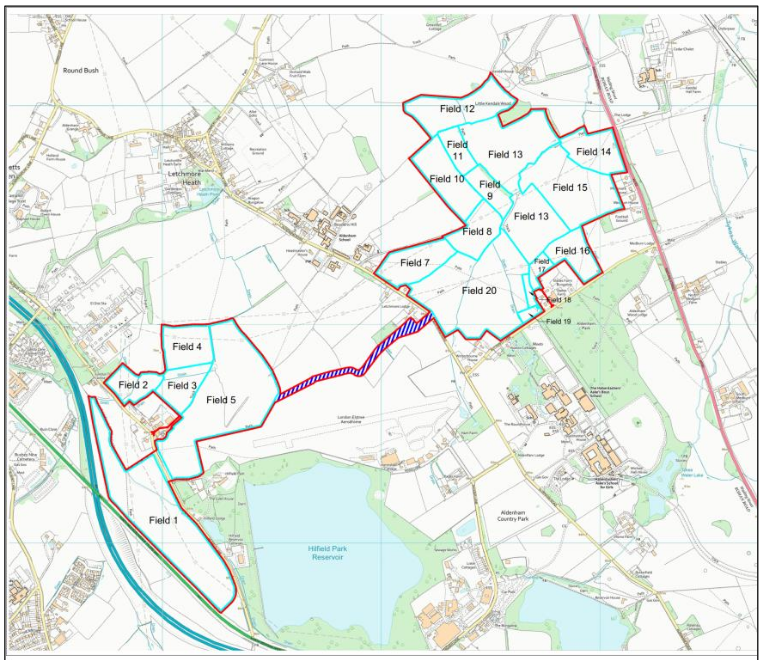
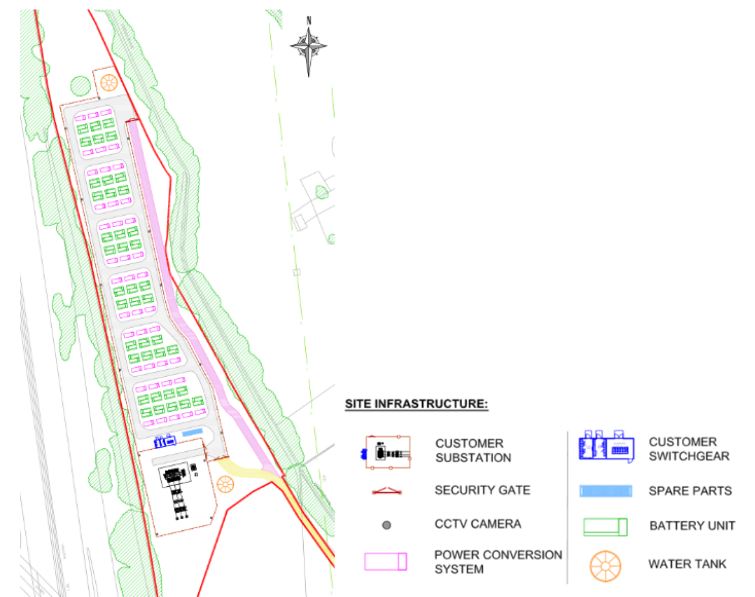
The 2020 planning application is not the same as the one being discussed by the Council in 2025.
The earlier proposal was at least five times larger, as can be seen from the Applicant's documentation:
Application 25/0153/FUL was submitted in February 2025, and was for 80 'containers' with a maximum grid connection for 49.9MW.
It occupies only the northern portion of the area designated Field-1 in the first map, adjacent to the M1.
By extrapolation, the initial 2020 Application would be requiring a grid connection of around 450MW - 500MW and therefore fell within the G99 Regulations which required a Generation Licence from Ofgem.
For that reason it would also have been classed as a Nationally Significant Infrastructure Proposal (NSIP), and would need to have been decided by the Planning Inspectorate, rather than the Local Planning Authority (LPA).
I have more information if you'd like, but we're starting to stray outside the theme of Electricity Price Predictions.
So you'll need to provide a price-related reason for continuing the conversation here 😊
This post was modified 1 month ago 3 times by Transparent