I should have asked what does 'matched pairs' mean?
It is an attempt to match the groups on one or more variables, in the hope that might match the groups on other potentially relevant variables. I took the idea from matched case control studies, where you might for example match the controls to cases on age or sex or both. If the setback days are cases, and the non-setback days are controls, then I can match on mean OAT, for each case (setback day) find a control (non-setback day) that had a very similar mean OAT (within 0.1 degree). It may or may not be a valid thing to do. The main downside is it loses a lot of data points (the ones that don't have matched controls). The only answer to that is to wait until I have more data.
Also how long was the setback (in days) in each case?
The entire period in each case, as in all the spring ones are setback days (~3 months), all the autumn ones are non-setback (~2 1/2 months).
The bonfire was a short one, but a merry one, until un-forecast rain stopped play. No blinding flashes of illumination came to me while I was tending it.
Midea 14kW (for now...) ASHP heating both building and DHW
This is in effect doing a back of the envelope eyeballed version of my predicted method. If we take the mid point 10 degrees OAT, the energy out is about 4.5kWh. Given a 6 hour setback, that is 6 x 4.5 = 27kWh of energy out, not 13kWh. I am not sure how you got to only 13kWh. But the real problem I have with this is approach (focusing on the energy out) is you then have to convert back to energy in (which is what we are actually interested in), and that is place where we have to make a lot of assumptions about things like COP. Why not do the simple thing and look at the energy in in the first place?
The 13kWh is as they say my bad, I was calculating 3 hour periods for the reheat and mistakenly only multiplied by 3 here, so 13 should have been 26.
The reason for energy out is because it directly relates to the temperatures (IAT and OAT), while energy in introduces another variable in the form of COP, so using energy out is easier to work with. But I'll come back to energy in...
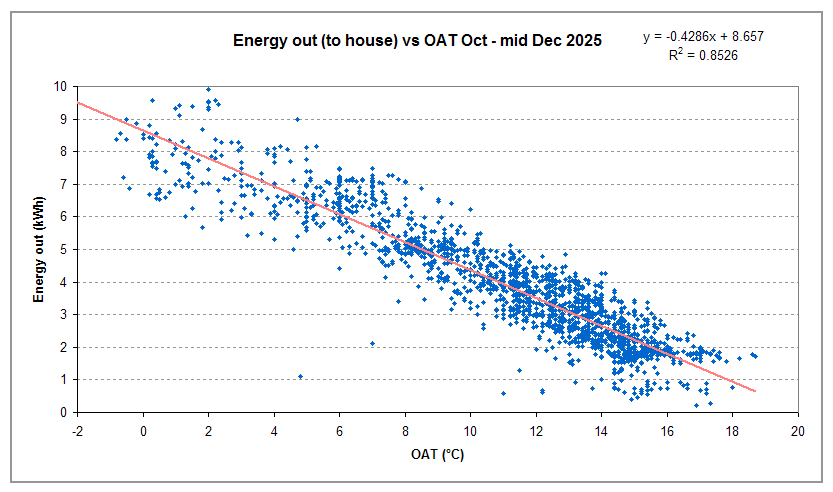
We can do better than 'about', we have the data in the csv files: it is 23.64kWh in the first 3 hours, 0300 to 0600 (your Mark 1 eyeball works very well!) but hourly mean OATs are lower (3.6, 3.5, 2.4), lets say 3.2 degrees, for which the energy out chart suggests around 7.4kWh, or 3 x 7.4 = 22.2kWh for the three hour period. That suggests extra energy out (to the house), but only 1.44kWh, not 4kWh.
Doing the same thing for 0600 to 0900 and 0900 to 1200 comes out at
0600 to 0900: 22.00kWh at a mean OAT of 4.07 vs 6.6 x 3 = 19.8kWh from the energy out chart = excess of 2.2kWh supplied vs your 6kWh
1900 to 1200: 11.97kWh at a mean OAT of 10.3 vs 4.3 x 3 = 12.9kWh from the energy out chart = excess of 0.9kWh supplied vs your 'about the same'.
Thus the total extra energy put back over the 0300 to 1200 period appears to have been 1.44 +2.2 + 0.9 = 4.54kWh, not 10kWh.
How does this compare to what was lost during the setback? The mean OAT was about 10 degrees, and IAT dropped from 19.9 to 18.5 degrees during the setback. If we treat my house house a big radiator sitting in my garden warming my garden, how much heat has to be lost from the house to the garden to for the IAT to fall by 1.4 degrees? Now, I am not sure, but it seems to me we can use the energy out chart to get a handle on this by changing it to an inside outside delta t chart rather than an absolute OAT chart. In fact, we don't even need to chart it. If the mean OAT was 10 degrees, and the mean IAT was near enough 19 degrees, then the 10 degrees OAT point on the charts is also the 9 degree inside/outside delta t point, with the energy out at that point being 4.37kWh (from the equation):
If we assume the inside/outside delta t to energy out relationship is linear, which we believe it is, and at 19 degrees IAT and OAT, the energy out/heat loss is zero, see chart, then that means for degree change in inside/outside delta t, the energy out changes by 4.37 / 9 = 0.49 kWh per degree change in inside/outside delta t. If we now flip that on its head, then I think we can say that for each degree decrease (because the IAT drops, getting closer to the OAT) in the inside/outside delta t, then the energy out and/or heat loss drops by 0.49 kWh. Now there is a lot of averaging out going one here, but if that drop goes on over six hours, then the loss over that six hours is 0.49 (drop per degree) x 1.4 (the drop) x 6 (number of hours) giving a total loss over the six hours of 4.12 kWh. Doing a sanity check, this doesn't seem entirely bonkers.
You can do better as you have the raw data and clearly my eyeballing of the graphs has its limitations! But you have calculated that your heat pump put in an extra 4.54 kWh to cover the 4.12 kWh energy deficit from the setback, that seems pretty close to the conservation of energy to me. And showing that the energy lost is replaced by the heat pump later.
Returning to energy in, below is a summary of the setback 6 hours and reheat 9 hours:
21-03 Setback mean OAT of 10C => deficit of 4.12 kWh
03-12 Reheat mean OAT of 5.86C (average of 3.2, 4.07, 10.3) => reheat of 4.54 kWh
I'd be interested in seeing the numbers but intuitively, given what we know of ASHP efficiency vs OAT, I think it is quite likely that less energy would have been needed to maintain the IAT during the 6 hours of setback at 10C OAT, than was used to reheat the house in the 9 hours at 5.86C. Eyeballing your graphs again, your COP at 10C looks to be almost 5 while at 6C it's about 4, suggesting that the energy in could be 20% more than continuous running.
Now, I am a retired doctor, not a retired heating engineer, and as a rule we doctors don't bother to calculate how much energy a feverish patient loses to the ward as their fever comes down, so I may have got this completely wrong. But, if I haven't, and the heat loss during the setback is around 4.12 kWh, and the extra heat put in during the full recovery period is 4.54 kWh, then, give or take, and allowing for measurement error, the building is to all intents and purposes in energy balance, the energy lost during the setback is replaced during the recovery, and thus no violations of the conservation of energy have taken place, but overall (from the previous calculations), I have saved some energy.
Except I don't think you have saved some energy, as your heat pump has replaced the energy lost during the setback at a lower OAT than the setback period and hence with lower efficiency/COP.
On the point about whether I have subconsciously baked in the necessary adjustments into my WCC to accommodate setbacks, possibly, possibly not. For long periods of time I have the same WCC (albeit with occasional auto-adapt tweaks), whether I am running setbacks or not. The last time I changed it was on 19th Feb this year, when I lowered the left hand flow temp by one degree. Since then I have had periods of setback running and non setback running. The energy in chart above uses data from a setback period, and 24 hour period under consideration is in that setback period, so I may have baked in some extra energy in in the recovery period. I can redo the analysis using energy in data from a non-setback period, and see if that makes any difference. The energy out chart above covers a non setback period.
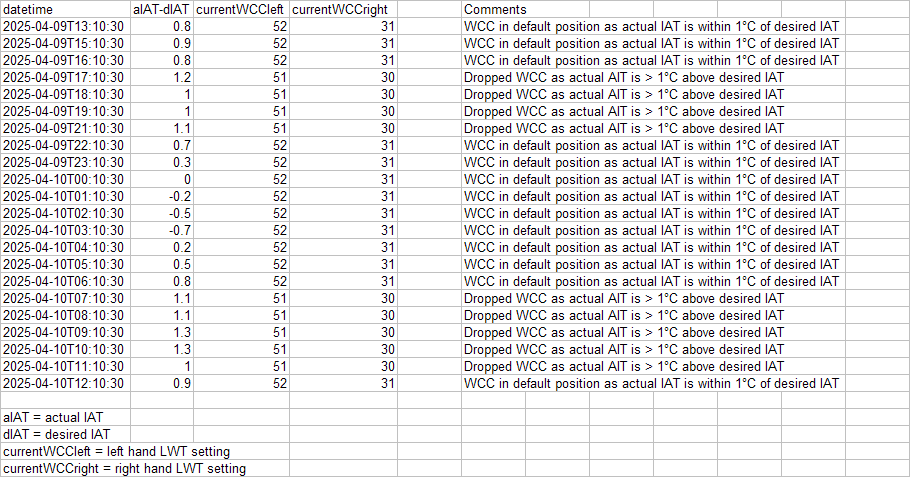
One final point just for clarity: my auto-adapt script will have done very little if anything during the 24 hours under consideration. The IAT didn't drop below 18 degrees, which is when a boost is triggered. It may have briefly lowered output a fraction mid morning on the 10th, when the IAT went over 20 degrees.
I remain as ever fully open to debate on this matter. Any comments are very welcome.
Redoing the analysis with non-setback data would be interesting, thanks in advance. It could just be coincidence, but for your auto-adapt script to possibly trigger to lower output at about the same time that your house has recovered from the setback is interesting. Do you know of any other instances where this might have happened?
The reason for energy out is because it directly relates to the temperatures (IAT and OAT), while energy in introduces another variable in the form of COP, so using energy out is easier to work with. But I'll come back to energy in...
I think I am finally getting this, since here we are looking at energy loss, gain and balance, the 'native currency' is energy out, so it makes sense to use that.
Except I don't think you have saved some energy, as your heat pump has replaced the energy lost during the setback at a lower OAT than the setback period and hence with lower efficiency/COP.
I agree, the energy balance suggests I didn't save energy, but the observed/expected method suggests I did, and it may well be the COP changes have something to do with this.
It could just be coincidence, but for your auto-adapt script to possibly trigger to lower output at about the same time that your house has recovered from the setback is interesting. Do you know of any other instances where this might have happened?
The auto-adapt script logs its behaviour, I can have a look. In fact I should already have done so!
Redoing the analysis with non-setback data would be interesting, thanks in advance.
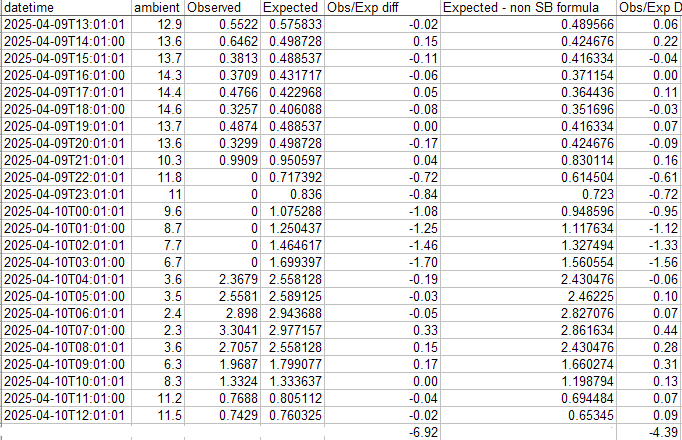
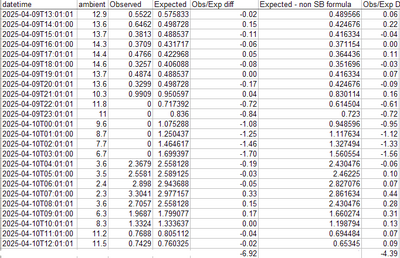
Here it is (as a snapshot). I think the result is interesting:
The last two columns are the revisions, revised expected then observed/expected difference, net difference in bottom row. At -4.39 kWh (minus = saving), it is almost slap bang in the middle between the energy balance estimates: 4.54 kWh extra during recovery to cover the 4.12 kWh setback loss. Is there some form of double counting going on here?
Midea 14kW (for now...) ASHP heating both building and DHW
The reason for energy out is because it directly relates to the temperatures (IAT and OAT), while energy in introduces another variable in the form of COP, so using energy out is easier to work with. But I'll come back to energy in...
I think I am finally getting this, since here we are looking at energy loss, gain and balance, the 'native currency' is energy out, so it makes sense to use that.
I have no problem posting it here, let me know what you would like.
Okay, thanks. Considering the setback and reheat periods at 10C and 5.86C (say 6C for simplicity), what are your mean COP values at those OATs? We could then compare the energy in for 4.12 kWh at 10C during the setback to the 4.54 kWh at ~6C during the reheat.
I agree, the energy balance suggests I didn't save energy, but the observed/expected method suggests I did, and it may well be the COP changes have something to do with this.
Yes, the COP changes are the most likely explanation.
It could just be coincidence, but for your auto-adapt script to possibly trigger to lower output at about the same time that your house has recovered from the setback is interesting. Do you know of any other instances where this might have happened?
The auto-adapt script logs its behaviour, I can have a look. In fact I should already have done so!
Great! This might be the key to why you can use the same WC curve with or without a setback. As your auto adapt script will neatly smooth out any small-ish discrepancies with your WC curve through its automatic raising or lowering of the curve.
Here it is (as a snapshot). I think the result is interesting:
The last two columns are the revisions, revised expected then observed/expected difference, net difference in bottom row. At -4.39 kWh (minus = saving), it is almost slap bang in the middle between the energy balance estimates: 4.54 kWh extra during recovery to cover the 4.12 kWh setback loss. Is there some form of double counting going on here?
Good question, something is amiss. You calculated the setback was equivalent to 4.12 kWh energy out, so it would be logical that the energy in for this period would be less than that (the COP being greater than one) but the table shows a saving of 6.29 kWh (energy in) during the setback period - so something is clearly wrong!
This post was modified 3 weeks ago 2 times by RobS
Considering the setback and reheat periods at 10C and 5.86C (say 6C for simplicity), what are your mean COP values at those OATs? We could then compare the energy in for 4.12 kWh at 10C during the setback to the 4.54 kWh at ~6C during the reheat.
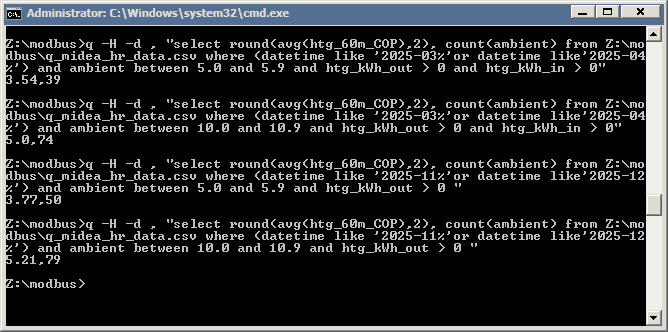
The command line program q Text as Data is good for this sort of thing. Here's some answers in four lines of code, as it looks onscreen (I've widened the ambient (OAT) range to include more samples, can also do for tighter ranges if need be):
If you are familiar with sql you will be able to make out what is going on here. For those who aren't, 'q' queries the csv file you give it based on criteria in the query. Here I am asking for a rounded average COP and count that average is based on where the date is something like, for example 2025-03% (% is a wild card) or 2025-04% ie all data from March 2025 and April 2025, and the ambient is between a range and the space heating is on (heating output > zero) and (for the first two) heating input > 0 (a workaround to deal with non-numeric values). The result is the mean COP, followed by the number of samples used for the mean. Thus:
For the March to April 2025 data (setbacks in use):
OAT 5.0-5.9 => mean COP 3.54 based on 39 samples
OAT 10.0-10.9 => mean COP 5.0 based on 74 samples
For the November to December 2025 data (no setbacks):
OAT 5.0-5.9 => mean COP 3.77 based on 50 samples
OAT 10.0-10.9 => mean COP 5.21 based on 79 samples
Both COPs are marginally better in the Nov-Dec (no setbacks) sample. Random variation, or does this tell us something?
This might be the key to why you can use the same WC curve with or without a setback. As your auto adapt script will neatly smooth out any small-ish discrepancies with your WC curve through its automatic raising or lowering of the curve.
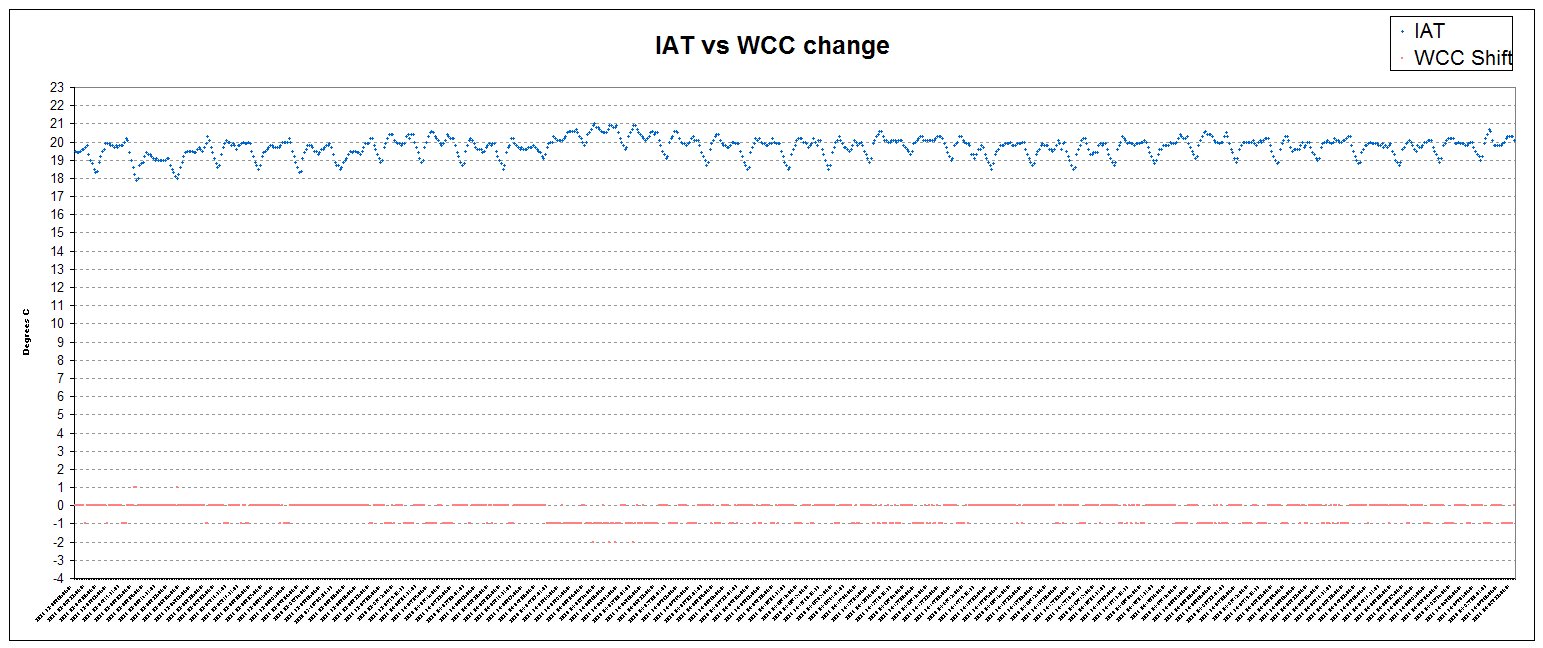
It didn't in fact do very much during the 24 hours in question because the IAT was within range most of the time:
But at other times when the actual IAT is some way out it definitely does do something!
You calculated the setback was equivalent to 4.12 kWh energy out, so it would be logical that the energy in for this period would be less than that (the COP being greater than one) but the table shows a saving of 6.29 kWh (energy in) during the setback period - so something is clearly wrong!
The 6.29 kWh (in) saving is the earlier version, using an equation derived from a setback period, and so perhaps less applicable. The rightmost column showing a 4.39 kWh (in) saving uses an equation derived from a non-setback period, and so is perhaps more applicable to predicting expected values as if there was not setback. Image re-posted here for ease of reference:
I'll do some more thinking about how to get representative COP values. One way might be to plot COP against OAT, and derive the equation. Because of the way least squares regression works, the values derived using the equation get to be mean (average) values for any given OAT.
The other thing I discovered when using q Text as Data is the previously unspotted 'inf' COP values (happens when the energy in is somehow zero but the energy out is non-zero (if only!), it seems a number divided by zero = infinity in my python script. The workaround I used works, but I would rather not have infinite COPs floating around, however desirable they might be on paper!
Midea 14kW (for now...) ASHP heating both building and DHW
If you are familiar with sql you will be able to make out what is going on here. For those who aren't, 'q' queries the csv file you give it based on criteria in the query. Here I am asking for a rounded average COP and count that average is based on where the date is something like, for example 2025-03% (% is a wild card) or 2025-04% ie all data from March 2025 and April 2025, and the ambient is between a range and the space heating is on (heating output > zero) and (for the first two) heating input > 0 (a workaround to deal with non-numeric values). The result is the mean COP, followed by the number of samples used for the mean. Thus:
For the March to April 2025 data (setbacks in use):
OAT 5.0-5.9 => mean COP 3.54 based on 39 samples
OAT 10.0-10.9 => mean COP 5.0 based on 74 samples
For the November to December 2025 data (no setbacks):
OAT 5.0-5.9 => mean COP 3.77 based on 50 samples
OAT 10.0-10.9 => mean COP 5.21 based on 79 samples
Both COPs are marginally better in the Nov-Dec (no setbacks) sample. Random variation, or does this tell us something?
@cathoderay yes I am familiar with SQL. Interesting numbers... If there was no setback we have 4.12 kWh and a mean COP of 5.21, so energy in of 0.791 kWh. With a setback the equivalent calculation (for the reheat) is 4.54 kWh and COP of 3.54 giving energy in of 1.282 kWh. The difference is a significant proportion (38% less), if not so significant in absolute terms (0.49 kWh).
Random variation or not? Difficult to tell, but as both non-setback COPs are ~5% better it would be interesting to see if other OATs have a similar difference. Could you use 'q' to repeat this for 8C and 12C?
It didn't in fact do very much during the 24 hours in question because the IAT was within range most of the time:
But at other times when the actual IAT is some way out it definitely does do something!
In the 24 hour period, it reduced the WC curve on 9 of the 18 non-setback hours. I think that is interesting and possibly (but not conclusively) points to your WC curve being setup to account for the fabric reheat after the setback. Do you have the same information for a day when there was no setback?
You calculated the setback was equivalent to 4.12 kWh energy out, so it would be logical that the energy in for this period would be less than that (the COP being greater than one) but the table shows a saving of 6.29 kWh (energy in) during the setback period - so something is clearly wrong!
The 6.29 kWh (in) saving is the earlier version, using an equation derived from a setback period, and so perhaps less applicable. The rightmost column showing a 4.39 kWh (in) saving uses an equation derived from a non-setback period, and so is perhaps more applicable to predicting expected values as if there was not setback. Image re-posted here for ease of reference:
The 6.29 kWh comes from the "Expected - non SB formula" column for the setback period (0.61+0.72+0.95+1.12+1.33+1.56), is that not the expected energy in from non-setback data?
I'll do some more thinking about how to get representative COP values. One way might be to plot COP against OAT, and derive the equation. Because of the way least squares regression works, the values derived using the equation get to be mean (average) values for any given OAT.
The other thing I discovered when using q Text as Data is the previously unspotted 'inf' COP values (happens when the energy in is somehow zero but the energy out is non-zero (if only!), it seems a number divided by zero = infinity in my python script. The workaround I used works, but I would rather not have infinite COPs floating around, however desirable they might be on paper!
Good idea and yes better to filter out the infinite values!
Random variation or not? Difficult to tell, but as both non-setback COPs are ~5% better it would be interesting to see if other OATs have a similar difference. Could you use 'q' to repeat this for 8C and 12C?
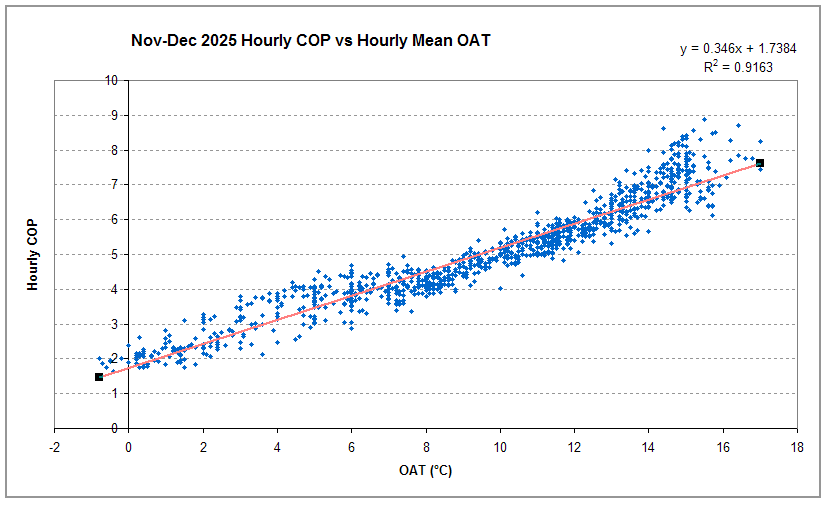
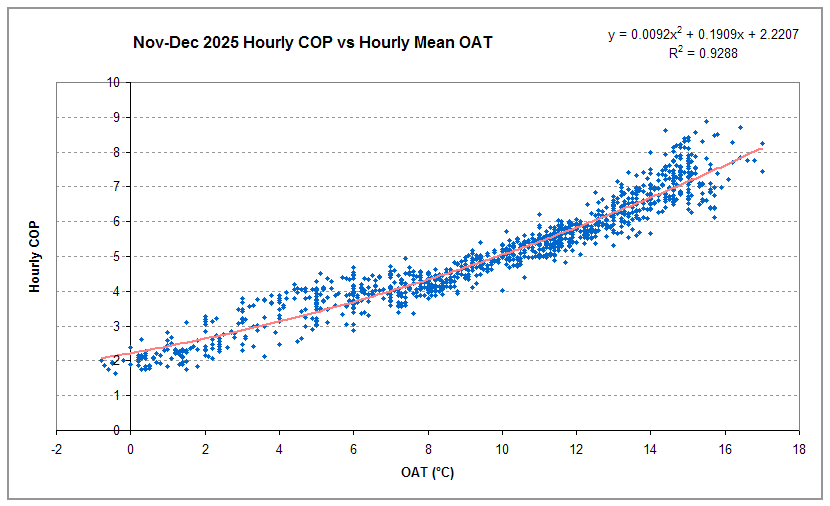
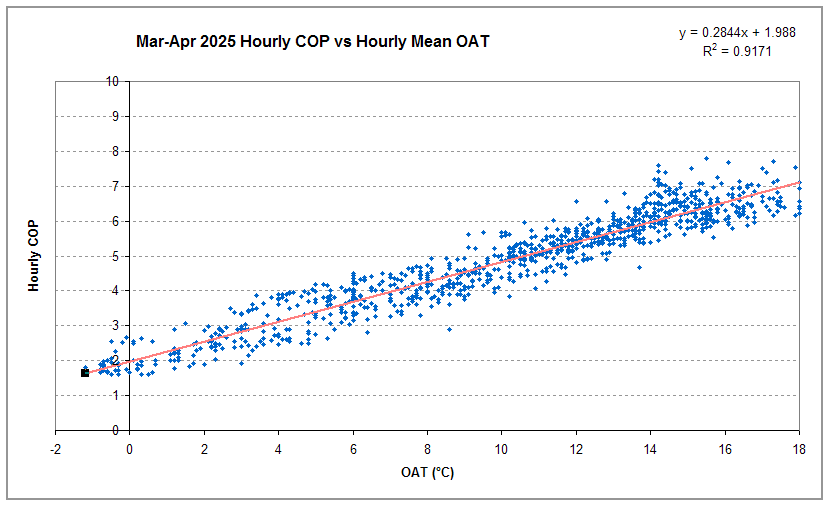
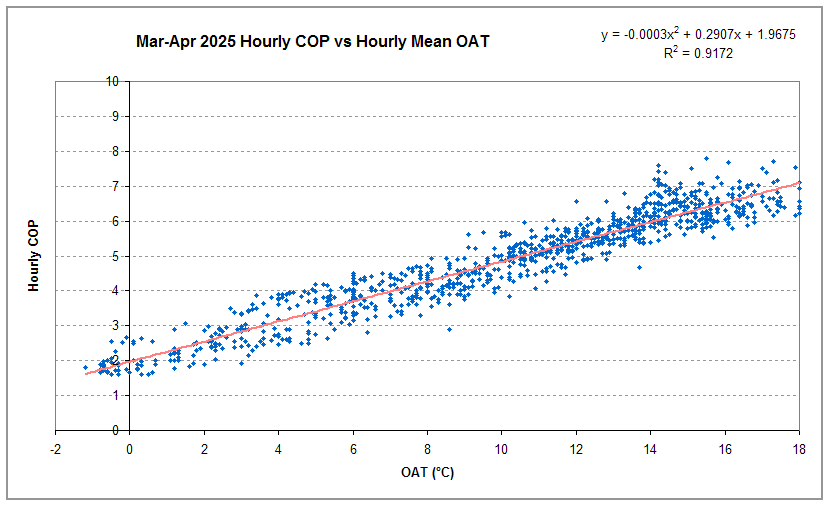
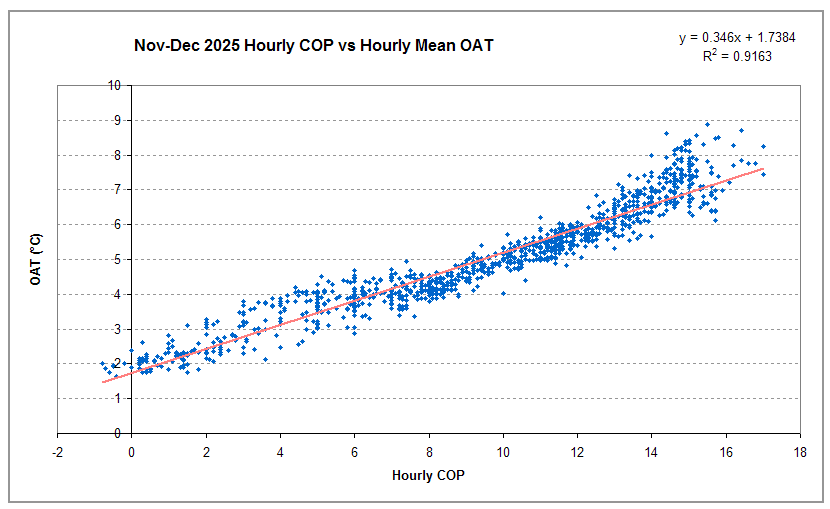
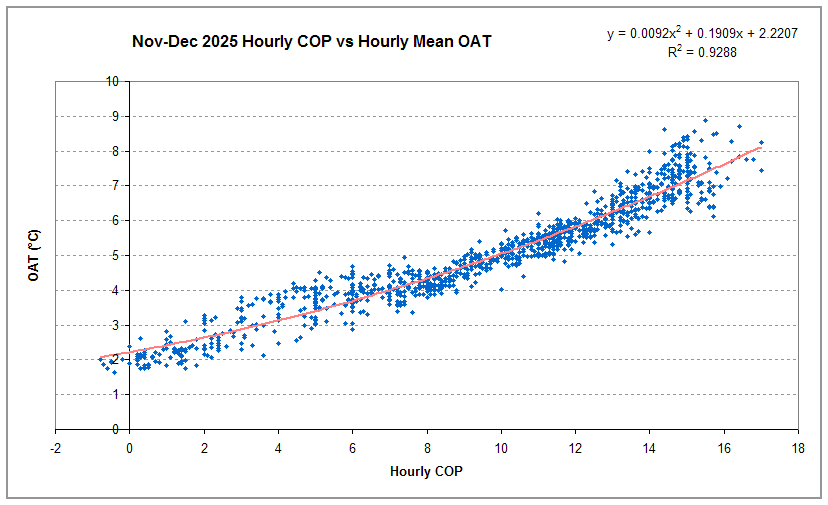
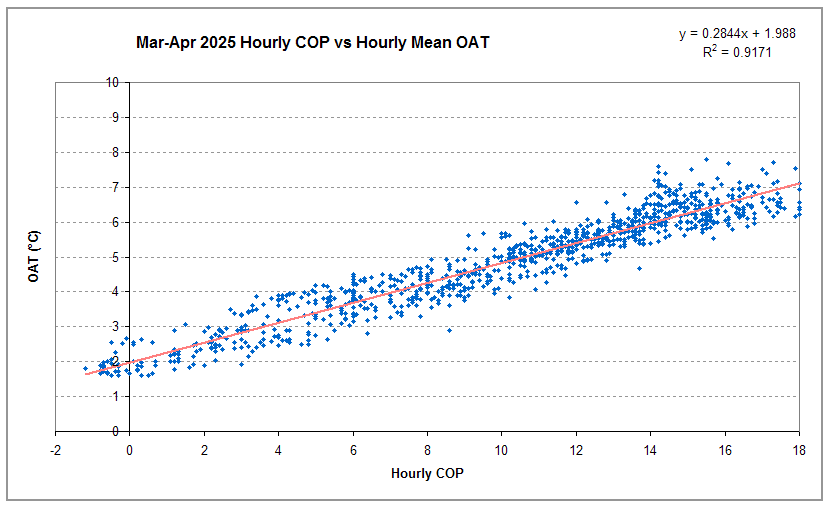
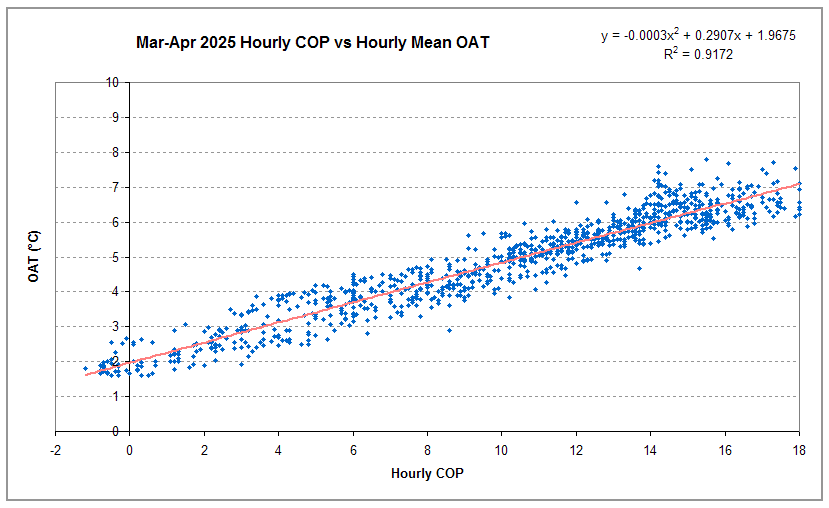
I could, but I think we can do better, by plotting hourly COP against hourly mean OAT, and the equation for the lime will give us the mean COP (or close to it) for any OAT. The only question is what form of regression to use, linear or 2nd order polynomial:
The Nov-Dec 2025 period is a no setback period, and I have cleaned up the data (removed a dozen or so gross outliers plus all 'inf' values). If I stand back and look from a distance, I think the lower chart line has a slightly better fit. The Y axis intercept is also more to my liking (I do not want my zero OAT COP to be less than 2!). Here are the same charts for the Mar-Apr 2024 period, which did have overnight setbacks (again cleaned of gross outliers and also no heating (setback) hours). I have kept the axes the same so visual comparison is valid):
This time they are very similar. But the equations for no setback vs setback running are not the same. First the no setback then the setback equations:
No setback:
Linear: y = 0.346x + 1.7384 Polynomial: y = 0.0092x2 + 0.1909x + 2.2207
Setback:
Linear: y = 0.2844x + 1.988 Polynomial: y = -0.0003x2 + 0.2907x + 1.9675
But really it is easier to look at the charts: the no setback charts (upper two) have better COPs at higher OATs. Could it be that setback running shoots itself in the foot by somehow compromising COPs at higher OATs?
Using the (simpler) linear equations, the COPs at 8 and 12 degrees OAT come out at:
OAT 8°C => 4.51 (no setback) and 4.26 (with setback) (5.5% lower)
OAT 12°C => 5.89 (no setback) and 5.4 (with setback) (8.3% lower)
ie the setback running is associated with (not the same as causes) lower COPs.
Using q Text as Data for the OAT ranges 7.5 to 8.5 and 11.5 to 12.5 gets:
OAT 7.5 to 8.5 => 4.22 (no setback) and 4.16 (with setback) (1.4% lower)
OAT 11.5 to 12.5 => 5.74 (no setback) and 5.37 (with setback) (6.4% lower)
Though not the same as the regression method (not sure why, perhaps because of point vs range estimates), again setback running is associated with lower COPs. Taken with the previous set of q Text as Data results it seems setback running is associated with lower COPs, .
It might be worth calculating the hourly estimated (predicted) energy in from the observed energy out by using the relevant COP value for the hour based on OAT, to see how that compares with the previous method based only on energy in data.
In the 24 hour period, it reduced the WC curve on 9 of the 18 non-setback hours. I think that is interesting and possibly (but not conclusively) points to your WC curve being setup to account for the fabric reheat after the setback. Do you have the same information for a day when there was no setback?
The auto-adapt script is set up to adjust the WCC when the actual IAT deviates by more than one degree from the desired IAT, for whatever reason (solar gain, doing a lot of cooking/entertaining, wind chill, left the door open for too long, setbacks, whatever). I just stuck in some logic that seemed like a good idea at the time: for each degree the IAT was out, shift the WCC one degree the other way, with a cap at three degrees either way to avoid meltdown if the IAT was really low. To that extent, the auto-adapt script will raise the WCC is the IAT drops enough during the setback, and by pushing the LWT up, will push the COP down. This may be a way that setback running can lower COPs.
I do have a very long time series of data from the auto-adapt log, albeit rather prone to missing values, but I am not yet sure how best to use it to answer the question: does auto-adaption following a setback raise the WCC leading to higher LWT values and so lower COP values? And if so, how significant is this?
22 Dec 25: edited to correct axis label swaps on charts
Some more data, not sure how much information it contains...
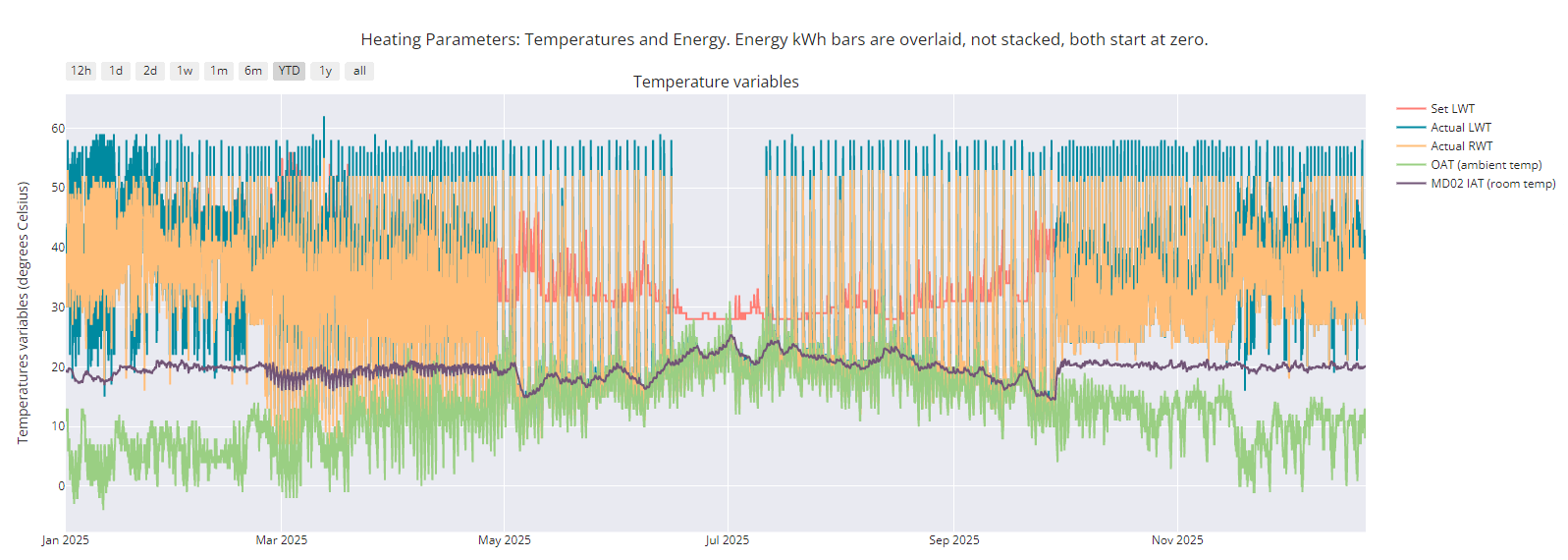
First a rather messy overview of the year to date:
We are primarily interested in the OAT (green line) and IAT (purplish line). Big Bang (when I opened up all radiator valves 100%) happened in late January, and it had a major effect on the maximum heat delivery possible (you can even see the step increase in IAT on the chart), meaning January is not like for like with the following months. Most of February was run without an overnight setback, March and April had an overnight setback, October, November and December did not. The setbacks can be seen in the wider dispersion of the IAT during the setback periods.
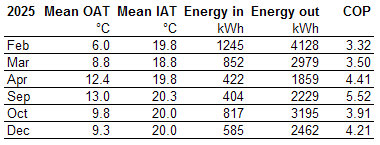
Some basic stats for each month of interest:
Nothing remarkable here. Most of the time the mean IAT was a bit over the target of 19°C. March's IAT was about a degree less than the other months for some reason. The COPs generally rank with OAT, as expected.
What influence did my auto-adapt script have? Not a lot. It only kicks in once the difference between the actual IAT and desired IAT is one or more degrees (either way), and then it shifts the WCC up or down the other way by one degree for each degree the actual IAT is off. If the IAT is two degrees below the desired IAT, the WCC goes up by two degrees, etc etc. Because the whole WCC goes up and down, all intermediate leaving water temps will go up/down by the same amount. In reality, the default WCC did a pretty good job of maintaining the actual IAT close to the desired IAT, when it did deviate, the IAT overshot, and the WCC went down. This can be seen in this far from ideal chart:
Having said that, the settings are arbitrary: we could just as easily say the default is one degree lower, and thus the auto-adjustment has the effect of raising the WCC. But I think the bottom line is that my default WCC works well enough most of the time to mean the auto-adaption isn't called into effect very much, and when it is called into action, it generally doesn't do much. I have of course assumed the script does what it should, and the data gets logged correctly, which I have no reason to doubt..
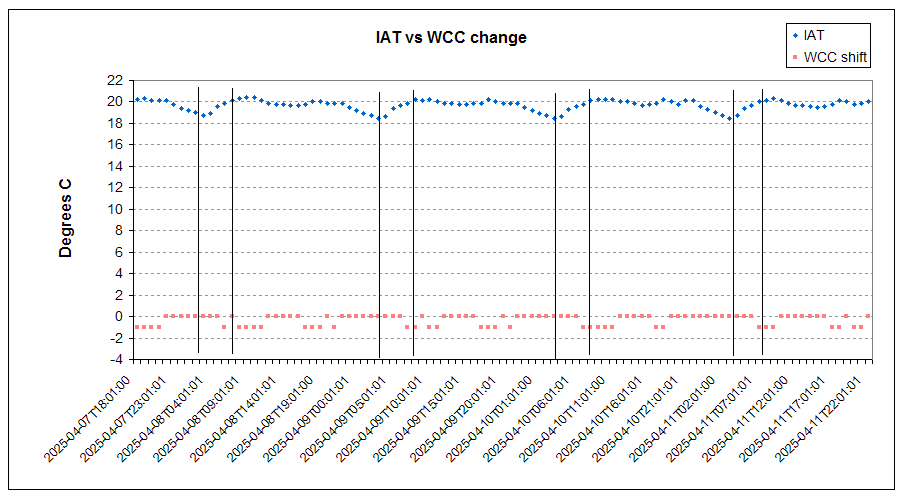
If we zoom in on the above chart for the period of interest, around 9th/10th April, when can see when the changes to the WCC happen in relation to the changes in the IAT:
Whether the change is seen as a fall from a higher baseline, or a rise from a lower baseline, the recovery from setback periods (the right side of each IAT dip when the IAT is rising, marked approximately by the vertical lines) are not marked by a consistent rise in the WCC. This suggests to me that whatever puts in the extra recovery heat, it is not caused by the auto-adaption.
As I said at the start, lots of data, but perhaps less in the way of information...
Midea 14kW (for now...) ASHP heating both building and DHW
I could, but I think we can do better, by plotting hourly COP against hourly mean OAT, and the equation for the lime will give us the mean COP (or close to it) for any OAT. The only question is what form of regression to use, linear or 2nd order polynomial:
The Nov-Dec 2025 period is a no setback period, and I have cleaned up the data (removed a dozen or so gross outliers plus all 'inf' values). If I stand back and look from a distance, I think the lower chart line has a slightly better fit. The Y axis intercept is also more to my liking (I do not want my zero OAT COP to be less than 2!). Here are the same charts for the Mar-Apr 2024 period, which did have overnight setbacks (again cleaned of gross outliers and also no heating (setback) hours). I have kept the axes the same so visual comparison is valid):
Good graphs @cathoderay but is the axis labelling wrong? X-axis (0-18) should be OAT and y-axis (0-10) COP? Interesting that the COP advantage of continuous running seems to diminish with OAT, until around 1C when the advantage starts to increase again (using the non-linear as they seem to fit better).
But really it is easier to look at the charts: the no setback charts (upper two) have better COPs at higher OATs. Could it be that setback running shoots itself in the foot by somehow compromising COPs at higher OATs?
It does seem so, the cause is a good question - system, environmental or both?
Using the (simpler) linear equations, the COPs at 8 and 12 degrees OAT come out at:
OAT 8°C => 4.51 (no setback) and 4.26 (with setback) (5.5% lower)
OAT 12°C => 5.89 (no setback) and 5.4 (with setback) (8.3% lower)
ie the setback running is associated with (not the same as causes) lower COPs.
Using q Text as Data for the OAT ranges 7.5 to 8.5 and 11.5 to 12.5 gets:
OAT 7.5 to 8.5 => 4.22 (no setback) and 4.16 (with setback) (1.4% lower)
OAT 11.5 to 12.5 => 5.74 (no setback) and 5.37 (with setback) (6.4% lower)
Though not the same as the regression method (not sure why, perhaps because of point vs range estimates), again setback running is associated with lower COPs. Taken with the previous set of q Text as Data results it seems setback running is associated with lower COPs, .
It might be worth calculating the hourly estimated (predicted) energy in from the observed energy out by using the relevant COP value for the hour based on OAT, to see how that compares with the previous method based only on energy in data.
While the graphed and the "q Text" results might not match, they do consistently show an advantage to continuous running, which reinforces the results from earlier in our discussion. Giving more evidence that continuous running could well be the way to use less energy, and hence cheaper.
Using the observed energy out and the predicted COPs to calculate the expected energy in would be good to do, for comparison purposes.
In the 24 hour period, it reduced the WC curve on 9 of the 18 non-setback hours. I think that is interesting and possibly (but not conclusively) points to your WC curve being setup to account for the fabric reheat after the setback. Do you have the same information for a day when there was no setback?
The auto-adapt script is set up to adjust the WCC when the actual IAT deviates by more than one degree from the desired IAT, for whatever reason (solar gain, doing a lot of cooking/entertaining, wind chill, left the door open for too long, setbacks, whatever). I just stuck in some logic that seemed like a good idea at the time: for each degree the IAT was out, shift the WCC one degree the other way, with a cap at three degrees either way to avoid meltdown if the IAT was really low. To that extent, the auto-adapt script will raise the WCC is the IAT drops enough during the setback, and by pushing the LWT up, will push the COP down. This may be a way that setback running can lower COPs.
The logic to your auto-adapt script clearly works well. It could certainly play a role in lower COPs, but if that is what is required to raise the IAT back to an acceptable level in the required timeframe then that is a necessary part of running a setback. This combined with the OAT during the setback period usually being greater than during the reheat period, seems to result in lower COPs (as your calculation above and previous ones show) when running with a setback.
I do have a very long time series of data from the auto-adapt log, albeit rather prone to missing values, but I am not yet sure how best to use it to answer the question: does auto-adaption following a setback raise the WCC leading to higher LWT values and so lower COP values? And if so, how significant is this?
Comparing how often the auto-adapt script changed the WC curve down on setback and non-setback days was to determine if your auto-adapt script was the reason you keep the same WC curve set when running setback or non-setback. It is not directly related to COP values, just to hopefully answer a side question.
But really it is easier to look at the charts: the no setback charts (upper two) have better COPs at higher OATs. Could it be that setback running shoots itself in the foot by somehow compromising COPs at higher OATs?
It does seem so, the cause is a good question - system, environmental or both?
'setback running shoots itself in the foot by somehow compromising COPs at higher OATs?' is very plausible.
At higher OATs the heat pump is going to be cycling anyway, and thus having to operate at a higher FT than 'ideal' in order to deliver the required energy. In a sense a setback simply blocks together the off periods of the cycle. The higher the OAT the greater the off period required to make the energy balance work, so at higher OATs the WC curve needs to be elevated more to account for cycling than at moderate OATs. Of course you dont know you are doing this because you just adjust it so the house feels right while its cycling.
This post was modified 2 weeks ago 2 times by JamesPa
4kW peak of solar PV since 2011; EV and a 1930s house which has been partially renovated to improve its efficiency. 7kW Vaillant heat pump.