

Notifications
Clear all
Joining the Renewable Heating Hub forums is completely free and only takes a minute. By registering you’ll be able to ask questions, join discussions, follow topics you’re interested in, bookmark useful threads and receive notifications when someone replies. Non-registered members also do not have access to our AI features. When choosing your username, please note that it cannot be changed later, so we recommend avoiding brand or product names. Before registering, please take a moment to read the Forum Rules & Terms of Use so we can keep the community helpful, respectful and informative for everyone. Thanks for joining!

Topic starter
16/07/2026 5:44 pm
Does anyone know if
1. The comms cable should be 50 mm from the power cable (mine isn’t, it’s been clipped to the power cable). The install manual says it should.
2. Is it mandatory (MCS or electrical safety regs) for the power cable to be run inside trunking. Mine has just been clipped and runs on the outside of the brickwork. The reason I ask is that the install manual states it should be run in ducting of suitable IP rating to protect from water and possible shock.
I just had a service from BG and they indicated it was a problem/contrary to install manual. I approached the installer and they said it was not an issue.
Thanks

16/07/2026 8:12 pm
1. The comms cable should be 50 mm from the power cable (mine isn’t, it’s been clipped to the power cable). The install manual says it should.
If the instal manual says it should then yes it should. As to whether it makes a difference that is another matter.
2. Is it mandatory (MCS or electrical safety regs) for the power cable to be run inside trunking. Mine has just been clipped and runs on the outside of the brickwork. The reason I ask is that the install manual states it should be run in ducting of suitable IP rating to protect from water and possible shock.
This is principally in the UK a matter for electrical regulations and on particular the electrician doing the installation. The regs frequently put it in these terms, rather than absolute terms.
The electrician is, I believe, required to make an assessment of the risk. This link references some specificregs which apply: https://professional-electrician.com/technical/external-installations-cables/.
Of course different electricians will make different assessments.
FWIW mine is run in trunking for the fixed part (ie up to the breaker) but not thereafter, on the grounds that the last metre is mechanically protected by the body of the heat pump.
That said if the installation manual says it's mandatory (read the wording very carefully as a lawyer would) then it is arguably mandatory.
What exactly does the installation manual actually say about these cases, it's not unknown for them to be misquoted (for example it's frequently quoted that vaillant require a specific type of RCD. This is true, but only if an RCD is fitted. There is however no requirement to fit an RCD so a legitimate option is not to bother).
One approach is to ask bg precisely which paragraphs in the installation manual or regs they are referring to, you can then look them up. If they don't know they are giving you BS.
This post was modified 3 months ago 3 times by JamesPa
4kW peak of solar PV since 2011; EV and a 1930s house which has been partially renovated to improve its efficiency. 7kW Vaillant heat pump.
1

16/07/2026 8:16 pm
I can’t comment on comms cabling as installed for heat pumps but I can say that network cabling (which, let’s face it, is a form of comms cable) needs to either be separated from power cabling or needs to be shielded cable. If not, there will be interference on the data cable as a result of its proximity to mains electrical current. It makes sense the same would hold true for any other comms cable but I’ve no idea if the effect would be as severe or, of course, sufficient to cause communication issues.
105 m2 bungalow in South East England
Mitsubishi Ecodan 8.5 kW air source heat pump
18 x 360W solar panels
1 x 6 kW GroWatt battery and SPH5000 inverter
1 x Myenergi Zappi
1 x VW ID3
Raised beds for home-grown veg and chickens for eggs
"Semper in excretia; sumus solum profundum variat"
1
Topic starter
16/07/2026 8:21 pm
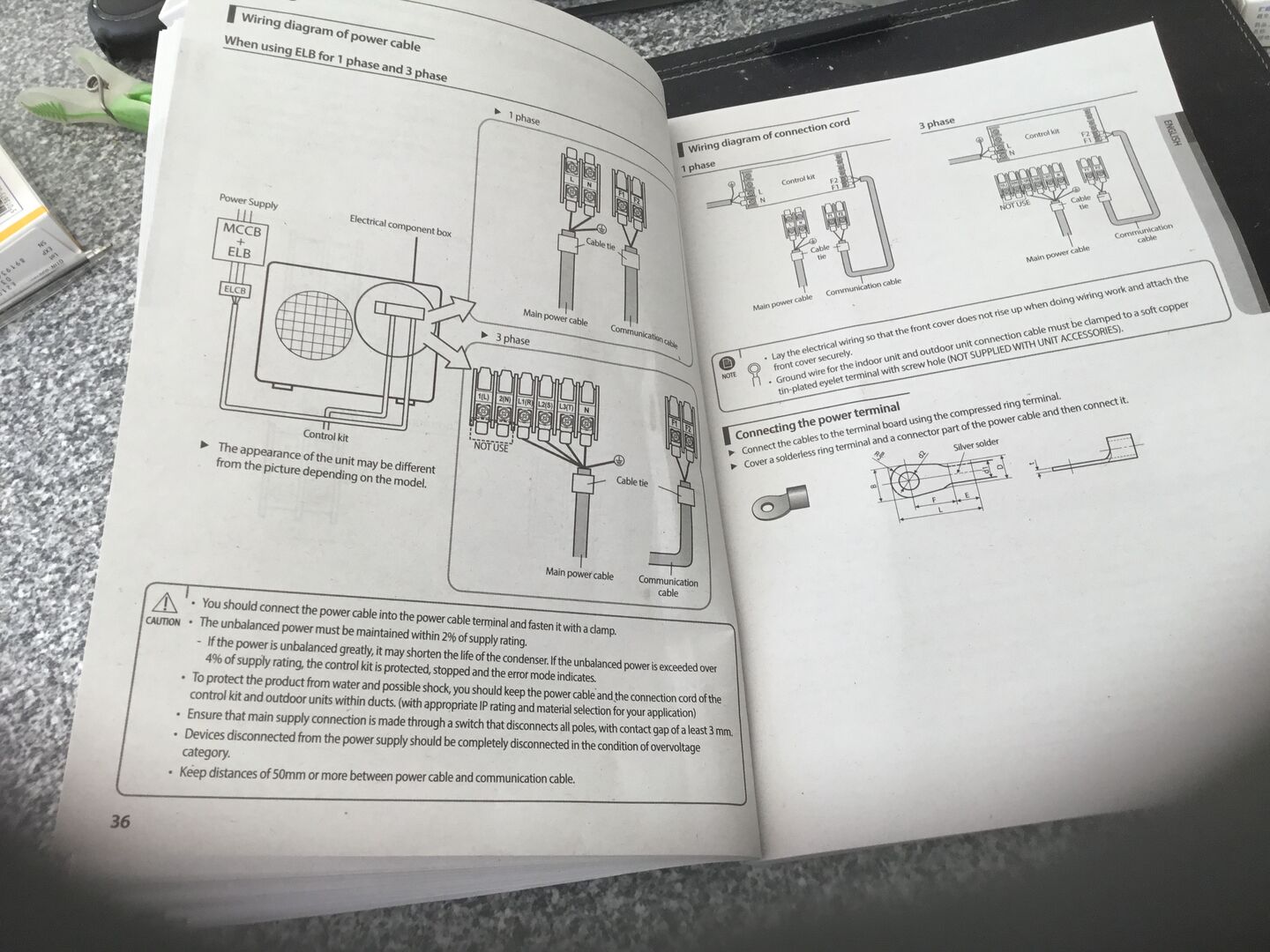
@jamespa Thanks, bottom left is the section from the install manual, it looks like a mandatory instruction to me.

16/07/2026 8:40 pm
In relation to the power cord it says 'should' not 'shall' or 'must'. Should is often but not universally taken to mean that the instructions is to be complied with unless there are reasons to the contrary. MCS use it this way.
I tend to agree that, unless there are reasons to the contrary or the meaning of should is defined elsewhere on the manual, this installation manual specifies to put the power courd in an appropriate duct. Really it's absolutely no business of the hp manufacturer to specify how electrical safety should be approached, other than in relation to matters specific to their product, but it appears they have.
On this basis (but not on any technical basis) I would say bg do have a reasonable argument and your installer should respond with their rebuttal.
In relation to the Comms cable the instructions are clear and there is a technical underpinning for separation. Ignore at your peril
This post was modified 3 months ago 2 times by JamesPa
4kW peak of solar PV since 2011; EV and a 1930s house which has been partially renovated to improve its efficiency. 7kW Vaillant heat pump.
Topic starter
16/07/2026 8:43 pm
I was half earwigging, BG rang Samsung and asked him to check the shielding status. I don’t know the status but apparently they advised it does need to be at least 50mm away. BG was here for just under 4 hours for service, very thorough. Checked and cleaned every terminal, took fan blades off, spent 30 mins cleaning the fins and drain pan, straightened some fins, checked inhibitor and topped it up, cleaned mag filter. Spent another hour on the inside unit but I had to take a call so didn’t hang over his shoulder. I was impressed for a £180 service.
I give the fins a quick hose down quarterly when I do the windows, but I was amazed at how much black crap the cleaner solution took off. I no longer think it’s an unnecessary gimmick as all that residue that must impact heat xfer.
2
Topic starter
16/07/2026 8:54 pm
Thanks James. I’ll see what they say.
I always thought the purpose of trunking was largely to protect the cable against UV and mechanical damage, it’s quite hefty (on a 32A circuit) and runs at calf height on the wall.
17/07/2026 7:14 am
always thought the purpose of trunking was largely to protect the cable against UV and mechanical damage
That's also my understanding. Obviously outside mechanical damage (potentially exposing live wire hence the risk) is arguably more likely than indoors.
4kW peak of solar PV since 2011; EV and a 1930s house which has been partially renovated to improve its efficiency. 7kW Vaillant heat pump.


17/07/2026 8:54 am
@papahuhu do you have a link where you can sign up for that servicing deal with BG?
Never mind - found it.
This post was modified 3 months ago by Old_Scientist
Samsung 12kW gen6 ASHP with 50L volumiser and large radiators. 7.2kWp solar (south facing), Tesla PW3 (13.5kW). Net Zero
Topic starter
17/07/2026 9:18 am
this was the one I used (there are 3, but this is the one for warrantied items, non glycol soupy stems only.) They were here 4 hours.
https://www.britishgas.co.uk/heating/heat-pump-service.html
1
17/07/2026 9:31 am
Interesting, they will service but not cover systems with glycol. That's a pointer to the future!
4kW peak of solar PV since 2011; EV and a 1930s house which has been partially renovated to improve its efficiency. 7kW Vaillant heat pump.
Topic starter
17/07/2026 9:48 am
I can only guess the issue is with cost of disposal or refilling. I know they also limit it to certain manufacturers too, I assume to the ones that BG fit themselves.
The pricing is a bit weird, it works out about £5 a month extra for break down cover above and beyond the service cost, for parts and labour I thought that was cheap as chips.
But the same cover for non warrantied systems is nearly £600 a year and has limits on part costs.

Page 1 / 2
Next

SPONSORS
Degrees of Separation
Latest Posts
-

RE: The Changing Jet Stream Could Challenge UK Air Source Heat Pumps
I'm not overly concerned about the potential for really...
By Rob of York , 48 minutes ago
-
RE: Electrical works for air to air heat pump
An electrician who signs off work is responsible for it...
By EtchedPixels , 1 hour ago
-
RE: Are there any comparisons of DHW heat stores around?
@sarahemmm I have done things the opposite way round I ...
By Toodles , 2 hours ago
-
RE: 15kw pump for 225m2 1990's house - over kill?
@seaviews I have read you latest response re buffer ...
By JamesPa , 21 hours ago
-
RE: How will removing the standing charge on gas bills benefit heat pumps?
The BUS grant funding for 2026/27 will run out at the c...
By Rob of York , 1 day ago
-
-
@editor Ouch, sorry to re start the tick. I had assume...
By DavidB , 3 days ago
-
RE: Say hello and introduce yourself
@e-a-west as the good Major said, welcome to the forums...
By Mars , 3 days ago
-
RE: How much of your renewable and home setup would still work if the internet went down?
Yes I actually have a copy of a tool that whenever a ce...
By EtchedPixels , 3 days ago
-
RE: Indevolt Batteries UK Support & Info Thread
@editor Hi, To resolve this, please tap on the A...
By Indevolt Tech , 4 days ago
-
RE: Double or Triple Glazed Windows?
Posted by: @singlespeed With 9 years repairing windo...
By Rob of York , 4 days ago
-
@transparent we’re still running a secure version of PH...
By Mars , 4 days ago
-
RE: How quickly would you want/expect heat recovery to take from setback?
Much longer than that here. The heating isn't even on. ...
By bobflux , 5 days ago
-
RE: Passiv Smart Thermostat - Help & Forum Support
Obviously the weather is changeable but there's a defin...
By Singlespeed , 5 days ago






SPONSORS