
Notifications
Clear all
Joining the Renewable Heating Hub forums is completely free and only takes a minute. By registering you’ll be able to ask questions, join discussions, follow topics you’re interested in, bookmark useful threads and receive notifications when someone replies. When choosing your username, please note that it cannot be changed later, so we recommend avoiding brand or product names. Before registering, please take a moment to read the Forum Rules & Terms of Use so we can keep the community helpful, respectful and informative for everyone. Thanks for joining!

Topic starter
05/02/2025 12:54 pm
I’m attempting to measure the heat transfer coefficient of my home, one room at a time. This is not straightforward as, ideally, steady-state conditions are required. I run my gas CH system 24/7 with no setbacks (not the most efficient, but the most comfortable) so the temperatures of the adjacent heated rooms are stable. Mother nature isn’t quite so helpful; outdoor temperatures are seldom stable. In mitigation, where possible, I record data (OAT, room IAT and energy input) overnight for a 10-hour measurement period. Although overnight temperatures often vary by a few degrees overnight, they tend to result in the maximum temperature difference between inside and outside which, hopefully, swamps any effect due to measurement inaccuracies. The method I use is to turn off the room radiator TRV and use a thermostatically-controlled 1kw fan heater (controlled via an ESP32/DS18B20 temperature sensor and Shelly power meter and switch) to maintain the room temperature. I place multiple Bluetooth temperature sensors (TIP: 6 for £15 from AliExpress) around the room to determine an ‘average’ temperature, so as not to be dependent on temperature measurement in a single location. Again, I assume that any small temperature difference between adjacent rooms is negligible relative to the much larger room to outdoor temperature difference. I am wary of potential early sources of error (e.g. Radiator still cooling down) and late sources of error (e.g. solar gain at dawn). Since this method maintains the existing conditions, I assume that the buildings thermal mass and thermal inertia do not affect my results.
I have been evaluating results over the 10-hour window and across separate 2-hour windows because of the OAT variation. For the larger, higher heat loss rooms, I have repeated the measurements on several occasions. I am ignoring any obvious ‘outlier’ results and taking the view that those remaining are in the right ‘ballpark’, with the mean value probably being the figure for me to settle on.
My understanding is that the relationship between heat loss and the heat transfer coefficient is considered to be linear for our circumstances. Although my gas consumption is broadly consistent with the house heat loss as determined by the usual U-value spreadsheet methods, I have been concerned that I cannot get my condensing boiler to run without producing plumes of steam, even with return water temperatures below 50°C. My measurements suggest a heat loss for my house approximately two-thirds of that determined using heat loss spreadsheets.
What have I missed?

05/02/2025 3:53 pm
My understanding is that the relationship between heat loss and the heat transfer coefficient is considered to be linear for our circumstances. Although my gas consumption is broadly consistent with the house heat loss as determined by the usual U-value spreadsheet methods, I have been concerned that I cannot get my condensing boiler to run without producing plumes of steam, even with return water temperatures below 50°C. My measurements suggest a heat loss for my house approximately two-thirds of that determined using heat loss spreadsheets.
What have I missed?
What is your concern triggering the question.
I am impressed at trying to determine individual rooms, I was content to determine whole house by measurement and use this to 'calibrate' the individual rooms in fabric spreadsheet
FWIW my house loss determined by gas consumption is 7kW vs 10.5kW based on the spreadsheet method - I put the difference down to ACH. So Im not surprised by what you have found.
In terms of 'what have you missed', thermal mass matters for changes in OAT as well as for changes in IAT and you are ignoring this (I think). I once did a 'best fit' exercise playing with two thermal masses, one affected by IAT and another affected by OAT. The OAT effect was about one quarter the size of the IAT effect, but this was one house only and I suspect it may be heavily dependent on construction. When I did my whole house measurements, where no account was taken of thermal mass, I found that 12 hr offset gave best fit - a sort of crude correction for thermal mass.
4kW peak of solar PV since 2011; EV and a 1930s house which has been partially renovated to improve its efficiency. 7kW Vaillant heat pump.
Topic starter
05/02/2025 5:54 pm
What is your concern triggering the question.
I'm simply trying to determine a more accurate heat loss figure so as not to oversize an ASHP. I didn't want to rely on my gas consumption as a 'sanity check' for the reasons stated.
I am impressed at trying to determine individual rooms
It would be impracticable to use my mmeasurement method otherwise. Too many valriables. There are enough measurement uncertainties as it is.
With regard to thermal mass, I haven't ignored it as such. I've done my best to ensure stable conditions and all I can do is hope for minimal changes during my measurement period. I believe that a degree or two of 'measurement error' will be swamped by the much larger IAT-OAT value, so I feel confident in ignoring that. When I started I made the mistake of increasing my room temperature for testing then realised that was bleeding energy into adjacent rooms. Where you are considering thermal mass, I think in terms of thermal inertia. The external walls will have some effect but my test method removes internal mass from the equation. I have tried correlating gas consumption against external temperature over several 24 hour periods but drew a blank. Other than obvious major effects I couldn't see any time offset I could apply to my measured data. If the time constant for my home is greater than, say, six hours then I'm not going to get any convincing data from my endeavours. All I will have is my 'gut feel'.
05/02/2025 9:36 pm
I have tried correlating gas consumption against external temperature over several 24 hour periods but drew a blank. Other than obvious major effects I couldn't see any time offset I could apply to my measured data. If the time constant for my home is greater than, say, six hours then I'm not going to get any convincing data from my endeavours. All I will have is my 'gut feel'.
Firstly, your method may well work, Im jolly impressed and please continue to post to inform us all!
In response to your comment above
a) I obviously don't know the time it takes your house to settle down but mine well exceeds a day (I know this from close monitoring of a week about 2 years ago when it was -2 all day and night for several days running). I have a 1930s house originally with solid walls, that has two modest modern extensions and piecemeal fabric upgrades (loft insulation and partial and very variable internal wall insulation).
b) the scatter in my case over 'several 24 hour periods' was certainly far too large for a determination. I ended up using 2 years of data, although one year would have sufficed.
in case it helps here is the data I persuaded my installer (and one other) to use to 'calibrate' the GIGO spreadsheet method. This is the aggregate from two 'seasons'. Points on the consumption vs degree day chart represent a day, but of course several days with similar figures may be superimposed. Note the quite considerable scatter, easily sufficient that just taking a few days really wouldn't have 'done'.
Bear in mind that this measured data for my house shows a loss of 7kW, two 3 hr surveys (one of which I paid £300 for!) came out with 16kW, and a fabric spreadsheet completed by me but with the 'default' MCS assumptions came out as 10.5kW.
I hope that might give you some points of comparison.
This post was modified 1 year ago 4 times by JamesPa
4kW peak of solar PV since 2011; EV and a 1930s house which has been partially renovated to improve its efficiency. 7kW Vaillant heat pump.
Topic starter
06/02/2025 12:46 pm
My 200m²property was built in 1990. I have increased the loft insulation, replaced the original double-glazed patio doors with lower U-value double-glazed bi-folds and taken the opportunity to add extra internal insulation on the northern kitchen wall during a re-fit. My own fabric spreadsheet with default MCS assumptions came out around 11.5kW but, as you will know, this is greatly influenced by air change values. I paid a modest amount for a desk-based Heat Engineer assessment (based on information I supplied) which came out with a similar figure but this also takes historic gas consumption into account, I believe. My own gas consumption versus degree-day analysis provided similar results but I am highly sceptical of my condensing boiler's efficiency. My suspicion is that the heat loss is more like 8kW and, despite the lack of clarity and repeatability in my measurements, I think they generally substantiate my view.
One concern I have with my measurement method that I have not mentioned is that the energy data from the Shelly power meter and the temperature measurement device controlling the fan heater are both updated once per minute (polled by HomeAssistant). I don't expect any artefacts as a result of asynchronicity of data but I do believe that this may add significant noise or scatter. Typically, the heater could be on for 10 minutes then off for six. Noisy data is more difficult to process for shorter time periods (e.g. if the OAT isn't behaving nicely).
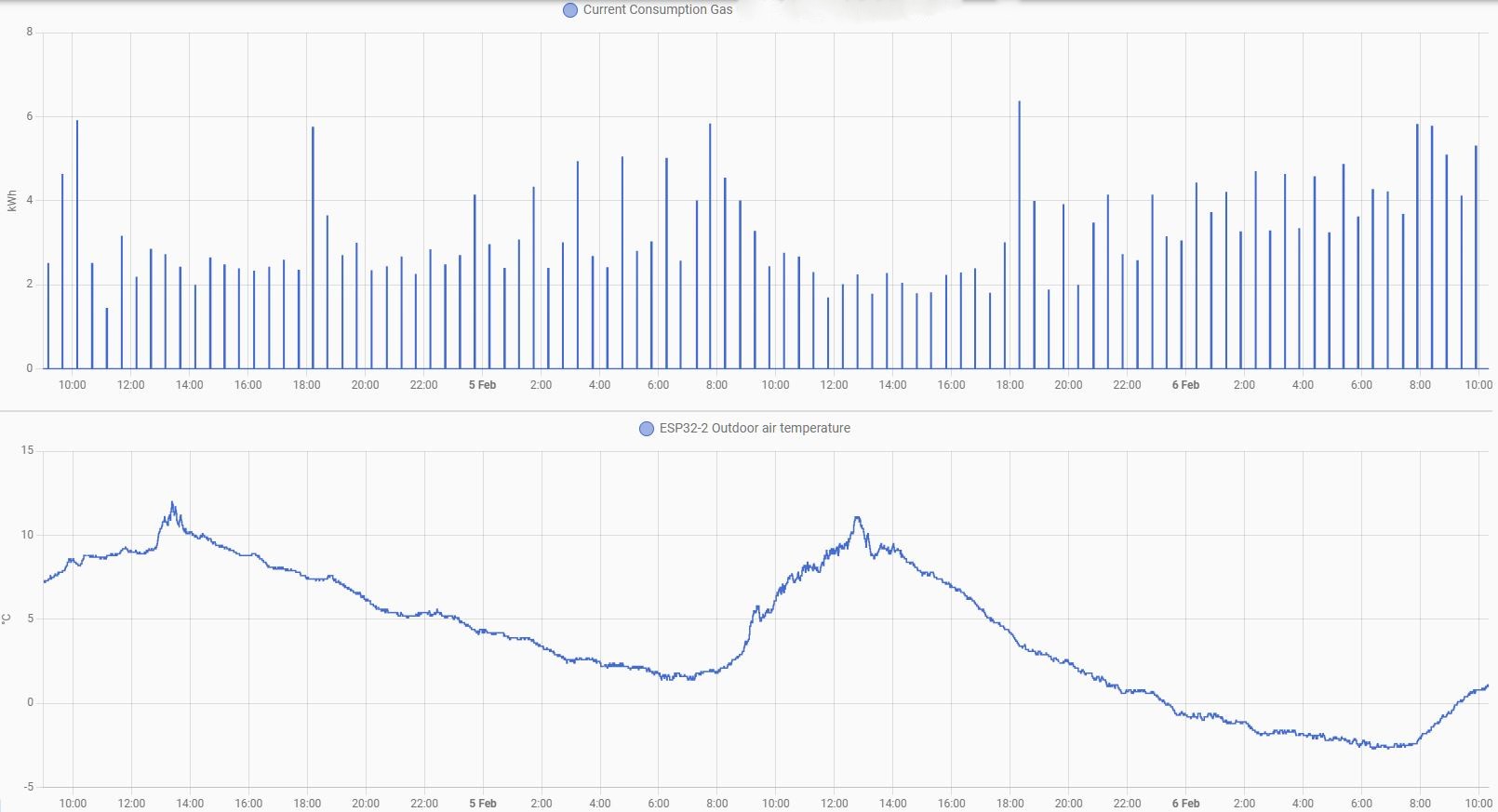
Regarding the thermal mass or thermal inertia issue, I have just tried plotting my half-hourly gas meter reading alongside OAT for the past couple of days. By eye, if I had to identify a correlation, I'd say that the gas consumption lags OAT by around 2 hours.
06/02/2025 1:47 pm
but I am highly sceptical of my condensing boiler's efficiency.
Thats definitely a reasonable suspicion. The initial results fom my heat pump suggest my condensing boiler (which was operated at FT50/55 so should be condensing) might transfer to the house <90% of the declared calorific value of the fuel used, whereas in principle this figure could be as high as 110% (gas calorifc value doesn't include latent heat of condensation). I need more data to confirm and of course I don't know how accurate the 'heat out' measurements are from my heat pump (I have seen it stated that Vaillant heat output is an understatement). I cant comment on the lag other than it seems short, but as you are keeping the IAT constant maybe not actually.
4kW peak of solar PV since 2011; EV and a 1930s house which has been partially renovated to improve its efficiency. 7kW Vaillant heat pump.
Topic starter
06/02/2025 3:42 pm
I know my boiler flow and return temperatures. If I knew the flow rate then I assume I could determine the heat energy transferred to my home. I believe it's simple fixed head/speed pump. I may be able to monitor when it's running from the 'call-for-heat' control or similar (although I know there are occasionsl situations when the boiler doesn't necessarily fire-up). Presumably I could find the flow from the specification sheet (if I could find it).
06/02/2025 4:51 pm
That's correct. You probably will need to measure flow rate though, spec sheet will likely just be a pump curve.
4kW peak of solar PV since 2011; EV and a 1930s house which has been partially renovated to improve its efficiency. 7kW Vaillant heat pump.

Latest Posts
-
RE: Octopus Cosy 12 Heat Pump Regret: Incredibly Loud, Poor Heating & Constant Hum - Help!
Balancing is a long process and its possible to mess th...
By JamesPa , 37 minutes ago
-
RE: Daikin Altherma 3 LT compressor longevity question
Up to a point yes. However every heat pump (and every ...
By JamesPa , 2 hours ago
-
Thanks everyone for the help, Havenwise now diasbled. q...
By Boycey , 4 hours ago
-
RE: Advice needed after a successful "leftfield" experiment.....
@pauli Depending on whether you can get an EV tariff, I...
By ChandyKris , 4 hours ago
-
-
RE: New Build ASHP Defects - Looking for Advice, Support & Shared Experiences
Is that a single pair only? If so it may be part if th...
By JamesPa , 6 hours ago
-
RE: Solar Power Output – Let’s Compare Generation Figures
@technogeek I think you are correct, but, it didn’t inf...
By Papahuhu , 6 hours ago
-

@batpred, you’re quite right; it does work well. I don’...
By Majordennisbloodnok , 7 hours ago
-

@Mars at the time of writing heating oil is £1.28 / ltr...
By TechnoGeek , 7 hours ago
-
RE: Ecodan Cylinder Possible Weeping Around Thermostat Port
Update: Mitsubishi sent an engineer around. It was li...
By Gruff2001 , 10 hours ago
-
RE: A Smarter Smart Controller from Homely?
@benson Agreed. I believe the COP gains with homely, i...
By Papahuhu , 10 hours ago
-
RE: Samsung Gen 7 16kW Integrated unit Modbus monitoring
The setup for this is a Samsung Modbus card. Connected ...
By antonical , 12 hours ago
-

RE: Forum updates, announcements & issues
@davidalgarve, if the emails are more than roughly a mo...
By Mars , 12 hours ago
-
How to Find All Your Posts and Topics on the Forum – A Quick Guide
If you’ve ever posted something on the forum and then s...
By Mars , 12 hours ago
-
RE: If a heat pump can only heat DHW to 50C then what? Issue with 18KW Heliotherm heat pump
Sorry to hear that but I'm not surprised TBH. Stratifi...
By JamesPa , 13 hours ago
-
RE: Say hello and introduce yourself
@pt151 welcome to the forums, and looking forward to he...
By Mars , 1 day ago
-
RE: Setback savings - fact or fiction?
The answer was in two parts in my reply, the second par...
By RobS , 1 day ago
-
Samsung Gen 7 16kW Integrated unit Modbus monitoring
Looking for some assistance to get modbus monitoring wo...
By antonical , 1 day ago
-
Ecodan control return to Melpump from Havenwise trial. settings check
Hi, Just got control back after being on the hav...
By Boycey , 1 day ago
-
RE: Refrigerant R32, is it now banned in the EU from 1st Jan 2027 for monobloc ASHPs?
I wonder if heat pump manufacturers will tone these sit...
By JamesPa , 1 day ago
-
RE: Who’s Caved and Switched the Heating On Already?
@editor yesterday we used 12kW of electricity for heat,...
By Judith , 1 day ago
-
RE: Rate the quality of your heat pump design and installation
Loss assessments can be a very serious case of GIGO. I...
By JamesPa , 1 day ago
-
RE: Who's your electricity provider and what's your tariff?
@jamespa Just bizarre. This is our data. I really don't...
By antonical , 2 days ago
-
RE: Mitsubishi Ecodan 11.2kW review
I think you said its an 11.2kW model and your house is ...
By JamesPa , 2 days ago