

Notifications
Clear all
Joining the Renewable Heating Hub forums is completely free and only takes a minute. By registering you’ll be able to ask questions, join discussions, follow topics you’re interested in, bookmark useful threads and receive notifications when someone replies. Non-registered members also do not have access to our AI features. When choosing your username, please note that it cannot be changed later, so we recommend avoiding brand or product names. Before registering, please take a moment to read the Forum Rules & Terms of Use so we can keep the community helpful, respectful and informative for everyone. Thanks for joining!

Topic starter
07/02/2025 9:46 am

The installation of my Baxi air source heat pump was completed yesterday.
The subcontractors who installed the system gave a very cursory overview before they left.
My supplier should be coming to see me to go over the workings of it next week.
Here is the schedule on the thermostat. Does this look ok to you or should I change anything? Many thanks for any advice.

07/02/2025 10:39 am
@cathyem1 - welcome to the forum.
My supplier should be coming to see me to go over the workings of it next week.
It might be sensible to wait until after this visit - the supplier could just as well get things right or wrong! However, in preparation for the visit, it won't do any harm to mention some basics.
1. You do not want to use a room thermostat to control the heat pump (yes, the subcontractor got that wrong). You want the heat pump to be always on, which means setting the room stat very high - say 28 degrees all the time.
2. The control comes from something called weather compensation. Basically this controls the temperature of the water leaving the heat pump according to the outside air temperature. When it's cold outside, you need more heat, so the LWT (leaving water temperature) goes up, when it's milder you need less heat, and the LWT goes down.
3. You then aim to get the weather compensation settings such that they are at the lowest LWT consistent with keeping your home warm. This is a trial and error process: you start with some initial best guess settings, and watch happens. Home too cool? Up the weather compensation settings a bit, and see what happens. Home too warm? Lower the weather compensation settings a bit, and see what happens. Carry on until you get it just right.
4. The ease of setting the weather compensation settings varies with heat pump brand. If you have a manual (or can find one online) it should tell you how to adjust the settings. Your supplier when he visits should also be able to show you how to set them. Normally there are two pairs of settings, one for low outside air temperatures eg 45 @ -2 which means LWT at 45 degrees when it's -2 degrees outside, and one for high outside air temperatures eg 30 @ 15 degrees which means LWT at 30 degrees when it is 15 degrees outside. In between these outside air temperatures, the weather compensation operates on a sliding scale between the lower and upper outside air temperature end points.
5. You also want to mostly run the system as 'open circuit' as possible. What this means is no obstructions, specifically no TRVs (to start with, occasional bedroom use may be OK once you have the system set up).
That may all seem rather daunting if you are new to heat pumps, but it basically the bread and butter of how we run them. Always on, low and slow, with control coming from weather compensation.
Good luck, and let us know how you get on!
Midea 14kW (for now...) ASHP heating both building and DHW
1

07/02/2025 10:45 am
That's the sort of schedule we'd expect to see for a typical gas boiler installation @cathyem1
but it doesn't best reflect how your heat pump should operate.
It is a requirement of the Building Regulations (Part-L) that you are supplied with site-specific documentation,
and instruction on how to operate the system such that the (electricity) fuel being used is minimised.
Ie, that's the definition of an efficient heating system.
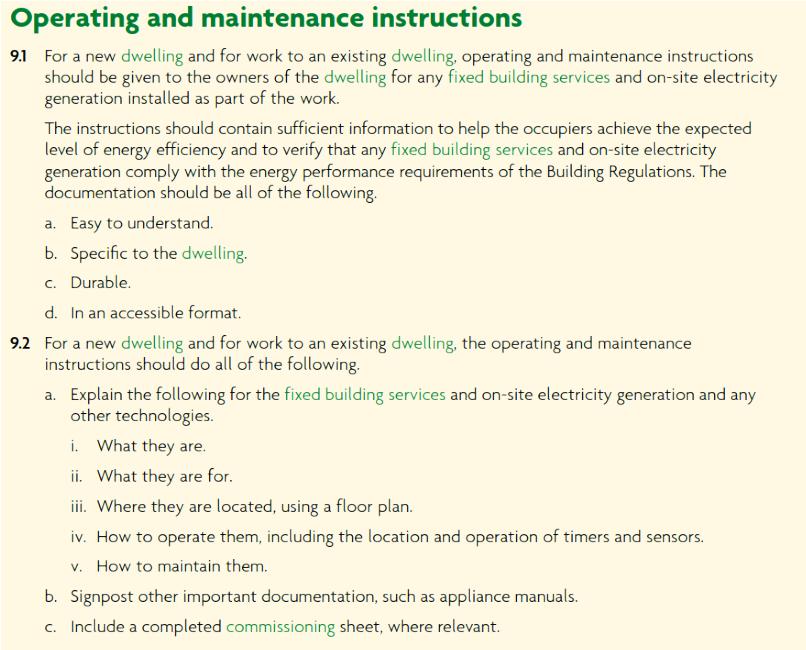
Simply handing you the manufacturers' instructions for the heat-pump, thermostat, and domestic hot water (DHW) cylinder is inadequate to comply with Part-L.
You should have the system diagram for your particular house, and the Commissioning Procedure sheet, with the results for each of the 'tests'.
That will include the settings which the contractor arrived at to optimise the system.
You should have already received the Household Energy Survey report, which was completed prior to installation.
That gives you the design parameters which were used to dictate which specific hardware was required for your home.
It will show the total energy losses for the entire house, which are used to decide the size of heat-pump required (in kilowatts),
and the losses for each room, which dictates the size of radiator required, and the size of pipework to deliver that heat.
Can you also please tell us the model of Baxi which has been fitted?
and basic description of your house
- when it was built
- detached/terraced etc
- number of floors
- number of bedrooms
- floor area in square meters (or any other units, and we'll do the calculations for you!)
- what insulation is in the attic/roof, and the walls
Looking forward to helping you get this sorted. 🙂
Save energy... recycle electrons!
1
Topic starter
07/02/2025 12:33 pm
@transparent Thank you. We did receive a lot of information from the supplier after he did our survey with all the recommended specifications for the new system.
I have been told today, after emailing and texting the supplier about my issues with the system, that their “process” is to send out a handover pack which will include the warranties, certificates and manuals in due course. They will come to see us and talk through the system sometime next week. I wasn't aware of this when the subcontractors left yesterday.
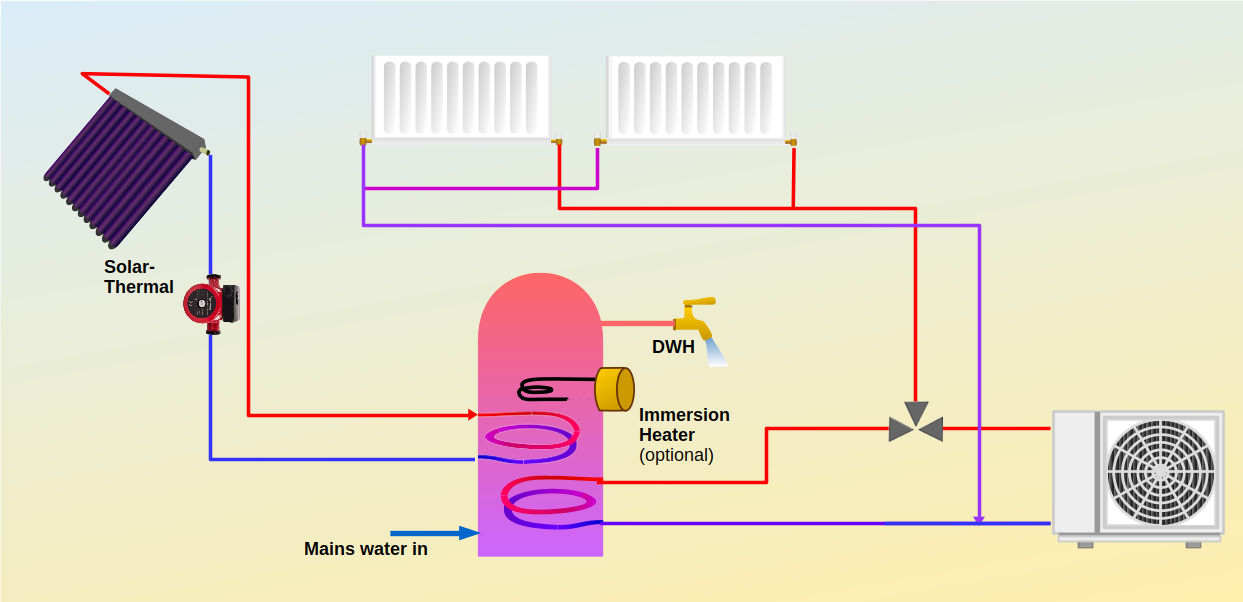
As an aside, I also have solar thermal water heating which was fitted a few years ago, so our cylinder is dual coil.
House is a semi that was built in 2005
2 floors and 2 bedrooms
Floor space is 71 m2
The loft has 200mm of fibreglass insulation that was in when we bought the house new in 2007.
The walls have insulation built in.
The heat loss is noted as 2.74kw on the heat loss report and system design.
The heat pump is a Baxi HP40 Heat Pump air/water “inverter” and the cylinder is a Cyclone 180l dual coil.

07/02/2025 1:31 pm
That's interesting @cathyem1
Many installers don't like reconnecting an existing solar-thermal to a newly installed heat-pump system.
It can be more tricky to commission.
The Baxi controller needs to 'understand' that the energy being supplied from the solar-thermal coil might be greater than its own flow (output).
But let's note that it's only feeding into the Domestic Hot Water tank.
There's no solar-thermal gain supplying the radiator 'space'-heating element of your installation, which accounts for 80% of your heat requirement.
Save energy... recycle electrons!
1
Topic starter
07/02/2025 1:53 pm
@transparent Thank you, yes, I realise that the solar is only helping the hot water and not the heating.
I really hope the supplier comes to see me on Monday as my bill is rising and rising and i don’t know what to do about that other than turn the thermostat own or switch the system off 😬
07/02/2025 2:17 pm
I suspect that the heat-pump is 'cycling'.
Ie it's switching on/off every few minutes in response to temperature sensors.
If you have Thermostatic Radiator Valves (TRVs) then these need to be fully open.
They're not required for heat-pumps and shouldn't be fitted.
Radiators should be 'balanced' by the installer, using the lockshield valve on the other end.
Only then might you achieve any 'success' by reducing the 21°C setting on the main controller.
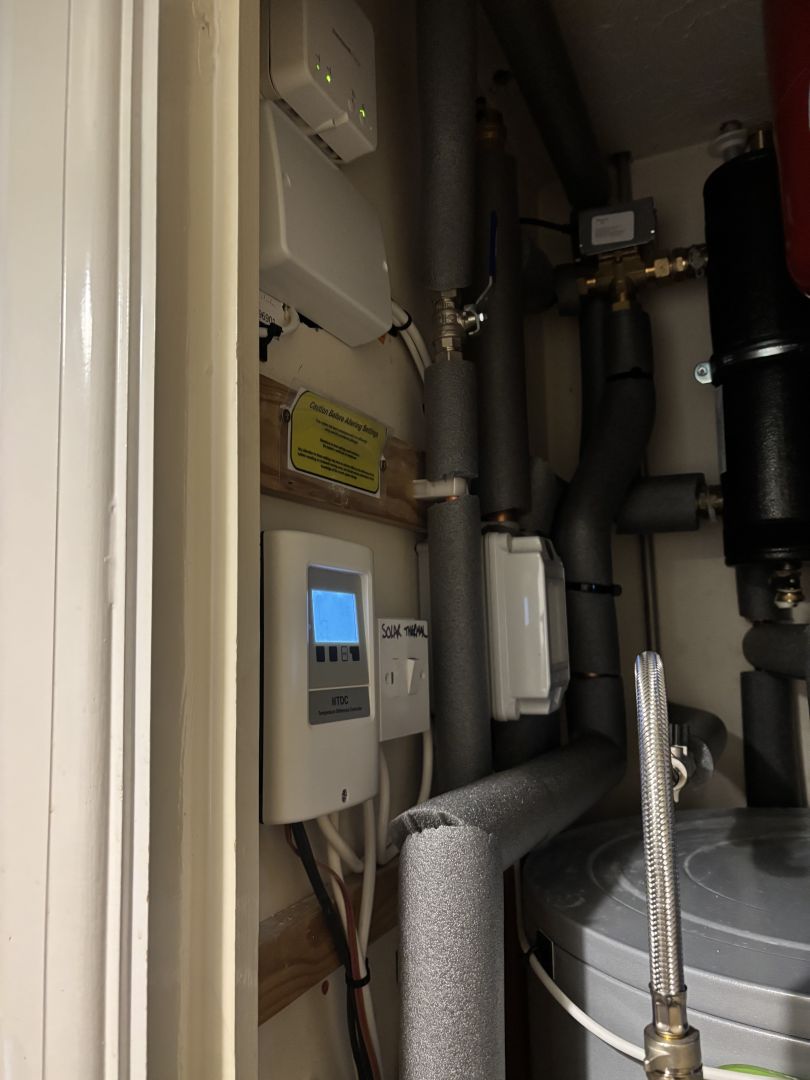
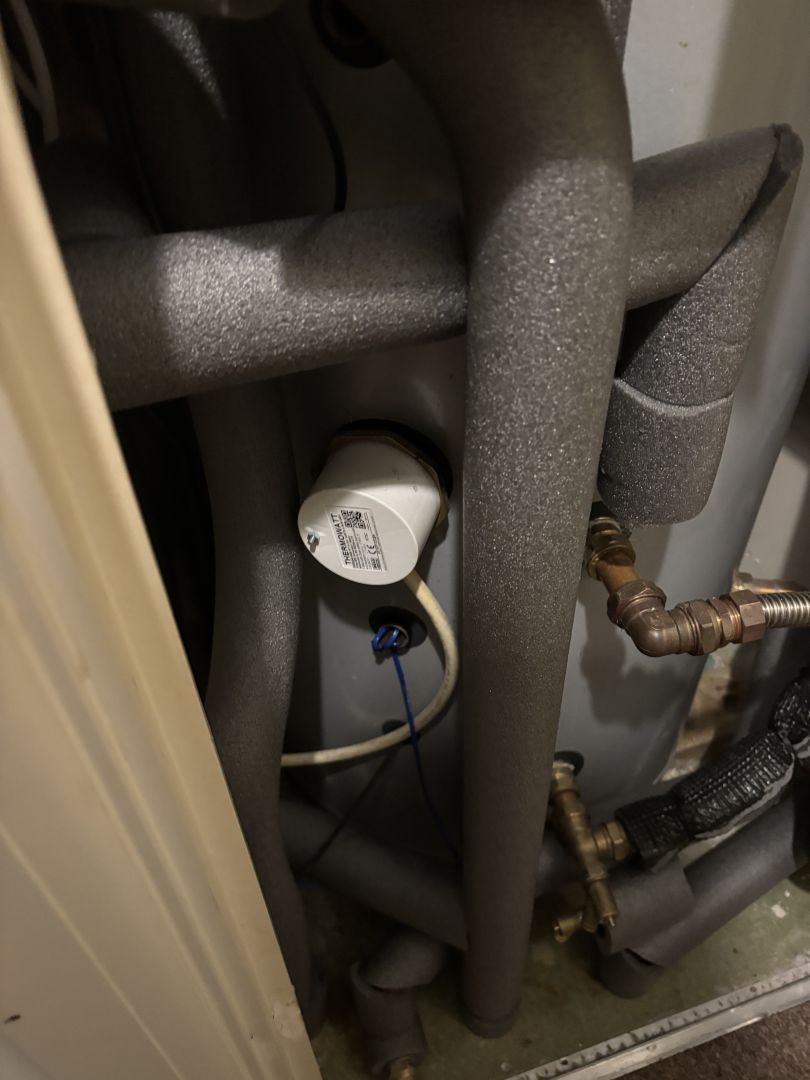
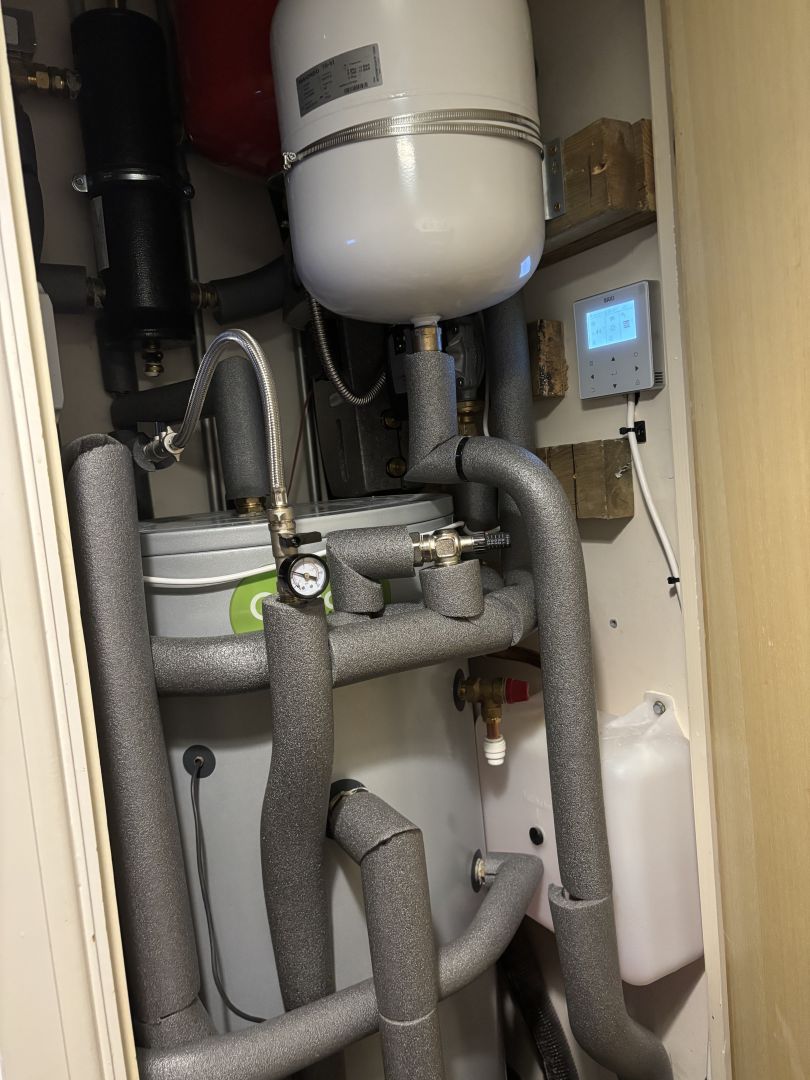
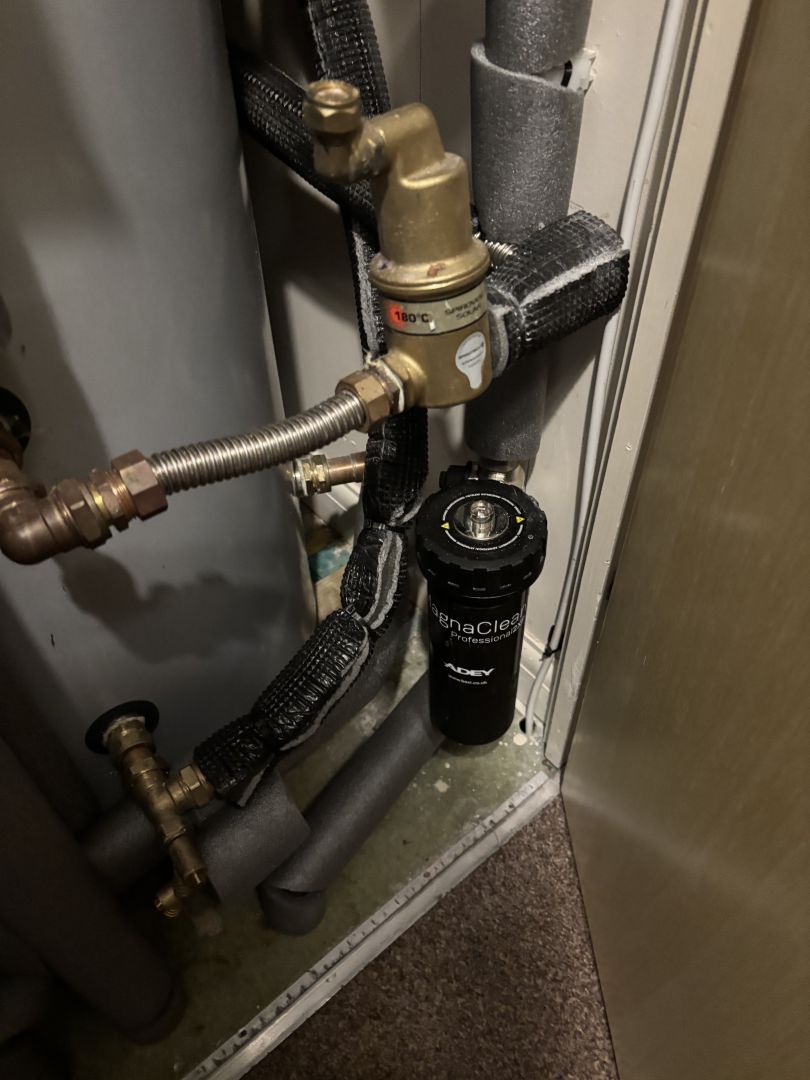
Do have any other large 'tank' installed?
It might be called a volumiser or a buffer.
Save energy... recycle electrons!
Topic starter
07/02/2025 3:15 pm
@transparent I have controls at the end of each radiator but they just look like my old radiator valves. They are all fully open.
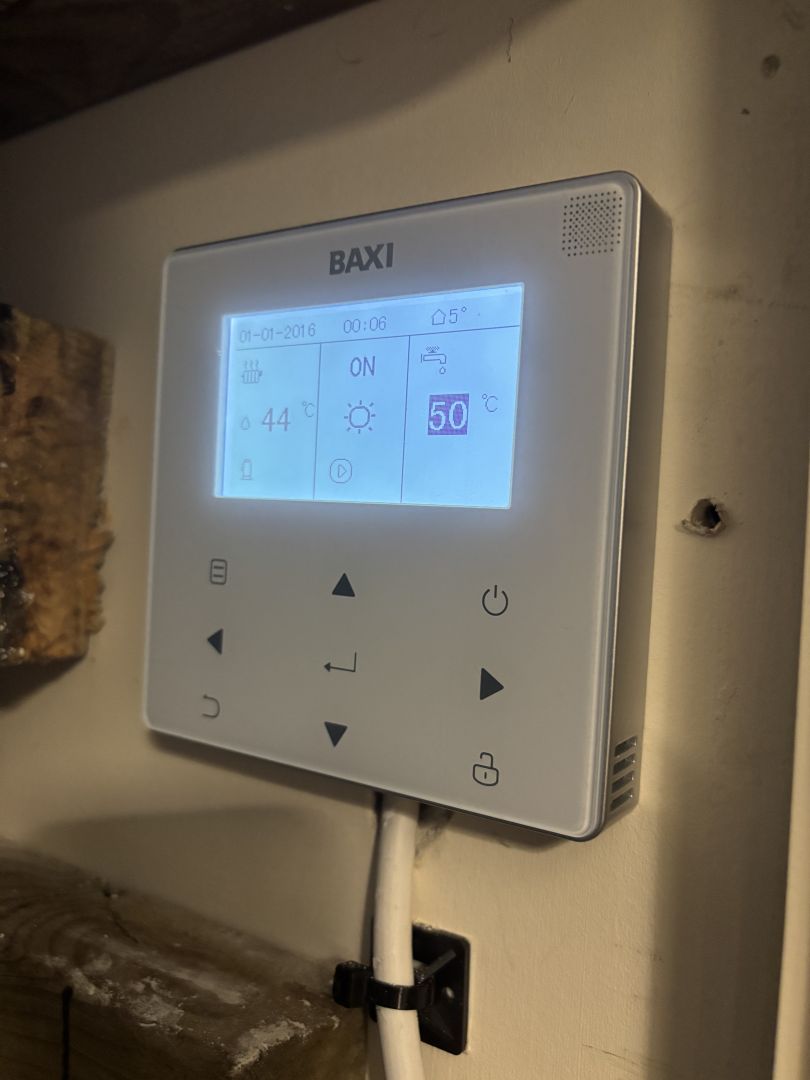
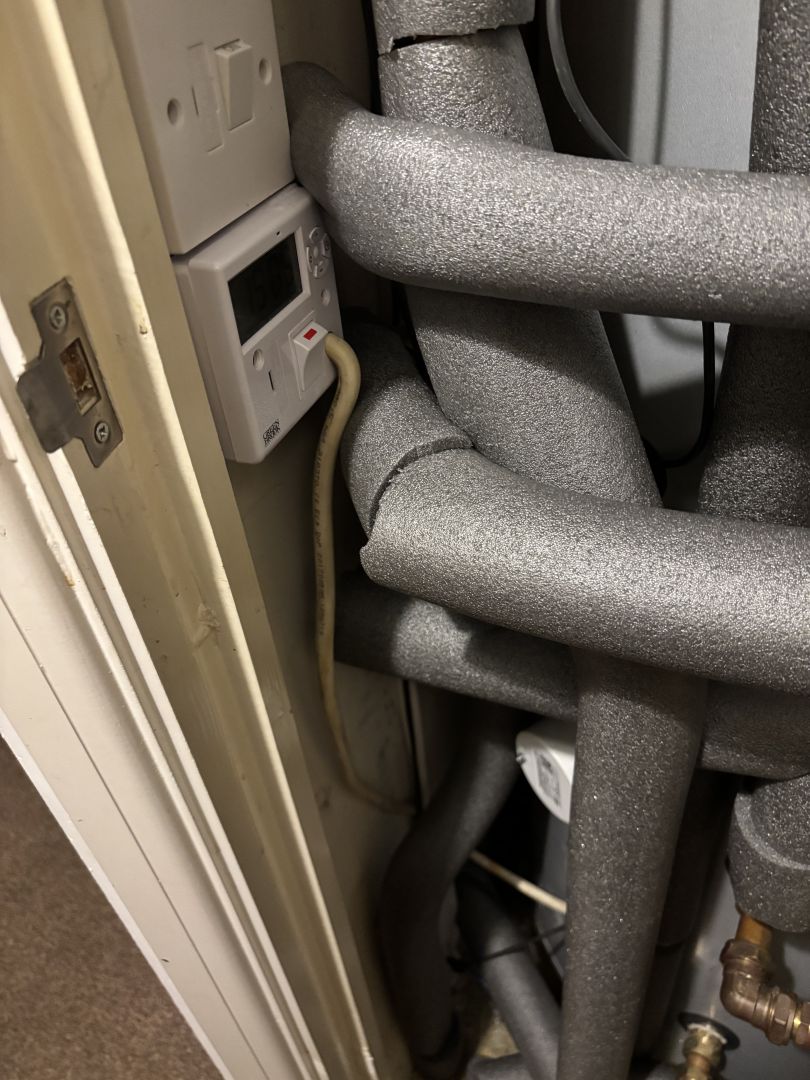
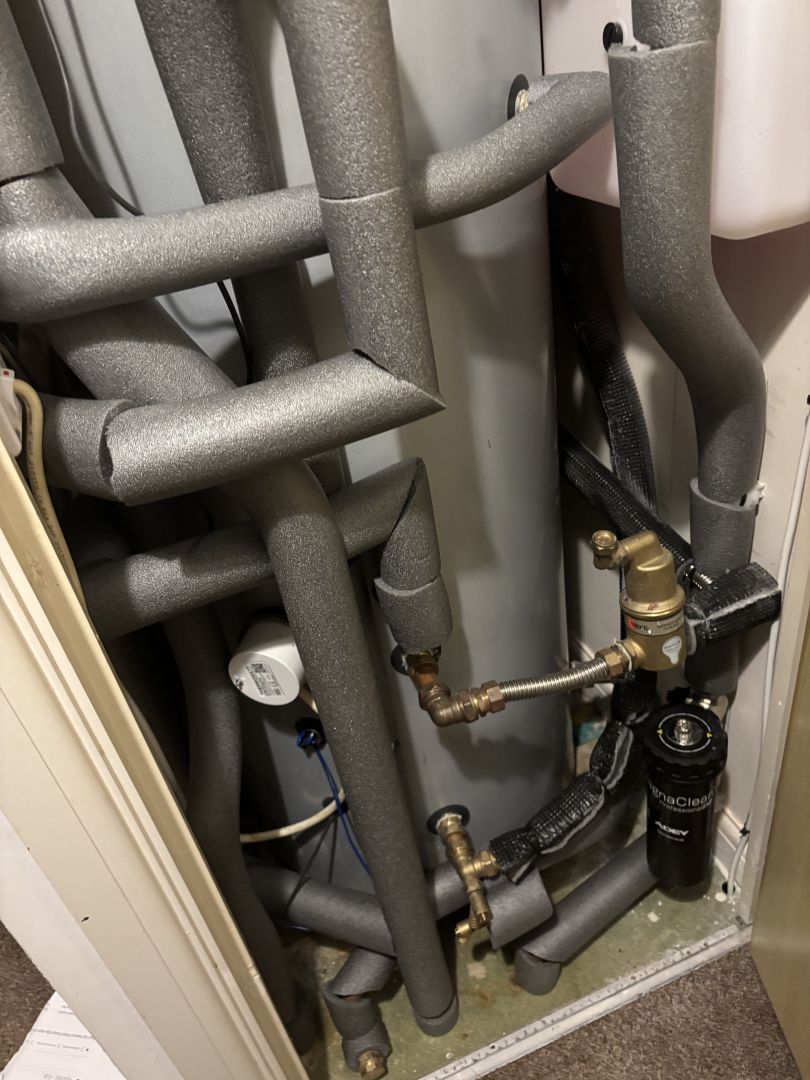
I have several other tanks. One in the loft and two in the airing cupboard. See the attached photos,

07/02/2025 3:46 pm
@cathyem1 - do you happen to know if Baxi is a Midea clone? The reason I ask is the first photo of your wired controller looks very like a Midea controller. If it is a Midea clone, there is a lot more known about them than Baxi.
From the controller I can see the OAT (outside air temperature) is 5 degrees and also rather interestingly you may be in a time warp (2016)!
Midea 14kW (for now...) ASHP heating both building and DHW
Topic starter
07/02/2025 4:01 pm
@cathoderay Haha! Yes, the current date needs to be input.
I don't know about Midea I’m afraid.
What sort of temperature should my system be showing overnight?
07/02/2025 4:18 pm
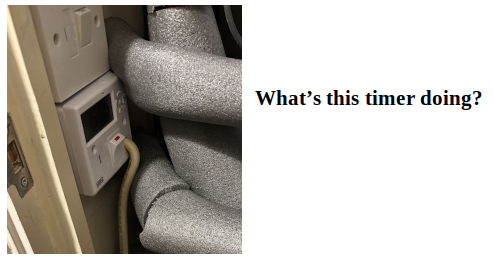
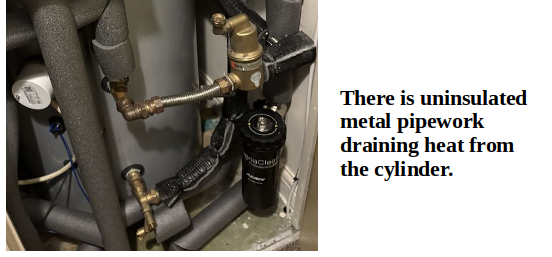
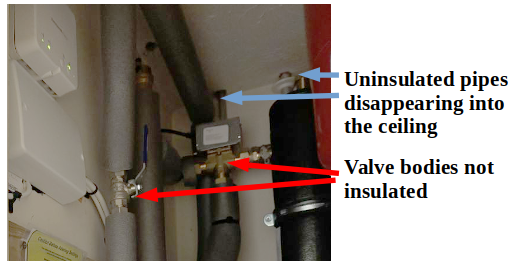
Save energy... recycle electrons!
1
07/02/2025 4:21 pm
What sort of temperature should my system be showing overnight?
There are lots of temperatures! The key space heating ones are outside air temperature (as seen on the display, by the house icon), leaving water temperature (temperature of the water as it leaves the heat pump) and returning water temperature (some thing for return). These can be viewed on a Midea controller and very likely clones (I am pretty sure it is a Midea clone from the appearance). The display can be confusing at times to say the least, especially the space heating panel on the left hand side. Try unlocking the keypad (long press on the padlock symbol, padlock top left of display should disappear then press Menu repeatedly to see if you can find OPERATIONAL PARAMETER, if you can, select it and go to page 3 of the operational parameters and if possible take a photo of it and then also take a photo of page 4 of the operational parameters and post them here.
Midea 14kW (for now...) ASHP heating both building and DHW
1
Page 1 / 10
Next
SPONSORS

Degrees of Separation
Latest Posts
-

RE: Why don't people choose heat pumps?
I love that concept of net0! My concern with the nesta ...
By Batpred , 5 hours ago
-
RE: How much of your renewable and home setup would still work if the internet went down?
I think you're right! 🤨
By Transparent , 7 hours ago
-
RE: Renewables & Heat Pumps in the News
ECO4 muddies the water somewhat, and then some. I thi...
By cathodeRay , 7 hours ago
-
RE: Air-to-Air Heat Pumps & Air Conditioning: UK Heating and Cooling Q&A
@jamespa Yes indeed, I meant ‘add-on’ in the sense that...
By Toodles , 8 hours ago
-
RE: Vaillant ecoTEC Plus - Flow Temp and Set Up
If there is a drain nearby that's exactly what I would ...
By JamesPa , 8 hours ago
-
RE: DIY powerflushing tutorial
This is what bacterial growth in UFH loops looks like. ...
By Pirate Rich , 15 hours ago
-
I think that CCGT plant in Lingen is more likely to suc...
By Transparent , 2 days ago
-
RE: Heat Geek installations: share your experiences
@l8again fwiw my experience (Valiant but not with heat ...
By JamesPa , 2 days ago
-
RE: How Can I Prove Coal Was My Main Heating Source Without Receipts?
@etchedpixels thank you for the advice paid cash all...
By Chilli304 , 3 days ago
-
RE: The Changing Jet Stream Could Challenge UK Air Source Heat Pumps
@susannasaunders An interesting conversation to have ...
By Rob of York , 3 days ago
-
RE: Electricity price predictions
@rob-of-york sounds like a term that Heidegger would...
By Papahuhu , 4 days ago
-
RE: Adding data centre electricity costs to domestic energy bills?
never ceases to amaze me.. Keeping steel works going ...
By Batpred , 4 days ago
-
RE: Boiler Upgrade Scheme funding reduced by circa £750 million in 2026 budget
Absolutely agree. The massive Hager CU my vaillant requ...
By Batpred , 4 days ago
-
RE: Octopussy cosy 6 experience
People who have a Cosy appear generally to be happy wit...
By JamesPa , 4 days ago
-
RE: Aerotherm and weather compensation
@jamespa I replied yesterday with detailed readings whi...
By DavidB , 6 days ago


SPONSORS
